
 Cart (
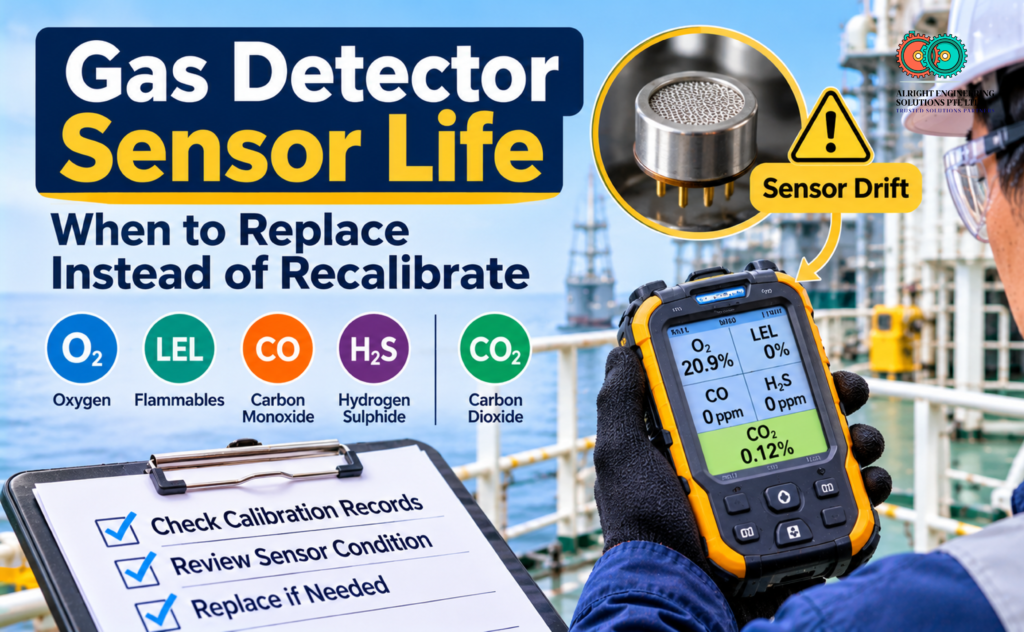
Gas Detector Sensor Life: When to Replace Instead of Recalibrate
The detector fails its span calibration. Someone suggests trying again, someone else wants to order a new sensor, and a third person asks whether it’s time for a new detector altogether. Each of those can be the right answer, and there’s no IMO rule that settles it. SOLAS and MSC.1/Circ.1477 leave calibration and maintenance to the manufacturer’s instructions, so the gas detector sensor replacement interval on your ship comes down to the maker’s figures, the ship’s planned maintenance system and what the calibrations are telling you. This guide covers how long sensors usually last, the signs that a sensor is finished, and what to rule out before you replace anything.
How long gas detector sensors last
Sensor life depends mostly on the technology. These are typical figures from manufacturers and distributors, not deadlines:
| Sensor | Measures | Typical life quoted |
|---|---|---|
| Electrochemical | CO, H₂S, other toxics | About 2 to 3 years; some newer designs 5 years or more |
| Galvanic electrochemical | O₂ | About 2 to 3 years; consumed as it works |
| Catalytic bead | %LEL | About 2 to 5 years, shortened by poisons |
| Infrared (NDIR) | CO₂, some LEL | 5 years or more |
MSA, for example, says many electrochemical cells last two to three years depending on gas type, exposure and environment, with some designs reaching five to seven. Its Altair 5X specification quotes an expected four-year life for the LEL, O₂, CO, H₂S and IR sensors. The K-600 detectors on our site list a sensor life of two years depending on use.
A figure like “two-year sensor life” can mean different things, though. It might be a typical service life, a period the instrument is programmed to count down, or a fixed date the maker says the sensor must be replaced by. Check which one your manual means, because a fixed replacement date applies even if the sensor still calibrates.
Why there’s no single replacement interval
Two identical sensors can age at very different rates. A sensor’s life is closely tied to how much target gas it sees, and the more often and the higher the concentration, the shorter it lasts. The UK gas detection manufacturers’ association CoGDEM made a similar point when it looked at electrochemical sensor lifetime: sensors kept in clean laboratory air showed little degradation after 15 years, while sensors used to measure boiler flue gas were often replaced every two to three years.
On a ship, the things that shorten sensor life are mostly the ones that cause drift: heat, humidity swings, poisons such as silicone sprays, high-gas alarms and knocks. We covered those in why gas detector sensors drift. The practical result is that a detector used every week for tank entries on a chemical tanker won’t keep its sensors as long as one that lives in a cabinet on a container ship.
Signs a sensor needs replacing
The most useful evidence comes from calibration, because that’s when the sensor’s response is measured against a known gas.
Falling sensitivity. Industrial Scientific reports this as “span reserve”. Above 100% means the sensor is in new condition and 70 to 99% is good. At 50 to 69% it’s time to plan a replacement, and below 50% it will fail calibration and must be replaced. Other makers show the same thing in different ways, often as an as-found reading on the certificate or an end-of-life symbol on the display. Normal ageing is linear and gradual, so a sudden drop between two calibrations usually means something outside the sensor, such as poisoning or a big gas exposure, has damaged it.
Repeated failed spans. On MSA’s Altair 4X, a sensor life indicator appears when the span calibration fails twice, telling you the sensor has reached the end of its life.
Still responding, but not reliably. CoGDEM defines end of life as the point where performance decays rapidly, even though the sensor will still respond to test gas. That’s why a bump test pass doesn’t mean a sensor is healthy. The bump gas is usually well above the alarm point, so a weak sensor can still trip it. We explain the difference in what a bump test can and can’t prove.
Slow or unstable behaviour. An oxygen cell that’s slow to settle at 20.9% in fresh air, a toxic sensor that won’t hold a steady zero, or a response that takes much longer than it used to are all common signs of a sensor near the end, once the gas path has been checked.
Rule these out before you replace anything
A failed calibration isn’t always the sensor’s fault. MSA’s own manuals warn that a span calibration can fail for many reasons besides an end-of-life sensor, and tell users to check the gas remaining in the cylinder, its expiry date and the calibration cap before repeating the calibration. Before you condemn a sensor, check that the calibration gas is in date, has enough pressure left and matches the concentration set in the detector. Then check the regulator, tubing and calibration cap for leaks, make sure the filters aren’t blocked and the pump is drawing properly, and confirm the detector had its full warm-up time.
An expired 4-gas calibration mix can fail a perfectly good sensor, and a fresh cylinder sometimes solves the problem. If the calibration still fails with good gas and a sound gas path, the sensor is the likely cause.
Sensor or whole detector?
Once a sensor is condemned, the next question is whether to replace that sensor or the detector. Some instruments are built as sealed, maintenance-free units with a fixed working life, and the whole detector is replaced at the end of it. For serviceable detectors, it usually makes sense to replace a single failed sensor on a unit that’s otherwise in good order. When several sensors are near the end at once, the detector is old, or you need a CO₂ channel the current unit can’t take, a new instrument is often the better spend. Our guide to 4-gas vs 5-gas detectors on ships covers that last case.
Spare sensors also have a shelf life. Electrochemical sensors typically keep for about six months to a year before use, and storage in heat shortens that. A box of spare cells bought three years ago and kept in a hot store may be partly used up before it’s ever fitted. Every new sensor also needs a full zero and span calibration once it’s installed, before the detector goes back into use.
Sensor replacement checklist
- Check the manual for whether the stated sensor life is a typical figure or a fixed replacement date.
- Record each sensor’s install date, and keep its as-found readings from every calibration.
- Plan a replacement when the sensitivity margin is getting low or the as-found error is growing visit by visit.
- When a calibration fails, check the gas, regulator, cap, filters and pump before blaming the sensor.
- Replace any sensor that fails twice with good gas or shows an end-of-life warning.
- Calibrate every new sensor before use and note the replacement on the certificate or maintenance record.
- Don’t stockpile spare electrochemical sensors, and store any you hold somewhere cool.
Spotting worn sensors early
During an onboard gas detector calibration in Singapore, our engineers record as-found readings for every sensor before any adjustment and flag worn filters and failed sensors. Span gas, regulators and replacement detectors are supplied from Singapore, so a failed sensor doesn’t have to hold the ship up, and sensor replacement and repairs can be handled ashore while a spare meter covers the ship. The full range of units is on our portable gas detectors page, including pumped models such as the K-600M 5-in-1 detector. If a detector keeps failing calibration, send us the model and the last certificate and we’ll tell you whether it looks like the sensor, the gas or the unit.
Back to that failed span calibration. Trying again is right if the gas or the cap was the problem, and the as-found history on the certificates will show whether this sensor has been sliding for a while. Replacing the whole detector only makes sense when the sensors and the unit are both near the end.