
 Cart (
Fire Detection System Testing in Singapore for Ships
On-board testing and servicing of fixed fire detection and alarm systems on vessels alongside or at anchorage in Singapore. We test detectors and call points loop by loop, prove the alarms and bridge indication, check the emergency power changeover, and leave an inspection report your surveyor can read.
- ISO 9001:2015
- ISO 45001:2018
- bizSAFE Level 4
- bizSAFE Star
- Alongside & anchorage
- Consilium Salwico spares in stock
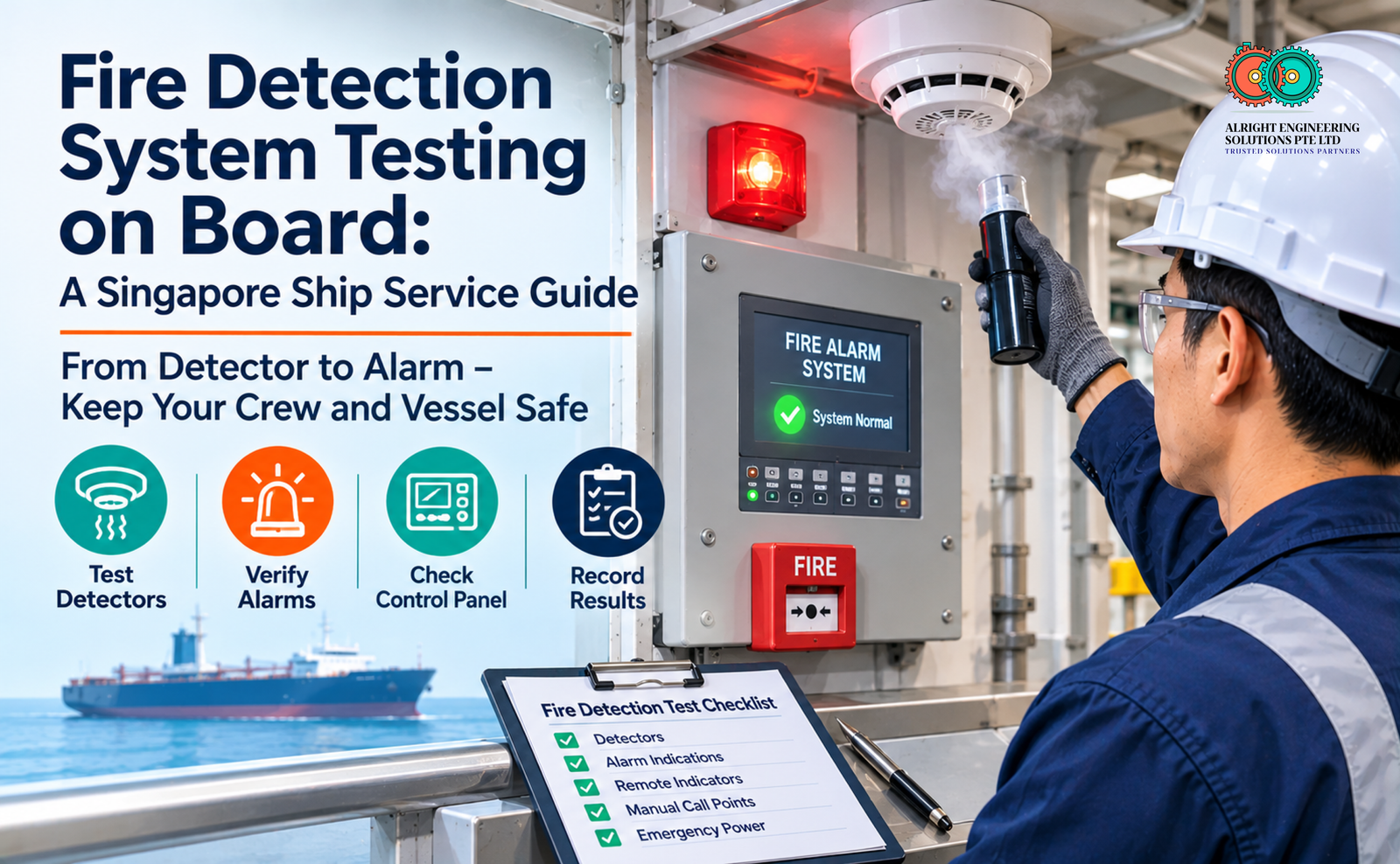
Fire detection system testing in Singapore, in short: Alright Engineering Solutions (AES) tests and services fixed fire detection and fire alarm systems on ships in Singapore. We work through the system end to end: each detector and manual call point, the loop wiring and control panel, the audible and visual alarms, the bridge indication, the emergency power changeover, and any release signal to a fixed fire-fighting system. You get a written inspection report listing every point tested and every fault found.
What We Test on Your Fire Detection System
A detector that works but never reaches the bridge is no use. We test the whole chain, not just the heads.
Smoke, heat and flame detectors
Each head functionally tested with the correct test method for its type, then confirmed back in normal surveillance at the panel.
Manual call points
Call points operated and reset, with the correct zone and address shown at the control panel.
Control panel & loops
Indicator lamp test, loop continuity, fault conditions, disablement handling and the event log checked against the as-fitted drawings.
Sounders & bridge indication
Audible and visual alarms proven in the spaces they cover, and the repeat indication on the bridge confirmed.
Emergency power changeover
Main to emergency supply changeover and battery operation tested, with battery condition recorded.
Release & shutdown signals
Where detection releases a fixed fire-fighting system or trips fans and dampers, that signal is proven too.
Sample-type smoke detection on cargo holds, oil mist detection and gas detection are separate systems. See oil mist detector calibration and gas detector calibration.
Fire Detection Testing Intervals on a Ship
IMO's guidelines for the maintenance and inspection of fire protection systems set out what gets done weekly, monthly and annually. Your on-board maintenance plan under SOLAS II-2 should match them.
| Interval | What has to be done | Usually by |
|---|---|---|
| Weekly | Verify that all fire detection and alarm control panel indicators are working, using the lamp test switch | Ship's crew |
| Monthly | Test a sample of detectors and manual call points, rotating the units so that every detector has been tested within a five-year period | Ship's crew, recorded |
| Annual | Test all fire detection systems, including any that automatically release a fixed fire-extinguishing system, for proper operation | Specially trained personnel |
| Annual | Visually inspect all accessible detectors for tampering, obstruction and damage, so every detector is seen within the year | Specially trained personnel |
| Annual | Test the emergency power supply changeover and operation on batteries | Specially trained personnel |
The five-year rolling rule is the one that catches ships out. If the monthly sample hasn't been rotated properly, there will be detectors on board that have not been tested in years, and the panel won't tell you which ones.
Some of This the Crew Can Do. Some of It They Shouldn't.
IMO's guidelines are clear that certain inspections may be carried out by competent crew members with advanced fire-fighting training, while others should be done by people specially trained in maintaining these systems. When a service technician who is not ship's staff does the work, an inspection report is handed over at the end of the testing. That report is what a surveyor or vetting inspector asks to see.
- Weekly panel checks and the monthly detector sample sit naturally with the crew
- The annual full system test, the all-detector visual inspection and the emergency power test are where an outside technician is expected
- The report should list every detector and call point, not just say the system was found satisfactory
- Faults found but not corrected belong in the report too, with what's needed to close them
Background reading: our guide to fire detection system testing on board a Singapore ship.
Detector Types and How Each One Is Tested
The space decides the detector, and the detector decides the test method. Using the wrong method is how heads get damaged or left out of service.
| Type | Where it's used | How we test it | Reference point |
|---|---|---|---|
| Smoke (optical / ionisation) | Accommodation, corridors, stairways, control stations, cargo holds | Aerosol test gas applied at the head, response timed, then reset at the panel | Operates before smoke density exceeds 12.5% obscuration per metre |
| Heat (fixed temperature / rate of rise) | Galleys, laundries, drying rooms, machinery spaces where smoke or steam is normal | Calibrated heat source applied to the head, operation and reset confirmed | Operates by 78°C, with the range raised for drying rooms and saunas |
| Flame | Machinery spaces, pump rooms, areas with a fuel or oil mist risk | Approved test lamp at the rated distance, response and alarm confirmed | Per the maker's test procedure |
| Manual call point | Escape routes, exits, machinery spaces | Operated and reset, zone and address verified at the panel | Alarm raised without delay |
| Sample-type smoke detection | Cargo holds on some ship types | Sample lines, fans and detector unit checked for flow and response | Per the maker's manual |
Typical coverage is about 37 m² per heat detector and 74 m² per smoke detector, so a space that has been rearranged since build can end up under-covered without anyone noticing.
How an On-Board Test Runs
Planned with the chief engineer and the bridge, so alarms don't go out to the whole ship unannounced.
Send the details
System make and model, number of loops and detectors, as-fitted drawings if you have them, and your ETA and ETD.
Agree the plan
We agree with the bridge and the engine room which zones are isolated and when, and whether any release outputs are inhibited during the test.
Panel checks first
Lamp test, fault and disablement handling, event log and loop condition checked before anyone goes to a detector.
Point by point
Each detector and call point is tested with the right method, and the zone and address at the panel are confirmed against the drawings.
Alarms & power
Sounders, bridge indication, emergency power changeover and battery operation are proven.
Report & restore
Every point tested and every fault found goes in the report, isolations are removed and the system is left in normal surveillance.
Panel in fault, or a zone disabled and nobody sure why? Send us the model and the fault text.
Why Ships Get False Alarms, and Why Real Ones Get Missed
- Zones left disabled. A zone isolated to stop nuisance alarms during cargo work, and never put back.
- Dust and paint on heads. Detectors painted over at a yard period or clogged in machinery spaces.
- Wrong detector for the space. A smoke head in a galley or a steamy laundry will keep crying wolf until someone isolates it.
- Drawings that don't match. The panel says one space, the detector is somewhere else, so the response goes to the wrong place.
- Tired batteries. The system works on mains and fails the moment the supply changes over.
- Loop faults after a refit. Cabling damaged or jumpered during steel work, leaving part of a loop blind.
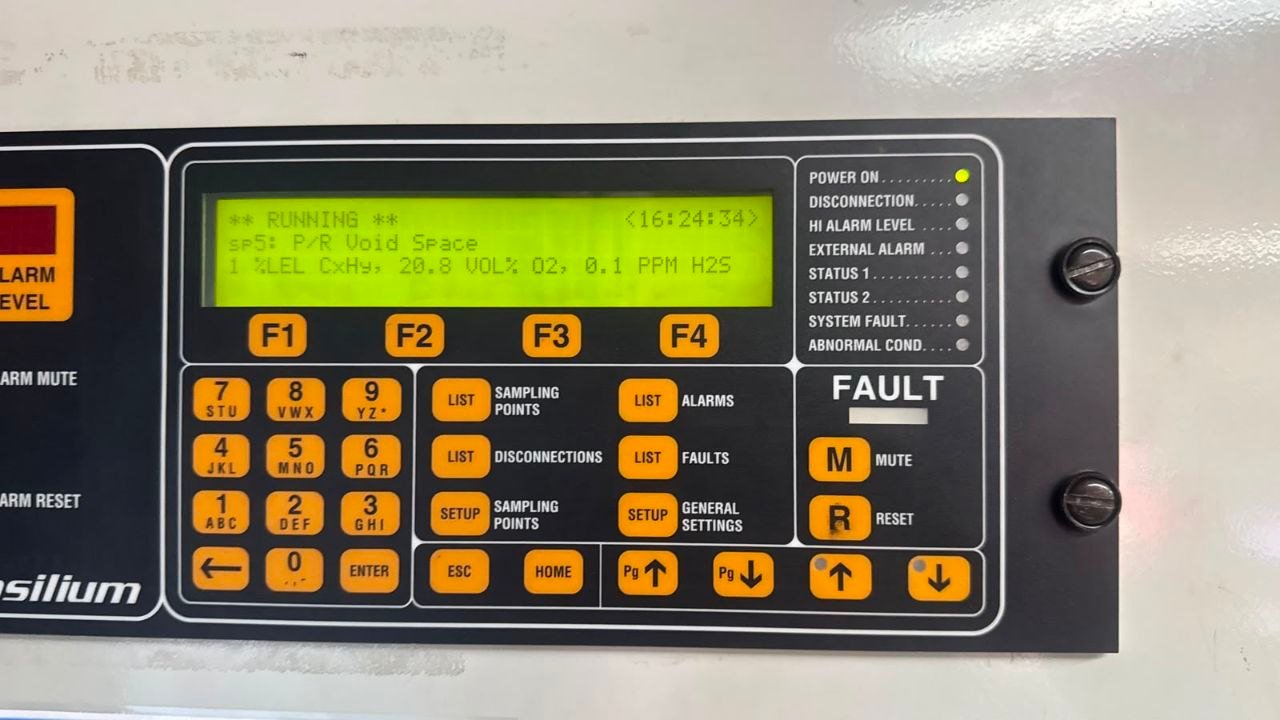
We traced a sampling fault on a Consilium SW2020 system in Singapore. Read the SW2020 analyser pump leakage case study.
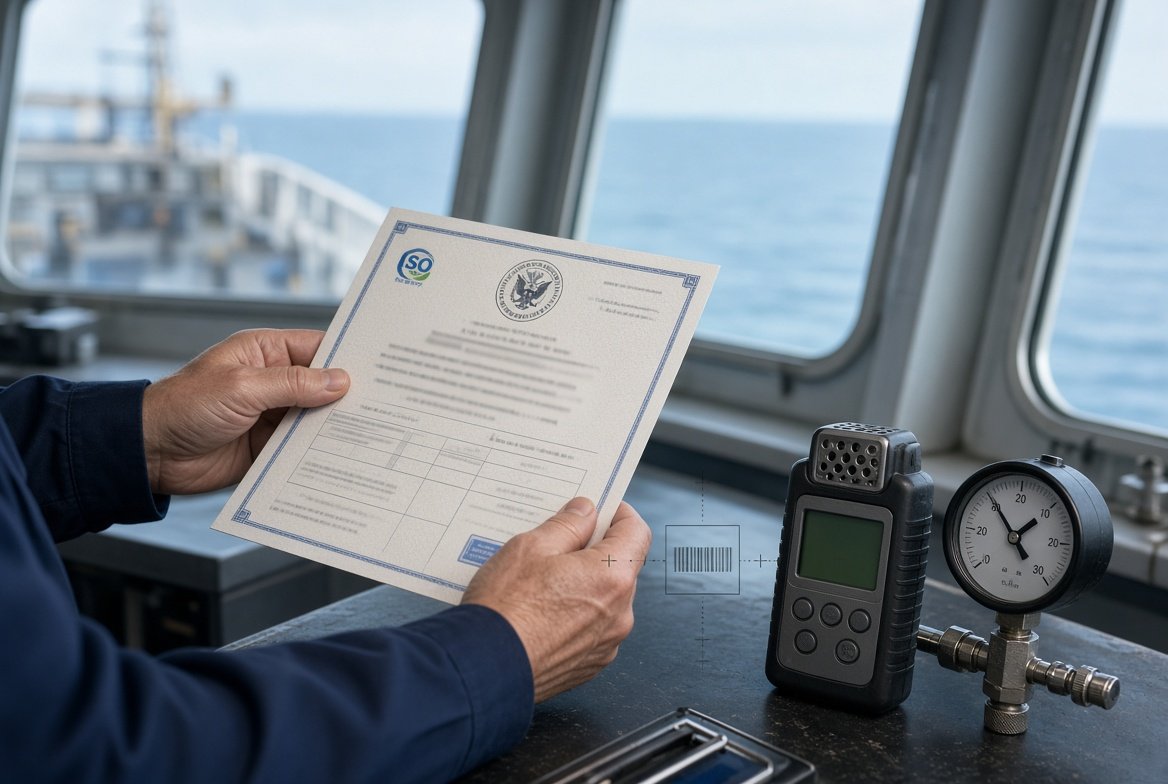
What Your Inspection Report Should Show
- System make, model, number of loops and panel software version
- Every detector and call point listed by zone and address, with its result
- Test method used for each detector type
- Sounder, bridge indication and emergency power changeover results
- Faults found, what was corrected on board and what is outstanding
- Date, vessel, IMO number, next due date and the technician's signature
See what inspectors look for in our guide to marine calibration certificates, and which equipment gets flagged in PSC detainable deficiencies.
Booking checklist — send us these
- Vessel name, IMO number and ship type
- Fire detection system make and model
- Number of loops and approximate number of detectors
- As-fitted drawings or zone list, if available
- Any zones currently disabled or in fault
- Berth or anchorage, with ETA and ETD
Systems We Work With, and Spares We Hold
Send your system make and model and we'll confirm the method before booking.
- Consilium Salwico
- Autronica
- Minerva / Thorn
- Nittan
- Tyco
We hold Consilium Salwico parts in Singapore, so a failed card doesn't wait for shipping:
Why Ship Managers Use AES for Fire Detection Testing
Point-by-point records
Every detector and call point listed by zone and address, so you can prove the five-year rotation rather than hope.
Spares on the shelf
Consilium Salwico cards, displays and detector parts held in Singapore.
Certified management systems
ISO 9001:2015 and ISO 45001:2018, bizSAFE Level 4 completed and bizSAFE Star.
Planned with the bridge
We agree isolations and timing first, so testing doesn't turn into a general alarm during cargo work.
More done per port call
Combine with gas detector, oil mist detector or machinery instrument work.
Alongside and at anchorage
At terminals, shipyards and Singapore anchorages, planned around your port stay.
See all our marine calibration services in Singapore.
Fire Detection System Testing in Singapore: Common Questions
How often does a ship's fire detection system need testing?
Panel indicators are checked weekly and a sample of detectors and call points monthly, rotated so every detector is tested within five years. Annually the whole system is tested for proper operation, all accessible detectors are visually inspected, and the emergency power changeover is proven. Our marine instrument interval table sets this alongside other equipment.
Can the crew do the testing themselves?
Partly. IMO's guidelines allow competent crew with advanced fire-fighting training to do certain inspections, while others should be done by people specially trained in maintaining these systems. The annual full test is normally where an outside technician comes in, and the inspection report is handed over at the end.
Do you test every detector, or a sample?
Tell us which you need. For the annual test we work through the system so you have a complete record, and we can also pick up the monthly rotation if your records have gaps. Either way the report lists what was actually tested.
Is fire detection testing the same as calibration?
No. Detectors are function tested against their response criteria and either pass or fail. There is no as-found and as-left adjustment the way there is on a gas detector or a pressure transmitter. A head that doesn't respond is cleaned or replaced.
Will testing set off the general alarm?
Not if it's planned. We agree with the bridge and the engine room which zones are isolated and when, and any release outputs are handled before testing starts. Everything is restored to normal surveillance at the end.
Do you supply spares for Consilium Salwico systems?
Yes. We hold SW2020 and CS3000 cards, displays and analysing unit parts in Singapore, so a fault found during testing doesn't have to wait for a shipment.
Can you attend at Singapore anchorage?
Yes. We attend ships at anchorage as well as alongside at terminals and shipyards. Your agent usually arranges the launch.
How much does fire detection system testing cost in Singapore?
It depends on the number of loops and detectors, whether you need a full test or a sample, and any parts needed. Send the details through the contact form or WhatsApp and we'll price it before we board.
Get Your Fire Detection System Tested in Singapore
Send the vessel details, system model and number of loops. We'll confirm the plan, timing and price, then attend alongside or at anchorage.
Email sales@alrightes.com · 3791 Jalan Bukit Merah #06-01, E-Centre @ Redhill, Singapore 159471
Other Calibration Services in Singapore
Gas Detector Calibration
Portable, personal and fixed gas detection systems.
View serviceOil Mist Detector Calibration
Crankcase oil mist detectors for main and auxiliary engines.
View servicePressure & Temperature Calibration
Gauges, switches, sensors and transmitters.
View serviceODME Calibration
Oil discharge monitoring equipment on tankers.
View serviceOWS 15ppm Bilge Alarm Calibration
15ppm bilge alarms and oil content meters.
View serviceOxygen Analyzer Calibration
IGS, IGG and N2 generator oxygen analysers.
View serviceUTI Meter Calibration
Portable ullage, temperature and interface meters.
View serviceTank Gauging System Calibration
Tank level, pressure and temperature monitoring systems.
View serviceEGCS Scrubber Analyzer Calibration
SO2/CO2 emission analysers and CEMS on scrubber systems.
View service