
 Cart (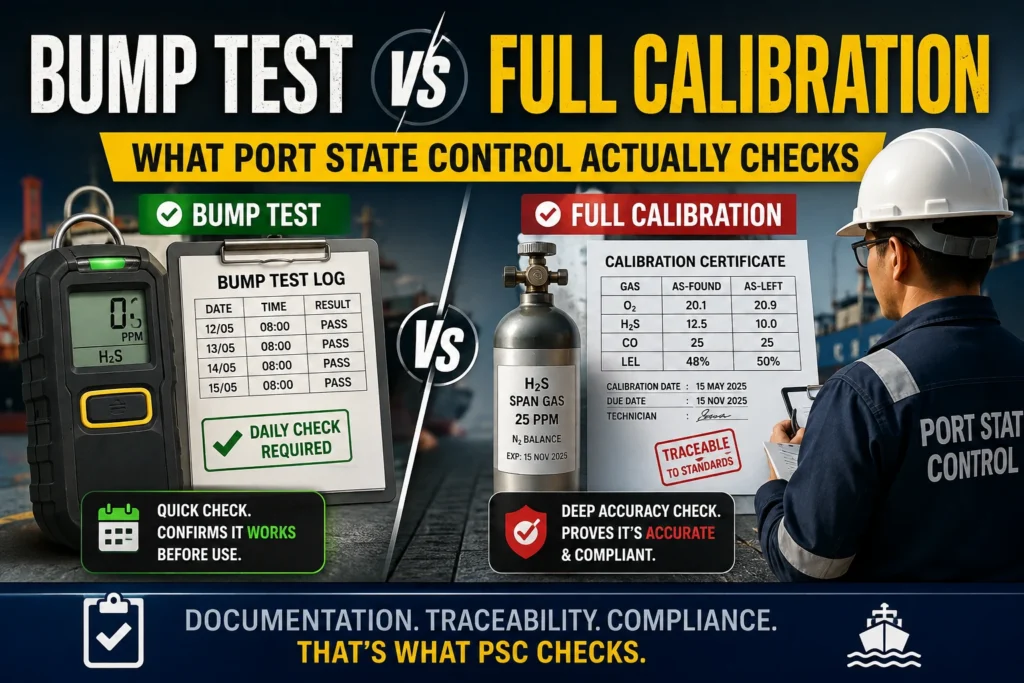
Bump Test vs Full Calibration: What Port State Control Actually Checks
A Port State Control officer comes aboard, walks straight to the portable gas detector, and asks one question: when was this last checked? The officer of the watch, confident, pulls out the pre-use log — bump tested that morning, alarm triggered fine. The PSCO isn’t satisfied. He wants the calibration certificate.
This mix-up happens more often than it should, and it’s one of the more avoidable ways a routine inspection turns into a deficiency. A bump test and a full calibration are not the same procedure. They don’t prove the same thing, and a PSCO inspecting under the Tokyo MOU — the regime Singapore inspects under — knows exactly which one he’s asking for.
This article breaks down the real difference between a bump test and a full calibration, what a PSC officer actually asks to see onboard, and where crews most often go wrong — from the workshop side of the industry, not a textbook.
What Is a Bump Test?
A bump test is a quick, pass/fail function check. The detector is exposed to a known concentration of test gas — enough to trigger the alarm — and you confirm the sensor responds and the alarm activates. That’s it. No adjustment is made to the instrument, and the test doesn’t confirm the reading is accurate, only that the sensor and alarm are working.
Bump testing is meant to be fast and frequent. It’s normally done by the crew, before each use, or at minimum daily on instruments in active service. It needs a small amount of span gas and a few minutes — no calibration station, no technician, no certificate.
Think of it as the smoke-alarm test button of gas detection: it tells you the alarm will sound, not that the sensor is measuring gas concentration correctly. Check our portable gas detector calibration services
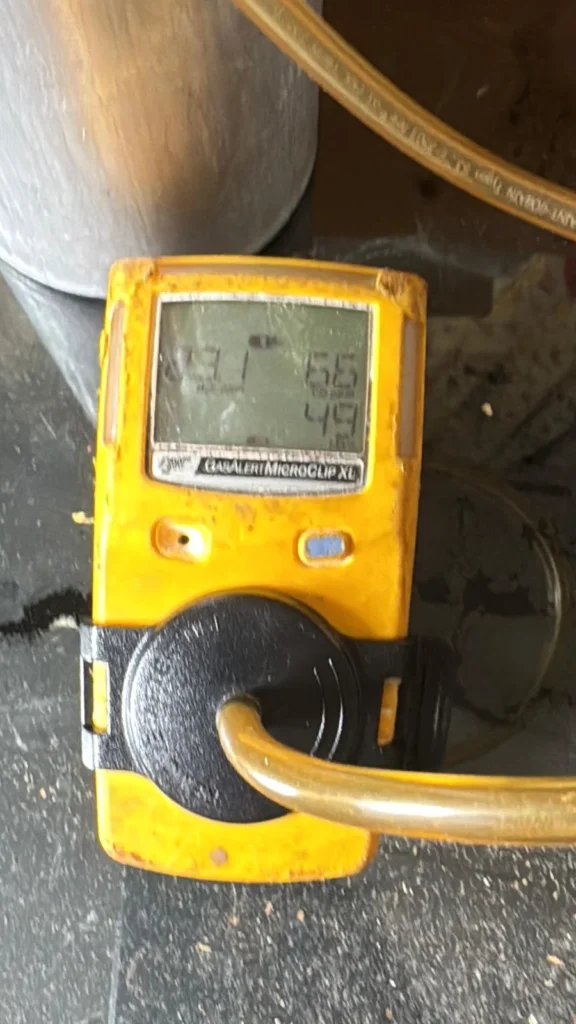
What Is a Full Calibration?
A full calibration is a quantitative adjustment. The instrument is exposed to a traceable, certified concentration of zero gas and span gas, and its reading is adjusted to match that known value. Where a bump test only asks “does it respond,” a full calibration asks “is the number on the screen correct” — and corrects it if it isn’t.
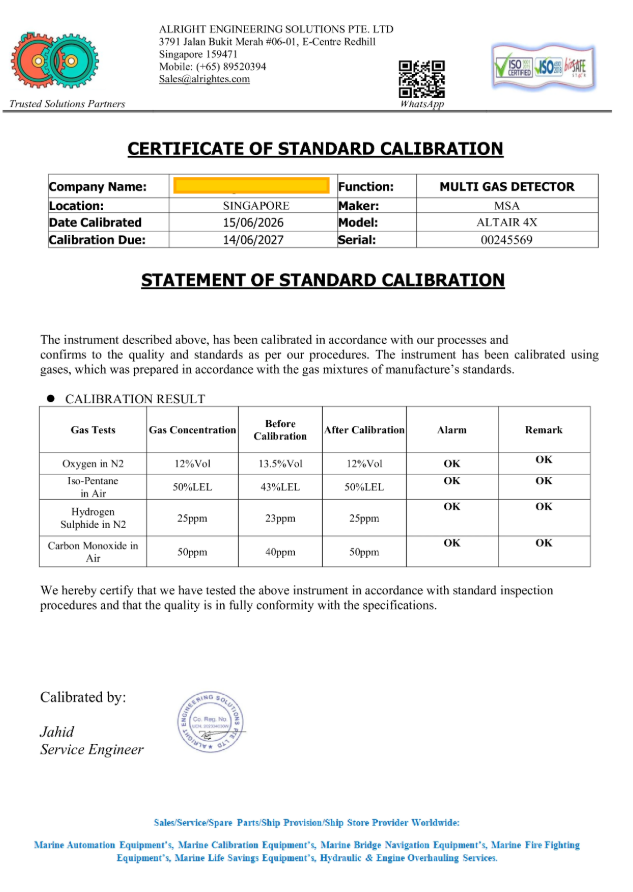
This is why full calibration needs proper equipment and a qualified technician, not just a cylinder and a hose. At the end of the process, you should receive a calibration certificate showing as-found readings (what the instrument was reading before adjustment) and as-left readings (after adjustment) — this as-found/as-left pairing is what most PSC officers specifically look for, because it proves the instrument was actually checked against a known reference, not just switched on and waved at. Check our portable gas detector calibration services
The Middle Step Most Guides Skip: Calibration Check
Most explanations online stop at two terms — bump test and calibration — and lump everything else under “calibration.” That’s not quite accurate. The International Safety Equipment Association (ISEA), which set the industry protocol most gas detector manufacturers follow, actually defines three distinct procedures:
- Bump test — pass/fail function check
- Calibration check — a check of accuracy against a known gas, without adjusting the instrument
- Full calibration — the instrument’s readings are actually adjusted to match the known reference
The confusion between “calibration check” and “full calibration” is where a lot of onboard paperwork goes wrong — a calibration check that passes doesn’t mean the instrument has been calibrated in the sense a PSCO is asking about.
What a PSC Officer Actually Asks to See Onboard
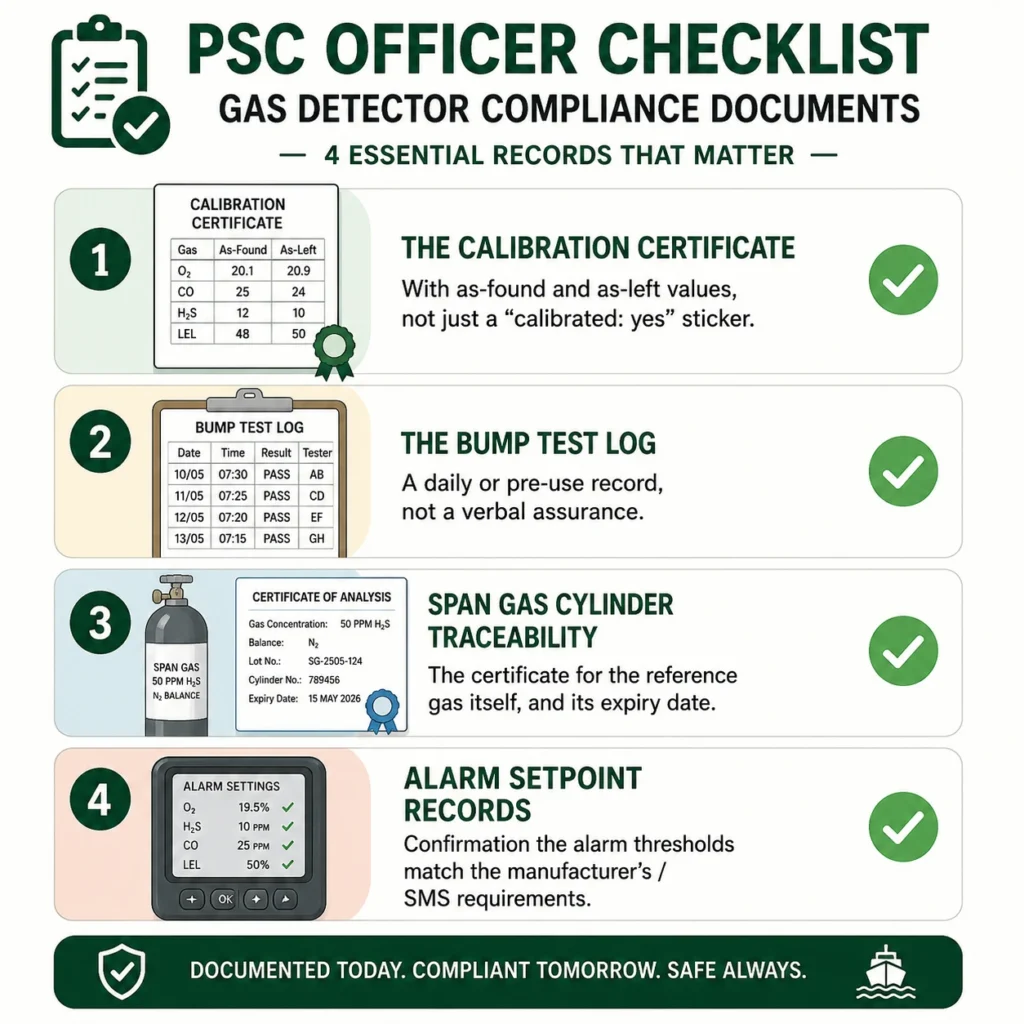
This is the part most articles skip, because most of them aren’t written by anyone who’s actually stood next to a PSCO during an inspection. In practice, what gets asked for is fairly consistent:
- The calibration certificate — with as-found and as-left values, not just a “calibrated: yes” sticker
- The bump test log — a daily or pre-use record, not a verbal assurance
- Span gas cylinder traceability — the certificate for the reference gas itself, and its expiry date
- Alarm setpoint records — confirmation the alarm thresholds match the manufacturer’s/SMS requirements
A gap in any one of these is treated the same way as a gap in the equipment itself. In 2020, the US Coast Guard issued a marine safety alert after Port State Control officers in Boston found fixed gas detection sensors on several LNG carriers reading outside manufacturer tolerances, with calibration checks that had failed — resulting in deficiencies and delayed cargo operations. It’s a useful reminder that this isn’t a paperwork formality; PSCOs are checking because sensor drift on a gas detector is a genuine safety issue, not just a box to tick.
What Happens If You Get It Wrong — the PSC Deficiency Code
When a PSCO isn’t satisfied with the state of your gas detection equipment or its records, it doesn’t just get a verbal note. It’s logged against a specific deficiency category in the inspection database — broadly, “gas detection plant and/or toxic gas detection plant defective.” Depending on severity, this can range from a deficiency with a rectification deadline to a full detention if it’s judged serious enough to be a safety risk.
For vessels calling at Singapore, this matters more than it might elsewhere — Singapore’s Maritime and Port Authority is a founding member of the Tokyo MOU, and deficiencies get recorded against your vessel’s inspection history in that regime. Repeated or serious deficiencies raise your risk profile, which means more frequent and more detailed inspections on future port calls — a cost that compounds well beyond the original fix.
Check: MPA’s official Port State Control
The New Requirement Changing the Calibration Conversation: 5-Gas Detectors
There’s a shift underway in what counts as an acceptable portable gas detector for enclosed-space entry. The industry direction is toward requiring detectors that measure five parameters — oxygen, LEL (flammable gas), carbon monoxide, carbon dioxide, and at least one additional toxic gas such as H₂S — rather than the four-gas configuration that’s been standard on many vessels for years. A legacy four-gas unit, however well maintained and calibrated, may simply not meet the sensor configuration requirement anymore.
This is worth knowing before your next equipment renewal or calibration due date, because it can turn into a compliance gap even on an instrument that’s been perfectly calibrated throughout its life. As it happens, some of the multi-gas detectors we supply and calibrate — including the BELL Lite — already measure all five in a single unit, which is worth keeping in mind if you’re due for a replacement rather than a repair.
Bump Test vs Full Calibration — Quick Reference
| Bump Test | Full Calibration | |
|---|---|---|
| Purpose | Confirms sensor & alarm respond | Confirms & adjusts accuracy |
| Frequency | Before each use / daily | Per manufacturer, class, and SMS interval |
| Performed by | Crew | Qualified technician / calibration provider |
| Output | Pass / fail | Certificate with as-found/as-left values |
| Accepted by PSC as proof of calibration? | No | Yes |
How Often Should Marine Gas Detectors Be Calibrated in Singapore?
Bump testing should happen before every use, full stop — it costs almost nothing and takes minutes. Full calibration intervals depend on the instrument manufacturer’s recommendation, your classification society’s requirements, and your company’s Safety Management System, whichever is most frequent. Portable units are typically recalibrated on a shorter cycle than fixed systems, which are usually checked annually at minimum.
Check our marine-calibration-services-singapore
Frequently Asked Questions
Can a bump test replace a full calibration? No. A bump test only confirms the alarm responds to gas — it doesn’t verify or correct the instrument’s accuracy. A passed bump test on an instrument that’s overdue for calibration doesn’t satisfy a PSC inspection.
How long is a gas detector calibration certificate valid? This depends on the manufacturer’s recommended interval and your vessel’s SMS requirements, not a single fixed industry number.
What happens if PSC finds an uncalibrated gas detector? It’s typically logged as a deficiency, with a rectification deadline. If it’s assessed as a serious safety risk — such as on a gas carrier where fixed detection integrity is critical — it can lead to detention until it’s resolved.
Does Singapore follow Tokyo MOU or Paris MOU? Singapore’s Maritime and Port Authority conducts Port State Control under the Tokyo MOU, the Asia-Pacific regional agreement, and is one of its founding members.
Can crew perform a full calibration onboard, or does it need a service provider? Full calibration requires calibrated reference gas and equipment traceable to a recognised standard, along with the competence to carry out and document the adjustment correctly. Most operators use a specialist calibration provider for this rather than relying on crew alone.
The Bottom Line
A bump test tells you the alarm works today. A full calibration, documented with as-found/as-left readings, is what tells a PSC officer the instrument can be trusted. Confusing the two — or having the second one without the paperwork to prove it — is one of the more preventable ways to pick up a deficiency in Singapore or anywhere else under the Tokyo MOU.
If your gas detection equipment, portable or fixed, is due for calibration or you’re not sure your current documentation would hold up to a PSC inspection, get in touch with our team for a calibration service tailored to your vessel’s equipment.