
 Cart (
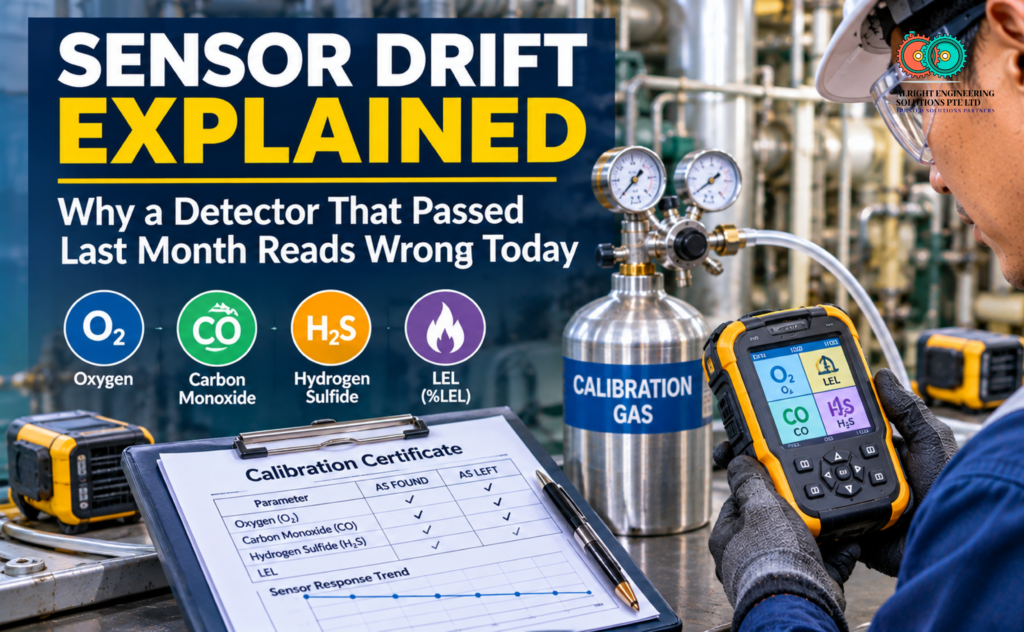
Sensor Drift Explained: Why a Detector That Passed Last Month Reads Wrong Today
A detector was calibrated last month, the certificate is in the folder, and this morning it fails its bump test or reads a few ppm low against the test cylinder. Nothing is broken in the obvious sense. The sensor has drifted, which is what sensors do. OSHA’s guidance on portable gas monitors puts it plainly: calibration drift “happens to all sensors over time” (OSHA SHIB 09-30-2013). This guide explains how each type of sensor drifts, what speeds it up on a ship, and how to read drift from your own calibration records before it catches someone out.
What gas detector sensor drift is
Drift is a slow change in what a sensor reports for the same amount of gas. It shows up in two ways. Zero drift moves the baseline, so the meter shows a small reading in clean air or a slightly wrong one in nitrogen. Span drift changes the sensitivity, so the meter under-reads or over-reads a known concentration. Most drift in portable detectors is a loss of sensitivity, and a sensor that has lost sensitivity reads low, which is the dangerous direction.
The rate varies by sensor. Manufacturers commonly define drift for electrochemical sensors as somewhere under 2% to under 5% a month, so a cell that read 100 ppm on its calibration day might read 95 ppm a month later. At 5% a month, three months gives a sensor reading about 86% of the true value (our arithmetic), and an H₂S alarm set at 10 ppm then wouldn’t sound until the real level was nearer 12 ppm.
How each sensor type drifts
The four sensor types in a typical marine multigas detector age in different ways.
| Sensor | Measures | How it drifts | What can kill it suddenly |
|---|---|---|---|
| Electrochemical | CO, H₂S | Electrolyte gains or loses water with humidity; electrodes age; output changes with temperature | Solvent vapours, corrosive gases, very high gas exposure |
| Galvanic (electrochemical) | O₂ | The lead anode is used up as it works, so output falls over its life | Reaching the end of the anode; failure often comes quickly |
| Catalytic bead | %LEL | Gradual loss of catalyst activity | Silicones, hydride gases, halogenated hydrocarbons, sulphide gases |
| NDIR (infrared) | CO₂, some LEL | Lamp and detector age; optics get contaminated | Moisture in the optics or sample line |
Electrochemical toxic sensors contain a liquid electrolyte, often sulphuric acid, that gains water in humid air and loses it in dry air. Sensor makers specify sensitivity loss of up to around 20% a year for some cells. OSHA lists solvent vapours and highly corrosive gases as contaminants that can damage them, and some cleaning alcohols do the same.
Oxygen cells are galvanic. The lead anode is consumed as the sensor measures oxygen, so the cell has a fixed life, and when the lead runs out the cell can fail with very little warning. A cell that’s slow to reach 20.9% in fresh air, or struggles to span, is usually close to that point.
Catalytic LEL beads are the most exposed to sudden damage. OSHA names volatile silicones, hydride gases, halogenated hydrocarbons and sulphide gases as poisons. Honeywell’s technical note on LEL poisons separates the two effects: poisoning is permanent, while inhibition, for example by H₂S, usually recovers in clean air. Silicone sprays and some engine room lubricants are the usual suspects on a ship. A poisoned bead can sit at zero in fresh air and look perfectly healthy, which is why a bump test or calibration is the only way to catch it.
NDIR sensors for CO₂ drift more slowly because nothing in them is consumed, but the lamp and detector still age, and moisture or dirt on the optics shifts the reading. The zero is a particular trap for CO₂, which we cover in how CO₂ sensors on marine gas detectors are calibrated.
What speeds drift up on a ship
OSHA’s bulletin lists the main causes of calibration drift, and several describe ordinary life at sea. Alongside normal ageing and the poisons above, it names extreme temperature and humidity, high levels of airborne particulates, exposure to high concentrations of the target gas, and handling or knocks that affect the electronics over time.
Humidity matters in Singapore and the region. Some electrochemical cells start absorbing water once relative humidity goes above about 60%, and Singapore’s long-term average sits well above that, at roughly 80 to 85% according to NEA’s records. The bigger problem is usually the swing. A detector carried from a cold, air-conditioned control room into a hot, damp engine room or tank can collect moisture on or inside the sensor, which can cause baseline drift.
Storage is the easiest factor to control. A detector kept in a cabinet in the accommodation will usually age more gently than one left on a shelf in the engine room or in a deck locker, and it’s worth logging any time a detector is dropped or saw a big gas alarm, because both are reasons to check it before the next entry.
Why last month’s pass doesn’t cover today
It’s reasonable to treat a recent calibration certificate as proof the meter is right. For most of the month it probably is. The trouble is that drift is continuous and some damage happens in a single event, such as one silicone spray, one drop or one very high H₂S reading.
A bump test helps, but it answers a narrower question. OSHA defines it as a qualitative check that the sensors and alarms respond. A calibration check confirms the readings are within the manufacturer’s limits, and a full calibration adjusts them to a certified gas. A meter can pass a bump test while reading low, because the alarm still trips at the bump gas concentration. We’ve covered the difference in more detail in what a bump test can and can’t prove.
US industry guidance from ISEA recommends a bump test or calibration check before each day’s use, with a full calibration if it fails. The IMO doesn’t set an interval. MSC.1/Circ.1477 leaves it to the manufacturer, and MSC.581(110) asks for “properly calibrated” equipment, so the actual schedule sits in your SMS. Our marine instrument calibration interval table is a reasonable place to start.
Reading drift on your calibration certificates
The most useful drift data you have is probably already in your files. A good calibration certificate records an as-found reading, taken before any adjustment, and an as-left reading after it. The as-found figure tells you how far each sensor had drifted since the last visit.
Put two or three certificates for the same detector side by side and patterns appear. For example, a CO sensor that was 3% low last time and 12% low this time is ageing faster than the interval allows for. An O₂ cell that needed more adjustment at each visit is heading for replacement. A catalytic sensor that suddenly lost half its response points to poisoning rather than age. None of that is visible from a pass or fail label. It’s why our gas detector calibration in Singapore records as-found and as-left readings for every sensor, along with the calibration gas lot numbers. For how inspectors read those documents, see what PSC inspectors look for on marine calibration certificates.
The gas matters as well. OSHA advises using only certified, traceable test gas within its expiry date. An expired 4-gas calibration mix or a single-gas cylinder such as H₂S 25 ppm that’s past its date can make a drifting sensor look fine, or a good one look faulty.
Drift checks for the ship
- Bump-test each detector before the day’s use, with in-date gas.
- Log any drop, heavy knock or high gas alarm, and check that detector before its next entry.
- Keep silicone sprays and solvent cleaners away from detectors and their storage.
- Store detectors away from the engine room, and let them settle before use after a big temperature change.
- Compare as-found readings across your last few certificates and note any sensor getting worse.
- Replace sensors that keep failing calibration rather than adjusting them again.
Getting drift measured properly
Drift isn’t a fault you can fix once. It’s something you measure and manage. Our engineers calibrate portable and personal detectors on board, alongside or at anchorage, and record what each sensor read before adjustment so you can see the trend. If you’d like to check a detector you’re unsure of, send us the model and your last certificate. Replacement units and single-gas monitors such as the BELL MINI H₂S detector are on our portable gas detectors page.
Back to the detector that passed last month. It was probably right on the day it was calibrated. What its certificate can’t tell you is how much it has moved since, and only certified gas will show that.