
 Cart (
EGCS Scrubber Analyzer Calibration in Singapore
On-board calibration of exhaust gas cleaning system analysers for ships alongside or at anchorage in Singapore. We zero and span the SO₂ and CO₂ analysers with certified gases, check the washwater pH, PAH and turbidity sensors, leak-test the sample system, and leave records your surveyor and PSC can read.
- ISO 9001:2015
- ISO 45001:2018
- bizSAFE Level 4
- bizSAFE Star
- Scheme A & Scheme B
- SO₂ / CO₂ span gases in stock
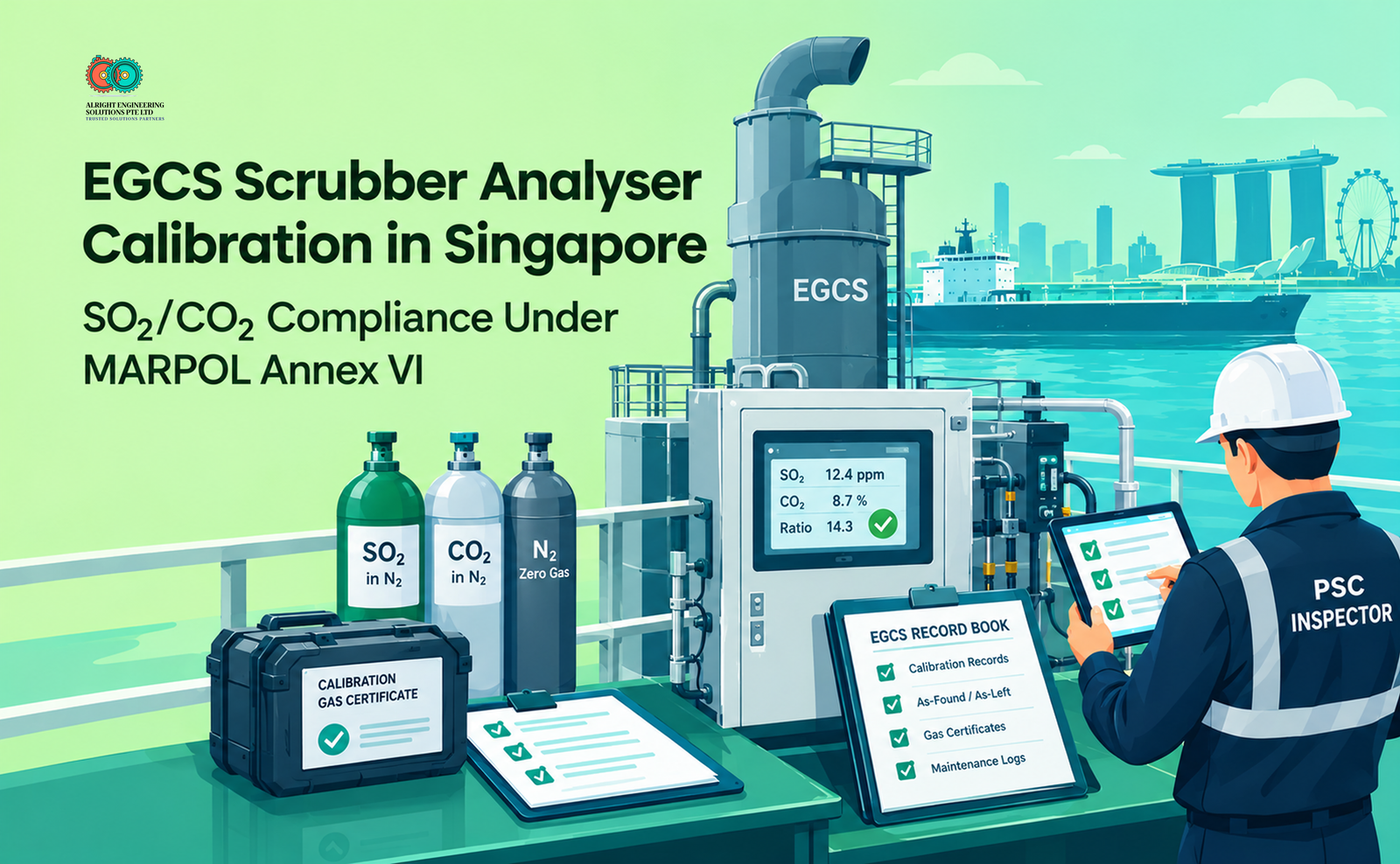
EGCS analyser calibration in Singapore, in short: Alright Engineering Solutions (AES) calibrates the monitoring instruments that prove your scrubber is compliant. We record the as-found readings, zero and span the SO₂ and CO₂ analysers with certified gases, check the washwater pH, PAH and turbidity sensors, leak-test the extractive sample line, and hand over a certificate with as-found and as-left values ready for the EGCS Record Book.
What We Calibrate on Your Scrubber
A scrubber can be working perfectly and still fail an inspection if the instruments measuring it have drifted. Those instruments are what we service.
SO₂ and CO₂ analysers
NDIR and NDUV analysers zeroed and spanned with certified gases, with the emission ratio checked against the certified value.
Sample & conditioning system
Heated sample line, probe, filters, cooler and pump checked, plus the leak test on extractive systems that the OMM calls for.
pH sensors
Inlet and discharge pH electrodes calibrated against certified buffers, with slope and temperature compensation checked.
PAH monitors
Fluorescence and UV PAH monitors checked against reference standards in phenanthrene equivalents across the working range.
Turbidity sensors
Inlet and outlet turbidity sensors checked against formazin standards, with the difference reading verified.
Span gases & spares
SO₂, CO₂ and nitrogen span and zero gases, regulators, electrodes and sensors supplied in Singapore.
SO₂ 160ppm + CO₂ 8% span gas →Scheme A or Scheme B? It Changes What Gets Checked
Your SECC and your technical manual say which scheme your scrubber is approved under. The scheme decides what has to be monitored, how often, and what the records have to show.
| Scheme A | Scheme B | |
|---|---|---|
| Basis of compliance | Unit certification to a certified value, plus continuous monitoring of operating parameters | Continuous monitoring of the exhaust emissions themselves |
| Emission ratio | Spot-checked daily for at least five minutes once readings have stabilised, where no continuous monitor is fitted | SO₂, CO₂ and the emission ratio recorded continuously while the EGCS is running |
| Technical manual | ETM-A, including the certified value | ETM-B, with no certified value |
| Daily parameter checks | Yes, recorded | Yes, recorded |
| What calibration proves | That the spot-check reading can be trusted | That every recorded data point can be trusted |
Either way, the EGCS Record Book holds maintenance and servicing entries for at least three years, and monitoring data is kept for at least 18 months. A calibration certificate is what makes those entries mean something.
The Number That Decides Compliance Is a Ratio
A scrubber doesn't prove compliance by measuring sulphur. It measures SO₂ in ppm and CO₂ in percent, and compares the ratio with the value for the fuel sulphur limit that applies where you're trading. Both analysers have to be right, because an error in either one moves the ratio.
| Fuel oil sulphur content (% m/m) | SO₂ (ppm) / CO₂ (%) ratio | Where it applies |
|---|---|---|
| 1.50 | 65 | Historic ECA equivalent |
| 0.50 | 21.7 | Global sulphur limit |
| 0.10 | 4.3 | Emission control areas |
- Span gas is a mixture of SO₂ and CO₂ in nitrogen at more than 80% of the analyser's full scale
- CO₂ is measured by NDIR; SO₂ by NDIR or NDUV, unless your Administration has accepted another principle
- Zero and span checks and drift data are recorded as your OMM specifies
- Extractive sample systems are leak-checked at start-up and at the intervals the OMM sets
We stock the SO₂ 160ppm with CO₂ 8% span gas and 99.995% nitrogen in Singapore, so the crew can run checks between our visits.
How We Calibrate an EGCS Analyser On Board
We follow the procedure in your OMM for your system, planned around when the scrubber can be taken offline.
Send the details
EGCS maker and model, Scheme A or B, analyser type, washwater sensors fitted, and your ETA and ETD.
As-found readings
Each analyser and sensor is recorded on the reference gases and standards before anything is adjusted.
Sample system check
Probe, heated line, filters, cooler and pump checked, and extractive systems leak-tested.
Zero & span
Zero on nitrogen, span with a certified SO₂ and CO₂ mixture above 80% of full scale, then drift recorded.
Washwater sensors
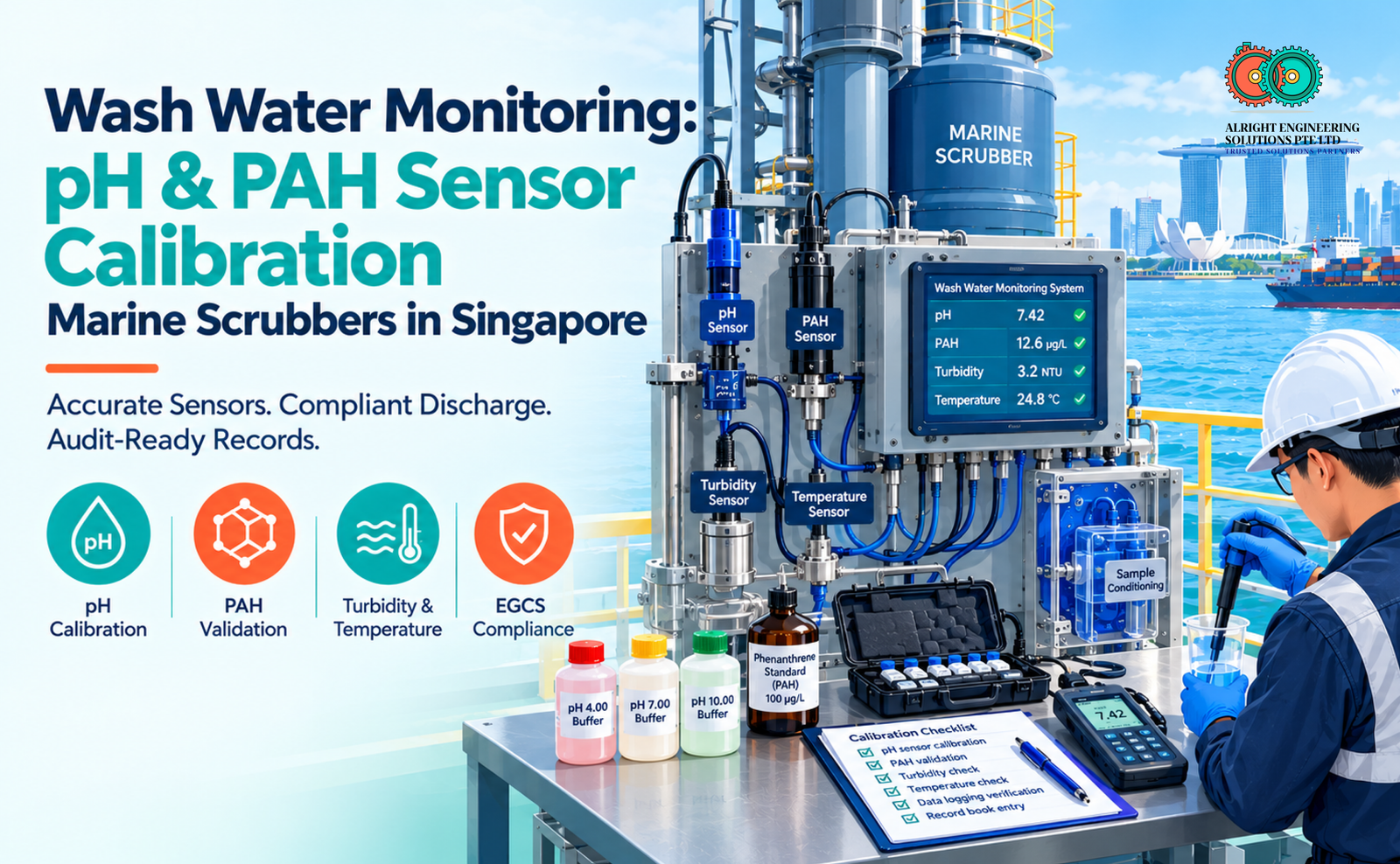
pH against certified buffers with slope and temperature compensation, PAH against reference standards, turbidity against formazin.
Records & certificate
As-left values, gases and standards used, and the results written up for the EGCS Record Book.
Analyser drifting or the ratio reading wrong? Send us the model and your port window.
Washwater Monitoring: pH, PAH and Turbidity
Open-loop and hybrid scrubbers have a second set of instruments watching what goes over the side. These sensors sit in a dirty, warm, moving environment, and they drift faster than the exhaust analysers do.
| Sensor | What it has to prove | How we check it |
|---|---|---|
| pH | Not less than 6.5 at the overboard discharge, or the value that achieves 6.5 at 4 m with the ship stationary | Certified buffers, slope and temperature compensation |
| PAH | No more than 50 µg/L above inlet in phenanthrene equivalents, normalised to 45 t/MWh flow | Reference standards across the working range |
| Turbidity | No more than 25 FNU above inlet, as a rolling 15-minute average | Formazin standards on both inlet and outlet sensors |
Full detail in our guide to washwater pH and PAH sensor calibration.
Why EGCS Analysers Read Wrong
Most of these start in the sample path or the sensor's environment, not in the electronics.
Leaking sample line
Air drawn in dilutes the sample, so SO₂ reads low and the ratio looks better than it is.
Condensation in the line
A heated line running cool lets acid condense, which absorbs SO₂ before it reaches the analyser.
Dirty optics
Soot and film on NDIR and NDUV cells shift the reading and show up as span drift between checks.
Expired span gas
Calibrating on an out-of-date cylinder, or one at the wrong concentration for the range, bakes the error in.
Tired pH electrodes
Slope falls off with age and fouling. The reading still moves, just not to the right number.
Fouled turbidity windows
Biofilm on the inlet or outlet sensor changes the difference reading, which is what the limit is set against.
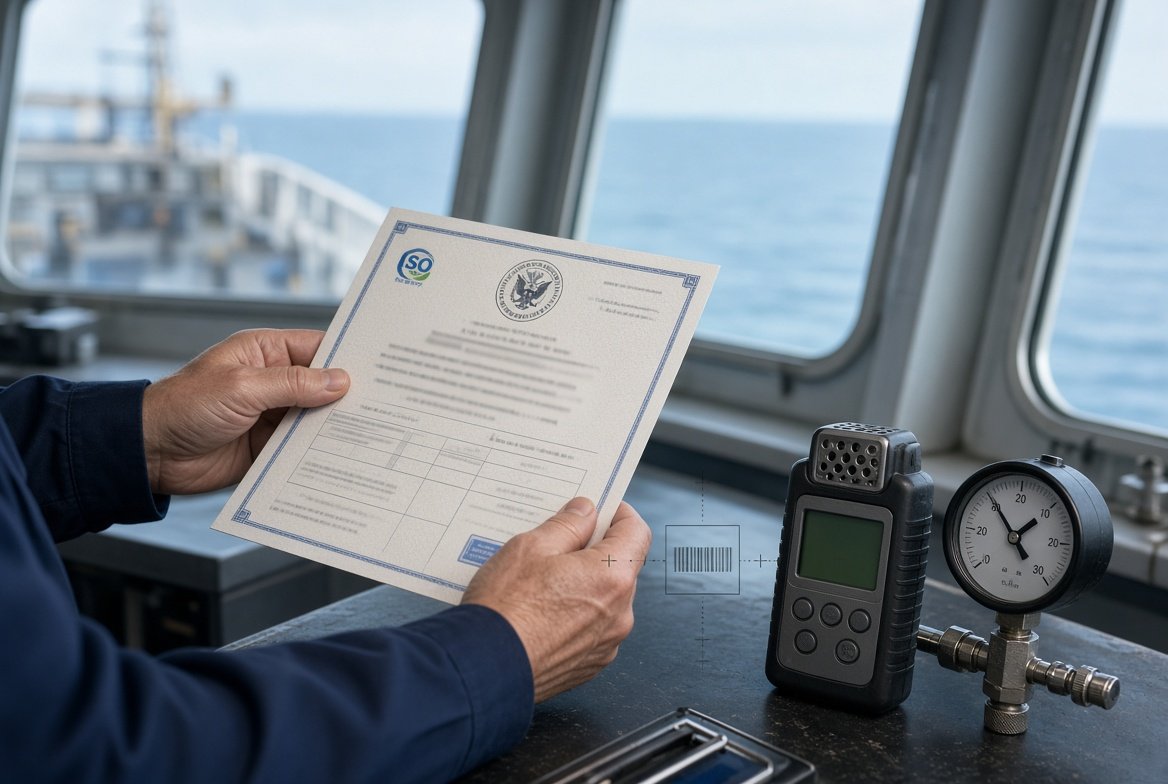
What Your Calibration Record Has to Show
- Analyser and sensor make, model and serial numbers
- Span gases used, with concentration, cylinder lot number and expiry date
- Buffers, formazin and PAH standards used, with their certificate details
- As-found and as-left readings at zero and span, with drift recorded
- Sample system leak check result
- Date, vessel, next due date and the attending engineer's signature
See what inspectors check in our guide to marine calibration certificates, and which equipment gets flagged in PSC detainable deficiencies.
Booking checklist — send us these
- Vessel name, IMO number and ship type
- EGCS maker and model, open loop, closed loop or hybrid
- Scheme A or Scheme B
- Analyser make and model, and washwater sensors fitted
- Berth or anchorage, with ETA and ETD
EGCS Calibration Gases We Supply in Singapore
Span gas has to sit above 80% of the analyser's full scale, so the mixture has to match your range. Tell us the analyser model and we'll match it.
- SO₂ 160ppm + CO₂ 8% vol, bal. N₂
- SO₂ 5 / 10 / 50 ppm, bal. N₂
- CO₂ 1 / 3 / 5 / 10 / 15%, bal. N₂
- Nitrogen 99.995% zero gas
Browse all calibration gas mixtures and specialty gases. We also supply regulators and tubing.
Why Ship Managers Use AES for EGCS Calibration
Exhaust and washwater together
One attendance covers the SO₂ and CO₂ analysers and the pH, PAH and turbidity sensors, so the whole monitoring chain is on one certificate.
We bring the gases
Certified SO₂ and CO₂ mixtures and nitrogen, matched to your analyser's range, from stock in Singapore.
Sample system first
We leak-test and service the sample path before calibrating, because that's where most bad readings start.
Certified management systems
ISO 9001:2015 and ISO 45001:2018, bizSAFE Level 4 completed and bizSAFE Star.
Alongside and at anchorage
Planned around when the scrubber can come offline, at terminals, shipyards and Singapore anchorages.
More done per port call
Combine with IG oxygen analyser, gas detector or ODME calibration.
See all our marine calibration services in Singapore.
EGCS Analyzer Calibration in Singapore: Common Questions
How often should an EGCS analyser be calibrated?
Your OMM sets the zero and span check procedure and how often it runs, and the checks have to be frequent enough to keep the analyser inside its required accuracy at all times. Crew usually run zero and span checks on a short cycle, with a full service calibration at longer intervals. Our calibration interval table gives common intervals.
What gas do you use to calibrate a scrubber SO₂ analyser?
Nitrogen for zero, and a certified mixture of SO₂ and CO₂ in nitrogen for span, at more than 80% of the analyser's full scale. The exact concentration depends on your analyser's range, so send us the model.
Does the scrubber have to be running?
Not for the calibration itself. Zero and span are done on reference gases. We do need the system available so the sample line, pump and conditioning can be checked, and so the readings can be confirmed afterwards.
Do you calibrate the washwater pH, PAH and turbidity sensors too?
Yes. On open-loop and hybrid systems they're part of the same compliance chain, and we do them in the same attendance so everything lands on one certificate.
What's the difference between Scheme A and Scheme B?
Scheme A certifies the unit to a certified value and relies on continuous monitoring of operating parameters, with the emission ratio spot-checked daily where no continuous monitor is fitted. Scheme B monitors and records the emissions themselves continuously while the EGCS runs.
How long do EGCS records have to be kept?
EGCS Record Book entries are kept for at least three years after the last entry, and monitoring data for at least 18 months from the date it was recorded.
Can you attend at Singapore anchorage?
Yes. We attend ships at anchorage as well as alongside at terminals and shipyards. Your agent usually arranges the launch.
How much does EGCS analyser calibration cost in Singapore?
It depends on the scheme, how many analysers and washwater sensors are fitted, and the gases your range needs. Send the details through the contact form or WhatsApp and we'll price it before we board.
Get Your Scrubber Analysers Calibrated in Singapore
Send the vessel details, EGCS model and scheme. We'll confirm the gases, timing and price, then attend alongside or at anchorage.
Email sales@alrightes.com · 3791 Jalan Bukit Merah #06-01, E-Centre @ Redhill, Singapore 159471
Other Calibration Services in Singapore
Oxygen Analyzer Calibration
IGS, IGG and N2 generator oxygen analysers.
View serviceGas Detector Calibration
Portable, personal and fixed gas detection systems.
View servicePressure & Temperature Calibration
Gauges, switches, sensors and transmitters.
View serviceODME Calibration
Oil discharge monitoring equipment on tankers.
View serviceOWS 15ppm Bilge Alarm Calibration
15ppm bilge alarms and oil content meters.
View serviceOil Mist Detector Calibration
Crankcase oil mist detectors for main and auxiliary engines.
View serviceUTI Meter Calibration
Portable ullage, temperature and interface meters.
View serviceTank Gauging System Calibration
Tank level, pressure and temperature monitoring systems.
View serviceFire Detection System Testing
Fire alarm and detection systems on board.
View service