
 Cart (
Is Your 4-Gas Detector Still Compliant? 4-Gas vs 5-Gas for Enclosed Space Entry
Your 4-gas detector still meets SOLAS. What it can’t do is read carbon dioxide, and the IMO’s revised enclosed space guidance now asks for a CO₂ reading below 0.5% by volume before anyone goes in. Whether that leaves your meter “non-compliant” depends on your flag, your cargoes and how your SMS treats the guidance, so the honest answer is more useful than a yes or no. This guide sets out what each type of detector measures, where the 4-gas meter stands today, and three practical ways to close the CO₂ gap.
What a 4-gas and a 5-gas detector each measure
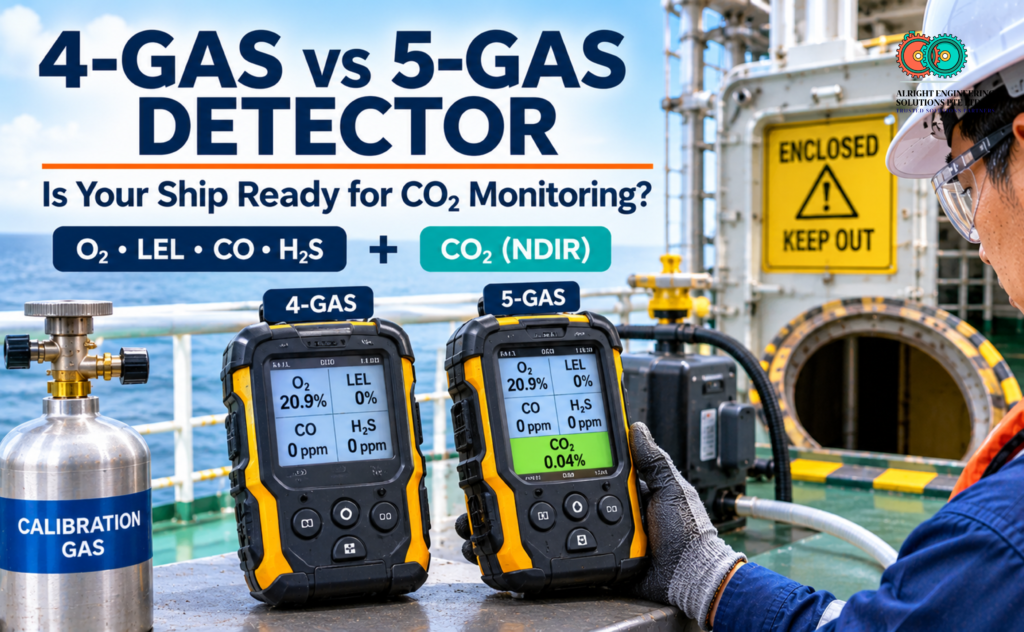
A standard 4-gas meter reads the four gases SOLAS regulation XI-1/7 has required since 2016. A marine 5-gas unit adds a fifth sensor for CO₂, almost always infrared.
| Gas | Typical 4-gas | Typical 5-gas | Usual sensor |
|---|---|---|---|
| Oxygen (O₂) | Yes | Yes | Electrochemical |
| Flammables (%LEL) | Yes | Yes | Catalytic bead or infrared |
| Carbon monoxide (CO) | Yes | Yes | Electrochemical |
| Hydrogen sulphide (H₂S) | Yes | Yes | Electrochemical |
| Carbon dioxide (CO₂) | No | Yes | NDIR (infrared) |
The oxygen sensor won’t stand in for the missing CO₂ channel. The CO₂ table in Appendix 5 of MSC.581(110) gives 3% CO₂ as a 10-minute ceiling exposure limit, and at that level the O₂ reading would only have dropped to about 20.3%. We go through the sensor side in how CO₂ sensors on marine gas detectors are calibrated.
Compliant with what?
“Compliant” needs a reference point, and there are three that matter here.
SOLAS XI-1/7. This is mandatory, and a calibrated 4-gas meter still satisfies it. The regulation names oxygen, flammables, CO and H₂S, plus a suitable means of calibration. CO₂ isn’t on the list.
MSC.581(110). The IMO’s revised recommendations took effect on 3 December 2025. Paragraph 7.4.2 sets the CO₂ limit before entry, and paragraph 8.2 lists CO₂ among the gases each entrant’s personal detector should monitor. It’s a recommendation, though, and the resolution invites governments to bring it to shipowners’ attention rather than amending SOLAS. We cover the detail in what MSC.581(110) actually asks of your detectors.
Your flag. This is where the recommendation turns into a rule, or doesn’t. The Danish Maritime Authority wrote MSC.581(110) into law from 1 July 2026 and gave Danish ships until 1 December 2026 to get CO₂ devices on board (DMA Circular 035). The Isle of Man went further back in 2024. Its Technical Advisory Notice 005-24 treats the basic four-gas detector as insufficient for organic cargoes, and says CO₂-emitting cargoes shouldn’t go on a ship’s cargo list unless CO₂ detection is on board.
Class societies have told owners to align their SMS with the resolution, taking their flag into account, and the Tokyo MOU has a joint inspection campaign on enclosed space entry planned with the Paris MoU for 2027. So even where your flag hasn’t legislated, it would be unwise to plan around the 4-gas meter alone.
When a 4-gas meter still earns its place
Some pages tell owners to bin every 4-gas detector. That’s poor advice. A working, calibrated 4-gas meter is still a valid SOLAS instrument, and plenty of ships bought theirs because it was exactly what the rules asked for.
The difficulty is arguing that CO₂ doesn’t matter for a given entry. Paragraph 8.2 names CO₂ for every entrant’s detector. Paragraph 10.5.7 says ships carrying organic cargoes in bulk should keep testing for CO₂ before entry and frequently afterwards, because those cargoes continue to emit it. Rust uses up oxygen too, and ABS’s summary of the resolution notes that testing in steel-related spaces such as chain lockers has to allow for oxygen lost to oxidation. A risk assessment that rules CO₂ out entirely is hard to defend for most cargo ships.
So the realistic role for a 4-gas meter is alongside a CO₂ instrument, or as the second SOLAS set, rather than on its own. That’s also how ABS frames it in its guidance on the resolution: verify what your detectors can measure, then replace or supplement them.
Three ways to close the CO₂ gap
| Route | How it works | Strengths | Trade-offs | Usually suits |
|---|---|---|---|---|
| Keep and add a CO₂ monitor | Keep the 4-gas meter; add a certified single-gas NDIR CO₂ monitor | Fastest; uses detectors you already own | Two instruments to carry, charge, bump test and calibrate | Ships with newer 4-gas meters, or waiting on delivery |
| Fit a CO₂ sensor | Add an IR CO₂ sensor to a multigas unit designed to take one | One instrument; keeps the familiar unit | Only works on upgradeable models; may need the maker’s service centre | Fleets already using an IR-capable platform |
| Replace with a 5-gas unit | Buy a multigas unit with CO₂ built in | One device, one certificate, simplest procedure | Highest upfront cost; units can be larger and heavier | Older meters near end of sensor life |
The first route is quicker than it sounds. Single-gas CO₂ personal monitors using NDIR sensors exist, so a ship can cover the gap without replacing every instrument. The cost is discipline, because two devices mean two charging routines, two bump tests and two lines in the calibration schedule, and the CO₂ monitor is the one most likely to be left in the cabinet. An onboard gas detector calibration visit can at least cover both instruments in one attendance.
The second route depends entirely on the hardware. Many 4-gas designs have exactly four sensor positions. The MSA Altair 4X, for example, takes LEL, oxygen and up to two toxic gases, and there’s no option for CO₂. Other platforms are built for it. MSA’s Altair 5X IR can carry one infrared sensor for CO₂, and Dräger offers IR CO₂ sensors for several of its X-am models. If you’re not sure which you have, check the model number against the manual before ordering a sensor.
The third route suits ships whose existing sensors are close to the end of their life anyway. The K-600M pumped 5-in-1 detector is one example, with an IR CO₂ sensor reading 0 to 5% by volume. The rest of the range is on our portable gas detectors page.
What to check before you buy
Whichever route you take, a few specifications decide whether the instrument is fit for enclosed space work.
Hazardous-area certification. MSC.1/Circ.1477 says the SOLAS instrument should be intrinsically safe. Not every CO₂ monitor on the market is. Some single-gas CO₂ units are sold for safe areas only, so check the Ex marking and the certificate before anything goes near a hold or tank.
Range and resolution near 0.5%. A sensor that reads in 0.1% steps gives you five steps up to the limit. One that reads in 0.01% steps gives you fifty. For a pass or fail decision at 0.5%, the finer resolution is worth having.
Pump or diffusion. Pre-entry testing from outside the space needs a pump and hose. Paragraph 7.2 also asks for readings at as many levels and areas as necessary, because gases stratify. A diffusion-only personal monitor is fine on the belt, but it won’t sample the bottom of a tank from the manhole.
Run time and power. IR-equipped units usually run for less time between charges. MSA’s specification lists at least 17 hours for the IR version of the Altair 5X against 20 hours for the standard unit, and only the non-IR units have an alkaline battery option. That matters on long tank inspections.
Span gas. A CO₂ channel needs its own calibration gas. The four-gas cylinder most ships carry has no CO₂, so budget for CO₂ span gas in nitrogen at the concentration the manual specifies.
Numbers of sets. Paragraph 7.3 asks for at least two sets of gas detection equipment, with two more on ships carrying cargoes that need regular entry for inspection or cleaning. Plan the CO₂ coverage across all of them, not only the one the chief officer carries.
A detector review checklist
- List every portable and personal detector on board with make, model, serial number and fitted sensors.
- Mark which units have a CO₂ channel and which could take one.
- Check each unit’s Ex certification and its CO₂ range and resolution.
- Compare the number of CO₂-capable sets with paragraph 7.3 and your cargo profile.
- Read your flag’s latest circular on MSC.581(110) and note any deadline.
- Confirm the ship holds CO₂ span gas, in date, and that every certificate lists all sensors with as-found and as-left readings.
- Update the SMS, the entry permit and crew training to cover the CO₂ readings and the instrument you’ve chosen. EEBDs aren’t suitable for entry, as paragraph 9.2 reminds, so the plan should never lean on them.
Getting your detectors reviewed in Singapore
Our gas detector calibration service in Singapore covers the 4-gas meters you keep as well as new CO₂-capable units, on board alongside or at anchorage, with certificates showing as-found and as-left readings for every sensor. On that page we also suggest a 5-gas unit or a separate CO₂ monitor where a 4-gas meter lacks a CO₂ channel, which is the same choice this article sets out. If you’d like a second opinion first, send us your detector list and we’ll mark which route fits each unit. For what inspectors look for afterwards, see our posts on what a bump test can and can’t prove and PSC deficiencies linked to uncalibrated equipment.
The 4-gas meter in your locker isn’t obsolete, and it may be reading perfectly well. It’s just answering four of the five questions the entry permit now asks.