
 Cart (
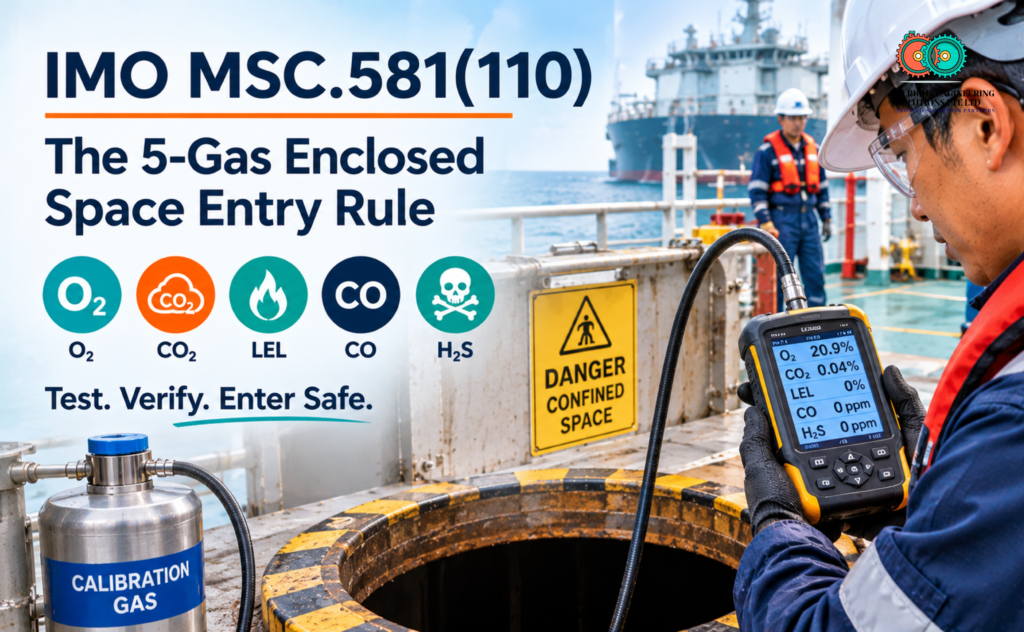
IMO MSC.581(110) Explained: The 5-Gas Enclosed Space Entry Rule and Your Detectors
InterManager’s figures, submitted to the IMO, show 14 enclosed space incidents in 2022 and another 14 in 2023. Deaths in those incidents rose from 18 to 34. That jump sits behind IMO Resolution MSC.581(110), and it’s why superintendents are asking whether their 4-gas meters are still good enough. A 4-gas meter can show a clean oxygen, LEL, CO and H₂S reading in a hold where carbon dioxide is already above the new entry limit. What the resolution actually asks for isn’t quite the “MSC.581(110) 5 gas requirement” you’ll see quoted online.
What MSC.581(110) changed for atmosphere testing
The Maritime Safety Committee adopted MSC.581(110), the Revised Recommendations for Entering Enclosed Spaces Aboard Ships, on 27 June 2025. It took effect on 3 December 2025 after the IMO Assembly endorsed it, and it replaces Resolution A.1050(27).
The change that matters most for detectors is in paragraph 7.4. Before anyone enters, the resolution asks for steady readings of all of the following:
| Parameter | Entry criterion | Paragraph |
|---|---|---|
| Oxygen | 20.9% by volume | 7.4.1 |
| Carbon dioxide | Below 0.5% by volume (5,000 ppm) | 7.4.2 |
| Flammable gas or vapour | Below 1% of the lower flammable limit (LFL) | 7.4.3 |
| Toxic gases and vapours | Below 50% of the occupational exposure limit (OEL) | 7.4.4 |
If the readings fall short, paragraph 7.5 says to ventilate further and retest after a suitable interval. Testing should be done with ventilation stopped (7.6), and the sample permit in Appendix 2 suggests stopping it for about 10 minutes first. The resolution also warns that oxygen and flammability readings tell you nothing about toxicity (7.7), and that oxygen-deficient pockets should always be suspected (7.8).
Once people are inside, the atmosphere should be tested frequently (8.1), and personal detectors should monitor oxygen, carbon dioxide, flammable gases or vapours and toxic gases including carbon monoxide (8.2). After a break, the space has to be retested before anyone goes back in (8.3), and single-person entry isn’t permitted at all.
Where the “5-gas” label comes from
Plenty of pages say MSC.581(110) requires a five-gas detector, though they don’t agree on which five. The resolution itself doesn’t use the phrase, and it doesn’t mention hydrogen sulphide anywhere.
What it names is oxygen, CO₂, flammables, toxic gases including CO, and any other gas the risk assessment identifies for that space or cargo. H₂S comes in from a different document. SOLAS regulation XI-1/7, in force since 1 July 2016, requires ships to carry a portable atmosphere testing instrument that can measure, as a minimum, oxygen, flammable gases or vapours, hydrogen sulphide and carbon monoxide, with suitable means of calibrating it. MSC.1/Circ.1477, the IMO’s guidelines for selecting that instrument, uses the same four.
So “5-gas” is shorthand for SOLAS’s four plus the CO₂ limit in MSC.581(110). A CO₂-capable multi-gas unit covering all five is the tidiest way to satisfy both documents with one instrument, but it doesn’t cover everything. If the risk assessment for a cargo flags ammonia, phosphine or benzene, a five-gas meter won’t see them, and you’ll need another sensor, detector tubes or a separate instrument.
It’s worth being fair to the 4-gas meter here. For nearly a decade it was exactly what SOLAS and Circ.1477 asked for, and buying one was the sensible decision. It still covers the SOLAS minimum today. What it can’t do is give you the CO₂ reading paragraph 7.4.2 asks for, so it needs a CO₂ instrument alongside it or a replacement with the channel built in. ABS’s guidance on the resolution describes the options as replacing or supplementing existing detectors, which is fairer than the “non-compliant” label some sales pages use. We set out the wider SOLAS picture in our earlier guide to portable gas detector calibration under IMO and SOLAS.
Is it a requirement or a recommendation?
MSC.581(110) is a set of recommendations. The resolution invites governments to bring it to the attention of shipowners; it doesn’t amend SOLAS. It gets legal force when a flag state writes it into national rules.
Denmark is a clear example. The Danish Maritime Authority implemented MSC.581(110) through Order no. 472 from 1 July 2026, then gave Danish-flagged ships until 1 December 2026 to acquire portable CO₂ detection devices because of limited availability and long delivery times. The authority was explicit that the extension didn’t relax anything else in the resolution.
A sharp reader will point out that if your flag hasn’t legislated, you’re technically still working to SOLAS XI-1/7 alone. That’s true as far as it goes. In practice, class societies including ABS, DNV and LR have told owners to update their safety management systems against MSC.581(110), taking their flag’s requirements into account, and the Tokyo MOU has announced a joint concentrated inspection campaign with the Paris MoU on enclosed space entry for 2027. Singapore’s MPA listed the resolution among the MSC 110 outcomes in Shipping Circular No. 07 of 2025. Check your own flag’s circulars rather than assuming either way.
The ship’s instrument and the personal detector do different jobs
Two kinds of detector show up in these documents. The SOLAS XI-1/7 instrument is ship’s equipment. It tests the space from outside before anyone goes in, usually drawing a sample through a hose with a pump. Circ.1477 says plainly that its guidelines don’t cover a personal detector carried by someone inside the space.
The personal detector is what paragraph 8.2 is about. It goes in with the entrant and alarms if conditions change while they’re working. A clip-on single-gas monitor such as a BELL MINI O₂ detector does that job for one hazard, which is why it can’t stand in for a multi-gas unit with a CO₂ channel.
On numbers, paragraph 7.3 says all ships should carry at least two sets of gas detection equipment as required by SOLAS XI-1/7. Ships carrying cargoes that can create a hazardous atmosphere, and that need regular entry for inspection or cleaning, should carry two more. The four-set figure applies to that cargo category, not to every ship. Fixed systems in pump rooms and compressor rooms are a separate subject, covered in our guide to fixed gas detection calibration for tankers and gas carriers.
Paragraph 7.1, and why some sensors struggle in thin air
Paragraph 7.1 says gas detection equipment, including CO₂ devices, should be capable of operating correctly even in an oxygen-depleted atmosphere. That’s a statement about sensor physics.
Most portable LEL channels use a catalytic bead, or pellistor, which measures flammable gas by burning it on a heated catalyst. It needs oxygen to do that, and one manufacturer gives a minimum of about 10% by volume. In a depleted or inerted space the bead can’t oxidise all the gas present, so the %LEL figure reads low, and a low reading there isn’t proof the space is free of flammables. Infrared LEL sensors don’t need oxygen, but they can’t see hydrogen, so the right choice depends on what the space might hold. The oxygen analyser on an inert gas plant is a different instrument again, covered in our guide to oxygen analyser calibration for inert gas systems.
CO₂ is almost always measured by non-dispersive infrared (NDIR). The reading depends on the pressure, temperature and humidity of the gas reaching the optical cell, and it still drifts over months of use. Oxygen, CO and H₂S are usually electrochemical cells, which have a finite life and lose sensitivity as they age.
| Channel | Usual sensor | Known weakness | What to check |
|---|---|---|---|
| Flammables (%LEL) | Catalytic bead or IR | Bead reads low in low O₂ and can be poisoned by silicones and sulphur compounds; IR can’t see hydrogen | Which sensor is fitted, and whether it suits the spaces you enter |
| CO₂ | NDIR | Affected by pressure, temperature and humidity; drifts | Range and resolution around 0.5% vol; a CO₂ line on the certificate |
| O₂ | Electrochemical | Ageing and drift | Zero in nitrogen, span at 20.9% |
| CO, H₂S | Electrochemical | Ageing, drift, cross-sensitivity | Span against certified gas within its shelf life |
If you’re choosing a replacement, look at the sensor list before the gas count. The K-600M pumped 5-in-1 detector, for example, uses an IR sensor for CO₂ over a 0 to 5% range and comes with either an IR or a catalytic sensor for methane. The full range is on our portable gas detectors page. If you’re keeping existing meters, an onboard gas detector calibration visit records as-found readings for each channel, which shows quickly whether drift is a problem.
Calibrating the fifth channel
Neither SOLAS nor the resolution sets a calibration interval. Circ.1477 says the manufacturer’s instructions should define clear calibration requirements, and the interval follows the manufacturer. MSC.581(110) asks for “properly calibrated” equipment (7.2 and 6.5.3) and crew training in calibration (3.6). Your SMS sets the actual schedule, and our marine instrument calibration interval table is a reasonable starting point if you’re building one.
Adding a CO₂ channel changes the calibration kit. The quad mix many ships hold, such as CO 50 ppm, H₂S 25 ppm, methane at 50% LEL and 12% O₂ in nitrogen, has no CO₂ in it, so it can’t bump-test or span the fifth sensor. You’ll need a CO₂ span gas in nitrogen, sold in concentrations from 1% to 15%, or a mix that includes CO₂, matched to whatever the detector’s manual specifies. Pure nitrogen is handy for zeroing the O₂ cell.
A bump test and a calibration aren’t the same thing either. A bump test exposes the sensors to gas to confirm they respond and alarm, while a calibration measures the error against certified gas and corrects it. Neither MSC.581(110) nor Circ.1477 mentions bump testing, so its frequency comes from the manufacturer and your SMS. We’ve written separately about what a bump test can and can’t prove.
When a detector comes back from calibration, the certificate should list every channel, CO₂ included, with as-found and as-left readings, calibration gas concentrations, cylinder lot numbers and expiry dates, the alarm set points tested and the next due date. We cover that detail in what PSC inspectors look for on marine calibration certificates.
A readiness check before your next Singapore call
- List every portable and personal detector on board with make, model and fitted sensors, and mark which ones have a CO₂ channel.
- Check the LEL sensor type on each multi-gas unit against the spaces you enter, especially inerted tanks and holds with oxygen-depleting cargo.
- Count your sets against paragraph 7.3, including the extra two if your cargoes call for regular entry.
- Confirm your span gas covers CO₂ and that the cylinders are in date.
- Check that the latest calibration certificates name every sensor, with as-found and as-left data.
- Record the testing means for each space in the Enclosed Space Register, as paragraph 4.2 asks.
- Read your flag’s latest circular on MSC.581(110) so you know whether it’s law or guidance for your ships.
Getting your detectors checked in Singapore
Our gas detector calibration service in Singapore covers portable, personal and fixed detectors on board, alongside or at anchorage, with certificates showing as-found and as-left readings for each sensor, and it’s part of our fixed and portable measurement equipment services. Send us your detector makes, models and sensor lists and we’ll tell you which units can cover the CO₂ limit and which need attention before you sail.
As for the 4-gas meter from the start, it may well be reading accurately. It just can’t see the gas MSC.581(110) added, and on a ship carrying grain, logs or coal, CO₂ is often one of the gases building up behind a closed hatch.