
 Cart (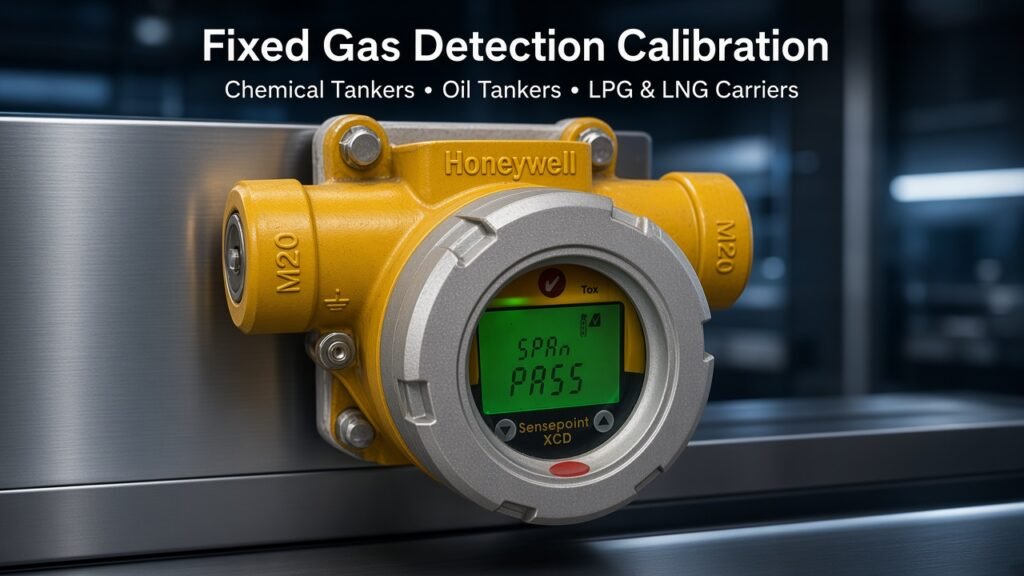
Fixed Gas Detection Calibration for Chemical Tankers, Oil Tankers, LPG and LNG Carriers
A single failed sensor in a pump room, or a double-hull space nobody’s checked in months, can be enough to stop cargo operations cold or draw an immediate detention from USCG, Paris MOU, or Tokyo MOU inspectors. Fixed gas detection systems, mandated under SOLAS II-2/4.5.7 and FSS Code Chapter 16, sit at the center of that risk, and they’re more vulnerable to drift and cross-contamination than most PMS schedules treat them as being.
Calibrating one properly isn’t just a matter of applying test gas and confirming a number on the display. It means matching sensor physics, infrared, catalytic, or electrochemical, to the actual atmosphere the vessel is carrying. Get that match wrong, and the calibration can look clean while the sensor is quietly lying to you.
Vessel-Specific Calibration Realities
Different vessel types demand different sensor placements, different hazard profiles, and different calibration gas chemistry entirely. Treating an LPG carrier’s compressor room the same way you’d treat an oil tanker’s pump room is where a lot of otherwise careful calibration programs start going wrong.
| Vessel Type | Primary Sensor Zones | Target Hazards & Calibration Gases | Critical Compliance Standard |
| Oil Tankers | Pump rooms, pipe tunnels, double-hull spaces | Hydrocarbons (% LEL / % Vol), Hydrogen Sulphide (H₂S) | ISGOTT & SOLAS II-2 |
| Chemical Tankers | Cargo pump rooms, vapor processing areas | Wide-spectrum toxic vapors, Volatile Organic Compounds (VOCs) | IBC Code & OEL limits |
| LPG Carriers | Cargo compressor rooms, motor rooms | Propane, Butane, Ammonia (% LEL) | IGC Code & Class Rules |
| LNG Carriers | Interbarrier spaces, insulation spaces, valve manifolds | Methane (CH₄), Inert gas / oxygen depletion | IGC Code & SIGTTO guidelines |
For oil tankers, that usually means keeping a certified H₂S span gas mix on hand alongside a hydrocarbon standard, since H₂S is one of the faster-expiring gases in most calibration lockers. LPG carriers add ammonia-balanced span gas to that inventory, and LNG carriers need a methane-specific hydrocarbon mix rather than the generic combustible-gas cylinder used on a general cargo ship. Our calibration gas mixtures and specialty gases range covers most of these vessel-specific profiles.
The Dangerous Calibration Mistake: Sensor Technology vs. Span Gas Background
This is the mistake behind most USCG detention alerts on this topic, and it usually starts with good intentions.
Catalytic bead (pellistor) sensors need at least 10% oxygen in the surrounding atmosphere to read flammable gas accurately. That means the span gas used to calibrate them has to be balanced with fresh air, roughly 20.9% O₂, not nitrogen. Calibrate a catalytic sensor with a nitrogen-balanced cylinder, which is common practice around inerted spaces, and the calibration will look fine on the display while the sensor itself is effectively blind. That’s exactly the failure mode that’s landed vessels in detention.
Infrared sensors work the opposite way. They don’t need oxygen to function, so IR sensors used in inerted cargo tanks or for methane tracking on LNG carriers should be calibrated against nitrogen-balanced span gas rather than a fresh-air mix. Using the wrong background gas on an IR sensor doesn’t create the same oxygen-starvation risk it does with catalytic beads, but it does throw off zero and span accuracy, and PSC inspectors know the difference even when a crew doesn’t.
There’s a third trap worth naming: response factors. Calibrating a sensor against methane and then exposing it to a heavier hydrocarbon like pentane can produce a dangerously understated LEL reading, since different combustible gases don’t respond identically to the same sensor. Chemical tankers that shift cargoes often, from benzene to toluene in the same week, are the vessels most exposed to this. A wide-spectrum span gas standard matched to the actual cargo slate, not a generic default, is the fix.
Calibrating Extraction (Sampling) Systems vs. Point Sensors
Point sensors, the ones mounted directly in a pump room or compressor room, are calibrated locally with a calibration cap fitted onto the sensor head. It’s the more straightforward job of the two.
Sequential sampling systems are the harder case. These pull air through lines running from ballast tanks, cofferdams, or interbarrier spaces up to an analysis cabinet in the Cargo Control Room, and calibrating the sensor alone doesn’t tell you the system is working. Crews also need to check the sample pump’s flow rate, verify the multi-cock valve sequencing is actually cycling through every monitored space, and run an air purge between samples to keep moisture out of the lines. A line drawing too slowly, or a valve sticking on one position, can hold a system that reads perfectly clean while the space it’s supposed to monitor never actually gets sampled.
We’ve documented a real version of this failure in a case study on a Consilium SW2020 analyser pump leakage we handled in Singapore, where the sensor calibration itself was fine and the leak was in the sampling path.
What PSC Actually Checks During a Fixed Gas Detection Audit
Three things come up in almost every PSC audit of a fixed gas detection system.
Traceability is the first. Span gas cylinders need valid, internationally traceable certificates, not just a sticker showing a fill date. Expiry is the second, and it matters more than crews sometimes expect, since reactive gases like H₂S degrade quickly and a cylinder that’s technically still onboard can be chemically useless well before its printed expiry date. The third is the document trail: calibration records need to sit inside the ship’s Planned Maintenance System and, ideally, in a physical log kept near the central gas display panel, since that’s usually the first place an inspector looks.
None of these three are hard to get right on their own. Where vessels get caught out is when the equipment is compliant but the paperwork behind it isn’t, and an inspector has no way to confirm a calibration actually happened the way the system claims it did. A structured calibration interval table helps keep the schedule and the paper trail in sync, and understanding how a full lab calibration differs from a routine bump test matters just as much for fixed systems as it does for portable ones.
The Fatal Flaw in Uniform Calibration Programs
Most calibration failures on tankers and gas carriers don’t come from neglect. They come from treating every sensor and every space the same way, applying one span gas standard across a fleet running several different sensor technologies in several different atmospheres.
Before your next PSC audit:
- Audit your span gas inventory against sensor type, not just against expiry date.
- Match catalytic sensors to fresh-air-balanced span gas and IR sensors to nitrogen-balanced span gas. Never assume the two are interchangeable.
- Confirm the PMS logs every individual channel, not just a system-level “gas detection: OK” entry.
- Train crew on cross-sensitivity, particularly on chemical tankers where the cargo, and the calibration gas that should match it, changes from voyage to voyage.
- Check sampling-line flow rates and valve sequencing on extraction systems, not just the sensor readings at the analysis cabinet.
Our fixed gas detection and automation service covers exactly this kind of vessel-specific calibration work for tankers and gas carriers calling at Singapore.