
 Cart (
CO₂ Sensors on Marine Gas Detectors: Why NDIR, and How They’re Calibrated
A lot of ships now carry a gas detector with a CO₂ channel, mostly because IMO Resolution MSC.581(110) sets a pre-entry limit of 0.5% CO₂ by volume (5,000 ppm). It’s only useful if it reads true near that limit, and it’s calibrated differently from the O₂, LEL, CO and H₂S sensors the crew already know. Get the zero or the span gas wrong and the entry decision gets made on a number that’s off by a sizeable fraction of the limit. This guide covers how the sensor works, what makes it drift, and what a sound CO₂ calibration looks like.
Why CO₂ has to be measured directly
It’s tempting to assume the oxygen sensor will catch a CO₂ build-up, since CO₂ displaces air. The numbers say otherwise. Fresh air is about 20.9% oxygen, so if CO₂ rises to 3% by volume and displaces air evenly, oxygen only falls to roughly 20.3%. That’s still above the 19.5% low-oxygen alarm many detectors are set to, while CO₂ sits at six times the entry limit.
That’s why MSC.581(110) names CO₂ separately, and why the Isle of Man Ship Registry told owners back in 2024 that the basic four-gas detector isn’t enough for organic cargoes. We cover the regulation itself in what MSC.581(110) actually asks of your detectors. The rest of this article is about the sensor.
How an NDIR CO₂ sensor works
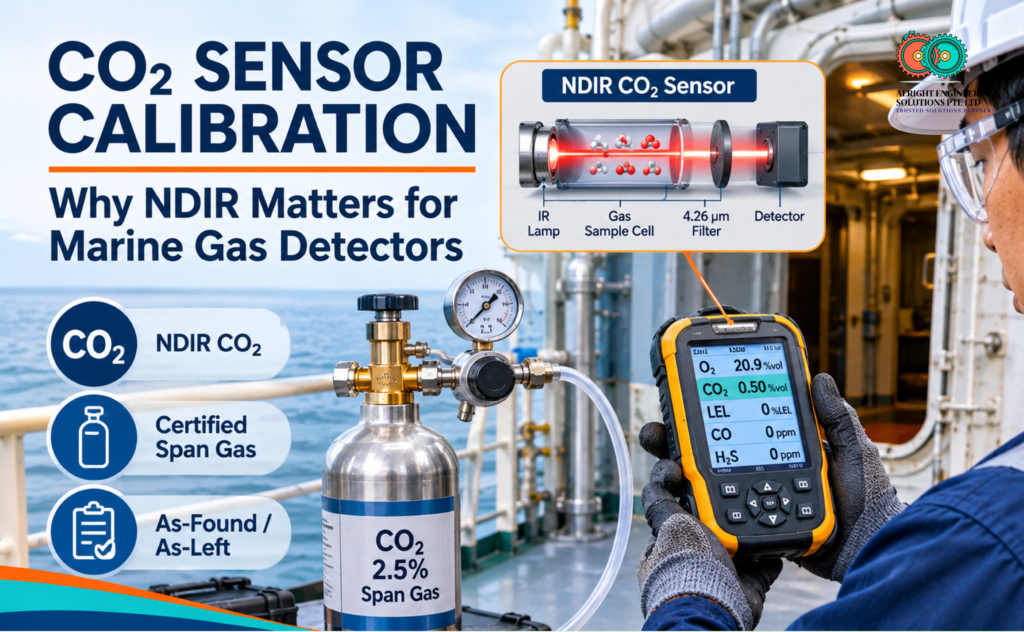
Almost every portable CO₂ channel uses non-dispersive infrared (NDIR). An infrared source shines through a small gas cell onto a detector fitted with a filter tuned to about 4.26 µm, a wavelength CO₂ absorbs strongly. The more CO₂ in the cell, the less light reaches the detector, and the instrument converts that loss into a concentration.
Most designs add a second, reference channel at a wavelength CO₂ doesn’t absorb. Because both channels see the same lamp and the same temperature, comparing them cancels out much of the drift from an ageing source or a warm engine room.
For marine work, NDIR has two practical advantages. It doesn’t consume oxygen to make a measurement, which matters because MSC.581(110) paragraph 7.1 asks for CO₂ devices that work correctly in oxygen-depleted air. And it isn’t poisoned by silicones or sulphur compounds the way a catalytic LEL bead can be.
What still makes an NDIR reading drift
NDIR is stable, but it doesn’t correct itself. Room CO₂ sensors in offices often run automatic background calibration, quietly treating the lowest reading of the week as about 400 ppm. A safety detector shouldn’t be trusted that way. Its accuracy is set and checked with gas.
Three things move the reading over time. The lamp and optics age, and the reference channel only compensates for part of that. The sensor counts molecules, so changes in sample pressure shift the result, and a sensor without pressure compensation will underreport at lower pressure. Moisture is the third, and the most practical one on a ship. A pumped sample drawn up a long hose from a damp ballast tank or hold can condense in the line or on the optics, and condensation isn’t an acceptable way to condition a sample. Our case study on a Consilium SW2020 analyser is a different instrument, but it shows how a fault can sit in the sample path rather than the sensor.
Getting the zero right
The zero is where CO₂ calibration differs most from the other channels. Clean outdoor air isn’t CO₂-free. NOAA’s measurements put the global background at 425.62 ppm in 2025, and it’s still rising by around 2 ppm a year.
Manufacturers handle this differently, which is why the manual matters:
| Instrument | CO₂ zero method | Default CO₂ span gas |
|---|---|---|
| MSA Altair 5X IR (10% vol CO₂) | Fresh air, with zero value set to 0.03% | 2.5% CO₂ |
| Dräger X-am 7000 | Fresh-air calibration excludes the O₂ and CO₂ channels | Per manual |
| Dräger X-am 5600 | Fresh-air zero not supported on the CO₂ channel; CO₂-free zero gas such as nitrogen | Per manual |
The MSA approach assumes fresh air holds 300 ppm. Today’s background is closer to 425 ppm, so there’s a built-in offset of roughly 125 ppm, which is small against a 5,000 ppm limit. The bigger risk is where the zero gets done. Run a fresh-air zero in a closed control room or a crowded mess where CO₂ is at 1,500 ppm, and the instrument may read low by around 0.12% vol for the rest of its service. That’s nearly a quarter of the entry limit. Zeroing with high-purity nitrogen takes the room out of the equation, where the manual allows it.
Matching the span gas
The span step sets the sensor’s sensitivity against a known concentration, and two mistakes are easy to make.
The first is using the wrong mix. The four-gas cylinder most ships hold, such as CO 50 ppm, H₂S 25 ppm, methane at 50% LEL and 12% O₂ in nitrogen, contains no CO₂ at all. It can’t bump-test or span the fifth channel. The Isle of Man notice says plainly that span gas for any CO₂ meter should be supplied to the vessel.
The second is a mismatch between the cylinder and the instrument’s programmed span value. If the detector expects 2.5% CO₂ and someone connects a 3% cylinder without changing the setting, the calibration will “pass” and leave the channel reading wrong. MSA lets you change span values through its software when you’re using different cylinders, and other makers have similar settings. Either buy the concentration the manual names, or change the setting to match the cylinder you have. We supply CO₂ span gas in nitrogen at 1%, 3%, 5%, 10% and 15%, and other calibration gas mixtures can include CO₂. Check the cylinder’s certificate of analysis and expiry date either way.
Bump test, calibration and who does them
A bump test exposes the sensor to gas to show it responds and the alarm sounds. A calibration measures the error against certified gas, adjusts it, and records the as-found and as-left values. We’ve written up what a bump test can and can’t prove, and the difference matters most on a channel the crew hasn’t worked with before.
No IMO document sets a calibration interval for portable detectors. MSC.1/Circ.1477 leaves it to the manufacturer’s instructions, and MSC.581(110) asks only for “properly calibrated” equipment. Your SMS sets the schedule, and our marine instrument calibration interval table is a reasonable starting point.
Flags differ on where the work happens. Transport Malta accepts calibration at a manufacturer’s approved shore facility as a suitable means under SOLAS XI-1/7, while the Isle of Man expects regular CO₂ bump testing on board with span gas supplied. Plenty of SMSs combine the two, with crew bump tests between full calibrations. If class or a charterer asks about the calibrating lab, our note on manufacturer versus ISO 17025 calibration covers what’s usually accepted.
What the certificate should show for CO₂
A CO₂ line on a calibration certificate is worth very little without the detail behind it. These are the fields to check:
| Field | Why it matters |
|---|---|
| Zero gas used (nitrogen or fresh air) | Shows whether the zero carries a room offset |
| CO₂ span gas concentration and balance gas | Must match the instrument’s programmed span value |
| Cylinder lot number and expiry | Links the result to a traceable, in-date gas |
| As-found reading | Shows how far the channel had drifted |
| As-left reading | Shows the correction held |
| CO₂ alarm set points tested | Confirms the TWA, STEL and high alarms work |
| Next due date | Ties the channel to your SMS schedule |
For how inspectors read these documents, see what PSC inspectors look for on marine calibration certificates.
A CO₂ channel check before your next port call
- Find the CO₂ zero and span instructions in each detector’s manual, and note the span concentration it expects.
- Confirm the ship holds that CO₂ span gas, in date, and not only a four-gas mix.
- Check the span value programmed in each detector matches the cylinder.
- If the crew zero in fresh air, make sure they do it outdoors on deck, not in an enclosed room.
- Inspect sampling hoses and filters for moisture after use in wet spaces.
- Check that the last calibration certificate lists the CO₂ channel with as-found and as-left readings.
Calibrating CO₂ channels in Singapore
Our gas detector calibration service in Singapore covers infrared CO₂ sensors on 5-gas and single-gas instruments, on board alongside or at anchorage, with certificates showing as-found and as-left readings for every sensor. If you’re choosing new equipment, the K-600M pumped 5-in-1 detector uses an IR CO₂ sensor over a 0 to 5% range. NDIR is the same technology used in scrubber analysers, and our EGCS analyser calibration guide covers that side. Send us your detector models and the span gas you carry and we’ll confirm what matches before we attend.
Going back to the 3% CO₂ example at the start, the O₂ sensor would have shown 20.3% and stayed quiet. The CO₂ channel is the only thing on the instrument that would have caught it, which is a good reason to make sure its zero and span are right.