Cart (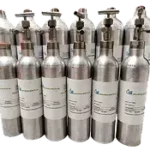
Overview
Carbon dioxide monitoring is a requirement across a wider range of industries and environments than most procurement teams initially anticipate. From confined space entry programmes on vessels and industrial sites, to continuous atmospheric monitoring in cold storage facilities, fermentation tanks, and CO2-rich process environments, the demand for CO2 detector calibration spans multiple concentration ranges — and a single fixed-concentration cylinder rarely covers all of them.
The Carbon Dioxide (CO2) Balanced Nitrogen Span Gas range addresses that directly. Available in five concentrations — 1%, 3%, 5%, 10%, and 15% by volume — and across five cylinder sizes from 34 litres up to 116 litres, this product line gives safety managers, instrument technicians, and procurement teams the flexibility to specify the exact calibration gas concentration and cylinder capacity that matches their specific detector model, detection range, and operational volume.
What distinguishes this range from generic calibration gas offerings is the breadth of concentration options available from a single supplier. Rather than sourcing low-range CO2 calibration gas from one supplier and high-range from another — and managing the supplier relationships, documentation, and procurement timelines that come with split sourcing — this range consolidates the full CO2 calibration gas requirement under one product family. For operations with detectors spanning both confined space CO2 monitoring and high-range process or cargo atmosphere detection, that consolidation is a procurement advantage with a measurable impact on administrative overhead.
Key Features
Five Concentrations — 1%, 3%, 5%, 10%, 15% CO2 — Full Range Coverage in One Product Family
The range covers CO2 calibration concentrations from 1% through to 15% by volume — spanning the detection ranges of the most commonly deployed CO2 monitors in industrial, marine, and commercial environments. Lower concentrations (1% and 3%) are appropriate for spanning CO2 monitors used in occupied spaces, confined space entry programmes, and environments where early-warning CO2 alarm thresholds are set well below immediately dangerous levels. Mid-range concentrations (5% and 10%) cover process gas monitoring and cargo atmosphere detection applications. The 15% concentration supports high-range CO2 detectors used in environments where CO2 can accumulate to very high levels — including cargo holds, sealed tanks, and CO2-blanket storage atmospheres. Having the correct span concentration for each detector type is not optional: spanning a detector at the wrong concentration introduces systematic error across the entire measurement range.
Nitrogen Balance Gas — No Cross-Sensitivity Interference
All concentrations in this range are balanced in nitrogen (N2) — a chemically inert diluent that introduces no cross-sensitivity interference with CO2 infrared or electrochemical sensor technologies. For CO2 calibration in particular, nitrogen balance is the technically preferred formulation because it eliminates the oxygen-related variability that can affect certain sensor types when air-balanced calibration gas is used. For operations where calibration accuracy and batch-to-batch repeatability are audited as part of a quality or safety management system, nitrogen-balanced CO2 calibration gas provides a consistent and defensible calibration standard across every calibration cycle.
Five Cylinder Sizes — 34L, 58L, 103L, 110L, 116L — Matched to Operational Volume
Cylinder size selection directly affects both calibration cost-per-event and the logistics of managing calibration gas inventory. Smaller cylinders (34L) suit low-volume applications — a single site, a small instrument count, or a project-based calibration requirement where gas consumption is limited and cylinder changeover is infrequent. Larger cylinders (103L to 116L) are appropriate for high-volume calibration operations: multi-site safety equipment maintenance programmes, instrument hire fleets requiring frequent recalibration, or industrial facilities with large fixed detector installations where calibration gas consumption is continuous and predictable. Specifying the correct cylinder size for the actual gas consumption rate reduces the cost of frequent cylinder replacements and minimises the dead gas left in undersized cylinders at the end of their service life.
Aluminium Cylinder Construction — Lightweight and Corrosion-Resistant
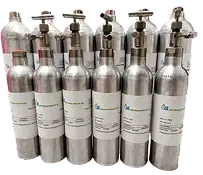
All cylinders in this range are manufactured from aluminium — a cylinder material that combines low weight with corrosion resistance appropriate for CO2 calibration gas service. Aluminium cylinders are significantly lighter than steel equivalents of the same gas capacity, reducing the handling burden for technicians transporting calibration equipment to field locations. Aluminium is also compatible with the inert nitrogen balance gas and non-reactive CO2 component — ensuring no cylinder material interaction that could affect the stability or accuracy of the certified gas concentration over the cylinder’s service life.
Certified Concentration — Traceable Analytical Accuracy
Each cylinder is supplied with a certificate of analysis specifying the verified gas concentration against traceable reference standards. Certified calibration gas is the only defensible basis for a calibration record that may be reviewed during regulatory inspection, class survey, or management system audit. An uncertified or nominally specified calibration gas provides no documented evidence that the detector was exposed to a known concentration during calibration — which means the calibration record itself cannot be verified. For operations where calibration traceability is a documented requirement, the certificate of analysis supplied with each cylinder is as important as the gas itself.
Technical Specifications
Cylinder: C10 — Aluminium
Available Sizes: 34L / 58L / 103L / 110L / 116 Litres
Carbon Dioxide (CO2): 1% / 3% / 5% / 10% / 15% Vol
Balance Gas: Nitrogen (N2)
Benefits
Correct span concentration eliminates systematic calibration error across the detector’s measurement range. A CO2 detector spanned at the wrong concentration — either too high or too low relative to the instrument’s specified calibration point — will produce readings that are systematically offset across the entire measurement range. That offset is invisible in normal operation; the instrument appears to be functioning, but its readings cannot be trusted at any point in the range. Selecting the correct certified span concentration for each detector model is the single most important factor in producing a calibration record that reflects the instrument’s actual measurement accuracy.
Consolidated CO2 calibration gas sourcing simplifies procurement and documentation. Operating with detectors across multiple CO2 concentration ranges — confined space monitors at lower range, process detectors at mid-range, cargo atmosphere monitors at high range — typically means managing calibration gas from multiple suppliers or product lines. This range covers the full 1%–15% CO2 span in a single product family from a single supplier, reducing the number of supplier relationships, purchase orders, and cylinder certificates to manage within the calibration gas inventory.
Cylinder size flexibility reduces gas waste and total calibration consumable cost. Oversized cylinders leave residual gas at end of service life that cannot be used — representing a direct cost on every cylinder cycle. Undersized cylinders run out before the calibration schedule is complete, causing calibration interruptions and unplanned procurement. Specifying the correct cylinder size for actual gas consumption — which this range makes possible with five size options — optimises the cost-per-calibration-event and eliminates both waste and unplanned stockout risk.
Nitrogen balance gas supports consistent calibration results across technicians and calibration cycles. Calibration results that vary between technicians or between calibration cycles — with no change in the underlying instrument — are often traceable to inconsistent calibration gas rather than instrument drift. Nitrogen-balanced CO2 calibration gas, supplied at a certified concentration from a consistent manufacturing source, eliminates one of the most common sources of calibration result variability. For safety management systems where calibration result trends are monitored as part of instrument performance tracking, that consistency provides cleaner data and more reliable drift detection.
Who It’s For
The Safety Equipment Manager Running a Multi-Site or Fleet Calibration Programme
You manage gas detector calibration across multiple facilities, vessels, or project sites — each potentially running different CO2 detector models with different calibration concentration requirements. Sourcing the full range of CO2 calibration gas concentrations from a single supplier, in the cylinder sizes that match each site’s consumption volume, simplifies both procurement and the administrative burden of managing calibration gas certificates and inventory records. When your calibration programme spans the 1%–15% CO2 range, a product family that covers the full range in one place is a practical operational advantage.
The Instrument Technician Responsible for Scheduled Detector Calibration
You calibrate CO2 detectors on a scheduled maintenance cycle — portable monitors used for confined space entry, fixed detectors in process areas, or atmospheric monitors in refrigerated storage. Each detector type may require a different span concentration to calibrate correctly against its specified alarm thresholds. Having the right certified calibration gas concentration available for each instrument — rather than using a nominally “close” concentration because the correct one wasn’t in stock — is the difference between a calibration record that withstands audit scrutiny and one that doesn’t.
Possible Applications
- Marine vessel confined space entry monitoring — Span calibration of portable CO2 monitors used for pre-entry atmosphere testing in cargo holds, ballast tanks, pump rooms, and enclosed spaces on commercial vessels
- Cold storage and refrigerated warehouse gas detection — Calibration of fixed CO2 detectors monitoring refrigerant atmosphere and worker safety in cold storage rooms, blast freezers, and refrigerated distribution centres where CO2 is used as a refrigerant or accumulates from produce respiration
- Breweries, wineries, and fermentation facility monitoring — Span calibration of CO2 monitors used in cellars, fermentation rooms, and bottling areas where CO2 is produced continuously as a fermentation by-product and can accumulate to dangerous concentrations in low-lying or poorly ventilated areas
- Industrial process gas detection — petrochemical and refinery applications — Calibration of fixed CO2 detectors deployed in process areas where CO2 is present as a process gas, combustion product, or inertisation agent at concentrations requiring mid- to high-range span calibration
- Confined space entry programmes — underground utilities and tunnelling — Calibration of multi-gas monitors with CO2 channels used for atmosphere testing in sewers, utility tunnels, underground infrastructure maintenance, and construction excavations where CO2 accumulation in low-lying spaces is a credible hazard
- Continuous emissions monitoring systems (CEMS) — Span calibration of CO2 analysers used in stack and flue gas monitoring at power generation facilities, cement plants, and waste-to-energy installations where CO2 concentration measurement is a regulatory reporting requirement
- Safety equipment hire and calibration service operations — High-volume CO2 calibration gas supply for instrument hire companies and third-party calibration service providers maintaining large portable gas detector fleets requiring regular recalibration across multiple CO2 concentration ranges
Trust and Certifications
Certified Calibration Gas — Traceable to National Measurement Standards
Each cylinder is supplied with a certificate of analysis confirming the verified CO2 concentration against traceable reference standards. Calibration gas traceability is a requirement under ISO 17025 accredited calibration programmes and is expected under most safety management system frameworks where gas detector calibration records are subject to internal or external audit. The certificate of analysis provides the documented evidence of calibration gas concentration accuracy that supports the validity of every calibration event performed with the cylinder.
Aluminium Cylinder — Manufactured to Pressure Vessel Standards
Cylinders are manufactured and tested to applicable pressure vessel standards. Cylinders should be handled, stored, and transported in accordance with compressed gas cylinder safety requirements — including secure upright storage away from heat sources, use of appropriate cylinder caps or valve guards during transport, and connection only via compatible single-stage calibration gas regulators rated for the cylinder pressure and gas service. Cylinder re-qualification intervals should be observed in accordance with local compressed gas cylinder regulations.
Supplied by Alright Engineering Solutions
The CO2 Balanced N2 span gas range is supplied through Alright Engineering Solutions Pte. Ltd., an authorised distributor of portable and fixed gas detection equipment, calibration gas, and marine safety system components based in Singapore. Alright Engineering Solutions provides local procurement support for calibration gas, gas detection instruments, and associated safety equipment across the Singapore and regional market.
Accessories and Variants
Calibration Gas Regulator
A single-stage calibration gas regulator is required to connect the cylinder to the instrument under calibration. Regulator selection depends on the cylinder valve outlet and the instrument’s calibration gas inlet connection. Alright Engineering Solutions can advise on compatible regulator options for your specific instrument model and cylinder configuration — contact our team with your instrument make, model, and cylinder size for regulator compatibility guidance.
Available Concentration Variants
CO2 1% Vol Bal N2 — For confined space entry monitors and low-range CO2 atmospheric detectors
CO2 3% Vol Bal N2 — For mid-low range CO2 monitors used in occupied space and early-warning applications
CO2 5% Vol Bal N2 — For mid-range CO2 detectors covering standard industrial confined space monitoring
CO2 10% Vol Bal N2 — For high-range CO2 detectors used in process gas and cargo atmosphere monitoring
CO2 15% Vol Bal N2 — For very high-range CO2 detection in sealed storage, CO2-blanket, and cargo hold applications
Related Products from Alright Engineering Solutions
SO2 160ppm / CO2 8%Vol Bal N2 Span Gas — Multi-component calibration gas covering SO2 and CO2 in a single cylinder for combined sensor calibration
GX-8000 Sample Draw Multi Gas Monitor — Portable marine sample draw multi-gas monitor with CO2 sensor option for vessel confined space entry
RX-8700 Portable Gas Detector — Portable multi-gas monitor with ATEX/IECEx/MED certification for marine and industrial applications
Fixed Gas Detection Systems — Fixed point CO2 detectors and system components for permanent installation in marine, commercial, and industrial environments
Get in Touch
If you need to source CO2 calibration span gas — whether for a specific concentration and cylinder size, a multi-site calibration programme, or an ongoing calibration consumable supply arrangement — contact Alright Engineering Solutions to confirm availability and request a formal quotation.
Our team can assist with concentration selection, cylinder size specification, and compatible regulator sourcing for your specific CO2 detector models and calibration programme requirements.
📍 3791 Jalan Bukit Merah #06-01, E-Centre @ Redhill, Singapore 159471