
 Cart (
Gas Detector Calibration in Singapore, Done On Board
Portable and fixed gas detector calibration for ships alongside or at anchorage in Singapore, and for shipyards, offshore and industrial sites. Our engineers come to you, calibrate against certified span gas and hand over a certificate with as-found and as-left readings.
- ISO 9001:2015
- ISO 45001:2018
- bizSAFE Level 4
- bizSAFE Star
- Alongside & anchorage
- As-found / as-left certificate

Gas detector calibration in Singapore, in short: Alright Engineering Solutions (AES) calibrates portable multi-gas detectors, single-gas personal monitors, tanker gas measurement instruments and fixed gas detection systems on vessels in Singapore. Each instrument is checked as found, adjusted with certified calibration gas, alarm-tested, and recorded as left on a certificate your crew can show at inspection.
Gas Detectors We Calibrate On Board
One attendance can cover every gas measuring instrument on your equipment list, from the chief officer's tank-entry meter to the fixed sampling cabinet in the cargo control room.
Portable multi-gas detectors
4-gas and 5-gas enclosed-space entry meters measuring O₂, LEL, CO and H₂S, plus CO₂ where fitted. Pump and diffusion models.
Portable detectors we supply →Single-gas personal monitors
Clip-on O₂, H₂S and CO monitors worn by crew and surveyors during entry and cargo work.
Tanker gas measurement
Instruments for hydrocarbon in %LEL and %Vol and O₂ in inerted atmospheres, used for gas-freeing, purging and inert gas checks.
Fixed gas detection systems
Pump room, cargo compressor room and accommodation-space detectors, plus gas sampling cabinets on chemical, oil and gas carriers.
Fixed system calibration guide →IG oxygen analysers
Fixed O₂ analysers on inert gas and nitrogen systems, checked with zero and span gas and alarm set points verified.
Oxygen analyzer calibration →Calibration gas & regulators
Span gas cylinders, regulators and tubing so your crew can bump test between our visits. Supplied in Singapore.
Calibration gas mixtures →Which Gases and Sensors Get Calibrated?
Every sensor in the instrument is calibrated against its own reference gas. Here's what we typically see on vessels calling Singapore.
| Gas | Typical sensor | Where it matters on board |
|---|---|---|
| Oxygen (O₂) | Electrochemical | Enclosed space entry, inerted cargo tanks, void spaces, ballast tanks |
| Flammable gas (%LEL) | Catalytic bead or infrared | Pump rooms, cargo tanks after gas-freeing, engine room, hot work permits |
| Hydrocarbon (%Vol) | Infrared | Tank atmospheres under inert gas, purging and gas-freeing on tankers |
| Carbon monoxide (CO) | Electrochemical | Cargo holds, engine room, spaces near combustion sources |
| Hydrogen sulphide (H₂S) | Electrochemical | Sour crude cargoes, bilge and sewage spaces, ballast tanks |
| Carbon dioxide (CO₂) | Infrared (NDIR) | Bulk holds with organic cargoes, fumigated spaces, CO₂ room checks |
Does Your Gas Detector Measure CO₂? The Enclosed Space Rules Changed
SOLAS regulation XI-1/7 has required ships to carry a portable atmosphere testing instrument since 1 July 2016. It must measure oxygen, flammable gases or vapours, hydrogen sulphide and carbon monoxide, with suitable means provided for calibrating it. IMO's selection guidelines (MSC.1/Circ.1477) leave the calibration requirements to the manufacturer's instructions.
IMO's revised Recommendations for entering enclosed spaces aboard ships, resolution MSC.581(110), replaced A.1050(27) from 3 December 2025. They add carbon dioxide to the gases checked before entry, with an entry criterion below 0.5% by volume, and expect people entering to wear personal detectors that include CO₂.
- If your 4-gas meter has no CO₂ channel, you may need a 5-gas unit or a separate CO₂ monitor.
- CO₂ sensors need their own span gas. Check your calibration gas mix covers it.
- Your calibration certificate should list every sensor, including CO₂.
- The recommendations also ask for a ship-specific register of enclosed spaces, managed through your SMS.
Want the full breakdown? Read our guide to portable gas detector calibration requirements under IMO and SOLAS.
How We Calibrate Your Gas Detectors On Board
Every job follows the same sequence, so the numbers on your certificate mean something when an inspector asks.
Send the details
Vessel name, IMO number, berth or anchorage, ETA/ETD and your instrument list with make, model and serial numbers.
Engineer attends
We board alongside at a terminal or shipyard, or at anchorage via your agent's launch, with the calibration gases your sensors need.
As-found readings
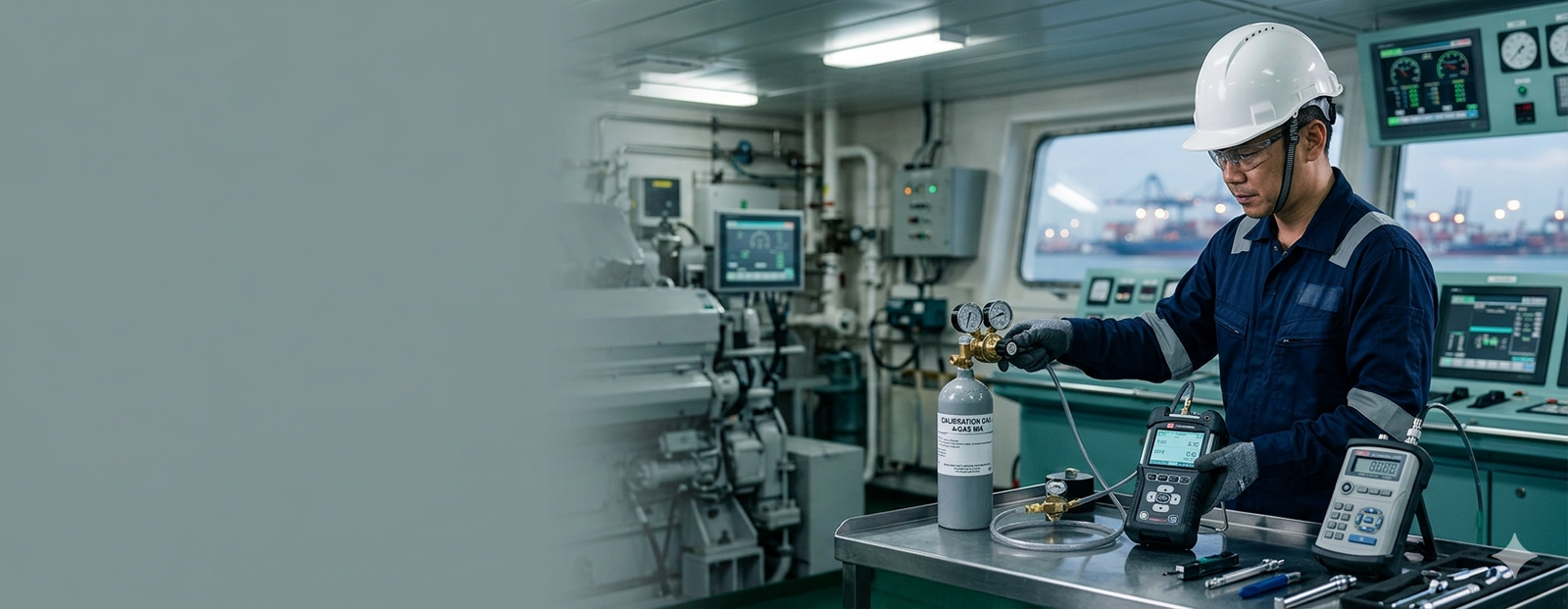
Each sensor is exposed to certified gas before any adjustment, so you get a true record of how far it had drifted.
Zero & span adjustment
Sensors are zeroed in clean air (or nitrogen for O₂-free checks) and spanned against traceable calibration gas.
Alarm & pump check
Alarm set points, audible and visual alarms, pump flow and sample lines are tested. Worn filters and failed sensors are flagged.
Certificate & label
As-left readings go on the certificate with the next due date, and each instrument gets a calibration label.
During your port stay
Portable and fixed detectors are calibrated on board while you're alongside or at anchorage, planned around your ETA and ETD.
Drop-off calibration
Spare or shore-based detectors can be brought to our office at E-Centre @ Redhill and returned calibrated with a certificate.
Short-notice requests
Vessel arriving soon or a detector failed its bump test? WhatsApp us and we'll tell you straight away what we can do in your port window.
Tell us your port stay and we'll plan the attendance around it.
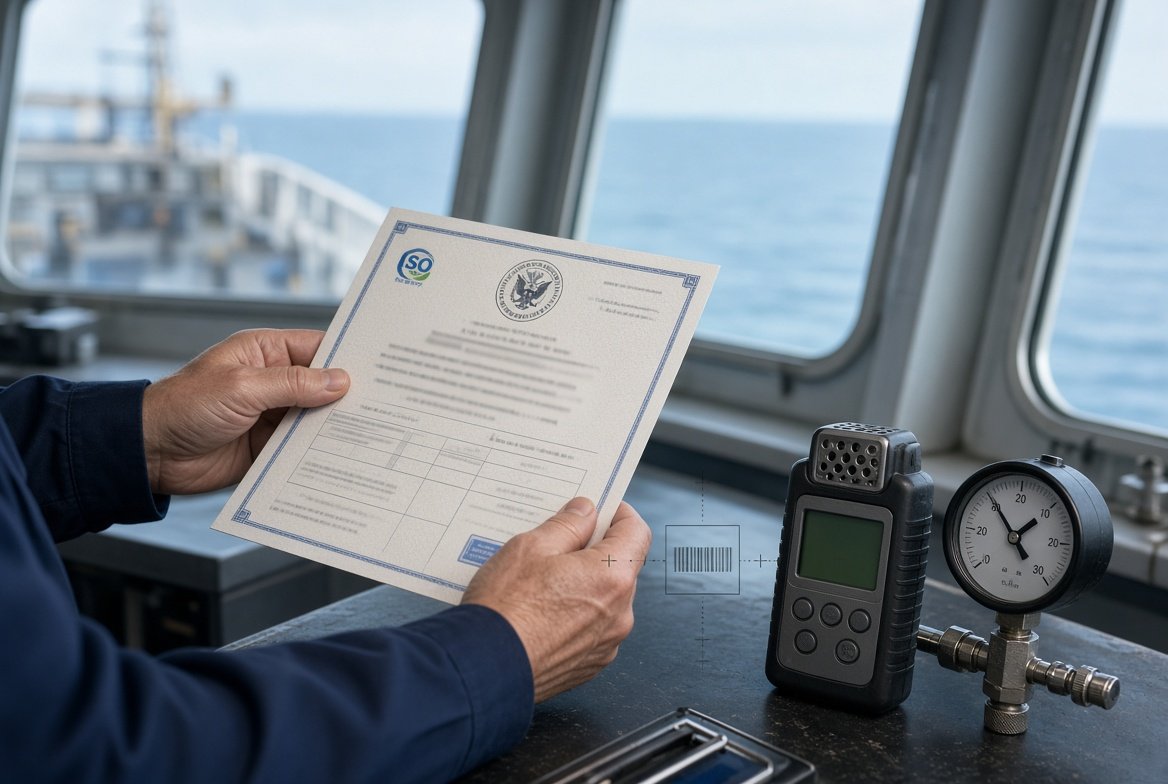
What's on Your Gas Detector Calibration Certificate
A certificate that just says "calibrated" doesn't prove much. Ours record the full trail from reference gas to finished reading:
- Instrument make, model and serial number, and each sensor fitted
- Calibration gas concentrations, cylinder lot number and expiry date
- As-found and as-left reading for every sensor
- Alarm set points tested and pass/fail result
- Date, vessel, location and next calibration due date
- Name and signature of the attending engineer
See what inspectors actually look for in our article on marine calibration certificates and PSC checks.
Onboard Calibration vs Sending Detectors Ashore
Both are accepted routes for calibrating portable atmosphere testing instruments. The right one depends on your port stay and how many spare meters you carry.
| Onboard (alongside or anchorage) | Sent ashore to workshop | |
|---|---|---|
| Instrument off the ship | No. Stays on board throughout | Yes, for the workshop period |
| Backup meter needed | No | Yes, so entry testing can continue |
| Fixed systems covered | Yes, in the same attendance | No, fixed systems are calibrated in place |
| Crew involvement | Officer can witness each sensor | Minimal |
| Best for | Short port stays, tankers, full equipment lists | Spare meters, sensor replacement, repairs |
Booking checklist — send us these
- Vessel name and IMO number
- Berth, shipyard or anchorage name
- ETA and ETD in Singapore
- Ship's agent contact (for anchorage launch)
- Instrument list: make, model, serial, sensors
- Photo of the last calibration certificate, if available
Gas Detector Repair, Sensor Replacement and Servicing
Calibration often shows a sensor that can't be recovered or a pump that's struggling. We fix it in the same job, so the detector leaves with a valid certificate instead of a "fail".
Sensor replacement
O₂, LEL, CO, H₂S and CO₂ sensors replaced when they fail span, respond slowly or reach end of life, then calibrated before return.
Pump, filter & probe service
Sample pumps, inlet filters, hoses and probes checked for flow and leaks. A weak pump gives late readings in deep tanks.
Battery & charging
Battery packs and chargers checked so the meter lasts a full entry or cargo watch.
Alarm set points & config
Alarm levels, units and datalogging set to your company procedure and checked against the certificate.
Docking & bump stations
Automatic test and calibration stations set up with the right gas cylinders and regulators, so crew bump tests are quick and logged.
Replacement detectors
When repair isn't worth it, we supply a replacement unit in Singapore. See our portable gas detectors.
How long do gas detector sensors last?
Sensors wear out even when the detector looks fine. These are typical figures; your maker's manual has the exact life for your model.
| Sensor | Typical life | What shortens it |
|---|---|---|
| Electrochemical O₂ | About 2–3 years | Heat, very dry or very humid storage |
| Electrochemical CO and H₂S | About 2–3 years | High gas exposure, extreme temperatures |
| Catalytic bead LEL | About 3–5 years | Poisoning by silicones, lead and sulphur compounds; low oxygen |
| Infrared LEL, HC %Vol and CO₂ | Often 5 years or more | Dirty optics, condensation, physical damage |
A sensor near the end of its life may still pass a bump test but fail span at calibration. That's one of the main reasons full calibration matters.
Gas Detector Brands We Calibrate and Supply
We work with the makes most common on vessels trading through Singapore. Don't see yours? Send the model number and we'll confirm.
- Henan Bosean Authorised
- GDI Solutions BELL Authorised
- MSA Altair 4X / 5X
- Riken Keiki (GX-3R, GX-2009, GX-8000, RX-8700)
- Honeywell BW (GasAlert Max XT II, MicroClip)
- Dräger X-am series
- Industrial Scientific (Ventis, Radius)
- Crowcon (Gas-Pro, T4)
- Consilium gas sampling systems
As authorised distributor and service agent for Henan Bosean and GDI Solutions BELL gas detectors, we also stock their span gases and regulators in Singapore. Browse portable gas detectors and fixed gas detectors if you're replacing a unit.
Where We Calibrate Gas Detectors in Singapore
Our engineers work from our office at E-Centre @ Redhill and attend wherever the detectors are.
Vessels at anchorage
- Western and Eastern anchorages
- Western Petroleum anchorages
- Changi and other general purpose anchorages
Alongside & shipyards
- Jurong Island and Pulau Bukom terminals
- Pasir Panjang and Tuas port areas
- Repair yards in Tuas and Benoi
Who we work for
- Ship owners and technical managers
- Tanker, chemical and gas carrier operators
- Shipyards, offshore and marine contractors
Fleet calling Singapore regularly? We can keep a calibration due-date list for your vessels and remind you before each port call.
Why Calibration Finds Problems a Bump Test Won't
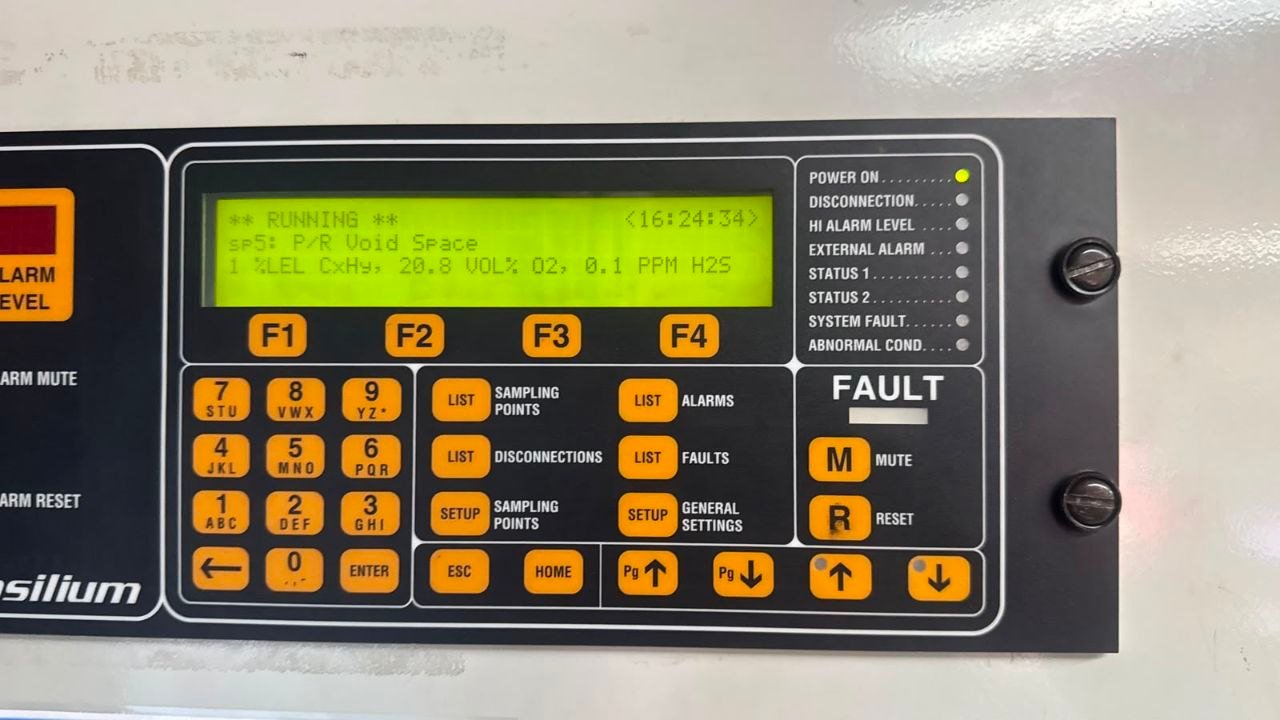
A bump test tells you the alarm goes off. It doesn't tell you the reading is right. A sensor can drift low, still trigger at a high concentration, and pass every morning check while under-reading the space your crew is about to enter.
Full calibration compares the reading with certified gas and corrects it. On fixed sampling systems, it also shows up faults the display never mentions, like the analyser pump leak we traced on a Consilium SW2020 system in Singapore.
Why Ship Managers Choose AES for Gas Detector Calibration
Engineers who board
Our engineers attend the vessel themselves, alongside and at anchorage, so your meters never leave the ship.
Certificates with real data
As-found and as-left readings, gas lot numbers and alarm checks, not a one-line "passed".
Certified management systems
ISO 9001:2015 and ISO 45001:2018 certified, bizSAFE Level 4 completed and bizSAFE Star status for safe work on board.
Gas and spares in stock
Span gas, regulators and replacement detectors supplied from Singapore, so a failed sensor doesn't hold you up.
One visit, more instruments
Combine it with ODME & OWS 15ppm, UTI meter, oil mist detector or machinery & cargo instrument calibration.
Regional fleets
We support owners and managers across Southeast Asia, the Middle East and South Asia when their vessels call Singapore.
Need other instruments covered? See our full range of marine calibration services in Singapore.
Gas Detector Calibration in Singapore: Common Questions
How much does gas detector calibration cost in Singapore?
The price depends on four things: how many detectors, how many sensors each one has (a 5-gas meter with CO₂ needs more gases than a single-gas monitor), any sensors or parts that need replacing, and where we attend (alongside, anchorage or our office). Calibrating several detectors in one visit costs less per unit than separate jobs. Send your instrument list through the contact form or WhatsApp and we'll give you a fixed price before we board.
Do gas detectors need calibration?
Yes. Every sensor drifts with age, heat, humidity and gas exposure, so a detector can under-read without any warning. Calibration compares each sensor with certified gas and corrects it. On ships, SOLAS requires suitable means of calibrating portable atmosphere testing instruments, and inspectors expect a current certificate.
Can crew calibrate gas detectors on board, or does it need a service provider?
Crew should bump test before use and can do routine checks with the right span gas, following the maker's manual. Full calibration with as-found and as-left records, sensor replacement and a certificate is normally done by a competent service provider. We do both: the calibration, and supplying gas and regulators so the crew's checks are done properly.
Can you calibrate gas detectors while the ship is at anchorage?
Yes. We attend vessels at Singapore anchorages as well as alongside at terminals and shipyards. Your agent usually arranges the launch boat; we'll coordinate timing with them.
How long does onboard calibration take?
A single portable multi-gas detector is quick once the gas is connected. Total time on board depends on how many portable meters and fixed detection points you have. Share your list and we'll give you a realistic time window for your port stay.
How often should marine gas detectors be calibrated?
Follow the manufacturer's instructions and your company's safety management system. IMO guidance points to the manufacturer's defined calibration requirements, and bump tests are done between calibrations. Our marine instrument calibration interval table sets out common intervals by instrument type.
Is a bump test the same as calibration?
No. A bump test confirms the sensors respond and the alarms work. Calibration measures the error against certified gas, corrects it and records the as-found and as-left values. Read the full comparison.
Do you calibrate CO₂ sensors for the new enclosed space entry recommendations?
Yes. We calibrate infrared CO₂ sensors on 5-gas and single-gas instruments, and can advise if your existing meters need a CO₂ channel added or a separate monitor.
Can you supply calibration gas for onboard bump testing?
Yes. We supply span gas cylinders, regulators and tubing in Singapore, matched to the sensors in your instruments.
Do you replace sensors and repair gas detectors?
Yes. We replace O₂, LEL, toxic and CO₂ sensors, service pumps and filters, and calibrate the detector before it goes back. If a unit isn't worth repairing, we can supply a replacement in Singapore.
Are your calibration certificates ISO 17025 accredited?
Our certificates are traceable calibration certificates issued under our ISO 9001:2015 quality system, using certified calibration gases with lot numbers and expiry dates recorded. If your company or charterer specifically needs an ISO/IEC 17025 accredited certificate, tell us when you book. Our article on ISO 17025 vs manufacturer calibration explains when each is accepted.
Do you calibrate gas detectors for shipyards and industrial sites?
Yes. Besides vessels, we calibrate portable and fixed gas detectors for shipyards, offshore and marine contractors and industrial sites in Singapore, on site or at our office.
Do you also calibrate fixed gas detection systems?
Yes. Pump room detectors, gas sampling cabinets and IG oxygen analysers are calibrated in place during the same attendance. More detail in our fixed gas detection calibration guide.
Get Your Gas Detectors Calibrated Before You Sail
Send your vessel details and instrument list. We'll confirm gases, timing and price, then attend alongside or at anchorage.
Email sales@alrightes.com · 3791 Jalan Bukit Merah #06-01, E-Centre @ Redhill, Singapore 159471