Cart (
Overview
Every vessel operating in international waters faces the same regulatory reality: bilge water containing oil above 15 parts per million cannot be discharged overboard. Under MARPOL Annex I and the requirements of MEPC.107(49), vessels must be equipped with an approved oil content monitor (OCM) that accurately detects oil concentration in bilge water before any overboard discharge — and that monitor must perform reliably across all the oil types encountered in a working engine room environment.
The practical difficulty lies in the range of contaminants. Bilge water on commercial vessels contains a mixture of heavy fuel oil (HFO), marine diesel, lubricating oil, and emulsified oil-water mixtures — often in combination. Many OCMs on the market are calibrated for a single oil type. A monitor calibrated for diesel may significantly under-read when HFO is present, creating a false compliance assurance that puts the vessel, the crew, and the operator at serious regulatory and environmental risk.
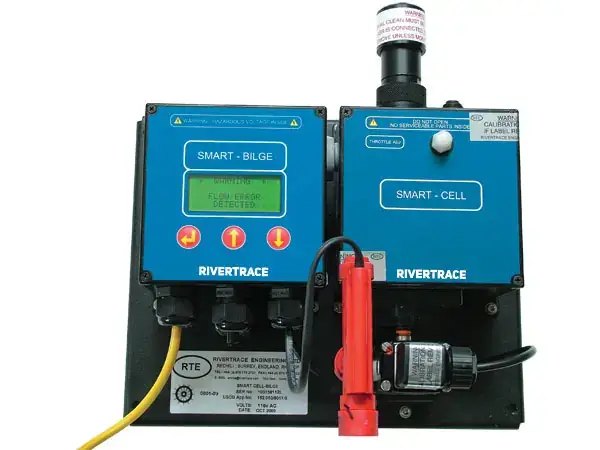
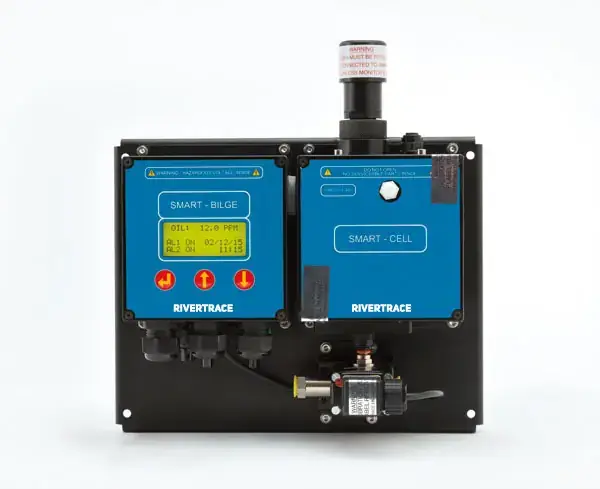
The Rivertrace SMART BILGE 15ppm Oil Content Monitor was developed in 2005 specifically to address this problem. Its proprietary Detector Array Technology — developed entirely in-house by Rivertrace — allows the system to simultaneously detect and measure all three IMO-defined oil types (HFO, Diesel, and Emulsions) without re-calibration between oil types. This is the defining technical differentiator that separates the SMART BILGE from single-type OCMs and why it has remained one of the most widely specified bilge alarm systems on commercial shipping for over two decades.
Key Features
Detector Array Technology — Simultaneous Multi-Oil Detection
The SMART BILGE uses Rivertrace’s proprietary Detector Array Technology housed within the SMART CELL measuring cell. Unlike conventional OCMs that rely on a single optical sensor calibrated to one oil type, the Detector Array reads all three IMO-defined oil categories — HFO, Diesel, and Mixture C (Emulsions) — simultaneously in a single measurement pass. In practice, this means the monitor responds accurately regardless of what combination of oil types is present in the bilge water at any given time. On vessels burning HFO in the main engine while using diesel in auxiliary generators, with lubricating oil residues also present, the SMART BILGE gives a single, accurate composite oil concentration reading without operator intervention or recalibration. The result is genuine MEPC.107(49) compliance across all realistic bilge water conditions.
No Re-Calibration Between Oil Types
One of the most time-consuming and error-prone aspects of OCM operation on vessels with mixed fuel and oil types is recalibrating the monitor when the oil composition of the bilge changes. The SMART BILGE eliminates this requirement entirely. Clean water calibration is held to +/- 2 ppm of factory-set values, and the Detector Array Technology handles all three oil types from a single calibrated baseline. For engineers and ETO teams managing a busy engine room, the removal of re-calibration from the OCM maintenance routine reduces the risk of calibration errors — and the compliance failures that follow from them — while also saving the time and consumables associated with manual recalibration procedures.
Dual Alarm Setpoints — User-Adjustable Thresholds
The SMART BILGE provides two independent oil alarm setpoints, both adjustable between 1 and 15 ppm by the vessel’s crew. Oil Alarm 1 can be configured with a delay of 0–5 seconds; Oil Alarm 2 with a delay of 0–600 seconds. The dual-alarm architecture allows operators to set a first-stage warning alarm at a lower threshold — giving advance notice that oil concentration is rising before the 15 ppm MARPOL limit is approached — and a second-stage alarm at or near the legal discharge limit. This staged alert structure is particularly valuable for vessels with high bilge water accumulation rates, where a single threshold alarm at 15 ppm may not give the engine room sufficient warning time to stop the overboard discharge pump before a limit exceedance occurs.
Solids Discrimination — Accurate Readings in Contaminated Bilge Water
Bilge water on working vessels is rarely clean. Metal particles, rust, soot, and other suspended solids are a constant presence — and on many optical OCM systems, solid contamination causes false high oil readings that trigger unnecessary alarms and overboard pump shutdowns. The SMART BILGE is specified to discriminate 100 ppm Iron Oxide in 10 ppm Diesel — meaning the system correctly reports 10 ppm oil even in the presence of high solid loading that would cause a false reading on a less discriminating instrument. For vessels with older machinery, high engine room activity, or significant rust contamination in bilge spaces, solids discrimination directly reduces nuisance alarms and the operational disruption they cause.
Fast Response Time — Under 5 Seconds
The SMART BILGE achieves an oil reading response time of under 5 seconds. For a bilge monitoring system, response time is directly linked to the volume of non-compliant bilge water that may be discharged between the point where oil concentration exceeds the alarm threshold and the point where the alarm activates and the overboard pump is stopped. At typical bilge pump flow rates, a 5-second response time represents a small and bounded volume of water — an important consideration for demonstrating due diligence under port state control inspection and for maintaining the integrity of the vessel’s Oil Record Book entries.
IMO-Required Data Logging and Retrieval
MARPOL requires oil content monitors to record and retain operational data as evidence of compliance. The SMART BILGE stores IMO-required data in the Control enclosure with multiple retrieval options: via the LCD display for local access, via RS 232 communications link for connection to vessel management systems, and via USB for direct data export. Calibration data is stored within the SMART CELL itself. For port state control inspections and Oil Record Book verification, the availability of retrievable onboard data records supports the vessel’s compliance documentation without dependence on external systems or cloud connectivity — a practical advantage in regions where shore-based connectivity for data retrieval cannot be assumed.
IP 65 Protection — Engine Room and Machinery Space Rated
The SMART BILGE carries an IP 65 protection rating — fully protected against dust ingress and against water jets from any direction. In the bilge monitoring context, IP 65 means the system is rated for the wet, humid, and wash-down exposed environment of the engine room and bilge spaces where it is installed and expected to operate continuously over a projected service life exceeding 50,000 hours. At a typical operational profile, that equates to well over five years of continuous operation before the projected end of component life — a design life that supports the capital investment justification for a Class-approved OCM.
Technical Specifications
Oil Types Detected: HFO, Diesel, and Mixture C / Emulsions (IMO-defined)
Oil Measurement Range: 0 – 40 ppm
Accuracy (Oil + Solids): +/- 5 ppm up to 30 ppm
Clean Water Calibration: +/- 2 ppm of factory set values
Response Time: < 5 seconds (oil reading)
Solids Discrimination: 100 ppm Iron Oxide in 10 ppm Diesel
Oil Alarm 1 Setpoint: 1 – 15 ppm (user adjustable)
Oil Alarm 1 Delay: 0 – 5 seconds (user adjustable)
Oil Alarm 2 Setpoint: 1 – 15 ppm (user adjustable)
Oil Alarm 2 Delay: 0 – 600 seconds (user adjustable)
Analogue Output: Active 4-20 mA / 0–20 mA
Switch Inputs: 2 × switch inputs (separator and backflush status)
Data Storage — Calibration: Stored in SMART CELL
IMO Data Storage: Stored in Control enclosure
Data Retrieval: LCD display, RS 232 comms link, USB
Supply Voltage: 115 or 230V AC, 50–60 Hz
Power Consumption: < 50 VA (including solenoid valve)
Supply Voltage Tolerance: +/- 15%
Projected Service Life: > 50,000 hours
Protection Class: IP 65
Weight: 3.2 kg / 7.05 lb
Approvals: MEPC.107(49) — DNV-GL, USCG, CCS, Russian Register, Transport Canada
Benefits
For a ship operator, the fundamental value of the SMART BILGE is straightforward: it removes the uncertainty from overboard bilge water discharge compliance. In ports where MARPOL enforcement is active and port state control inspections scrutinise Oil Record Book entries and OCM performance records, operating a multi-oil-type certified monitor with retrievable data logs is a concrete risk management measure. A port detention for a MARPOL violation carries direct costs — port dues, legal fees, crew time — and reputational consequences that can affect charter relationships and flag state standing for years. The SMART BILGE is a documented, Class-approved compliance tool that holds its value precisely because its operational record is verifiable.
For the chief engineer and engine room team responsible for daily operation, the practical difference is in reduced nuisance alarms and simplified maintenance. The solids discrimination capability means the system does not raise false alarms during periods of high suspended solids in the bilge — a common occurrence after machinery maintenance, cleaning operations, or periods of heavy weather. Fewer false alarms means fewer unnecessary interruptions to bilge water management operations and lower wear on the overboard pump isolation system. The absence of a re-calibration requirement eliminates a routine task that, on many vessels, is performed inconsistently or deferred — replacing an ongoing maintenance obligation with a system that simply functions correctly from a fixed calibrated baseline.
For fleet managers and technical superintendents managing multiple vessels, the SMART BILGE’s combination of established Class approvals across five major flag state and classification society authorities — DNV-GL, USCG, CCS, Russian Register, and Transport Canada — means it is acceptable for vessels operating under a wide range of flags and calling at ports subject to different port state control regimes. A single OCM model that satisfies the approval requirements across this range of jurisdictions simplifies fleet standardisation, spare parts inventory management, and crew familiarity across vessels.
Who It’s For
Chief Engineers on Deep-Sea Commercial Vessels
A chief engineer on a bulk carrier or tanker burning HFO in the main engine and marine diesel in auxiliaries knows that the bilge space contains a mixture of both fuel types at any given time. When the bilge alarm triggers at 0300 on approach to a port with active MARPOL enforcement, there is no time to recalibrate an OCM or question whether the reading is accurate for the oil type currently present. The SMART BILGE gives a correct reading across all oil types present, with a retrievable data log that supports the Oil Record Book entry — so the chief engineer can manage the bilge situation with confidence in both the reading and the compliance record.
Fleet Technical Superintendents and Ship Managers
A technical superintendent responsible for MARPOL compliance across a mixed fleet — vessels under different flags, calling at ports in different PSC regimes — needs OCM equipment that satisfies Class requirements across the jurisdictions where their vessels operate. Specifying the SMART BILGE for new installations or OCM replacements across the fleet gives a consistent, multi-approval platform supported by a 20-year operational track record in commercial shipping. When a Class surveyor or PSC inspector asks for the approval documentation for the vessel’s OCM, the SMART BILGE’s MEPC.107(49) type approval with five classification society endorsements is a straightforward and complete answer.
Newbuilding and Retrofit Project Teams
A naval architect or outfitting project manager specifying the bilge alarm system for a newbuilding or vessel conversion needs an OCM that satisfies the flag state’s MARPOL equipment requirements, integrates with the vessel’s existing analogue I/O infrastructure, and has a reliable supply chain for spares and service support. The SMART BILGE’s 4-20 mA analogue output, dual switch inputs for separator and backflush status integration, and 115/230V AC dual-voltage supply make it a practical fit for a wide range of vessel electrical configurations — while its approval status under five recognised organisations covers the flag state requirements for the majority of commercial vessels in the global fleet.
Possible Applications
Bulk Carriers and General Cargo Vessels — Continuous monitoring of bilge water accumulation in main engine rooms where HFO and diesel are both present; integration with automated bilge pump control systems to prevent non-compliant discharge on vessels without continuous engineering watch.
Tankers and Chemical Carriers — MARPOL-compliant overboard discharge monitoring on vessels operating under strict port state control scrutiny in US, European, and Pacific ports; support for Oil Record Book Part I compliance documentation under USCG and Paris MOU PSC inspection protocols.
Offshore Support Vessels and Platform Supply Vessels — Bilge monitoring on vessels operating in environmentally sensitive offshore locations, including North Sea and Gulf of Mexico fields where zero discharge policies and frequent Class surveys demand certified and retrievable OCM performance records.
RoRo Vessels and Car Carriers — Monitoring of bilge water from vehicle deck drains where contamination from vehicle fluids and fuel spillage creates complex multi-type oil contamination profiles requiring simultaneous multi-oil detection capability.
Passenger Vessels and Cruise Ships — OCM installation in engine rooms subject to frequent and rigorous MARPOL compliance inspections by multiple port state control authorities, where documented Type Approval and retrievable operational data logging are mandatory inspection requirements.
Navy and Government Vessels — Bilge alarm systems on government-operated vessels requiring multi-flag-state approval documentation, specifically vessels operating under US (USCG), Russian Register, Canadian (Transport Canada), and Chinese (CCS) authority requirements.
Vessel Newbuildings — Shipyard Outfitting — Series OCM installation during newbuilding construction for bulk carrier, tanker, and offshore vessel series where a single MEPC.107(49)-approved OCM model with multi-authority Class approval simplifies the outfitting specification and Class plan approval process.
Trust & Certifications
MEPC.107(49) Type Approval — IMO Mandatory Equipment Certification
MEPC.107(49) is the IMO resolution that defines the revised performance standard for oil content meters used in the MARPOL bilge alarm system. Type Approval under MEPC.107(49) is mandatory for any OCM installed on a commercial vessel subject to MARPOL Annex I requirements — it is the base certification without which an OCM cannot be accepted by a flag state administration or classification society as a compliant bilge monitoring system. The SMART BILGE holds MEPC.107(49) Type Approval, providing the foundational certification that confirms the system has been independently tested and verified to meet the IMO performance standard for 15 ppm oil detection, alarm function, data recording, and all other mandatory requirements of the regulation.
DNV-GL — Major Classification Society Approval
DNV-GL (now DNV) is one of the world’s leading maritime classification societies, classing a significant portion of the global commercial fleet. DNV Class approval for the SMART BILGE confirms that the system meets DNV’s own review requirements for MARPOL OCM equipment — relevant for all vessels operating under DNV class notation, and widely recognised as an additional mark of technical credibility across the broader maritime market.
USCG — United States Coast Guard Approval
USCG approval is mandatory for any vessel entering US waters that requires a MARPOL-compliant bilge alarm system. The United States Coast Guard has historically conducted some of the most rigorous MARPOL enforcement in the world — USCG port state control inspections and the USCG’s own Type Approval testing requirements for OCM equipment represent a high bar for compliance. USCG-approved status for the SMART BILGE confirms that the system meets US federal requirements for overboard discharge monitoring on vessels calling at US ports.
CCS, Russian Register, and Transport Canada
China Classification Society (CCS) approval covers the large and growing fleet of vessels operating under CCS class, including vessels calling at Chinese ports where CCS inspection is routine. Russian Register approval supports vessels operating under Russian flag or frequently calling at Russian ports, where Russian Register Class requirements apply. Transport Canada approval is required for vessels operating in Canadian waters. Together with DNV-GL and USCG, these five approvals give the SMART BILGE one of the broadest multi-authority approval portfolios in the OCM market — allowing operators to deploy a single OCM model across a geographically and flag-state-diverse fleet without encountering authority acceptance issues.
Rivertrace — Established OCM Manufacturer with 20-Year Track Record
Rivertrace is a UK-based manufacturer specialising in oil-in-water detection and bilge monitoring equipment for the maritime industry. The SMART BILGE was introduced in 2005 and has been in continuous commercial production and operational deployment on vessels worldwide for over 20 years — an operational track record that provides practical evidence of field reliability that newer OCM designs cannot yet match. Rivertrace’s proprietary Detector Array Technology is the company’s own intellectual property, developed and refined specifically for the multi-oil maritime bilge monitoring application, rather than an adaptation of optical detection technology designed for other industries.
Accessories & Variants
SMART CELL Replacement Measuring Cell
The SMART CELL is the measuring component of the SMART BILGE system, containing the Detector Array Technology. Rivertrace’s design separates the measuring cell from the control enclosure, allowing the SMART CELL to be replaced as a service item without disturbing the installed control enclosure wiring and integration. For vessels where periodic cell replacement is part of the planned maintenance schedule, replaceable SMART CELLs reduce the cost and downtime of major overhaul by confining the maintenance action to the measurement cell rather than requiring full system replacement.
Solenoid Valve
The SMART BILGE integrates with the vessel’s overboard discharge solenoid valve — included in the system’s power consumption specification at < 50 VA. The solenoid valve provides the automatic overboard pump isolation function on alarm activation, the core operational safety mechanism of the MARPOL bilge alarm system.
RS 232 Communications Interface
The RS 232 communications link enables connection of the SMART BILGE to vessel management systems, alarm monitoring panels, and shore-based monitoring platforms. For vessels with integrated vessel management systems (VMS) or engine room monitoring systems (ERMS), RS 232 connectivity allows OCM data to be captured within the vessel’s central data environment rather than requiring separate manual retrieval.
USB Data Retrieval
Direct USB data retrieval from the SMART BILGE control enclosure provides an alternative data access method for vessels without RS 232 system integration — enabling a chief engineer or superintendent to extract IMO-required operational records to a USB storage device for transfer to shore management systems, Flag State submissions, or PSC inspection documentation without requiring vessel management system connectivity.
Get in Touch
If you are specifying, replacing, or procuring a MARPOL-compliant 15ppm bilge alarm for a commercial vessel — whether for a newbuilding outfitting project, a Class-required replacement, or a fleet standardisation programme — contact us to discuss your vessel’s specific requirements and receive a formal quotation for the Rivertrace SMART BILGE 15ppm Oil Content Monitor.
Our team can advise on system configuration for your vessel type, confirm Class approval requirements for your flag state, and support supply and delivery timelines for planned dry-dock and port call installations.