Cart (
Overview
There is a compliance requirement embedded in MEPC.107(49) that many vessel operators are aware of in principle but find difficult to enforce in practice: the 15ppm bilge alarm must be provided with a representative sample of the separator discharge water. Specifically, the instrument operator is responsible for maintaining a proper sample flow through the measuring cell at all times during OWS operation. The IMO standard specifies this because an inadequate sample flow — too slow, intermittent, or absent entirely — means the bilge alarm is not actually measuring the water being discharged. It is measuring whatever stagnant water remains in the measuring cell from the last time the sample line was flowing. A non-representative sample is not a minor calibration issue; it is a fundamental breakdown of the measurement function that the entire MARPOL compliance process depends on.
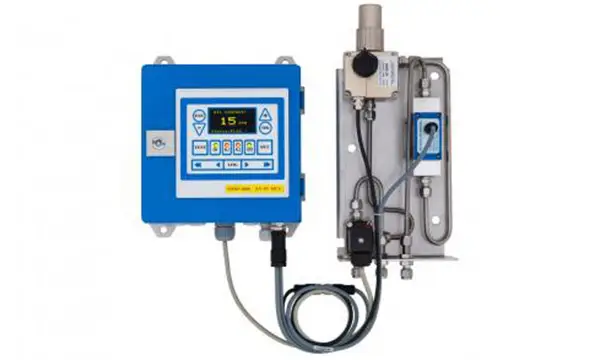
The Deckma Hamburg OMD-2008 EV FC MCU with Flow Control addresses this compliance gap directly. It is the flow-control variant of the OMD-2008 Series bilge alarm — the same proven MEPC.107(49)-exceeding instrument platform, extended with an integrated Flow Sensor positioned in the drain line of the measuring cell. The Flow Sensor continuously monitors the actual sample flow rate through the measuring cell. If flow drops below the acceptable threshold — or stops entirely — the instrument automatically enters alarm condition and displays a “Status: Flow?” message, alerting the duty engineer that the sample line condition is not sufficient for representative measurement. The bilge alarm does not continue to display ppm readings and operate apparently normally while the sample is inadequate; it actively flags the problem.
The differentiating characteristic of the OMD-2008 EV FC MCU against both the standard OMD-2008 and competing bilge alarm units without flow monitoring is precisely this: it closes the sample flow compliance gap that MEPC.107(49) establishes but that instruments without flow sensing cannot enforce. For vessels where sample line fouling, blockage, valve misoperation, or pressure variation could cause the sample flow to fall below the representative threshold without immediate detection, the OMD-2008 EV FC MCU transforms a potential silent compliance failure into an active, visible alarm condition.
Key Features
Integrated Flow Sensor in Measuring Cell Drain Line
The OMD-2008 EV FC MCU is equipped with a Flow Sensor positioned in the drain line of the measuring cell — monitoring the actual volumetric flow rate of the water sample passing through the measurement zone. The recommended sample flow rate for Deckma instruments is approximately 2 litres per minute, at which the measuring cell operates with the short reaction time to changes in oil content that MEPC.107(49) requires. The Flow Sensor verifies that this flow condition is being maintained continuously during OWS operation, rather than relying on the operator’s assumption that the sample line is flowing correctly. The flow monitoring function operates independently of the ppm measurement channels, providing a dedicated integrity check on the sample delivery system.
“Status: Flow?” Alarm — Active Sample Flow Failure Indication
When the Flow Sensor detects that the sample flow rate through the measuring cell is insufficient — whether due to a blocked sample line, a partially closed valve, inadequate sample water pressure, or complete sample flow failure — the OMD-2008 EV FC MCU enters alarm condition and displays a “Status: Flow?” message at the front panel. This active indication distinguishes a flow fault condition from normal operation and from a ppm alarm condition, allowing the duty engineer to identify immediately that the issue is with the sample delivery system rather than with the oil content of the water being discharged. The instrument does not continue to display ppm readings under a flow fault condition as though measurement is proceeding normally.
MEPC.107(49) Sample Flow Compliance Enforcement
MEPC.107(49) places the responsibility for maintaining a representative sample flow on the instrument operator — but without a flow sensor, the instrument has no means to verify that this obligation is being met. The OMD-2008 EV FC MCU builds compliance with this requirement into the instrument itself: the flow monitoring function provides the continuous verification that MEPC.107(49) implicitly requires but that instruments without flow sensing leave to manual management. For vessels where PSC inspectors or class surveyors examine sample flow management as part of bilge alarm compliance verification, the OMD-2008 EV FC MCU’s active flow monitoring provides documented evidence that sample flow adequacy is being verified instrumentally rather than assumed.
5 ppm + 15 ppm Dual-Threshold Alarm Architecture
The OMD-2008 EV FC MCU retains the full dual-alarm architecture of the OMD-2008 Series — Alarm 1 as a 5 ppm early-warning annunciation and Alarm 2 as the 15 ppm control threshold for overboard shut-off. Both alarm set points are independently adjustable between 1 and 15 ppm via the front panel, with Alarm 1 carrying an operating delay adjustable between 1 and 540 seconds and Alarm 2 carrying a delay adjustable between 1 and 10 seconds. The graduated response from early warning to control action operates alongside the flow monitoring function, providing comprehensive bilge alarm coverage across both the oil content measurement dimension and the sample delivery integrity dimension simultaneously.
Compact EV FC MCU Measuring Cell Unit — Separate from Computer Unit
The OMD-2008 EV FC MCU has a two-unit physical configuration: the Computer Unit (200 mm W × 200 mm H × 100 mm D) and the EV-FC-MCU + Measuring Cell assembly (150 mm W × 290 mm H × 140 mm D). The two units are connected by cable, allowing the computer unit to be mounted at a convenient operator access location while the measuring cell assembly is positioned at the sample takeoff point from the OWS discharge line. This separated configuration is well suited to engine room installations where the OWS and the operator panel are not in direct proximity — allowing instrument placement decisions to be made on the basis of both access convenience and sample line hydraulics rather than requiring both functions to be co-located.
Variable Sample Flow Range — 0.6 to 3 l/min
The OMD-2008 EV FC MCU operates across a sample flow range of approximately 0.6 to 3 litres per minute, depending on sample water pressure, with a separate clean water pressure specification of 0–6 bar and a sample water pressure range of 0.1–6 bar. This wider flow acceptance range — compared with the single-flow-rate specification of standard OMD units — reflects the flow control function of the MCU assembly, which manages the sample flow rate to the measuring cell within the acceptable operating range across the variation in OWS discharge pressure that occurs in practical operation. For vessels where OWS operating pressure is variable, the flow control function maintains measuring cell flow within specification without requiring manual adjustment each time OWS operating conditions change.
6 mm Tube OD Fittings — Compact Sample Line Connection
The OMD-2008 EV FC MCU uses tube fittings for 6 mm OD tube connections — a compact instrumentation tube standard suited to the small-bore sample lines typical of bilge alarm installations. The 6 mm tube OD fitting standard is widely compatible with instrumentation tubing available through marine supply channels, and the compact tube connections support neat, professional sample line installations in the constrained space of a typical engine room bilge alarm installation area.
IP65 Protection and Wide Voltage Acceptance
Both the Computer Unit and the EV-FC-MCU measuring cell assembly carry IP65 degree of protection — complete dust exclusion and resistance to water jets from any direction. The power supply accepts 24 V to 240 V AC or DC with automatic voltage selection, drawing less than 10 VA. These characteristics match the standard OMD-2008 platform and provide the same environmental protection and supply compatibility across the EV FC MCU variant as across the rest of the OMD-2008 series.
Technical Specifications
Model: OMD-2008 EV FC MCU
Manufacturer: Deckma Hamburg GmbH, Germany
Function: 5 ppm + 15 ppm bilge alarm with integrated flow control and flow sensor
Compliance Standard: IMO Resolution MEPC.107(49) — exceeds requirements
Measurement Range: 0–30 ppm; trend indication to 50 ppm
Accuracy / Linearity: Per MEPC.107(49); better than ±2% up to 30 ppm
Display: Yellow graphic display
Power Supply: 24 V–240 V AC or DC — automatic voltage selection
Consumption: <10 VA
Alarm Points: 2 × adjustable 1–15 ppm (works adjustment: 15 ppm; operational config: 5 ppm + 15 ppm)
Alarm 1 Delay: 1–540 seconds adjustable (works adjustment: 2 sec) — annunciation
Alarm 2 Delay: 1–10 seconds adjustable (works adjustment: 10 sec) — control
Flow Alarm: “Status: Flow?” — activated when sample flow is insufficient or absent
Alarm Indication: Red LEDs — Alarm 1, Alarm 2, System Fault
Alarm Contact Rating: Potential-free 1-pole changeover, 3A / 240V
Output Signal: 0–20 mA or 4–20 mA selectable, active; ext. load <150 Ω
Clean Water Pressure: 0–6 bar
Sample Water Pressure: 0.1–6 bar
Sample Flow: Approx. 0.6–3 l/min (dependent on pressure)
Sample Water Temperature: 1 to +65°C
Ambient Temperature: 1 to +55°C
Roll: Up to 45°
IP Rating: IP65
Weight: 5.9 kg
Dimensions — Computer Unit: 200 mm W × 200 mm H × 100 mm D
Dimensions — EV-FC-MCU + Measuring Cell: 150 mm W × 290 mm H × 140 mm D
Pipe Connections: Tube fittings for 6 mm tube OD
Benefits
The most direct benefit of the OMD-2008 EV FC MCU is the compliance assurance it provides against a failure mode that standard bilge alarms cannot detect: inadequate sample flow. In practical shipboard operation, sample line fouling is a recurring maintenance issue — scale, biological growth, sediment, and oil residue accumulate in sample lines and reduce flow over time, often without any immediate visible indication at the instrument. On a vessel with a standard bilge alarm, degraded sample flow means the instrument is measuring a stagnant or slowly refreshing cell sample while displaying ppm readings that appear normal. On a vessel with the OMD-2008 EV FC MCU, the Flow Sensor detects this condition and raises the “Status: Flow?” alarm before the measurement function is compromised without detection.
For PSC compliance purposes, the flow monitoring function provides a documented basis for demonstrating that sample flow adequacy is being actively verified rather than assumed. PSC inspectors in major inspection regimes are aware of the MEPC.107(49) representative sample requirement and may ask how the vessel demonstrates sample flow adequacy during OWS operations. The OMD-2008 EV FC MCU’s active flow monitoring provides a clear, instrumentally verified answer to this question — one that instruments without flow sensing cannot provide.
The variable flow acceptance range of 0.6 to 3 l/min, combined with the flow control function of the MCU assembly, reduces the manual management burden associated with sample line flow optimisation. On vessels where OWS operating pressure varies with bilge water level, temperature, or pump condition, the flow control function maintains the measuring cell sample flow within the acceptable range automatically — reducing the frequency of “Status: Flow?” alarms caused by normal OWS pressure variation rather than by sample line fouling or blockage.
The two-unit physical configuration provides installation flexibility that single-unit bilge alarms cannot offer. The ability to separate the computer panel from the measuring cell assembly by a distance appropriate to the engine room layout means that both operator access and sample line hydraulics can be optimised in the installation design — a practical advantage that reduces both installation time and the compromises that a single-unit design forces on engine room installation planners.
Who It’s For
Chief Engineers on Vessels with Known Sample Line Management Challenges
A chief engineer on a vessel where sample line fouling is a recurring maintenance issue — where the bilge alarm sample line requires periodic clearing, where scale or sediment buildup is a known problem, or where the OWS sample takeoff pressure is variable and difficult to regulate consistently — will immediately recognise the operational value of the OMD-2008 EV FC MCU’s flow monitoring function. Rather than managing sample line condition as a background maintenance task that may or may not be current when the bilge alarm is most needed, the Flow Sensor provides continuous, active verification that the sample line is delivering a representative flow. Sample line issues are surfaced as alarm conditions rather than discovered during post-hoc review.
Technical Superintendents Specifying High-Compliance OWS Systems
A technical superintendent specifying a bilge management system for vessels trading on routes with intensive PSC inspection exposure — particularly vessels with a PSC deficiency history related to MARPOL compliance equipment — may specify the OMD-2008 EV FC MCU as the bilge alarm component precisely because its flow monitoring function closes a compliance gap that standard bilge alarms leave open. For a superintendent building a bilge management system designed to withstand detailed PSC scrutiny, the active sample flow verification of the EV FC MCU variant provides a compliance margin that the standard OMD-2008 does not offer.
Classification Society Surveyors and MARPOL Compliance Auditors
For class society surveyors and MARPOL compliance auditors assessing bilge alarm system adequacy on vessels under survey, the OMD-2008 EV FC MCU presents a bilge alarm installation with verifiable sample flow monitoring — an instrument that actively enforces the MEPC.107(49) representative sample requirement rather than relying on operator self-reporting of sample line condition. For surveyors evaluating whether the vessel’s bilge alarm system provides the measurement integrity that MARPOL compliance requires, the flow monitoring function represents a demonstrable enhancement over standard bilge alarm configurations.
Possible Applications
Vessels with Long Sample Line Runs — Remote OWS Installations
On vessels where the oily water separator is located at a significant distance from the bilge alarm instrument panel — requiring a longer sample line run — the risk of sample line flow reduction due to line resistance, partial blockages, or pressure loss is higher than on installations with short sample runs. The OMD-2008 EV FC MCU’s flow monitoring function is particularly valuable in these installations, providing continuous verification that the extended sample line is delivering adequate flow to the measuring cell despite the additional hydraulic resistance of the longer run.
Older Vessels with Established Scale and Fouling in Bilge Systems
On vessels with extensive service histories, bilge system pipework, valves, and sample lines accumulate scale, corrosion products, and biological fouling that progressively restrict flow over time. The OMD-2008 EV FC MCU’s flow monitoring detects the gradual flow reduction that this fouling produces — alerting the engineering team to the need for sample line maintenance before the flow falls to a level where measurement representativeness is compromised, rather than after.
Tankers Under Vetting and PSC Scrutiny — Highest Compliance Standards
Tanker operators subject to SIRE and CDI vetting inspections — where bilge alarm compliance is reviewed in detail — have the strongest commercial motivation to specify bilge alarm equipment that provides verifiable compliance across all dimensions of MEPC.107(49), including the representative sample requirement. The OMD-2008 EV FC MCU’s active flow monitoring provides the vetting inspector with instrumental evidence of sample flow adequacy that a standard bilge alarm cannot produce.
Vessels Trading in Special Areas — Zero-Tolerance Discharge Environments
MARPOL special areas — the Baltic Sea, the North Sea, the Mediterranean, the Red Sea, and others — impose stricter discharge restrictions than the open sea standard. Vessels transiting or trading within special areas where any overboard discharge is prohibited must maintain the bilge alarm in a state of operational readiness with verified sample flow even when no OWS discharge is occurring. The OMD-2008 EV FC MCU’s flow monitoring supports this operational requirement by providing continuous sample flow verification regardless of OWS operating status.
Offshore Support Vessels with Stringent Field Operator Requirements
OSVs operating in support of offshore oil and gas production are frequently subject to field operator environmental compliance requirements that exceed the MARPOL standard. Field operators may specifically require evidence of instrument-level sample flow monitoring as part of their MARPOL compliance verification requirements for support vessels operating within their field area. The OMD-2008 EV FC MCU’s flow monitoring function directly addresses this requirement.
Vessels Undergoing Class Survey with MARPOL Compliance Focus
Class society surveys with a detailed MARPOL compliance component — particularly enhanced surveys following a PSC deficiency history — may include examination of the bilge alarm’s sample flow management provisions. The OMD-2008 EV FC MCU’s flow monitoring function provides a demonstrable response to class surveyor concerns about sample flow adequacy, supporting a positive survey outcome for vessels where this aspect of bilge alarm compliance has previously attracted surveyor attention.
Newbuild Specifications — Best-Practice Bilge Alarm Design
Vessel owners specifying bilge alarm equipment for newbuild construction may elect the OMD-2008 EV FC MCU variant as the preferred configuration where the additional compliance margin of integrated flow monitoring is considered part of the vessel’s standard equipment specification. Specifying flow-monitored bilge alarm equipment from delivery avoids the need for retrospective upgrades if sample flow compliance verification becomes a flag state or class society requirement in future survey cycles.
Trust & Certifications
IMO Resolution MEPC.107(49) — Representative Sample Requirement Enforcement
MEPC.107(49) requires that the 15ppm bilge alarm be provided with a representative sample, and places the obligation for maintaining adequate sample flow on the instrument operator. The OMD-2008 EV FC MCU enforces this requirement instrumentally through the Flow Sensor and “Status: Flow?” alarm — transforming a procedural obligation into an active monitoring function. The instrument’s overall performance specification meets and exceeds MEPC.107(49) requirements across all measurement accuracy, response time, and alarm performance parameters, with the flow monitoring function representing a compliance enhancement beyond the minimum standard.
Deckma Hamburg GmbH — OMD Series Engineering Heritage
The OMD-2008 EV FC MCU is a variant within the OMD-2008 Series, which is the current production generation of Deckma Hamburg GmbH’s OMD bilge alarm product line. Deckma Hamburg’s specialisation in marine oil content monitoring and the OMD series’ established track record across the international commercial fleet underpin the manufacturer credibility and documentation availability that procurement teams and compliance officers require. The EV FC MCU variant extends the OMD-2008 platform with flow monitoring capability developed from Deckma Hamburg’s operational experience with bilge alarm installations across diverse vessel types and OWS configurations.
IP65 — IEC 60529 Both Units
Both the Computer Unit and the EV-FC-MCU + Measuring Cell assembly carry IP65 protection under IEC 60529. The two-unit configuration maintains IP65 across both physical components, ensuring that the environmental protection level is consistent regardless of where each unit is mounted in the engine room — including the measuring cell assembly, which is positioned close to the OWS sample line and therefore exposed to the most demanding part of the engine room environment.
Classification Society Survey Compatibility
The OMD-2008 EV FC MCU’s MEPC.107(49) type approval credentials and Deckma Hamburg manufacturer documentation support class survey approval for installations, replacements, and newbuild specifications with the major classification societies. The flow monitoring function, as an enhancement beyond the MEPC.107(49) minimum, does not create additional type approval complexity — it is part of the OMD-2008 EV FC MCU’s instrument specification within the existing type approval framework.
Accessories & Variants
OMD-2008 Series — Standard Configuration (Without Flow Control)
The standard OMD-2008 Series provides the same 5 ppm + 15 ppm dual-alarm architecture, MEPC.107(49)-exceeding performance, and IP65 enclosure as the EV FC MCU variant, without the integrated Flow Sensor and flow control function. The standard OMD-2008 is the appropriate choice for installations where sample line management is straightforward and active flow monitoring is not required. Contact us to discuss whether the standard or EV FC MCU variant is more appropriate for your vessel’s OWS and sample line configuration.
Related Deckma Hamburg Bilge Alarm Models
Deckma OMD-24 Series — Shares the 5 ppm + 15 ppm dual-threshold configuration with OWS separator status input for data logging synchronisation. Contact us to compare the OMD-24 and OMD-2008 EV FC MCU for installations where both OWS status integration and flow monitoring are under consideration.
Deckma OMD-32 Series — Dual-alarm bilge alarm in the OMD series without the flow control option. Suited to installations where the flow monitoring function of the EV FC MCU is not required.
Deckma OMD-2005 — Compact single-enclosure bilge alarm for applications where the two-unit configuration and flow control capability of the EV FC MCU are not required. Contact us for a full OMD model comparison matched to your installation requirements.
External Chart Recorder / Monitoring System Interface
The OMD-2008 EV FC MCU’s 4–20 mA analogue output supports connection to an external chart recorder or vessel monitoring system for continuous ppm recording. The flow alarm relay contact can additionally be wired to the vessel’s alarm management system to ensure that “Status: Flow?” conditions are annunciated at the ship’s central alarm panel as well as at the instrument front panel — providing bridge-level visibility of sample flow failures during OWS operations.
Get in Touch
If you are specifying a bilge alarm for a vessel where sample line flow management is a known operational challenge — or where you need to demonstrate MEPC.107(49) representative sample compliance to PSC inspectors, class surveyors, or vetting inspectors — contact us to discuss the OMD-2008 EV FC MCU and confirm whether the flow control variant is the right specification for your installation.
Our team can assist with model selection across the full OMD-2008 Series range, MEPC.107(49) type approval documentation, installation guidance for two-unit configurations, and supply timelines for Singapore delivery or regional port supply.
📍 3791 Jalan Bukit Merah #06-01, E-Centre @ Redhill, Singapore 159471