Cart (
Overview
On a commercial vessel, the bilge alarm is one of those systems that has to work without requiring the crew to actively manage it through each watch. The practical reality is that engine room teams are already managing machinery, maintaining logs, handling cargo operations, and responding to routine alarms — a bilge monitoring system that demands regular manual intervention for washing, resetting, or fault checking adds a maintenance burden to an already full workload. When that burden gets deprioritised, the result is either a poorly maintained OCM that produces unreliable readings, or a deferred maintenance log that draws attention during a port state control inspection.
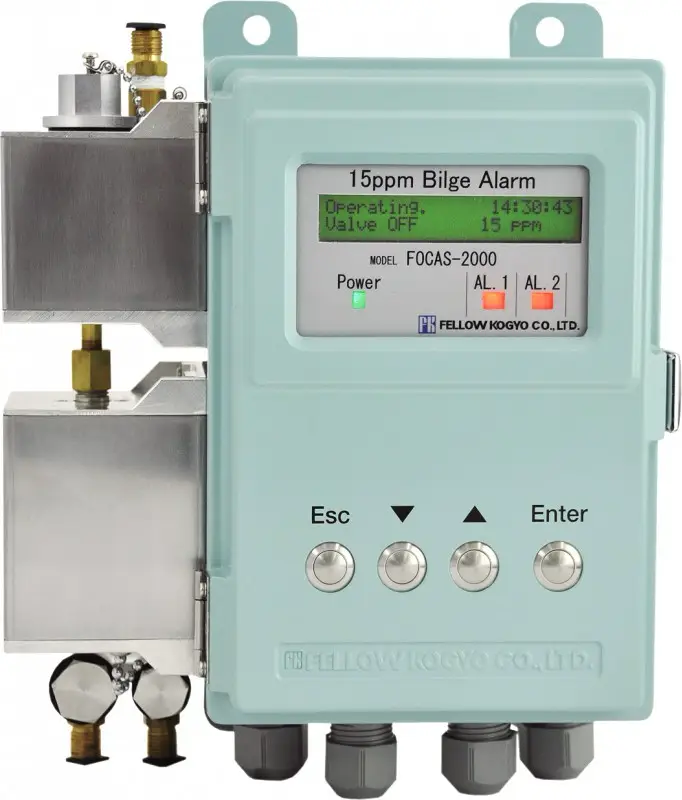
The Fellow Kogyo FOCAS-2000 15ppm Bilge Alarm is designed around a clear operational principle: the system should manage itself as much as possible, so the crew does not have to. Its pressure-activated automatic operation method synchronises the OCM directly with the bilge separator or pump — when sample water pressure is present, the system activates automatically; when it is not, the system stands by. Its automatic washing function cleans the detection unit without requiring manual intervention. Its memory card data logging captures operational records including trouble alarms for review at any time. And its double safety alarm method ensures that alarm activation occurs not only when oil concentration reaches 15ppm, but also when the sample water or the instrument itself is in a fault condition — closing the gap that exists in simpler alarm-only systems where an instrument fault can pass undetected until the next inspection.
Manufactured by Fellow Kogyo Co., Ltd. — the same Japanese marine instrument specialist behind the FOCAS-1500c — the FOCAS-2000 takes the FOCAS series into a higher tier of automation and self-diagnostics. It is the practical choice for operators who need a bilge alarm that performs reliably with minimal crew involvement and produces a clear, retrievable operational record for compliance documentation.
Key Features
Pressure-Activated Automatic Operation — Synchronised with Separator or Pump
The FOCAS-2000 uses sample water pressure as its trigger for automatic operation. When the bilge separator or bilge pump starts and sample water pressure is present at the OCM inlet, the system activates and begins measuring automatically. When pressure is absent — indicating that the separator or pump is not running — the system stands by without requiring any manual start or stop command from the crew. This pressure-based synchronisation means the OCM is always in the correct operational state relative to the bilge pump: measuring when discharge is possible, standing by when it is not. For engine room crews managing multiple systems during a watch, the removal of manual OCM start/stop from the bilge management procedure eliminates a step that is easy to miss under pressure.
Automatic Washing of Detection Unit — Reduced Manual Maintenance
The optical detection unit in the FOCAS-2000 is washed automatically using clean water, without requiring manual intervention from the crew. Oil residues and suspended solids accumulate on optical measurement surfaces over time, degrading reading accuracy and eventually causing staining that affects measurement performance. Automatic washing maintains the optical path in a clean condition between measurements, extending the service interval between manual cleaning actions and keeping the measurement accuracy within specification. The system includes a stain indication function that alerts the operator when the detection unit staining level has reached a point requiring attention — separating genuine maintenance requirements from routine operation, so the crew is not prompted unnecessarily.
Double Safety Alarm Method — Fault Condition Detection
The FOCAS-2000 uses a double safety alarm method that activates the alarm output under two distinct conditions: when oil concentration reaches 15ppm or above, and when the sample water is defective or the instrument itself develops a fault. In a single-alarm OCM, an instrument fault that prevents accurate measurement could leave the system apparently operational — showing a reading below 15ppm — while actually unable to correctly detect an oil exceedance. The FOCAS-2000’s double safety approach closes this gap: a fault condition in the instrument or sample water triggers an alarm in its own right, alerting the operator that the system is not functioning correctly and preventing the bilge pump from operating on the assumption of a valid below-threshold reading. This architecture directly supports the compliance integrity requirement that the OCM is either measuring correctly or is in an active alarm state — there is no silent failure mode.
Memory Card Data Logging — Operational Record Retrieval
The FOCAS-2000 records operational data — including trouble alarms — to a memory card that can be read and confirmed as required. For Oil Record Book compliance and port state control inspection preparation, the ability to retrieve a documented operational record from the OCM — showing measurement history, alarm activations, and fault events — provides the evidence base that PSC inspectors look for when verifying that the bilge alarm system has been operating correctly and continuously. Memory card-based storage gives the chief engineer direct local access to the operational record without requiring network connectivity or external software, and provides a portable data format that can be transferred to shore management systems for fleet compliance oversight.
Error Code and Stain Indication — Simplified Maintenance Diagnostics
When a device fault occurs, the FOCAS-2000 displays an error code identifying the nature of the fault — rather than a generic alarm that requires the engineer to diagnose the cause from first principles. The system also provides a separate stain indication for the detection unit, distinguishing between a measurement fault caused by instrument malfunction and one caused by detection unit fouling. This two-channel diagnostic approach means the engineer attending to an alarm can immediately identify whether the required action is a sensor cleaning procedure, a component replacement, or a fault investigation — reducing the time spent on fault diagnosis and the risk of incorrectly addressing the cause.
Replaceable Sensor — Five-Year Calibration Cycle
The FOCAS-2000’s detection unit (sensor) is separately sold and field-replaceable, with a calibration cycle designed around a five-year replacement interval. This maintenance architecture — a long-service-life calibrated sensor that is replaced rather than recalibrated in place — reduces the frequency of service events and provides a predictable maintenance schedule that can be budgeted in advance. The five-year sensor replacement cycle aligns with typical vessel drydock intervals, allowing sensor replacement to be planned as part of the drydock maintenance programme rather than as an unscheduled service event triggered by calibration drift.
Optical Continuous Measurement — Within 5 Seconds Response Time
The FOCAS-2000 uses optical continuous measurement with a response time of within 5 seconds. Continuous optical measurement provides a real-time reading that tracks oil concentration changes in the sample stream as they occur, rather than on a fixed cycle interval. The 5-second response time means that a rise in oil concentration to the 15ppm alarm threshold activates the alarm and pump isolation output within 5 seconds of the threshold being crossed — minimising the volume of water that could be discharged above the MARPOL limit before the system responds. For compliance purposes, the combination of continuous measurement and fast response time is the most defensible technical position for demonstrating active bilge alarm monitoring.
Technical Specifications
Model: FOCAS-2000
Measurement Method: Optical continuous measurement
Operation Method: Automatic operation using sample water pressure
Response Time: Within 5 seconds
Measurement Range: 0 – 30 ppm (full scale)
Measurement Accuracy: Within ±5 ppm at 15 ppm
Alarm Types: Double safety alarm — oil concentration (15 ppm) + instrument/sample water fault
Solids Discrimination: Light oil 10 ppm in 100 ppm iron oxide solution
Sample Water Pressure: 0.03 – 0.3 MPa
Sample Water Flow Rate: 0.2 – 3 L/min
Sample Water Temperature: +2 – +45°C
Washing Water Pressure: 0.03 – 0.6 MPa
Power Supply: AC 90 – 240V, 50 – 60 Hz, 20 VA or less
Service Temperature: 0 – 50°C
Allowable Humidity: 5 – 90% RH (no condensation)
Inclination Tolerance: Within 22.5° in each direction
Data Logging: Memory card — operational records and trouble alarms
Battery (Clock): Lithium CR2450, approx. 2 years
Display: LCD with error code and stain indication
Sensor Replacement Cycle: Approx. every 5 years
Benefits
The most meaningful operational change that the FOCAS-2000 delivers is a reduction in the number of decisions and actions required from the engine room crew to keep the bilge alarm system in a compliant, functioning state. Pressure-activated automatic operation means the OCM does not need to be manually started when the separator runs — it is already running. Automatic washing means the detection unit does not need to be manually cleaned on a scheduled interval — the system cleans itself. Error code diagnostics mean fault investigation starts from a defined code rather than from an open-ended symptom — the time to resolution is shorter and more predictable.
For fleet managers and technical superintendents, the double safety alarm architecture addresses a specific compliance risk that is easy to overlook in simpler OCM systems. A bilge alarm that only alarms on oil concentration can, in principle, show a below-threshold reading while being unable to correctly measure — if the sensor is fouled, the sample flow has stopped, or an internal fault has affected the measurement. The FOCAS-2000’s fault-condition alarm closes this gap, ensuring that the system is either measuring correctly or is in an active alarm state. For vessels subject to rigorous PSC inspection — particularly in USCG and Tokyo MOU ports — this alarm integrity architecture supports a stronger compliance position than a single-mode concentration alarm provides.
The five-year sensor replacement cycle and memory card data logging together support predictable lifecycle cost management. Sensor replacement is a planned, budgetable event with a known interval. The memory card operational record is available for compliance documentation at any time without requiring an external system or service visit. For procurement teams building a total cost of ownership case for OCM selection, the FOCAS-2000’s maintenance architecture reduces both the frequency of unplanned service events and the administrative cost of compliance record management.
Who It’s For
Chief Engineers on Vessels with Watchkeeping Constraints
A chief engineer managing a reduced engine room watch — or a vessel operating with unmanned machinery space (UMS) classification during port transit — needs bilge monitoring equipment that operates correctly without requiring manual intervention during every bilge pump cycle. On a UMS vessel, an OCM that requires a manual start each time the separator runs creates a compliance gap every time the pump operates outside of a manned watch period. The FOCAS-2000’s pressure-activated automatic operation resolves this directly: as long as sample water pressure is present, the OCM is measuring — regardless of whether an engineer is present to start it manually.
Technical Superintendents Focused on PSC Inspection Readiness
A technical superintendent preparing a vessel for port state control inspection in a high-enforcement port — Tokyo, Rotterdam, Los Angeles — knows that the bilge alarm system will be inspected, and that the inspection will include a review of the operational record and an assessment of whether the alarm system would have correctly detected a genuine oil exceedance during the period since the last inspection. The FOCAS-2000’s memory card operational record provides the documented history that answers the record review. The double safety alarm architecture provides the technical assurance that the system’s alarm integrity has been maintained — both conditions are what a PSC inspector is looking for, and both are what the FOCAS-2000 is designed to provide.
Vessel Operators Planning Scheduled Drydock Maintenance
A vessel operator planning a drydock programme for a bulk carrier or tanker on a five-year class renewal cycle needs to know, in advance, which instrument systems will require service, calibration, or replacement during the drydock period. The FOCAS-2000’s five-year sensor replacement cycle aligns directly with this planning horizon — the sensor replacement can be scheduled as a drydock work order item with a known cost and a known lead time for spare sensor procurement, without requiring an unplanned service visit or mid-cycle calibration arrangement between drydocks.
Possible Applications
UMS Vessels — Unmanned Machinery Space Bilge Monitoring — Pressure-activated automatic operation ensures the OCM measures continuously during bilge pump cycles that occur outside of manned watch periods, maintaining MARPOL compliance documentation integrity without requiring manual crew intervention for each pump start.
Bulk Carriers on High-Enforcement Trading Routes — MARPOL-compliant bilge monitoring with memory card operational records supporting PSC inspection documentation in USCG, Paris MOU, and Tokyo MOU ports; double safety alarm architecture supports compliance integrity verification during inspection.
Tankers and Chemical Carriers — Continuous optical measurement on separator outlet sample lines, with automatic washing to maintain detection unit cleanliness during extended separator operation periods with variable bilge water oil concentrations.
Drydock Cycle Maintenance Planning — Five-year sensor replacement cycle aligned to class renewal drydock intervals; sensor procurement and replacement scheduled as a planned maintenance work order rather than an unscheduled service requirement.
Fleet Compliance Management Programmes — Memory card data retrieval supporting shore-based compliance oversight; operational records and trouble alarm history transferable to fleet management systems for superintendent review without requiring a service visit to the vessel.
Retrofit on Existing Separators — Wide Power Supply Compatibility — AC 90–240V universal power supply accepts virtually any vessel electrical configuration without voltage conditioning; straightforward retrofit installation on existing separator outlets within the specified pressure and flow range.
Japanese-Built and Japanese-Operated Vessels — Fellow Kogyo OCM installation on vessels where Japanese manufacturer origin and Japanese class approval documentation support flag state and Class acceptance through established approval channels.
Trust & Certifications
MEPC Approval — IMO Resolution Compliance
The FOCAS-2000 is type approved in accordance with IMO Resolution requirements for 15ppm bilge alarm systems, providing the foundational regulatory certification required for installation on commercial vessels subject to MARPOL Annex I. IMO type approval means the system has been independently tested against the IMO performance standard — not self-certified — confirming that its measurement accuracy, response time, alarm function, and data recording capability all meet the requirements of the applicable resolution. Buyers should confirm the specific resolution under which the FOCAS-2000 is approved with Fellow Kogyo or their distributor, as applicable resolution acceptance varies by flag state and classification society.
Fellow Kogyo Co., Ltd. — Japanese Marine Instrument Specialist
Fellow Kogyo Co., Ltd. is a Japanese manufacturer of marine measurement and monitoring instruments, with the FOCAS series representing their dedicated bilge alarm product line. The FOCAS-2000 is the higher-specification model in the FOCAS range — incorporating automatic operation, automatic washing, double safety alarming, and memory card logging that are not present in the base FOCAS-1500c model. Fellow Kogyo’s focus on marine measurement applications means the FOCAS-2000’s design reflects the specific operational and maintenance constraints of commercial vessel engine rooms, rather than adapting a general-purpose optical instrument to a marine compliance application.
Lithium Battery Clock — Independent Timekeeping for Data Records
The FOCAS-2000 uses a lithium CR2450 battery for the internal clock, with an approximate two-year battery life. Accurate timekeeping is important for the operational data record — memory card logs need correct timestamps to be useful for compliance documentation and PSC inspection review. The two-year clock battery life is a scheduled maintenance item that should be tracked within the vessel’s planned maintenance system to ensure the operational record timestamps remain accurate throughout the service period between battery replacements.
Accessories & Variants
Replacement Sensor (Detection Unit)
The FOCAS-2000 sensor (detection unit) is separately sold and field-replaceable. The five-year calibration and replacement cycle means the sensor is a planned maintenance consumable — pre-ordering a replacement sensor ahead of the scheduled replacement date avoids lead time risk and allows the replacement to be carried out at a convenient port call or during drydock without urgency. Contact us to confirm the correct sensor part number for your FOCAS-2000 installation and to arrange supply at your vessel’s next maintenance interval.
Memory Card
The memory card used for operational data logging in the FOCAS-2000 should be of the type specified by Fellow Kogyo for the system. Holding a spare formatted memory card on board ensures that data logging can continue without interruption in the event that the primary card requires replacement or is extracted for shore-side data review.
Clock Battery — Lithium CR2450
The internal clock battery (lithium CR2450, approximately two-year service life) is a standard scheduled replacement item. Including CR2450 replacement in the vessel’s planned maintenance system ensures accurate data record timestamps are maintained throughout the OCM’s service life.
FOCAS-1500c — Entry-Level FOCAS Series Model
For installations where the automatic operation, automatic washing, double safety alarm, and memory card logging features of the FOCAS-2000 are not required, the FOCAS-1500c provides the same ultrasonic measurement principle in a simpler configuration at a lower specification level. For fleet operators standardising on the FOCAS platform across vessels with different monitoring requirements, both models can be supported from the same spare parts and service infrastructure.
Get in Touch
If you are specifying a bilge alarm for a new installation or a scheduled replacement — particularly for a UMS vessel, a vessel on a demanding PSC inspection schedule, or a fleet programme where drydock-aligned maintenance planning is a priority — contact us to discuss your requirements and request a formal quotation for the FOCAS-2000.
Our team can advise on system configuration, confirm approval documentation for your flag state and Class requirements, and arrange sensor and spare parts supply aligned to your vessel’s maintenance schedule.