Cart (
Overview
In a cold water abandonment scenario, survival time without thermal protection is not a comfortable statistic. In water at 0°C, the average person loses the ability to swim within minutes and becomes unconscious from hypothermia within less than an hour under most conditions. For vessels operating in Arctic approaches, Northern Pacific and Atlantic routes, the Norwegian Sea, and other cold water trading lanes, the difference between a crew member being recovered alive and not being recovered at all is directly connected to the thermal protection provided by the immersion suit they were wearing at the point of water entry — and specifically to how well that suit maintains core body temperature over the multi-hour period that a realistic SAR response may require.
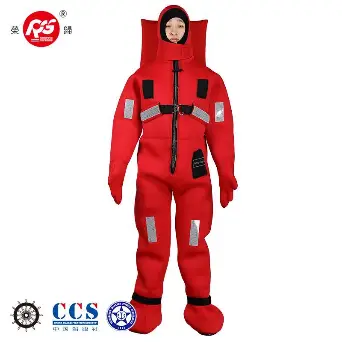
The RSF-II SOLAS Immersion Suit is a CR expanded neoprene composite cloth immersion suit designed and certified specifically for survival in cold water at or near 0°C for extended duration. Its defining performance specification is measurable and precise: after six hours of immersion in 0°C to 2°C static water, the wearer’s core body temperature will not have fallen more than 2°C below normal — a thermal protection standard that directly maps to the extended SAR response timelines that real cold water rescue operations require. The RSF-II carries CCS (China Classification Society) certification and EU EC certification, and complies with the SOLAS 1974 Convention including its latest amendment, the International Life-Saving Equipment Rules, and the Maritime Safety Council Resolution MSC.81(70) life-saving equipment test requirements.
What distinguishes the RSF-II in the SOLAS immersion suit category is the inherent buoyancy design — the suit provides sufficient positive buoyancy to support the wearer in the water without a separately worn lifejacket, with an integrated head pillow behind the hood that keeps the wearer’s head above the waterline even if they become unconscious. For vessel operators, ship managers, and safety equipment procurement teams assessing immersion suit specifications, this standalone buoyancy capability means the RSF-II provides both thermal protection and flotation in a single piece of equipment — eliminating the donning sequence complexity of wearing both an immersion suit and a lifejacket under emergency conditions.
Key Features
Quantified Thermal Protection — No More Than 2°C Core Temperature Drop After 6 Hours in 0°C Water
The RSF-II’s primary thermal specification is expressed as a measurable outcome rather than a material claim: core body temperature will not fall more than 2°C below normal after six continuous hours of immersion in 0°C to 2°C static water. This is the critical specification for cold water route procurement decisions — it gives HSE officers and safety managers a specific, testable thermal performance commitment that can be directly compared between suit options and verified against the applicable SOLAS LSA Code test standard. For vessels trading in waters where SAR response times may extend to six hours or beyond, a suit that maintains core temperature within this threshold over that full duration is the appropriate specification.
CR Expanded Neoprene Composite Cloth — Purpose-Specified Cold Water Material
The RSF-II is constructed from CR (chloroprene rubber) expanded neoprene composite cloth — a material selected specifically for cold water immersion suit performance. CR expanded neoprene provides thermal insulation through its closed-cell foam structure, which resists compression and water penetration over extended immersion periods. The composite cloth construction adds surface durability and additional water resistance to the base neoprene, maintaining material integrity through the physical demands of in-water survival, rescue boarding, and repeated suit inspection cycles over the service life of the equipment.
Inherent Buoyancy — Can Be Used Without a Separately Worn Lifejacket
The RSF-II is designed with inherent buoyancy sufficient to support the wearer in the water without a separately worn lifejacket — a meaningful operational distinction. In a high-stress abandon ship scenario, the donning sequence for both an immersion suit and a separately worn lifejacket adds complexity, time, and the possibility of incorrect assembly under pressure. A suit with inherent buoyancy removes the lifejacket from the donning sequence entirely, reducing both the time to achieve full protection and the risk of one component being incorrectly worn or omitted under emergency conditions.
Integrated Head Pillow — Keeps Head Above Water Even If Wearer Becomes Unconscious
The hood assembly includes an integrated pillow positioned behind the head that maintains the wearer’s face above the waterline in the survival position — even if the wearer becomes unconscious from hypothermia, injury, or exhaustion during the waiting period before rescue. This is not a comfort feature. An unconscious survivor who slips face-down in the water drowns rapidly regardless of thermal protection. The head pillow is the mechanism that converts unconsciousness from a near-certain fatality into a survivable condition — it keeps the airway above the surface until rescue assets reach the position.
Lifejacket Light, Whistle, and Stainless Steel Harness — Complete Survival Accessory Set Included
The RSF-II is supplied with three integrated accessories: a lifejacket light for night-time survivor location visibility, a whistle for audible signalling when visual contact is not established, and a stainless steel harness for rescue hoisting and boarding assistance. The stainless steel specification for the harness is a relevant detail — a rescue helicopter hoisting or a rescue vessel crew physically lifting a survivor from the water applies substantial load to the harness, and a harness that corrodes, weakens, or fails under load defeats its purpose. Stainless steel construction maintains harness integrity across the suit’s service life and in the corrosive marine environment where it will be stored and used.
CCS Certification and EU EC Certification
The RSF-II carries both CCS (China Classification Society) certification — one of the IACS member classification societies whose approvals are recognised by flag states and port state control authorities internationally — and EU EC certification, confirming compliance with European regulatory requirements for marine safety equipment. Dual CCS and EC certification broadens the vessel flag state and class society contexts in which the RSF-II can be used and counted toward SOLAS complement requirements, making it suitable for vessels classed with CCS, EU-flagged vessels, and vessels on international trades where both certification contexts may be relevant to class and port state control inspections.
SOLAS 1974 Compliance Including Latest Amendment and MSC.81(70)
The RSF-II complies with the SOLAS 1974 Convention and its latest amendment, the International Life-Saving Equipment Rules, and the Maritime Safety Council Resolution MSC.81(70) life-saving equipment test requirements. MSC.81(70) is the specific IMO resolution that establishes the revised test requirements for life-saving appliances — including the thermal performance test methodology that underpins the 6-hour/0°C/2°C core temperature specification. Compliance with MSC.81(70) confirms that the RSF-II’s thermal performance claim has been verified against the current international test standard, not an outdated or less demanding predecessor.
Technical Specifications
Model: RSF-II
Category: SOLAS Immersion Suit
Main Material: CR Expanded Neoprene Composite Cloth
Thermal Protection: Core body temperature drop ≤2°C after 6 hours immersion in 0°C–2°C static water
Buoyancy: Inherent buoyancy — can be used without a separately worn lifejacket
Head Support: Integrated head pillow — maintains head above waterline if wearer is unconscious
Accessories Included: Lifejacket light, whistle, stainless steel harness
Certifications: CCS (China Classification Society) / EU EC
Compliance Standards: SOLAS 1974 Convention (latest amendment), International Life-Saving Equipment Rules, IMO MSC.81(70)
Applications: Cold water shipping routes, Navy, fishing vessels, offshore installations, cargo and passenger ships
Colour: Red with retroreflective tape panels (high in-water visibility)
Benefits
A quantified 6-hour thermal performance specification gives procurement teams an objective, comparable benchmark for cold water route immersion suit selection. Many immersion suit specifications describe thermal performance in terms of material properties or general compliance with SOLAS LSA Code requirements. The RSF-II provides a specific, measurable outcome: ≤2°C core temperature drop after 6 hours at 0°C. This is directly comparable between suit options and directly relatable to the SAR response timelines relevant to the vessel’s trading route — enabling informed procurement decisions rather than approval-document comparison alone.
Inherent buoyancy without a separate lifejacket reduces donning complexity and eliminates a failure mode in the abandonment sequence. Every additional step in an emergency donning sequence is an opportunity for error under stress. Removing the lifejacket from that sequence — because the suit’s buoyancy is sufficient without it — directly reduces the risk of a crew member entering the water without complete protection because one component was incorrectly donned, forgotten, or not located at the muster station.
The integrated head pillow converts unconsciousness from a fatality risk into a survivable condition. In a cold water survival scenario where the SAR response takes several hours, the wearer may become incapacitated before rescue arrives. A suit that keeps the head above the waterline passively — without requiring the wearer to remain conscious and active — extends the window within which rescue can succeed.
Dual CCS and EC certification supports use on vessels classed and flagged across a wide range of regulatory contexts. For ship management companies operating mixed fleets under different class societies and flag states, sourcing a SOLAS immersion suit with dual CCS and EC certification reduces the risk of a suit being questioned at PSC inspection or class survey because its approval does not align with the vessel’s class society. The RSF-II’s dual certification covers the major class and regulatory contexts relevant to international trading vessels.
Complete accessory set — light, whistle, stainless steel harness — ready for immediate use without additional procurement. An immersion suit supplied without its required survival accessories, or with accessories that require separate sourcing, creates a procurement and inventory management complication for vessel LSA complement maintenance. The RSF-II’s complete accessory set eliminates that complication — the suit is received ready for SOLAS complement installation without additional accessory sourcing.
Who It’s For
The Technical Superintendent at a Ship Management Company Operating Cold Water Trading Routes
You manage safety equipment compliance for a fleet that includes vessels on North Atlantic crossings, Norwegian Sea transits, or Northern Pacific routes where water temperatures at or near 0°C are realistic immersion conditions for part or all of the voyage. Your SOLAS immersion suit specification for these vessels needs to go beyond generic LSA Code compliance and address the actual cold water conditions on the trading route — specifically, thermal protection sufficient for the extended SAR response times that apply in those sea areas. The RSF-II’s 6-hour/0°C thermal performance specification gives you the documented performance basis for specifying it on cold water route vessels, and its dual CCS/EC certification covers the class and flag contexts relevant to your fleet.
The Vessel Master or Chief Officer Preparing for Class Survey or PSC Inspection
Your immersion suit complement is due for survey verification, or an inspection has identified suits approaching end of service life. You need replacement suits with current certification documentation that will satisfy the class surveyor or PSC inspector without query, sized correctly for your crew complement, and supplied with complete accessories including light, whistle, and harness — so you are not sourcing individual accessories separately to make the replacement suits compliant. The RSF-II is supplied complete with all required accessories and carries the CCS and EC certification documentation needed for survey and inspection purposes.
The Safety Equipment Procurement Officer at a Ship Chandler or Marine Supplier Serving Cold Water Route Operators
Your clients include vessel operators on routes where cold water survival performance is the primary immersion suit specification criterion — not just SOLAS compliance, but documented thermal performance in near-freezing water. They need a suit with a specific, verifiable thermal claim, complete accessory set, and dual class society certification that covers the range of vessel class and flag contexts in their fleet. The RSF-II, available through Alright Engineering Solutions in Singapore, provides all three — contact us to discuss availability, sizing, and pricing for your clients’ cold water route vessel requirements.
Possible Applications
- Cold water route commercial vessel crew survival equipment — Primary SOLAS immersion suit for crew on cargo vessels, tankers, and bulk carriers trading on North Atlantic, North Pacific, Norwegian Sea, Baltic, and Arctic approach routes where sea temperature approaches 0°C
- Navy and government vessel crew survival equipment — Personal immersion suit for naval vessel crew and government maritime patrol vessel personnel operating in cold water areas where SOLAS-standard thermal protection is specified
- Commercial fishing vessel crew safety compliance — SOLAS-compliant cold water immersion suit for fishing vessel crew operating in cold water fishing grounds where man overboard (MOB) survival duration in near-freezing water is a realistic safety scenario
- Offshore platform and drilling vessel personnel survival equipment — Personal immersion suits for personnel on offshore oil and gas platforms, FPSOs, and drilling vessels in cold water offshore locations including North Sea, Norwegian Sea, and Barents Sea installations
- Cargo and passenger ship SOLAS complement requirements — Insulated immersion suit provision for cargo and passenger vessels required to carry crew immersion suit complements under SOLAS Chapter III, particularly on cold water trading routes where insulated suit performance is the relevant specification
- Search and rescue training and familiarisation exercises — SOLAS immersion suit provision for maritime training institutions and vessel crew STCW personal survival technique training in cold water environments
- Drydock safety equipment replacement and renewal — Scheduled replacement of end-of-service immersion suits during drydocking to restore SOLAS complement compliance with current certification documentation before returning to service
- Fleet-wide safety equipment standardisation programmes — Common immersion suit specification procurement across multiple vessel types in a managed fleet, using the RSF-II’s dual CCS/EC certification to cover different class society contexts within the same fleet
Trust and Certifications
CCS Certification — China Classification Society Type Approval
CCS (China Classification Society) is a full member of IACS (International Association of Classification Societies) — the body whose member societies issue the class certificates accepted by flag state administrations internationally for commercial vessel compliance verification. CCS type approval for the RSF-II confirms that the suit has been tested and certified to the SOLAS LSA Code requirements by an internationally recognised classification society. For vessels classed with CCS, CCS type approval is the directly applicable certification for SOLAS immersion suit complement compliance. For vessels classed with other IACS member societies, CCS certification is generally recognised as equivalent for flag state and PSC inspection purposes.
EU EC Certification — European Regulatory Compliance
EU EC certification confirms compliance with the applicable European regulatory requirements for marine safety equipment — relevant for vessels flagged under EU member states and for vessels trading in European waters subject to port state control inspection under the Paris MOU. The combination of CCS and EC certification on the RSF-II broadens its applicable fleet context, covering both internationally trading vessels classed with CCS and EU-flagged or EU-trading vessels where EC certification is the relevant regulatory documentation at inspection.
SOLAS 1974 / MSC.81(70) Compliance — Current International Test Standard
Compliance with SOLAS 1974 (latest amendment) and IMO Resolution MSC.81(70) confirms that the RSF-II’s performance specifications — including the 6-hour thermal protection claim — have been verified against the current IMO test standard for life-saving appliances, not an earlier or less demanding test protocol. MSC.81(70) is the resolution that updated the test requirements for SOLAS life-saving appliances to align with current performance expectations, and compliance with this resolution is the relevant current standard for immersion suit type approval documentation.
Supplied Through Alright Engineering Solutions Pte. Ltd. — Singapore
The RSF-II SOLAS Immersion Suit is available through Alright Engineering Solutions Pte. Ltd., a Singapore-based supplier of marine safety equipment, personal protective equipment, and gas detection systems for vessel operators, ship managers, and maritime procurement teams in Singapore and the regional market. Alright Engineering Solutions provides sourcing support, CCS and EC certification documentation, and procurement assistance for marine life-saving appliances. Contact our team to confirm RSF-II availability, sizing options, and pricing for your vessel or fleet immersion suit requirements.
Accessories and Variants
Lifejacket Light (Included)
The integrated lifejacket light activates automatically on water contact, providing a continuous light signal that allows SAR aircraft and rescue vessels to locate survivors at night or in low-visibility conditions. The light is included with the RSF-II as standard — it does not require separate procurement or attachment, and is positioned on the suit for maximum visibility from above and from the waterline during rescue approach.
Whistle (Included)
The integrated whistle provides an audible distress signal for survivor location when visual identification is not possible due to wave height, distance, or darkness. A whistle signal can be produced with minimal physical effort — relevant when the survivor’s physical capacity is reduced after extended cold water immersion. The whistle is included with the RSF-II as standard, secured to the suit in an accessible position.
Stainless Steel Harness (Included)
The stainless steel harness supports rescue hoisting by helicopter or manual lifting by rescue vessel crew — distributing the load of the survivor’s full body weight across the harness structure rather than the suit material. Stainless steel construction resists corrosion in the marine storage environment and maintains load capacity over the suit’s service life without requiring special maintenance. The harness is included with the RSF-II as standard, forming part of the complete survival equipment package.
Related Marine Safety Equipment from Alright Engineering Solutions
LALIZAS Neptune Insulated Immersion Suit — Alternative SOLAS insulated neoprene immersion suit with LALIZAS brand certification for vessels requiring EU manufacturer documentation
SOLAS Immersion Suit Model LMT-B — Additional SOLAS immersion suit option for vessel complement requirements
LALIZAS SCBA SOLAS/MED — SOLAS/MED approved self-contained breathing apparatus for vessel fire-fighting complement
Emergency Escape Breathing Devices (EEBD) — Short-duration escape apparatus for crew egress from smoke-affected spaces under SOLAS Chapter II-2
Get in Touch
If you need to source the RSF-II SOLAS Immersion Suit for your vessel’s crew complement — whether for a cold water route vessel specification, a drydock replacement programme, or a fleet-wide procurement — contact Alright Engineering Solutions to confirm availability, request CCS and EC certification documentation, and obtain a formal quotation.
Our team can assist with sizing selection across your crew complement, documentation support for class and flag state survey, and volume pricing for fleet procurement programmes.
📍 3791 Jalan Bukit Merah #06-01, E-Centre @ Redhill, Singapore 159471