Cart (
Overview
The relationship between an oily water separator and its bilge alarm is not a simple sensor-and-switch arrangement. The bilge alarm is the active compliance enforcer in a MARPOL bilge management system — it measures, judges, records, and acts. When it works correctly, the vessel stays compliant. When it fails silently, performs inaccurately, or provides alarm responses too slow or too indiscriminate for the OWS it is paired with, the compliance consequence falls directly on the chief engineer, the vessel owner, and the flag state record. The quality of the bilge alarm specification is not a secondary procurement consideration; it is the central one.
The Deckma Hamburg OMD-2008 Series is the current-generation 15ppm bilge alarm monitor from Deckma Hamburg GmbH — an updated development of the established OMD product line, bringing the performance architecture of the dual-threshold 5 ppm + 15 ppm bilge alarm into a revised enclosure design and instrument platform suited to current vessel installation requirements. Like its predecessors in the OMD series, the OMD-2008 is designed specifically for use in conjunction with oily water separator systems, with a specification that meets and exceeds the requirements of IMO Resolution MEPC.107(49). Deckma Hamburg GmbH is a German manufacturer with a longstanding specialisation in marine oil content monitoring — the OMD series is among the most widely recognised bilge alarm product lines in the international commercial fleet.
The defining characteristic of the OMD-2008 — and the concrete differentiator that distinguishes it from basic single-threshold bilge alarm units — is its 5 ppm + 15 ppm dual-alarm configuration. While the MARPOL threshold is 15 ppm and many bilge alarms are designed purely around that single limit, the OMD-2008’s Alarm 1 provides an early-warning annunciation at 5 ppm — one-third of the MARPOL limit — giving the duty engineer actionable notice of OWS performance degradation well before the 15 ppm control threshold is reached. This graduated response architecture is the difference between a bilge alarm that prevents compliance events and one that simply records them.
Key Features
5 ppm + 15 ppm Dual-Threshold Bilge Alarm Configuration
The OMD-2008 operates as a 5 ppm + 15 ppm bilge alarm according to IMO Resolution MEPC.107(49). Alarm 1 functions as an annunciation threshold — set at 5 ppm in standard operational configuration — alerting the duty engineer when oil content in the separator discharge is running at a level that warrants attention, even though the 15 ppm MARPOL limit has not yet been reached. Alarm 2 is the control threshold at 15 ppm, triggering the overboard shut-off relay when the limit is exceeded. Both alarm set points are adjustable between 1 and 15 ppm via the front panel buttons, and works-adjusted at 15 ppm from the factory, allowing on-site configuration to the preferred operational thresholds without specialist tools or service access.
Updated Enclosure Design — Blue Marine-Grade Housing
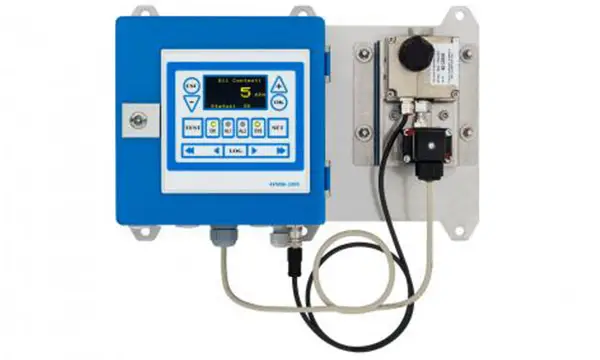
The OMD-2008 Series features a revised enclosure in a blue marine-grade housing that distinguishes it visually from earlier OMD generation units. The updated enclosure design reflects the physical refinements of the current product generation — a more compact profile, revised panel layout with a clear yellow graphic display and front-accessible control buttons, and IP65 protection in a housing suited to the installation aesthetics and cable entry arrangements of current commercial vessel engine room installations. For vessel managers replacing legacy OMD units at drydock, the OMD-2008’s enclosure configuration supports straightforward panel-for-panel or bulkhead replacement without significant rework of existing cable routes or mounting arrangements.
Yellow Graphic Display with Front Panel Alarm Indication
The OMD-2008 features a yellow graphic display providing continuous ppm readout and system status information alongside dedicated red LED indicators for Alarm 1, Alarm 2, and System Fault conditions. The yellow display technology provides good visibility in the variable lighting conditions of an engine room environment — readable under both fluorescent engine room lighting and the dimmed lighting of night watch operations. Front panel alarm LEDs provide immediate visual status indication without requiring the operator to read the display — a practical advantage during periods of high operational activity when a quick glance at the panel needs to be sufficient.
Independently Adjustable Alarm Delays — Annunciation and Control
Alarm 1 carries an operating delay adjustable between 1 and 540 seconds; Alarm 2 carries a delay adjustable between 1 and 10 seconds. The extended delay range on Alarm 1 (the annunciation channel) allows the 5 ppm early-warning threshold to be configured with sufficient delay to filter transient OWS output variations that would otherwise generate nuisance alarms — maintaining crew confidence in the alarm system without missing genuine OWS performance trends. The tighter delay range on Alarm 2 (the control channel) ensures that sustained exceedances of the 15 ppm threshold trigger overboard shut-off promptly, consistent with MEPC.107(49) response time requirements. Both delays are adjustable at the front panel without tools.
IP65 Degree of Protection
The OMD-2008 carries an IP65 enclosure rating — complete dust exclusion and resistance to water jet exposure from any direction under IEC 60529. In a typical bilge alarm installation location — adjacent to the oily water separator, in proximity to bilge pumps, pipework seals, and engine room washdown areas — IP65 provides the environmental protection level that supports instrument reliability and service life under real operating conditions. Enclosure protection is one of the most practical factors in bilge alarm longevity; instruments with lower protection ratings accumulate moisture-related damage in this environment over time.
Active System Fault Detection and Relay
The OMD-2008 monitors its own operational status through a dedicated System Fault channel — independent of both alarm channels. In normal operation the System LED blinks green. If a malfunction is detected, the LED changes to permanent red and a dedicated system fault relay contact switches. This active fault signalling ensures that instrument failure is immediately visible at the front panel and is simultaneously available as a relay output for integration into the vessel’s alarm management system. Silent instrument failure — where the bilge alarm has ceased to measure or alarm but shows no outward indication of failure — is one of the most consequential reliability risks in a MARPOL compliance system; the OMD-2008’s fault detection directly addresses this risk.
4–20 mA / 0–20 mA Selectable Analogue Output
The OMD-2008 provides a selectable 0–20 mA or 4–20 mA analogue output representing the 0–30 ppm measurement range, for connection to an external recorder, vessel monitoring system, or bridge display. The 4–20 mA option is the standard process signal range for marine automation systems, with the 4 mA live zero providing inherent broken-wire detection — the monitoring system will register a signal fault if the output cable is broken rather than silently reading zero ppm. For vessels with integrated engine room management systems, this output provides the continuous ppm signal feed for centralised ppm recording and display.
Wide Power Supply Acceptance — Automatic Voltage Selection
The OMD-2008 accepts supply voltages from 24 V to 240 V AC or DC with automatic voltage selection, drawing less than 10 VA. The wide acceptance range covers the full spectrum of vessel electrical supply standards encountered internationally — from 24 VDC instrument buses on small vessels to 220/240 VAC supply on large commercial ships — without requiring supply transformers, voltage regulators, or manual jumper configuration. For fleet managers standardising on the OMD-2008 across vessels with different electrical supply arrangements, automatic voltage selection removes a compatibility variable that would otherwise require case-by-case electrical planning for each installation.
Technical Specifications
Model: OMD-2008 Series
Manufacturer: Deckma Hamburg GmbH, Germany
Function: 5 ppm + 15 ppm bilge alarm monitor for OWS systems
Compliance Standard: IMO Resolution MEPC.107(49) — exceeds requirements
Measurement Range: 0–30 ppm; trend indication to 50 ppm
Accuracy / Linearity: Per MEPC.107(49); better than ±2% over 0–30 ppm
Display: Yellow graphic display
Power Supply: 24 V–240 V AC or DC — automatic voltage selection
Consumption: <10 VA
Alarm Points: 2 × adjustable 1–15 ppm (works adjustment: 15 ppm; operational config: 5 ppm + 15 ppm)
Alarm 1 Delay: 1–540 seconds adjustable (works adjustment: 2 sec) — annunciation
Alarm 2 Delay: 1–10 seconds adjustable (works adjustment: 10 sec) — control
Alarm Indication: Red LEDs — Alarm 1, Alarm 2, System Fault
Alarm Contact Rating: Potential-free 1-pole changeover, 3A / 240V (Alarm 1, 2, System Fault)
Output Signal: 0–20 mA or 4–20 mA selectable, active; ext. load <150 Ω
Sample / Fresh Water Pressure: 0–10 bar (recommended)
Sample Flow: Approx. 2 l/min
Sample Water Temperature: 1 to +65°C
Ambient Temperature: 1 to +55°C
Roll: Up to 45°
IP Rating: IP65
Weight: 5.4 kg
Dimensions (Computer Unit / Measuring Cell): 360 mm W × 240 mm H × 100 mm D
Pipe Connections: R ¼″ female
Benefits
The most operationally significant benefit of the OMD-2008’s 5 ppm + 15 ppm configuration is the shift it creates in the bilge management workflow — from reactive to proactive. A chief engineer running OWS operations with a single 15 ppm bilge alarm has no instrument-level warning that separator performance is degrading until the alarm triggers and the overboard line shuts. With the OMD-2008’s 5 ppm annunciation in place, the same engineer has an alert at one-third of the MARPOL limit — a point at which the OWS is still delivering compliant output but showing early signs of reduced separation efficiency. That advance warning creates time for inspection, adjustment, or a planned operational pause rather than a forced shut-off at the worst moment.
For vessel operators trading on routes with active PSC inspection regimes, the OMD-2008’s MEPC.107(49)-exceeding specification and comprehensive alarm documentation provide a compliance documentation standard that reduces the risk of equipment-related PSC findings. PSC inspectors reviewing bilge alarm equipment check type approval documentation, verify alarm response, and may test system fault indication. The OMD-2008’s active System Fault detection means that the instrument’s self-monitoring status can be demonstrated during inspection — a capability that instruments without fault detection cannot provide.
The 4–20 mA analogue output extends the OMD-2008’s compliance documentation function beyond the local display. A continuous ppm record fed to a vessel monitoring system or chart recorder provides an independent electronic history of bilge alarm readings across all OWS operations — corroborating the Oil Record Book entries that PSC inspectors cross-reference against instrument history. For vessels where ORB accuracy is a regular PSC inspection focus, an independent electronic ppm record provides a level of compliance documentation depth that paper log-only systems cannot match.
From a total cost of ownership perspective, the OMD-2008 Series represents the current production generation of Deckma Hamburg’s OMD bilge alarm line — meaning that spare parts, service documentation, and manufacturer support are aligned with the current product specification rather than a legacy platform approaching end of supported service life. For fleet managers planning bilge alarm replacement programmes across a multi-vessel fleet, specifying the current production generation reduces the risk of parts and support availability issues during the instrument’s intended service life.
Who It’s For
Chief Engineers Replacing End-of-Life Legacy Bilge Alarm Units at Drydock
A chief engineer on a fifteen-year-old bulk carrier approaching drydock knows that the vessel’s original bilge alarm unit is likely due for replacement — either because the unit is no longer serviceable to the original specification, because parts availability for the legacy model has become a sourcing challenge, or because the flag state survey requires updated type approval documentation. The OMD-2008 Series provides a direct current-generation replacement in the Deckma Hamburg OMD product line, with physical dimensions and installation footprint compatible with legacy OMD installations and current MEPC.107(49) type approval documentation that satisfies flag state and class survey requirements without additional certification work.
Technical Superintendents Standardising Fleet Bilge Alarm Equipment
A technical superintendent managing a fleet of ten Handysize bulk carriers through a rolling drydock programme needs a bilge alarm specification that can be applied consistently across vessels — simplifying spare parts management, service procedures, and compliance documentation across the fleet. The OMD-2008 as the current production generation of the OMD series provides that consistent specification baseline, and the Deckma Hamburg manufacturer documentation and type approval certificates are standardised across units, reducing the per-vessel compliance documentation effort for the superintendent’s technical team.
Marine Equipment Procurement Officers Sourcing Current-Generation OWS Equipment
A procurement officer sourcing a complete OWS system — separator unit and bilge alarm — for a vessel refit or new installation needs confidence that the bilge alarm specified is a current-production item with active manufacturer support, available spare parts, and a type approval certificate that is current rather than approaching renewal. The OMD-2008 Series designation indicates current-generation production within the Deckma Hamburg OMD line, and the manufacturer’s established market position supports the procurement accountability requirements of vessel management company purchasing processes.
Possible Applications
Legacy OMD Unit Replacement — Drydock Bilge Alarm Renewal
Vessels fitted with earlier generations of Deckma Hamburg OMD bilge alarms — OMD-24, OMD-32, or OMD-2005 series units approaching end of service life — are natural candidates for OMD-2008 replacement at drydock. The physical compatibility of the OMD-2008 with established OMD installation footprints, combined with current type approval documentation, makes drydock replacement straightforward and supports a clean class and flag state survey outcome for the replaced unit.
Bulk Carriers and General Cargo Vessels — High-Volume Bilge Water Operations
Bulk carriers and general cargo vessels on deep-sea routes generate significant bilge water volumes over extended passages and run OWS operations regularly throughout the voyage. The OMD-2008’s 5 ppm early warning gives engineering teams on these vessels advance notice of OWS performance variation during extended at-sea OWS runs — reducing the frequency of mid-operation shut-off events that require OWS inspection and restart during watch periods.
Tankers Under Vetting Inspection Oversight
Tankers trading under SIRE and CDI vetting regimes are subject to detailed equipment inspections where bilge alarm specification, type approval documentation, and operational records are reviewed as part of the vetting protocol. The OMD-2008’s current-generation Deckma Hamburg credentials and MEPC.107(49)-exceeding specification provide the documentation depth that thorough vetting inspections require without preparation burden beyond standard maintenance records.
Container Vessels and Ro-Ro Ships — Frequent PSC Exposure
Container vessels and ro-ro ships on regular liner services call at high-frequency PSC inspection ports — often multiple inspections per month across Tokyo MOU and Paris MOU ports on established trade routes. The OMD-2008’s active System Fault indication, dual-threshold alarm architecture, and type approval credentials reduce the risk of bilge alarm-related PSC deficiencies on vessels where the cumulative inspection record directly affects the vessel’s PSC risk profile and port access.
Offshore Support Vessels with Engine Room Management System Integration
OSVs operating in offshore support roles typically have integrated engine room management systems requiring bilge alarm data — relay contacts, ppm readings, and system status — to be fed into the vessel’s centralised alarm and monitoring architecture. The OMD-2008’s three independent relay contacts (Alarm 1, Alarm 2, System Fault) and 4–20 mA analogue output map directly to standard marine alarm management system input specifications, supporting straightforward integration without bespoke interface hardware.
Passenger Vessels and Ferries — High-Scrutiny Compliance Environments
Passenger vessels operating on regular routes face PSC inspection at virtually every port of call in major inspection regions. For these vessels, bilge alarm equipment must be demonstrably operational and correctly documented at each inspection without requiring special preparation. The OMD-2008’s active self-monitoring, front panel fault indication, and type approval documentation provide a compliance-ready equipment status that can be verified quickly during routine port inspections.
Newbuild Vessel Specifications — Current-Generation Equipment Fit
Shipyards specifying bilge alarm equipment for newbuild vessels require current-production units with valid MEPC.107(49) type approval as a condition of flag state and class approval. The OMD-2008 Series as the current-generation Deckma Hamburg bilge alarm provides a newbuild specification that delivers type approval compliance, manufacturer support aligned with the current production platform, and a service parts supply chain active for the foreseeable operational life of the vessel from delivery.
Trust & Certifications
IMO Resolution MEPC.107(49) — Exceeds the Performance Standard
MEPC.107(49) defines the minimum performance requirements for 15ppm bilge alarms — measurement accuracy, response time, alarm characteristics, shut-off requirements, and environmental testing conditions — that must be met for type approval and installation on MARPOL-applicable vessels. The OMD-2008 is built to a specification that exceeds these requirements: the 5 ppm + 15 ppm dual-threshold architecture, the 0–30 ppm measurement range with ±2% linearity, and the active System Fault detection collectively represent a performance envelope beyond the minimum standard. For procurement decisions where demonstrable compliance margin matters — vetting inspections, flag state audits, or class society surveys — specifying equipment that exceeds the standard rather than meeting it provides a documented performance basis that a minimum-compliance instrument cannot.
Deckma Hamburg GmbH — Current-Generation OMD Series
Deckma Hamburg GmbH is a German manufacturer with a specialised focus on oil-in-water monitoring instrumentation for marine and industrial applications. The OMD product series has been continuously developed across multiple generations, and the OMD-2008 represents the current production generation of this lineage. Specifying current-generation equipment from an active manufacturer means that type approval certificates are current, spare parts are in active production, service documentation reflects the installed specification, and manufacturer support is available through the company’s distribution network — factors that directly affect the total service life cost and compliance sustainability of the bilge alarm installation.
IP65 — IEC 60529 Environmental Protection
The OMD-2008’s IP65 rating under IEC 60529 provides independently verified protection against complete dust ingress and water jets from any direction. This protection level is relevant both for the operating environment of a commercial vessel engine room and for the installation approval requirements of class societies and flag states that specify environmental suitability criteria for safety-critical instrumentation. IP65 documentation is available as part of the instrument’s technical specification package for inclusion in class survey and flag state approval submissions.
Classification Society Survey Compatibility
The major international classification societies require MEPC.107(49) type-approved bilge alarm equipment, and the OMD-2008’s type approval credentials and Deckma Hamburg’s recognised manufacturer status support the class survey approval process for installations, replacements, and new specifications. The availability of current type approval documentation — aligned with the current production specification rather than a legacy platform — simplifies the class approval submission for drydock installation teams and technical superintendents managing survey documentation.
MARPOL Annex I Compliance — Oil Record Book Support
MARPOL Annex I Regulation 17 requires Oil Record Book entries for all bilge management operations. The OMD-2008’s 4–20 mA output supports connection to recording equipment for continuous electronic ppm logging that can be cross-referenced against ORB entries during PSC inspections. In both the Tokyo MOU and Paris MOU inspection regions, PSC inspectors routinely cross-check bilge alarm instrument records against ORB entries as a standard MARPOL compliance verification procedure — the OMD-2008’s analogue output capability supports this cross-referencing by providing an independent electronic ppm record for the full duration of each OWS operation.
Accessories & Variants
External Chart Recorder / Data Logger
The OMD-2008’s 4–20 mA analogue output supports direct connection to a compatible external chart recorder or electronic data logger for continuous ppm recording across all OWS operations. An external recorder provides the independent ppm record that supports Oil Record Book compliance and PSC inspection readiness — specify the analogue output option and recorder interface at time of order for vessels requiring this capability.
Vessel Monitoring System Interface
For vessels with integrated engine room management systems, the OMD-2008’s relay contacts and 4–20 mA output provide the interface signals required for bilge alarm integration into the vessel’s centralised alarm and monitoring architecture. The three independent relay outputs (Alarm 1, Alarm 2, System Fault) map directly to standard digital alarm input specifications; the 4–20 mA output maps to standard analogue input cards without signal conditioning.
Related Deckma Hamburg Bilge Alarm Models
Deckma OMD-24 Series — The OMD-24 shares the same 5 ppm + 15 ppm dual-threshold configuration as the OMD-2008 but includes a specific separator status input for OWS-synchronised data logging. The OMD-24 is the preferred choice for installations where the OWS can provide a separator status signal to the bilge alarm. Contact us to discuss which model is appropriate for your OWS configuration.
Deckma OMD-32 Series — The OMD-32 provides a dual-alarm architecture in a different enclosure configuration, suited to installations where the specific enclosure design of the OMD-2008 is not required. Contact us for a model comparison.
Deckma OMD-2005 — The OMD-2005 is a single-unit bilge alarm configuration for installations where the graduated 5 ppm + 15 ppm architecture is not required. Contact us to confirm the most appropriate model for your vessel’s bilge management system.
Product Variants
OMD-2008 Series — Standard Configuration — 5 ppm + 15 ppm bilge alarm, 0–30 ppm range, dual adjustable alarm points (1–15 ppm), IP65 blue marine enclosure, automatic voltage selection 24V–240V, 4–20 mA analogue output, three independent relay contacts. Works-adjusted at 15 ppm; field-configurable to 5 ppm + 15 ppm operational thresholds via front panel.
Alarm Set Point Variants — Both alarm set points are field-adjustable to any value between 1 and 15 ppm, and alternative configurations (e.g. 10 ppm + 15 ppm) are achievable via front panel adjustment without service access. Contact us to discuss non-standard set point requirements for specific applications.
Get in Touch
If you are planning a bilge alarm replacement at drydock, specifying OWS equipment for a vessel refit, or evaluating current-generation bilge alarm options for a fleet standardisation programme — contact us to discuss the Deckma Hamburg OMD-2008 Series and confirm the correct specification for your vessel type, OWS arrangement, and monitoring system requirements.
Our team can assist with MEPC.107(49) type approval documentation, OMD series model selection and comparison, installation and integration guidance, and supply timelines for Singapore delivery or regional port supply.
📍 3791 Jalan Bukit Merah #06-01, E-Centre @ Redhill, Singapore 159471