Cart (
Overview
When a vessel emergency requires crew to abandon ship in cold or open water, the time available for survival without thermal protection is measured in minutes — not hours. Hypothermia in cold water incapacitates a person far more rapidly than most crew members appreciate during drills: water conducts heat away from the body approximately 25 times faster than air at the same temperature. A crew member who enters cold water without an immersion suit may be unable to signal, swim, or assist in their own rescue well before a SAR response can reach them. A correctly worn, SOLAS-compliant immersion suit changes that survival equation fundamentally — by maintaining core body temperature and providing buoyancy for long enough to give rescue operations a realistic chance of reaching the survivor.
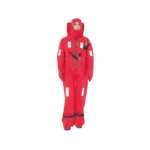
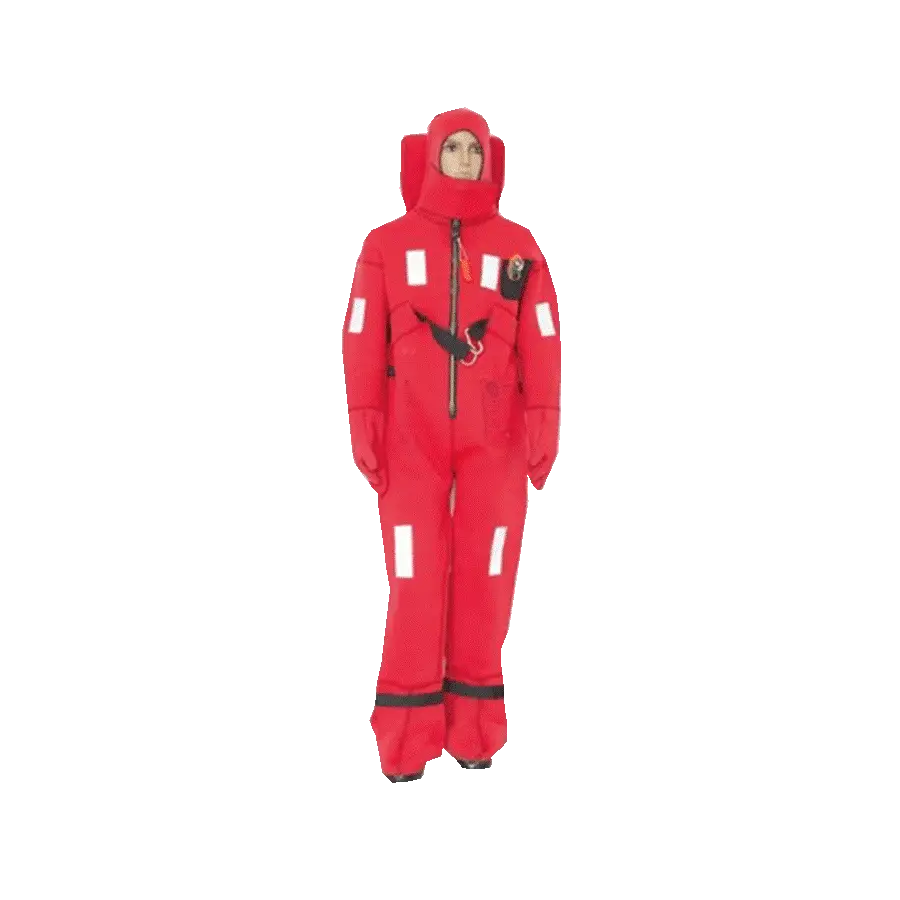
The SOLAS Immersion Suit Model LMT-B is a neoprene immersion suit designed and manufactured to meet SOLAS Chapter III requirements for personal life-saving appliances on commercial vessels. Constructed from neoprene material — the same closed-cell foam rubber used in professional diving suits for its thermal insulation and water-resistant properties — the LMT-B provides thermal protection, inherent buoyancy, flame resistance, and diesel-oil resistance in a single integrated suit designed for rapid donning and extended in-water survival. The suit is designed for adults of varying body sizes and is available with either neoprene or rubber gloves to suit different donning preference and operational requirements.
What distinguishes the LMT-B within the SOLAS immersion suit category is the combination of neoprene material construction with an extra-safe zipper system specifically designed to shield the suit and prevent water penetration at the primary closure point — the area most vulnerable to seal failure in a standard immersion suit design. For maritime procurement officers, ship managers, and vessel safety equipment buyers sourcing SOLAS-compliant immersion suits for vessel complement requirements, the LMT-B provides the certified thermal protection and water seal integrity that crew survival in cold water MOB and abandon ship scenarios demands.
Key Features
Neoprene Material Construction — Thermal Insulation by Material Properties
The LMT-B is constructed from neoprene — a closed-cell synthetic rubber material that provides thermal insulation through its cellular structure rather than relying solely on trapped air between the suit body and an inner layer. Neoprene retains its insulating properties even when the material is compressed under water pressure or physical movement, making it more thermally reliable during active in-water survival than some alternative immersion suit materials. For crew members who may be in the water for an extended period before rescue, consistent thermal insulation throughout the survival period — not just at the point of entry — is the relevant performance characteristic.
Extra Safe Zipper with Water Penetration Shield
The suit features an extra-safe zipper design that both seals the primary closure and includes a shield system that prevents water penetration at the zipper line — the area in most immersion suit designs where water ingress risk is highest under the physical movement and pressure of in-water survival. A zipper that allows water to track through over time in the water progressively undermines the suit’s thermal insulation, as incoming water displaces the insulating layer and accelerates heat loss. The LMT-B’s zipper shield design specifically addresses this failure mode at the component level.
Neoprene or Rubber Gloves — Hand Thermal Protection
The LMT-B is available with either integrated neoprene gloves or rubber gloves. Hand and extremity protection is a critical component of immersion suit thermal performance — cold water induces peripheral vasoconstriction that concentrates blood flow to the body core, and without hand insulation, the hands become non-functional for signalling, gripping life lines, or boarding a rescue vessel far earlier than core temperature reduction would impair the survivor. The choice between neoprene and rubber glove materials allows procurement teams to specify the hand protection configuration that matches their operational and crew preference requirements.
Buddy Line with Special Pocket Case
The suit includes a buddy line — a short tethering line that allows survivors in the water to connect to each other to form a group, preventing individual survivors from drifting apart during the rescue waiting period. The buddy line is stored in a special pocket case integrated into the suit, keeping it accessible and preventing line entanglement during donning and initial water entry. In a multiple-person abandonment scenario, the ability to form a survivor group using buddy lines directly supports rescue identification — a group of connected survivors is significantly more visible to SAR aircraft and vessels than isolated individuals dispersed across a sea area.
Thermally Insulated — Maintains Core Temperature During Extended In-Water Survival
The thermal insulation specification of the LMT-B is designed to maintain the wearer’s core body temperature above the threshold of hypothermic impairment for the survival duration required by SOLAS for a compliant immersion suit — providing meaningful protection against cold water heat loss during the period between abandonment and rescue. For vessel operators in cold water trading routes — North Atlantic, Northern Pacific, Arctic approaches, and high-latitude coastal trades — immersion suit thermal performance is not a marginal specification point but the primary survival parameter that determines whether crew members are recovered alive.
Diesel-Oil Resistant Material
The LMT-B material is resistant to diesel-oil contamination — a relevant performance characteristic for vessel emergency scenarios where the water surface in the abandonment area may be contaminated with fuel or lubricating oil from the distressed vessel. A suit material that degrades, absorbs oil, or loses integrity on contact with diesel-oil contamination has a meaningful performance risk in the exact scenario it will be used: a vessel casualty where fuel system damage is a common contributing factor to the emergency, and where the sea surface around the vessel is frequently contaminated with fuel. Diesel-oil resistance maintains suit integrity and thermal performance in these conditions.
Flame Resistant
The suit material is flame resistant — a SOLAS requirement for immersion suits used in abandon ship scenarios. Flame resistance is particularly relevant during the donning and evacuation phase of an abandonment, when crew members may need to move through or near fire-affected areas of the vessel on their way to muster stations and embarkation points, or when they are entering the water in an area where burning fuel may be present on the sea surface. Flame resistance does not make the suit fire-proof, but it reduces the risk of the suit material igniting from brief contact with flame during the abandonment sequence.
Technical Specifications
Model: LMT-B
Category: SOLAS Immersion Suit
Material: Neoprene
Glove Options: Neoprene gloves or Rubber gloves
Zipper: Extra safe zipper with water penetration shield
Thermal Insulation: Yes — thermally insulated neoprene construction
Diesel-Oil Resistance: Yes
Flame Resistance: Yes
Buddy Line: Included with special pocket case
Approval Standard: SOLAS Chapter III compliant
Colour: Red (high visibility)
Benefits
Neoprene material maintains thermal insulation integrity throughout extended in-water survival — not just at initial immersion. Some immersion suit materials provide strong insulation at point of entry but allow progressive heat loss as the survivor moves, the suit flexes, and water works into the insulating layer. Neoprene’s closed-cell structure resists this degradation, providing more consistent thermal protection over the full survival period until rescue.
Extra-safe zipper with water shield directly reduces the primary water ingress risk in standard immersion suit designs. For vessel operators and procurement teams evaluating immersion suit thermal performance, zipper seal integrity over time in the water is a material specification point — not just the initial donning seal. The LMT-B’s zipper shield design addresses this specifically at the component level.
Diesel-oil resistance maintains suit integrity in the most realistic vessel casualty abandonment conditions. An immersion suit that performs correctly in a controlled test but degrades on contact with fuel-contaminated water fails precisely when it is most needed. The LMT-B’s diesel-oil resistance specification addresses a real-world abandonment condition, not a theoretical one.
Integrated buddy line with pocket case supports survivor group formation without equipment management overhead during abandonment. In a high-stress abandon ship scenario, a buddy line that is tangled, difficult to locate, or stored separately from the suit creates a practical barrier to its use. The integrated pocket case keeps the line accessible and ready without requiring additional crew preparation steps.
SOLAS compliance satisfies flag state, class society, and port state control requirements for vessel immersion suit complement. Vessels that carry non-compliant or out-of-service immersion suits face deficiency findings at PSC inspection and class survey, and face the more serious consequence of inadequate crew protection in a genuine abandonment emergency. SOLAS-compliant LMT-B suits satisfy the regulatory requirement while providing the thermal and material performance characteristics that support real crew survival outcomes.
Who It’s For
The Ship Manager or Fleet Safety Superintendent Responsible for Vessel Life-Saving Appliance Compliance
You manage the LSA equipment maintenance and replacement programme for a managed fleet trading on routes that include cold water passages — North Atlantic crossings, Baltic and North Sea trades, Pacific northern routes, or coastal trades in high-latitude regions. Your vessels are required to carry a complement of SOLAS-approved immersion suits sized for all crew members, inspected and maintained in serviceable condition. When suits reach end of service life or fail inspection, you need to source replacement units that carry current SOLAS approval documentation and can be specified by size to match your crew complement. Contact Alright Engineering Solutions to discuss LMT-B immersion suit availability and sizing for your fleet replacement programme.
The Vessel Master or Chief Officer Managing On-Board Safety Equipment Readiness
Your vessel is preparing for annual class survey or flag state inspection, and your immersion suit complement needs to be verified for SOLAS compliance — correct approval documentation, serviceable condition, appropriate sizing for current crew, and correct stowage at designated muster station positions. You also need to ensure that your crew familiarisation programme covers correct donning procedure for the suit type carried on board. The LMT-B’s neoprene construction and extra-safe zipper design provide a straightforward donning procedure that can be covered in crew familiarisation drills without extensive equipment-specific training time.
The Marine Safety Equipment Procurement Officer at a Ship Chandler or Port Supplier
Your customers — vessel operators, ship managers, and vessel agents — require SOLAS-approved immersion suits for vessel complement requirements, crew replacement purchases, and drydock safety equipment renewal. They need suits with verified approval documentation, available in a range of sizes to cover adult crew members of varying body dimensions, at commercially competitive prices for procurement at vessel and fleet scale. The LMT-B, available through Alright Engineering Solutions in Singapore, provides a SOLAS-compliant immersion suit option with the neoprene construction and feature specification that your maritime clients require for crew survival equipment procurement.
Possible Applications
- Vessel abandon ship crew survival equipment — Primary immersion suit for all crew members under SOLAS Chapter III personal life-saving appliance requirements on cargo vessels, tankers, bulk carriers, and passenger ships
- Cold water route vessel operations — Immersion suit complement for vessels trading on North Atlantic, North Pacific, Baltic, North Sea, and high-latitude coastal routes where cold water immersion survival time without thermal protection is critically short
- Tanker and chemical carrier crew safety equipment — Immersion suits for crew on petroleum, chemical, and LNG/LPG tankers where fuel-contaminated water at the abandonment point makes diesel-oil resistance a relevant material specification
- Offshore platform and installation crew survival equipment — Personal immersion suits for personnel on offshore oil and gas platforms, FPSOs, and drilling vessels operating in cold water offshore locations
- Fishing vessel crew safety compliance — SOLAS-standard immersion suit provision for commercial fishing vessels operating in cold water fishing grounds where man overboard (MOB) and vessel casualty survival risks are elevated
- Drydock safety equipment renewal and replacement — Scheduled replacement of out-of-service immersion suits during planned drydocking or safety equipment renewal programmes to restore SOLAS complement compliance
- New vessel fit-out safety equipment supply — Initial immersion suit complement procurement for new-build vessels being fitted out to SOLAS LSA requirements before entering service
- Maritime training centre and drill equipment — Immersion suit provision for maritime training institutions conducting STCW survival craft and rescue boat training and familiarisation exercises
Trust and Certifications
SOLAS Chapter III Compliance — International Life-Saving Appliance Standard
SOLAS (International Convention for the Safety of Life at Sea) Chapter III establishes the international requirements for life-saving appliances on commercial vessels, including the standards for immersion suits carried as personal survival equipment for crew members. SOLAS-compliant immersion suits must meet the performance requirements of the LSA Code (International Life-Saving Appliance Code) as adopted by the IMO, covering thermal protection performance, buoyancy, donning time, material properties, and construction standards. Compliance with SOLAS Chapter III is the mandatory requirement for immersion suits counted toward a vessel’s SOLAS LSA complement at class and flag state survey — non-compliant suits cannot be counted toward the required complement regardless of their physical condition.
Flame Resistance — IMO LSA Code Material Requirement
Flame resistance is a specified material requirement under the IMO LSA Code for SOLAS immersion suits. The LMT-B’s flame-resistant neoprene material meets this requirement — confirming that the suit material has been tested against the applicable flame resistance standard as part of the SOLAS type approval process. For flag state and class society survey purposes, this material property is part of the SOLAS type approval documentation rather than a separately verified claim.
Diesel-Oil Resistance — LSA Code Operational Condition Requirement
The IMO LSA Code specifies that SOLAS immersion suits shall not ignite or melt when briefly exposed to flame, and shall maintain their performance characteristics when in contact with petroleum products that may be present on the water surface during an abandonment. The LMT-B’s diesel-oil resistance addresses this LSA Code operational condition requirement — maintaining suit integrity and thermal performance in the realistic abandonment scenario where sea surface fuel contamination is present.
Supplied Through Alright Engineering Solutions Pte. Ltd. — Singapore
The SOLAS Immersion Suit Model LMT-B is available through Alright Engineering Solutions Pte. Ltd., a Singapore-based supplier of marine safety equipment, personal protective equipment, and gas detection systems for vessel operators, ship managers, and marine procurement teams in Singapore and the regional market. Alright Engineering Solutions provides sourcing support, SOLAS approval documentation, and procurement assistance for marine life-saving appliances. Contact our team to confirm LMT-B availability, sizing options, and pricing for your vessel or fleet immersion suit requirements.
Accessories and Variants
Neoprene Glove Variant
The neoprene glove configuration provides integrated hand thermal insulation using the same neoprene material as the suit body — offering consistent thermal performance across the full suit including the hands. Neoprene gloves are the preferred configuration for cold water thermal protection performance, maintaining hand temperature and function for longer in cold water survival conditions than uninsulated alternatives.
Rubber Glove Variant
The rubber glove configuration provides a waterproof hand seal with good grip characteristics — suited to operational environments or crew preferences where rubber glove handling properties are preferred. Rubber gloves provide effective water exclusion from the hand area while offering tactile feedback for ladder climbing, life line gripping, and rescue vessel boarding tasks.
Related Life-Saving Appliances from Alright Engineering Solutions
LALIZAS SCBA SOLAS/MED — SOLAS/MED approved self-contained breathing apparatus for vessel fire-fighting complement requirements
Emergency Escape Breathing Devices (EEBD) — Short-duration escape apparatus for crew egress from smoke-affected spaces under SOLAS Chapter II-2 requirements
Personal Life Jackets and Lifejacket Lights — SOLAS-approved personal buoyancy equipment for vessel crew complement requirements
Portable Gas Detectors — Pre-entry and man overboard atmospheric monitoring for confined space and rescue operations on board vessels
Get in Touch
If you need to source SOLAS Immersion Suits (Model LMT-B) for your vessel’s crew complement, a drydock safety equipment renewal programme, or a fleet-wide immersion suit replacement — contact Alright Engineering Solutions to confirm sizing availability, request SOLAS approval documentation, and obtain a formal quotation.
Our team can assist with sizing selection across your crew complement, documentation support for class and flag state survey, and volume pricing for fleet procurement programmes.
📍 3791 Jalan Bukit Merah #06-01, E-Centre @ Redhill, Singapore 159471