Cart (
Overview
Not every maritime working environment requires a 150N offshore-grade inflatable life jacket. For vessel crew and shoreside personnel operating in sheltered harbour waters, port facilities, inland waterways, and coastal zones where rescue response is rapid and water conditions are manageable, a well-constructed inherently buoyant foam life jacket — one that provides immediate flotation without any inflation mechanism, without any action from the wearer, and without any maintenance beyond a visual inspection — is often the more practical and operationally appropriate choice. The risk is not the choice of buoyancy rating. The risk is specifying the wrong product for the environment, or specifying a product that crew members remove because it is too uncomfortable to work in.
The Marine Work Lifejacket is an inherently buoyant foam life jacket providing a minimum buoyancy of 74N — the performance level appropriate for sheltered or partially sheltered water environments where the wearer is likely to be conscious and able to assist in their own rescue. Built with an EPE polyethylene foam buoyancy core and a durable Terylene Oxford textile outer shell, this is a working life jacket designed for the conditions that port workers, harbour crew, river ferry personnel, and coastal vessel deck crew actually face day to day: repeated wear, outdoor exposure, physical work tasks, and the need for equipment that functions reliably without complex maintenance or servicing requirements.
What distinguishes an inherently buoyant foam life jacket from an inflatable alternative in a sheltered water operational context is the complete elimination of inflation system failure as a risk mode. There is no CO2 cartridge, no bobbin, no firing head, and no bladder to develop a leak. The foam is the buoyancy — and foam does not fail between service intervals. For procurement teams managing large working life jacket inventories where cost-effective compliance and minimal maintenance overhead are operational priorities, this characteristic alone is a significant practical advantage.
Key Features
≥74N Inherent Buoyancy — Immediate Flotation Without Inflation
The lifejacket provides a minimum buoyancy of 74 Newtons through its EPE foam core — buoyancy that is always present, always active, and completely independent of any inflation mechanism or manual action by the wearer. At 74N, the vest provides sufficient flotation for a conscious adult to keep their head above water in sheltered conditions without needing to tread water continuously — the functional buoyancy requirement for personnel working near the water’s edge in protected harbour, port, and inland waterway environments. Unlike inflatable life jackets, which must be activated to provide buoyancy, a 74N foam jacket begins working the moment the wearer enters the water.
EPE Foam Polyethylene Core — No Maintenance, No Failure Mode
The buoyancy material is expanded polyethylene (EPE) foam — a closed-cell foam widely used in marine life-saving appliances for its combination of buoyancy performance, water resistance, and long service life. EPE foam does not absorb water, does not compress permanently under load, and does not degrade under the UV exposure, salt water contact, and physical handling that working life jackets in active maritime service endure. The buoyancy provided by the foam core does not diminish between inspection intervals the way an inflatable bladder can, and there are no annual service components — no cartridge, no bobbin, no bladder pressure check — required to maintain the buoyancy function. For maintenance teams managing large life jacket inventories, this reduces the total cost of ownership significantly relative to inflatable alternatives.
Terylene Oxford Textile Outer Shell — Durability for Working Conditions
The outer shell is constructed from Terylene Oxford textile — a polyester-based woven fabric known for its resistance to abrasion, UV degradation, and the physical wear that working life jackets accumulate through repeated donning and doffing, storage in deck lockers and rope stores, and exposure to weather and salt water. A life jacket outer shell that degrades, tears, or loses its colour rapidly creates a visual inspection compliance problem: crew cannot easily identify whether the shell is still providing adequate protection to the foam core within. The Terylene Oxford construction maintains its structural integrity and colour stability through extended service life — important for both compliance management and the confidence of the personnel wearing it.
Reflective Tape Panels — Casualty Visibility in Low Light
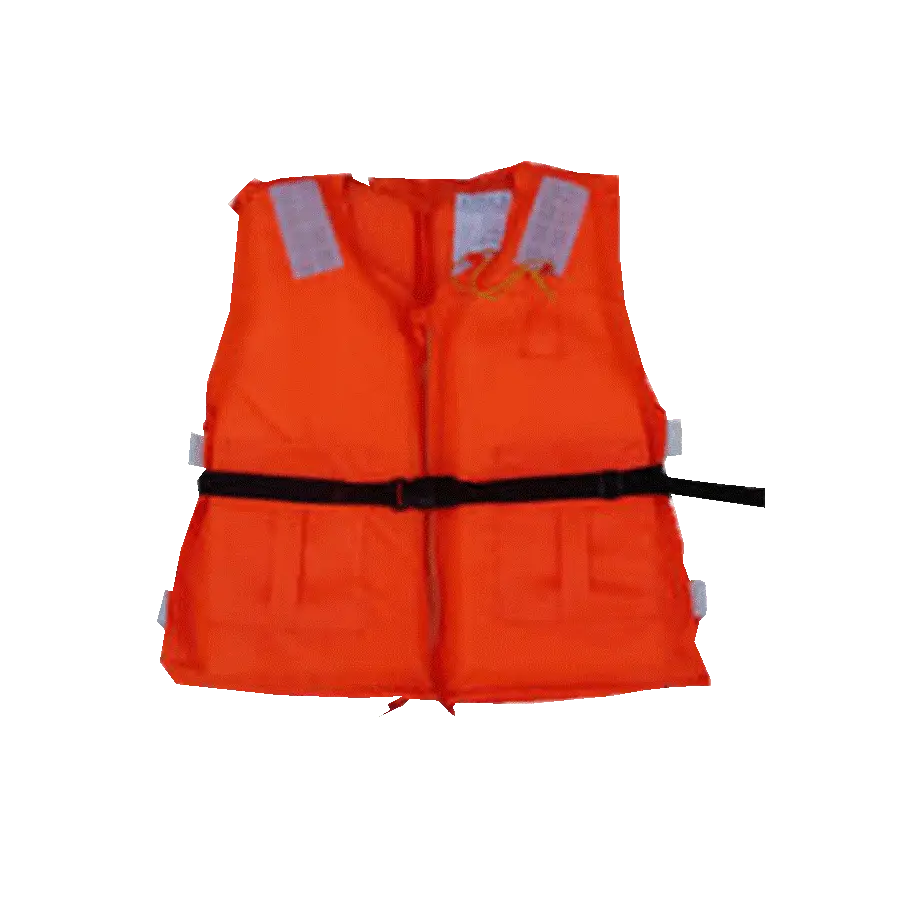
Reflective tape panels are fitted at the shoulder areas of the lifejacket — visible in the product image as the lighter-coloured patches on the orange shell. Reflective tape provides retroreflective visibility under torch, searchlight, or vessel navigation light illumination at night and in reduced visibility conditions. In a man-overboard situation occurring in harbour or port areas at night — during night-shift mooring operations, late cargo handling, or after-dark maintenance tasks — reflective tape on the life jacket significantly improves the speed of casualty location from a vessel or harbour launch. This is standard equipment on compliant maritime personal life-saving appliances and is a direct search and rescue performance feature, not a cosmetic fitting.
High-Visibility Orange Colour — International Maritime Distress Identification
The lifejacket is supplied in international maritime orange — the colour specified for personal life-saving appliances by SOLAS and IMO guidelines to maximise visual contrast against open water, harbour surfaces, and typical maritime backgrounds. Orange provides significantly better daytime visibility than neutral or dark colours across the range of lighting conditions encountered in port and harbour environments — from bright tropical midday sun to overcast northern European winter light. For rescue personnel and vessel crew conducting a visual man-overboard search, an orange life jacket is detectable at distance in conditions where any other colour would be lost against the water surface.
Black Webbing Waist Belt — Secure Retention Under Water Entry
The lifejacket is secured to the wearer via a black webbing waist belt visible across the front of the vest in the product image. A properly secured waist belt prevents the life jacket from riding up on the wearer’s body when they enter the water — a failure mode that reduces effective buoyancy and can compromise the jacket’s ability to support the wearer’s head above the waterline. The black webbing belt provides a clear visual contrast against the orange shell, making correct belt fastening straightforward to verify during pre-departure safety checks and muster station inspections. Correct donning and adjustment of the waist belt is the primary fitting requirement for inherently buoyant foam life jackets and directly affects their in-water performance.
Technical Specifications
Product: Marine Work Lifejacket
Category: Life Jacket / Personal Life-Saving Appliance
Buoyancy: ≥ 74 N
Buoyancy Type: Inherently Buoyant (Foam — No Inflation Required)
Inside Material (Buoyancy Core): EPE Foam Polyethylene
Outside Material (Shell): Terylene Oxford Textile
Colour: International Maritime Orange (High-Visibility)
Reflective Tape: Fitted (Shoulder Panels)
Fastening: Black Webbing Waist Belt
Maintenance Requirement: Visual Inspection (No Inflation Service Required)
Application Environment: Sheltered / Partially Sheltered Water, Harbour, Port, Inland Waterway
Regulatory Standard: ISO 12402-4 / SOLAS-Aligned (74N Level)
Benefits
The most immediate operational benefit of the inherently buoyant foam construction is the elimination of the annual inflation service from the maintenance programme. For organisations managing fifty, one hundred, or several hundred working life jackets across a fleet, port facility, or multi-site operation, removing the annual inflation service requirement — with its associated cartridge replacement, bobbin replacement, bladder inspection, and service contractor cost — represents a meaningful reduction in the total cost of life jacket fleet ownership. The foam core requires visual inspection as part of the routine maintenance schedule; it does not require specialist service intervention to maintain its buoyancy function.
From a wearing compliance standpoint, the foam vest design — with its front-opening construction and waist belt fastening — is familiar to maritime workers and straightforward to don correctly without training reinforcement. Workers who understand how to don the jacket, who find it comfortable enough to wear throughout a working shift, and who can verify their own correct donning with a simple belt-check are the workers who will actually be wearing the life jacket when a man-overboard incident occurs. Equipment that is removed during active work provides no protection at all.
For procurement teams, the foam construction provides a consistent, documentable specification that does not vary with service history. An inflatable life jacket that has not been serviced within its specified interval is effectively non-compliant regardless of its apparent condition. A foam life jacket that passes a visual inspection — foam intact, shell undamaged, reflective tape in place, belt functional — is demonstrably serviceable. That compliance verification simplicity is a practical advantage in high-turnover or high-inventory environments where detailed service records per individual unit create administrative overhead.
Who It’s For
Port Facility HSE Managers — Quayside and Terminal Working Life Jacket Inventory
A port facility HSE manager responsible for the safety of stevedores, crane operators, line handlers, and maintenance workers at quaysides and marine terminals needs a working life jacket that crew will actually wear during active physical tasks, that can be maintained without specialist service contractors, and that satisfies the occupational health and safety requirements applicable to water-adjacent work environments. The 74N foam vest — straightforward to don, inherently buoyant without any activation requirement, and maintainable through visual inspection — is the appropriate specification for this working population and environment. With large numbers of life jackets to manage across shift patterns, the low maintenance overhead of the foam construction directly reduces the HSE manager’s administrative burden.
Vessel Safety Officers — Crew Life Jackets for Sheltered Water Operations
A Safety Officer on a harbour ferry, river cruise vessel, coastal work boat, or port support vessel operating within sheltered harbour limits needs crew life jackets that meet the applicable regulatory requirements for the vessel’s operating area — and that crew will reliably wear during deck operations, mooring tasks, and gangway work. For vessels operating exclusively in sheltered harbour or inland waterway environments, 74N inherently buoyant foam life jackets can satisfy the applicable personal life-saving appliance requirements while providing a lower maintenance overhead and higher wearing compliance than inflatable alternatives. The Safety Officer benefits from a life jacket specification that simplifies the annual inventory check and reduces the per-unit service cost.
Marine Training Institutions — Student and Training Life Jacket Inventory
Maritime academies, sea school training centres, and competency training providers maintaining life jacket inventories for student use during practical training exercises in sheltered harbour and marina environments need equipment that is robust enough to withstand repeated use by multiple trainees, straightforward to inspect and maintain at scale, and appropriate for the training environment’s water conditions. The Terylene Oxford shell and EPE foam construction of this vest provides the durability required for high-turnover training use, while the absence of an inflation service requirement simplifies inventory management across large student cohorts.
Possible Applications
Harbour and Port Quayside Operations — Mooring and Line Handling
Line handlers, mooring crews, and bollard gangs working at quaysides and berths during vessel arrivals and departures face man-overboard risk on every shift. A 74N foam work lifejacket worn throughout the shift provides immediate inherent buoyancy protection during the highest-risk moments of mooring operations — with no activation requirement and no dependency on the worker remembering to inflate a vest in a sudden fall situation.
River Ferry and Inland Waterway Crew — Deck Operations
Crew on river ferries, passenger water taxis, and inland waterway cargo barges performing gangway deployment, mooring, and deck maintenance tasks in sheltered river and canal environments require personal flotation equipment appropriate for the water conditions and rescue response times of their operating area. A 74N foam lifejacket satisfies the buoyancy requirements for sheltered inland water environments while providing the wearing comfort needed for full-shift use.
Coastal and Harbour Work Boat Crew — Deck and Maintenance Tasks
Crew on harbour work boats, buoy tenders, pilot boats, and port authority launches performing maintenance and operational tasks in sheltered harbour waters require working life jackets appropriate for their operational environment. The foam vest is suited to the physical working conditions of small harbour craft, where crew are frequently moving around the deck and require freedom of movement alongside reliable personal flotation protection.
Shipyard and Drydock Personnel — Waterside Working
Shipyard workers operating at waterside positions — alongside vessels in wet berths, on floating pontoons, at drydock caisson access points, and during afloat ship movement operations — face man-overboard risk within enclosed or sheltered dock environments. A 74N foam life jacket worn during waterside tasks provides inherent buoyancy protection in environments where rescue response from within the facility is rapid.
Maritime Academy and Sea School Practical Training
Student trainees undertaking practical seamanship, small craft handling, and maritime safety training in sheltered harbour and marina environments require personal flotation equipment appropriate for supervised training water conditions. Foam life jackets are widely used in maritime training environments for their simplicity, durability under repeated use, and compliance with the flotation requirements of training exercises in protected waters.
Yacht Marina and Boatyard Personnel — Waterside Maintenance Work
Boatyard maintenance staff, marina berth attendants, and yacht delivery crew working alongside vessels in marina berths and boatyard lifting areas operate in sheltered water environments where 74N inherent buoyancy is the appropriate personal flotation specification. A foam work vest provides the protection level required without the maintenance overhead of an inflatable life jacket in a working environment where budgets and administrative resources are limited.
Port and Harbour Authority Inspection and Survey Teams
Port authority inspectors, harbour masters, and harbour survey teams conducting afloat inspections, buoy maintenance, and navigational mark servicing in sheltered port waters require working life jackets for water-adjacent tasks carried out from small boats and harbour launches. A 74N foam work lifejacket appropriate for the sheltered water conditions of port authority operations provides the required protection level with straightforward maintenance management.
Trust & Certifications
ISO 12402-4 — International Standard for Level 100N / 74N Personal Life-Saving Appliances
ISO 12402-4 is the international standard specifying the design, performance, and testing requirements for personal life-saving appliances at buoyancy levels appropriate for sheltered and partially sheltered water use. Under the ISO 12402 framework, 74N is the buoyancy level appropriate for environments where the wearer is likely to be conscious, can assist in their own rescue, and where rapid rescue response is available. Procurement teams should verify that the specific unit sourced carries the appropriate type approval documentation for their flag state, classification society, or regulatory authority requirements — and retain that documentation as part of the safety management system record for the life jacket inventory.
SOLAS Chapter III Alignment — Sheltered Water Personal Life-Saving Appliance Requirements
SOLAS Chapter III provides the framework requirements for life-saving appliances on commercial vessels, including provisions for vessels operating in sheltered water environments where lower buoyancy ratings than the 150N offshore standard may be appropriate. Procurement teams specifying life jackets for SOLAS vessels operating in sheltered or harbour waters should confirm with their flag state administration or classification society the applicable buoyancy rating requirement for their specific vessel type and operational area before finalising specification — the correct rating depends on the operational environment, not solely on the product’s inherent compliance documentation.
Workplace Safety Regulations — Occupational Health and Safety at Water-Adjacent Work Sites
For non-SOLAS applications — port facility workers, shipyard personnel, harbour authority staff, and other water-adjacent working populations — the applicable personal flotation equipment requirement is typically established by national occupational health and safety regulations rather than maritime convention. In most jurisdictions, these regulations specify that personnel working near open water must wear appropriate personal flotation equipment, with the buoyancy rating determined by the water conditions, depth, and rescue response capability at the specific work site. HSE managers specifying life jackets for land-based water-adjacent workforces should confirm the applicable regulatory requirement for their jurisdiction and work site classification.
EPE Foam Material Durability — Long Service Life Without Performance Degradation
Expanded polyethylene (EPE) foam is a well-established material in marine life-saving appliance construction, with a documented service life significantly exceeding that of inflatable bladder systems when maintained under routine visual inspection protocols. EPE foam’s closed-cell structure prevents water absorption, maintains its buoyancy performance over extended service periods, and resists the compression set that would reduce effective buoyancy in other foam types. For procurement teams evaluating total cost of ownership over a five or ten-year life jacket inventory lifecycle, the EPE foam construction provides a favourable durability profile relative to inflatable alternatives requiring annual service component replacement.
Accessories & Variants
Lifejacket Light — SOLAS-Compliant MOB Signalling
A SOLAS-compliant LED lifejacket light can be fitted to this work lifejacket to provide automatic water-activated visual distress signalling in man-overboard situations occurring at night or in reduced visibility. For vessels and facilities where the life jacket is used in shifts that include hours of darkness, a fitted lifejacket light is the recommended additional fitting — and is required by SOLAS Chapter III for life jackets carried on commercial vessels regardless of the operational area’s typical daytime working pattern.
Whistle — Personal Distress Signalling
A fitted whistle provides a simple, reliable audible distress signal for a casualty in the water — effective in harbour and port environments where vessel and facility noise may mask voice communication but where the sharp frequency of a maritime distress whistle carries. SOLAS Chapter III requires that life jackets carried on commercial vessels be fitted with a whistle. For work lifejackets used in occupational safety applications, a fitted whistle adds a low-cost distress signalling capability that may be required under applicable workplace safety regulations.
Crotch Strap / Leg Loop
A crotch strap or leg loop fitting prevents the life jacket from riding up on the wearer’s body upon water entry — a failure mode that reduces effective buoyancy and can compromise the jacket’s ability to support the wearer in the correct head-up position. For high-risk water entry scenarios where uncontrolled entry from height is possible — working at height over water, vessel boarding operations, gangway work — a crotch strap fitting is a recommended additional safety measure for inherently buoyant foam life jackets.
Available Variants
Marine Work Lifejacket — ≥74N | Inherently Buoyant | EPE Foam Core | Terylene Oxford Shell | International Orange | Reflective Tape | Waist Belt | Sheltered / Harbour Water Application
For operational environments requiring 150N open water buoyancy performance — offshore platforms, open sea vessel operations, or exposed coastal environments where the wearer may be unconscious — refer to the VSG SKIPPER150 inflatable life jacket with RINA Class Approval against ISO 12402-3. For guidance on selecting the correct buoyancy rating for a specific operational environment and regulatory requirement, contact the supplier team.
Get in Touch
If you are specifying working life jackets for a port facility, harbour authority, inland waterway fleet, shipyard, or maritime training institution — or if you need guidance on the correct buoyancy rating, compliance standard, and maintenance programme for your specific operational environment and workforce — contact us to discuss your requirement and request a formal procurement quotation.
Our team can advise on product selection against your regulatory requirement, confirm the appropriate specification for your operational water environment, and support procurement documentation for safety management system and audit purposes.
📍 3791 Jalan Bukit Merah #06-01, E-Centre @ Redhill, Singapore 159471