Cart (
Overview
When the fire protection design for a vessel, offshore platform, or industrial site calls for a wheeled mobile foam extinguisher, one of the first practical questions is capacity. A 50-litre foam trolley provides strong first-response suppression capability for typical machinery space and deck fire point coverage on commercial vessels and medium-scale industrial fire points. A 150-litre unit shifts the operational profile to a different level — one suited to large-volume fuel spill fires, tank farm periphery coverage, and sites where a single deployed extinguisher needs to deliver a sustained, high-volume foam application before fixed suppression systems or fire brigade response takes over. Both sizes solve the same fundamental problem — providing mobile foam suppression capability that is accessible to a single operator, deployable without fixed infrastructure, and recoverable after discharge without workshop facilities — but they address different fire scale assumptions in the fire protection design.
The ABS foam trolley range uses standard AFFF — a hydrocarbon-compatible foam agent that is ecological and biodegradable to 98%. This biodegradability characteristic matters in marine and coastal environments where regulatory pressure on synthetic firefighting foam chemicals continues to increase, and where spill or discharge of firefighting foam into water bodies is a compliance consideration under MARPOL and regional environmental regulations. A 98% biodegradable foam agent is not the same as an environmentally neutral one, but it represents a meaningfully lower environmental impact profile compared to legacy fluorinated foam formulations that persist in marine environments.
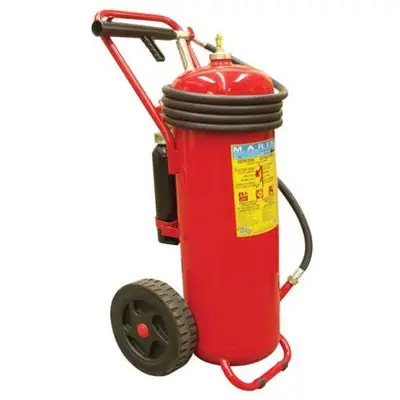
The ABS 50 LTR / 150 LTR Foam Trolley (Cartridge) range — available as model FEM-AB-FC50 (50 litres) and FEM-AB-FC150 (150 litres) — provides this foam suppression capability in the ABS field-repairable, cartridge-operated marine and industrial extinguisher platform: CO2 cartridge propellant replaceable on-site, wide cylinder opening for agent condition inspection and crew recharge, and EN1866-tested construction verified for suitability in the hostile operating environments of onboard vessels, coastal installations, and offshore platforms.
Key Features
Two Capacity Options — 50 LTR (FEM-AB-FC50) and 150 LTR (FEM-AB-FC150)
The two-model range allows fire protection planners to match the extinguisher capacity to the fire scenario scale at each fire point. The 50-litre model at 85 KG total weight is single-operator deployable and appropriate for machinery space fire points, deck fire stations, and medium-scale industrial fire coverage. The 150-litre model at 230 KG is a large-capacity unit — appropriate for tank farm perimeter coverage, large fuel handling area fire points, and high-capacity foam application requirements where the 50-litre discharge volume is insufficient for the credible fire scenario. Both models share the same EN1866 standard, 8-metre discharge distance, 13 Bar working pressure, and fire rating (233 IV B), differing in agent volume, discharge time, CO2 cartridge size, and physical dimensions.
Standard AFFF Agent — Ecological and 98% Biodegradable
The foam agent loaded in both variants is a standard AFFF (Aqueous Film-Forming Foam) formulation rated as ecological and biodegradable to 98%. As regulatory scrutiny of PFAS-containing fluorinated foam agents increases — in Singapore, across the EU, and internationally — the environmental profile of foam extinguishing agents is becoming a procurement consideration alongside performance. A 98% biodegradable AFFF provides the proven Class A and Class B hydrocarbon fire suppression performance that AFFF is specified for, with a lower environmental persistence profile than legacy fluorinated formulations. For vessels and facilities operating under MARPOL discharge restrictions and regional environmental compliance requirements, the biodegradability characteristic of the foam agent is a relevant procurement criterion.
Full Operator Visibility — No Obscuring Agent Cloud
Foam discharges as a directed stream and blanket — not as an obscuring cloud. The operator can see the fire, monitor suppression progress, confirm blanket coverage, and identify re-ignition throughout the entire discharge. In a confined vessel machinery space or enclosed industrial area, maintaining situational awareness during fire suppression is a safety requirement, not a preference. The visibility advantage of foam over dry powder is consistent across the ABS foam trolley range and applies to both the 50-litre and 150-litre variants equally.
Flashback Protection — Foam Blanket Suppresses Re-Ignition
After initial flame knockdown, the foam blanket continues to suppress vapour release from the fuel surface — preventing the fuel from re-establishing the vapour concentration needed for re-ignition from residual heat sources. This post-knockdown protection window is a characteristic of foam that dry powder does not provide: powder knocks down the flame but leaves the fuel surface unprotected and potentially re-ignitable. For large fuel spill fires — particularly relevant with the 150-litre variant positioned at high-risk fuel handling fire points — foam’s flashback protection is operationally significant.
Extended Discharge Time — 47 Seconds (50 LTR) to 150 Seconds (150 LTR)
The 50-litre model discharges in approximately 47 seconds; the 150-litre model in approximately 150 seconds — both at an 8-metre discharge distance. The longer discharge time of the 150-litre variant is a direct operational advantage for large-area coverage: it gives the operator over two minutes to apply foam systematically across a large fuel spill surface, work around obstacles, and ensure complete coverage rather than exhausting the agent charge before the surface is fully blanketed. For fire points where the design fire scenario involves a large spill area, the 150-litre discharge time is a meaningful specification factor.
CO2 Cartridge Propellant — Field-Repairable Without Workshop Access
Both models use a replaceable CO2 cartridge propellant — a 3-litre cartridge in the 50-litre model and a 6.7-litre cartridge in the 150-litre model. After discharge, the extinguisher is recharged on-site by refilling the foam agent charge through the wide cylinder opening and fitting a replacement CO2 cartridge, using only a standard adjustable spanner. This field-recharge capability eliminates the dependency on workshop service for post-discharge recovery — essential for vessels on extended voyages and offshore installations where a fire safety service contractor cannot be mobilised at short notice. Spare CO2 cartridges and foam concentrate stocked aboard or on-site are the only prerequisites for crew recharge.
EN1866 Tested — Verified Performance to European Mobile Extinguisher Standard
Both the 50-litre and 150-litre variants are tested to EN1866, the European harmonised standard for mobile fire extinguishers. EN1866 testing verifies discharge performance (distance, time, fire rating), working and test pressure structural integrity (13 Bar working, 30 Bar test), and product suitability for the environments in which mobile extinguishers are deployed. For marine vessels subject to class society survey, offshore platforms under applicable certification requirements, and industrial facilities requiring documented product compliance, EN1866 certification supports the procurement and maintenance documentation records that these compliance frameworks require.
Technical Specifications
| Specification | 50 LTR Model (FEM-AB-FC50) | 150 LTR Model (FEM-AB-FC150) |
|---|---|---|
| Part Number | FEM-AB-FC50 | FEM-AB-FC150 |
| Extinguishing Agent | 50 L AFFF Foam | 150 L AFFF Foam |
| Agent Biodegradability | 98% | 98% |
| Propellant | 3 LTR CO2 Cartridge | 6.7 LTR CO2 Cartridge |
| Fire Classes | Class A, Class B, Class F | Class A, Class B, Class F |
| Fire Rating | 233 IV B | 233 IV B |
| Discharge Distance | 8 metres | 8 metres |
| Approx. Discharge Time | 47 seconds | 150 seconds |
| Operating Temperature | 0°C to 60°C | 0°C to 60°C |
| Working Pressure | 13 Bar | 13 Bar |
| Test Pressure | 30 Bar | 30 Bar |
| Test Standard | EN1866 | EN1866 |
| Height | 1,145 mm | 1,380 mm |
| Width | 455 mm | 700 mm |
| Depth | 550 mm | 900 mm |
| Approx. Total Weight | 85 KG | 230 KG |
| Extinguisher Type | Wheeled mobile, cartridge-operated | Wheeled mobile, cartridge-operated |
Benefits
Two capacity options allow the extinguisher to be matched to the actual fire scenario scale at each fire point — without over-specifying or under-specifying. A 150-litre foam trolley at a small machinery space fire point is excessive and creates unnecessary logistical complexity. A 50-litre unit at a large fuel transfer fire point may exhaust its agent charge before achieving full surface coverage. Matching model to fire point from the available 50-litre and 150-litre variants means each fire point in the protection plan has the right capacity for its credible fire scenario — a more defensible fire protection design than a single-size-fits-all specification.
98% biodegradable AFFF agent reduces the environmental compliance exposure of foam extinguisher discharge in marine and coastal environments. For vessels operating under MARPOL Annex I and regional coastal environmental regulations, and for industrial facilities subject to spill control and environmental compliance requirements, the biodegradability of the foam agent affects both the regulatory impact of a discharge event and the facility’s broader environmental compliance profile. Specifying a 98% biodegradable AFFF over legacy fluorinated formulations is a procurement decision with measurable environmental compliance implications, not just a marketing preference.
Field-recharge capability maintains extinguisher availability on extended voyages and remote installations between professional service intervals. A discharged foam trolley returned to service by crew within hours — rather than decommissioned until the next contractor visit — remains part of the operational fire protection inventory. For vessels with 6-month or longer voyage cycles and offshore platforms in remote operating areas, this self-sufficiency in post-discharge recovery is the operational justification for specifying a cartridge-operated unit over a stored pressure alternative.
Long discharge time on the 150-litre variant supports methodical, complete coverage of large fuel spill fire scenarios. Two and a half minutes of continuous foam discharge at 8-metre range is a substantial operational window. It allows the operator to approach a large spill fire from a safe standoff, work systematically across the surface, and ensure the foam blanket has fully covered the fuel area before the agent charge is exhausted — the kind of thorough, controlled application that reduces the risk of incomplete suppression and post-knockdown re-ignition on large-area fires.
Who It’s For
The Fire Protection Engineer or HSE Manager Designing Fire Point Coverage for a New Vessel or Facility
You are specifying wheeled mobile foam extinguishers as part of a fire protection plan for a new vessel build, a facility refurbishment, or a fire protection audit that requires mobile extinguisher capacity to be revisited. Your fire point risk assessment has identified both moderate-scale and large-scale Class B fire scenarios across different areas of the vessel or facility — engine room fire points where 50 litres is appropriate, and fuel handling or tank farm perimeter fire points where 150 litres better matches the credible fire scenario. The ABS range, available in both 50-litre (FEM-AB-FC50) and 150-litre (FEM-AB-FC150) variants to the same EN1866 standard and the same ABS field-repairable platform, allows you to specify the correct capacity at each fire point from a single product family with consistent operational and maintenance characteristics.
The Technical Superintendent or Vessel Procurement Manager for a Tanker or Bulk Carrier Fleet
You manage fire extinguisher procurement across a fleet of vessels trading on routes that include tropical, temperate, and warm-climate passages — all within the 0°C to 60°C operating temperature range of the standard AFFF ABS foam trolley. Your vessels carry both 50-litre foam trolleys at machinery space fire points and larger-capacity units at deck and cargo area fire points. Standardising on the ABS EN1866-tested foam trolley range for both capacities gives you consistent documentation — same test standard, same fire rating, same part number system — across your fleet extinguisher inventory, simplifying procurement, maintenance records, and class society survey documentation.
The Harbour Master or Port Facility Safety Officer
Your port facility handles vessel bunkering operations, fuel transfer, and cargo loading — Class B fire risk activities that require mobile foam suppression capability at key operational points. The 150-litre ABS foam trolley positioned at high-risk bunkering and fuel transfer points provides the sustained high-volume foam discharge capacity that a large fuel spill fire at a port fire point demands. The 50-litre variant covers smaller fire points — offices, workshops, maintenance areas — within the same procurement framework. Biodegradable AFFF is an appropriate agent specification for a coastal port environment where foam discharge into the harbour is a realistic post-incident scenario.
Possible Applications
- Commercial vessel engine rooms — 50 LTR (FEM-AB-FC50) — Class B first-response coverage at engine room fire points on bulk carriers, container ships, tankers, and offshore support vessels; field-repairable by crew on extended voyages between port call service visits
- Vessel deck fuel transfer and bunkering areas — 150 LTR (FEM-AB-FC150) — Large-capacity foam coverage at deck fire stations during bunkering operations and fuel transfer on vessels where a large-volume fuel spill on deck is the credible fire scenario
- Petroleum and fuel storage terminals — 150 LTR — Tank farm perimeter and loading gantry fire point coverage at fuel terminals where large fuel spill fires require sustained high-volume foam application before fixed suppression system activation
- Offshore platforms and FPSOs — both variants — 50-litre units at accommodation and utility space fire points; 150-litre units at process area and wellhead fire stations on fixed and floating offshore production installations
- Shipyard fire points during vessel construction and repair — Mobile foam coverage at hull construction areas, fuel system installation work zones, and vessel sea-trial preparation areas where Class B fire risk from fuel system commissioning activities is elevated
- Port and harbour facilities — bunkering and cargo operations — Biodegradable AFFF foam trolley specification at coastal port fire points where post-discharge foam contact with harbour water is a regulatory consideration under port environmental management plans
- Industrial facilities — Class A and B general coverage — 50 LTR — Wheeled mobile foam coverage at manufacturing plant fire points, warehouse loading areas, and general industrial premises where the combination of Class A and Class B fire risk requires a versatile mobile suppression asset
- Training fire brigades and industrial fire response teams — Both variants used in live foam fire training exercises at industrial fire response training facilities, with field-recharge capability enabling post-exercise recovery and reuse without requiring replacement units
Trust and Certifications
EN1866 — European Standard for Mobile Fire Extinguishers
EN1866 is the European harmonised standard for mobile (wheeled) fire extinguishers, providing the independent performance verification that procurement documentation and compliance records require. Both the FEM-AB-FC50 and FEM-AB-FC150 variants are tested to EN1866, confirming their fire rating (233 IV B), discharge performance (8-metre range, 47-second and 150-second discharge times respectively), pressure integrity at working and test pressure, and overall construction standard. For class society survey compliance on SOLAS-regulated vessels and for regulated industrial premises subject to SCDF inspection, EN1866 certification is the relevant product standard credential.
SOLAS Chapter II-2 — Marine Vessel Fire Safety
SOLAS Chapter II-2 requires mobile fire extinguishers on commercial vessels to be maintained in serviceable condition and appropriate for the fire risks at the locations where they are positioned. The ABS 50 LTR and 150 LTR Foam Trolley variants, with EN1866 certification and CO2 cartridge field-repairable design, provide the agent type, capacity options, and operational characteristics appropriate for SOLAS-compliant foam mobile extinguisher specification across different vessel spaces and fire point requirements. Maintenance to the manufacturer’s specification with documented service records supports class society survey compliance.
MARPOL and Environmental Compliance — 98% Biodegradable AFFF
MARPOL Annex I prohibits the discharge of oil or oily mixtures into the sea from ships, and regional port state environmental regulations increasingly address the discharge of firefighting chemicals in coastal and harbour environments. The 98% biodegradable AFFF agent loaded in both ABS foam trolley variants provides a lower environmental persistence profile compared to legacy fluorinated foam formulations — a relevant specification consideration for vessels subject to MARPOL compliance and for port facilities with environmental management plan requirements governing foam agent selection at coastal fire points.
Supplied by Alright Engineering Solutions
The ABS 50 LTR / 150 LTR Foam Trolley (Cartridge) range is supplied through Alright Engineering Solutions Pte. Ltd., a Singapore-based fire safety and gas detection equipment distributor. Alright Engineering Solutions supplies the complete ABS foam and powder trolley extinguisher range — standard AFFF, anti freeze foam, alcohol-resistant foam, and Monnex BC powder variants — alongside portable fire extinguisher CO2 cartridges and fire safety accessories, providing a single regional supply source for fire extinguisher equipment and ongoing service components across marine, offshore, and industrial clients in Singapore and the Asia Pacific region.
Accessories and Variants
Model Variants — Capacity Selection Guide
FEM-AB-FC50 — 50 LTR Foam Trolley — 85 KG total weight; 47-second discharge; 3-litre CO2 cartridge propellant; suitable for machinery space fire points, deck fire stations on smaller vessels, and medium-scale industrial fire point coverage
FEM-AB-FC150 — 150 LTR Foam Trolley — 230 KG total weight; 150-second discharge; 6.7-litre CO2 cartridge propellant; suitable for large-capacity fire points at fuel handling areas, tank farm perimeters, large vessel deck fire stations, and industrial fire points where extended discharge time is required for large-area fuel fire coverage
Related ABS Foam Trolley Variants — Specialised Agent Options
ABS 50 LTR Anti Freeze Foam Trolley — Same platform with anti freeze foam agent rated to -20°C or -30°C; for vessels and installations operating in cold-climate environments where the 0°C lower operating limit of the standard AFFF variants is insufficient
ABS 50 LTR Alcohol Resistant Foam Trolley — Same platform with AR foam agent; for sites where polar solvent or alcohol fire risk requires alcohol-resistant foam capability alongside or instead of standard AFFF coverage
Related Mobile Extinguisher Products
ABS 50KG Monnex BC Powder Trolley — High-performance Monnex BC dry powder trolley for Class B and Class C fires; for sites specifying both foam and BC powder mobile extinguisher coverage across different fire point risk profiles
Replacement CO2 Propellant Cartridges
CO2 Cartridges for Mobile Fire Extinguishers (3 LTR — FEM-AB-FC50) — Replacement CO2 propellant cartridges for the 50-litre foam trolley; spare cartridges required for on-site field-recharge capability
CO2 Cartridges for Mobile Fire Extinguishers (6.7 LTR — FEM-AB-FC150) — Replacement CO2 propellant cartridges for the 150-litre foam trolley; spare cartridges required for on-site field-recharge capability on vessels and remote installations
Portable Extinguisher CO2 Cartridges
CO2 Cartridges for Portable Fire Extinguishers (Japanese, European, Asia Pacific brands) — For vessels and facilities carrying portable cartridge-type extinguishers alongside the ABS foam trolley range; available across Japanese (Yamato Protec, Hatsuda), European (Unitor, Gloria, Desaulter), and Asia Pacific (Hercules, SRI, Eversafe) brand specifications
Fire Extinguisher Mounting Accessories
Marine Fire Extinguisher Brackets (Small / Regular / Large) — Adjustable marine-rated bulkhead brackets for portable extinguishers on vessels carrying ABS foam trolleys as primary mobile suppression assets
Universal Heavy Duty Bracket / L Hook Brackets — Wall mounting solutions for portable extinguishers at industrial and commercial sites where ABS foam trolleys cover key fire risk locations
Get in Touch
If you are specifying foam trolley extinguishers for a vessel, offshore installation, port facility, or industrial site — and need to determine the correct capacity variant (50 LTR or 150 LTR) for your fire point requirements — contact Alright Engineering Solutions for model guidance, stock confirmation, and a formal supply quotation.
Our team can advise on capacity selection between FEM-AB-FC50 and FEM-AB-FC150 based on your fire protection design requirements, confirm EN1866 certification documentation, and assist with procurement and delivery for Singapore-based and regional marine, offshore, and industrial clients.
📍 3791 Jalan Bukit Merah #06-01, E-Centre @ Redhill, Singapore 159471