Cart (
Overview
Standard AFFF foam — the agent used in most foam fire extinguishers — is highly effective against hydrocarbon fuel fires. Against alcohol-based and polar solvent fires, it fails in a specific and predictable way: the alcohol in the burning liquid absorbs water from the foam blanket, breaking down the foam structure and destroying the suppression layer within seconds of application. The result is a fire that appears to be under attack but is not — the foam blanket disintegrates on contact, vapour continues to release from the fuel surface, and the fire re-ignites or never fully suppresses. Applying standard AFFF to an alcohol or polar solvent fire is not a partial solution; it is an ineffective one that consumes the agent charge without achieving suppression.
Alcohol-resistant foam — also designated AR-AFFF or AR foam — addresses this failure mechanism directly. The agent contains a polymer additive that forms a protective membrane between the foam blanket and the alcohol fuel surface, preventing the alcohol from breaking down the foam structure. On contact with a polar solvent fire, AR foam forms and maintains a stable, coherent blanket that suppresses vapour release and seals the fuel surface — the same suppression mechanism that makes standard AFFF effective on hydrocarbon fires, applied reliably to alcohol and solvent fires that standard foam cannot handle.
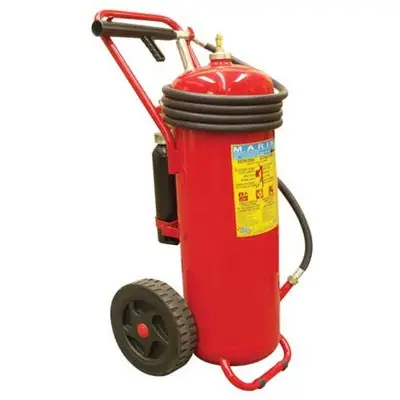
The ABS 50 LTR Alcohol Resistant Foam Trolley Cartridge loads this AR foam agent into the proven ABS wheeled mobile extinguisher platform: 50 litres of agent, N2 cartridge propellant for field-repairable operation without workshop access, wide cylinder opening for crew inspection, and the same EN1866-tested, hostile-environment-rated construction used across the ABS foam trolley range. For vessels, offshore platforms, pharmaceutical facilities, chemical plants, and any site where alcohol or polar solvent fire risk is part of the fire protection design basis, this is the foam trolley extinguisher specified for those scenarios.
Key Features
Alcohol-Resistant Foam Agent — Stable Blanket on Polar Solvent Fires
The AR foam agent in this extinguisher contains a polymer that forms a protective membrane on contact with polar solvents — alcohols, ketones, esters, and other water-miscible flammable liquids that break down standard AFFF on contact. This membrane prevents the alcohol from absorbing water out of the foam blanket, allowing the foam to maintain structural integrity, vapour suppression, and surface sealing on fuel types that standard foam simply cannot handle. For any site or vessel where alcohol, ethanol, methanol, acetone, or other polar solvents are stored, handled, or used in process operations, AR foam is not an optional upgrade — it is the correct agent specification for that fire risk profile.
Class A, Class B, and Class F Coverage — Including Polar Solvent Fuels
The ABS AR Foam Trolley is rated for Class A (solid combustibles), Class B (flammable liquids — both hydrocarbon and polar solvent), and Class F (cooking oils and fats) fires. The critical distinction from standard foam trolleys is the Class B coverage: this extinguisher handles both standard hydrocarbon Class B fires and alcohol/polar solvent Class B fires — making it the appropriate single-unit specification for sites where both fuel types are present. A standard AFFF trolley covers hydrocarbon Class B fires but fails on polar solvents; the AR foam trolley covers both without requiring a separate extinguisher for the alcohol risk.
Foam Blanket Integrity — No Disintegration on Alcohol Contact
When AR foam is discharged onto a burning alcohol or polar solvent surface, the foam blanket does not break down. The polymer membrane that forms between the foam and the fuel surface maintains blanket coherence throughout the suppression process — suppressing vapour, excluding oxygen, and providing flashback protection after the active flame is extinguished, just as standard AFFF does on hydrocarbon fires. This integrity on contact is the technical basis for the alcohol-resistant classification, and it is the characteristic that makes AR foam operationally effective where standard foam is not.
Full Operator Visibility Throughout Discharge
Like all foam extinguishers, the ABS AR Foam Trolley does not generate an obscuring agent cloud on discharge. The operator maintains full visual awareness throughout the attack — able to see the fire, confirm blanket coverage, identify areas requiring additional application, and monitor for re-ignition. On a vessel or in a confined industrial space where situational awareness and safe egress after suppression both matter, foam’s visibility advantage over powder is a practical operational benefit that goes beyond agent chemistry.
Long Discharge Time — Approximately 45 Seconds at 8-Metre Range
With an approximate discharge time of 45 seconds and a discharge distance of 8 metres, the AR foam trolley gives the operator the time and reach needed to apply a thorough, covering blanket over a large fuel spill fire. Alcohol fires in particular benefit from methodical, complete surface coverage — partial coverage leaves fuel surface exposed, and alcohol vapour will re-establish from any uncovered area. The extended discharge time allows the operator to work systematically across the fire surface rather than rushing the application under time pressure.
N2 Cartridge Propellant — Field-Repairable Without Workshop Access
The nitrogen cartridge propellant system allows post-discharge recharge on-site by trained crew: the foam agent is refilled through the wide cylinder opening and the spent N2 cartridge is replaced with a spare unit, using only a standard adjustable spanner. This field-recharge capability is critical for vessels on extended voyages and offshore platforms where a fire safety service contractor cannot be called in quickly. A discharged extinguisher that can be restored to service by crew within hours remains a functional asset; one that requires workshop service is out of the operational inventory until the next scheduled maintenance visit.
EN1866 Tested — Verified Performance and Construction Standard
The ABS AR Foam Trolley is tested to EN1866, the European standard for mobile fire extinguishers, which provides independent verification of performance claims including fire rating, discharge distance and time, working and test pressure integrity, and environmental suitability. EN1866 testing is the relevant product certification for mobile fire extinguishers specified on SOLAS-regulated vessels, offshore platforms, and regulated industrial premises where documented product compliance supports procurement records and class society survey maintenance documentation.
Technical Specifications
Product Name: ABS 50 LTR Alcohol Resistant Foam Trolley Cartridge
Extinguishing Agent: Alcohol-Resistant (AR) Foam — Anti Freeze formulation
Agent Capacity: 50 Litres
Propellant: N2 Cartridge (nitrogen, replaceable)
Fire Classes: Class A, Class B (hydrocarbon and polar solvent), Class F
Fire Rating: 233 IV B
Discharge Distance: 8 metres
Approximate Discharge Time: 45 seconds
Operating Temperature: -20°C or -30°C to +60°C
Working Pressure: 13 Bar
Test Pressure: 30 Bar
Height: 1,140 mm
Width: 455 mm
Depth: 550 mm
Approximate Total Weight: 80 KG
Test Standard: EN1866
Extinguisher Type: Wheeled mobile, cartridge-operated
Mobility: Two-wheel trolley
Tested Environments: Onboard vessels, coastal installations, oil rigs, offshore platforms
Product Category: Fire Extinguishers & Accessories
Benefits
AR foam provides effective suppression on the fire type that standard foam cannot handle — eliminating a coverage gap that matters in chemical, pharmaceutical, and fuel-blending environments. Any site or vessel where ethanol, methanol, isopropanol, acetone, or other polar solvents are present alongside conventional hydrocarbon fuels has a fire risk profile that standard AFFF does not fully cover. A single AR foam trolley positioned at a fire point covers both hydrocarbon and polar solvent Class B fires — eliminating the need to maintain separate extinguisher types for different fuel risks in the same area, and ensuring that the first-response asset at that fire point is effective regardless of which fuel type is involved.
Blanket integrity on polar solvent fires prevents the re-ignition risk that failed standard foam leaves behind. When standard AFFF breaks down on an alcohol fire, the fuel surface is left partially or fully exposed with residual heat and potential ignition sources still present — exactly the conditions for immediate re-ignition. AR foam maintains its blanket coherence and continues to suppress vapour after the initial knockdown, providing the same flashback protection window that makes foam the preferred agent for large fuel spill fires. For sites where alcohol or solvent fire scenarios could involve significant spill volumes, this post-knockdown protection is operationally important.
Full operator visibility improves suppression accuracy and reduces post-fire navigation risk in confined spaces. A confined shipboard machinery space or a pharmaceutical production area is not a place where operating blind inside an agent cloud is an acceptable condition. Foam’s discharge characteristic — a directed, visible stream that blankets the fuel surface without generating obscuring cloud — means the operator can see what they are doing throughout the attack, confirm coverage, and navigate the space safely after suppression.
Field-recharge capability maintains operational inventory on vessels and remote installations without contractor dependency. The N2 cartridge propellant and wide-opening cylinder design mean crew can return the extinguisher to service after deployment without external service support. For a chemical tanker at sea carrying alcohol cargo, or an offshore platform in a remote operating area, this self-sufficiency in post-discharge recovery is a direct operational advantage that stored pressure alternatives cannot provide.
Who It’s For
The HSE Manager at a Chemical Plant, Solvent Storage Facility, or Pharmaceutical Manufacturer
Your facility handles flammable polar solvents — ethanol, isopropanol, acetone, MEK, or other alcohol-based or water-miscible flammable liquids — as part of your production, storage, or distribution operations. Your fire protection plan identifies polar solvent spill fires as a credible Class B fire scenario, and you know that standard AFFF extinguishers are not the correct specification for that risk. You need wheeled mobile foam extinguishers at key fire points that will perform on both your solvent risk and any conventional fuel fire risk in the same areas. The ABS 50 LTR Alcohol Resistant Foam Trolley, with its AR foam agent rated to EN1866, is the specification that covers both without requiring you to maintain separate extinguisher types for each fuel class.
The Chief Officer on a Chemical Tanker or Alcohol Cargo Vessel
Your vessel carries bulk liquid alcohol cargoes — ethanol, methanol, or other polar solvent chemicals — alongside the conventional hydrocarbon fuel risk present in any commercial vessel machinery space. Your fire protection equipment needs to address both risk profiles. Standard AFFF trolleys at your cargo area fire points are not the correct specification for an alcohol spill fire on deck or in a cargo pump room. The ABS AR Foam Trolley, positioned at cargo area fire points, gives your crew first-response capability against a polar solvent cargo spill fire — with a field-repairable, ship-maintainable design appropriate for extended voyages between service ports.
The Safety Manager at a Fuel Terminal Handling Biofuel or Ethanol-Blended Fuel Products
Biofuel blending terminals, ethanol fuel storage facilities, and petroleum terminals handling ethanol-blended gasoline have a fire risk profile that sits at the intersection of hydrocarbon and polar solvent Class B fire risk. The ethanol content of blended fuels is sufficient to destabilise standard AFFF blankets — particularly at higher blend concentrations — making AR foam the appropriate specification for mobile extinguisher fire points at these facilities. The ABS AR Foam Trolley at transfer and loading area fire points provides the suppression capability that standard foam trolleys cannot reliably deliver on blended fuel or neat ethanol fires at these sites.
Possible Applications
- Chemical tankers carrying bulk alcohol or polar solvent cargoes — First-response Class B suppression at cargo area fire points and cargo pump rooms on chemical tankers carrying ethanol, methanol, isopropanol, and other polar solvent bulk liquid cargoes
- Pharmaceutical manufacturing plants — Mobile extinguisher coverage at production areas, solvent storage rooms, and dispensing areas in pharmaceutical facilities where ethanol, isopropanol, acetone, and other polar solvents are used in manufacturing processes
- Ethanol fuel terminals and biofuel blending facilities — Fire point coverage at ethanol fuel storage tank bunds, transfer pump stations, and loading gantries at biofuel and ethanol-blended fuel handling terminals
- Chemical storage warehouses and solvent distribution facilities — Wheeled mobile AR foam suppression at IBC storage areas, drum stores, and loading docks at chemical distribution facilities handling flammable polar solvent products
- Offshore platforms handling methanol injection chemicals — Class B coverage at methanol storage and injection skid areas on offshore production platforms where methanol is used for hydrate inhibition and pipeline chemical injection
- Paint manufacturing and coating production facilities — Mobile AR foam coverage at solvent-based paint production areas, solvent recovery systems, and flammable liquid storage at coating and paint manufacturing plants
- Marine vessel galley and catering areas — Class F fire coverage at large-scale catering and galley operations on passenger vessels and offshore platform accommodation modules alongside the Class A and B coverage across other vessel spaces
- Winery, distillery, and food and beverage production facilities — Class B polar solvent fire coverage in fermentation areas, spirit distillation operations, and alcohol storage at beverage production facilities where large volumes of ethanol are present at various stages of the production process
Trust and Certifications
EN1866 — European Standard for Mobile Fire Extinguishers
EN1866 is the European harmonised standard for mobile (wheeled) fire extinguishers, covering construction integrity, performance testing, discharge characteristics, and working and test pressure requirements. The ABS AR Foam Trolley’s EN1866 certification provides independent verification of its fire rating (233 IV B), discharge distance (8 metres), discharge time (approximately 45 seconds), and structural integrity at 13 Bar working pressure and 30 Bar test pressure. For procurement teams and HSE managers specifying mobile extinguishers for SOLAS-regulated vessels, class society survey compliance, and regulated industrial premises, EN1866 is the product certification standard that supports procurement documentation.
AR Foam Agent Standard — ICAO Level B and Industry Recognition
Alcohol-resistant foam agents are evaluated under internationally recognised performance standards that test agent effectiveness on both hydrocarbon and polar solvent Class B fires — the dual-fuel capability that defines AR foam’s specification advantage. ICAO Level B performance rating is the aviation industry standard for AR foam agents used at airports handling biofuels and alcohol-blended aviation fuels, and industry standards bodies in the petrochemical sector have established AR foam as the required agent specification for sites with polar solvent fire risk. The AR foam agent loaded in the ABS 50 LTR Alcohol Resistant Foam Trolley meets these recognised performance requirements for the polar solvent fire class it is designed to address.
SOLAS Chapter II-2 — Marine Vessel Fire Safety Compliance
Chemical tankers and vessels carrying alcohol or polar solvent cargoes are subject to SOLAS Chapter II-2 fire safety equipment requirements and the International Bulk Chemical Code (IBC Code), which specifies fire fighting media requirements based on the cargo carried. For vessels carrying alcohol cargoes where the IBC Code or vessel fire fighting plan requires alcohol-resistant foam capability at cargo area fire points, the ABS AR Foam Trolley provides the correct agent type in a wheeled mobile format appropriate for deck and cargo pump room fire point positioning. Maintenance to the manufacturer’s specification with EN1866-certified components supports the maintenance documentation required for class society survey.
Supplied by Alright Engineering Solutions
The ABS 50 LTR Alcohol Resistant Foam Trolley Cartridge is supplied through Alright Engineering Solutions Pte. Ltd., a Singapore-based fire safety and gas detection equipment distributor. Alright Engineering Solutions supplies fire extinguishers across the ABS marine and industrial range — including AR foam, anti freeze foam, and BC powder trolley variants — alongside portable extinguisher CO2 and N2 cartridge supplies, providing a single regional source for mobile and portable fire extinguisher equipment and ongoing service components for marine, offshore, and industrial clients in Singapore and the Asia Pacific region.
Accessories and Variants
Operating Temperature Variants
-20°C Operating Temperature Variant — Standard AR anti freeze foam formulation; suitable for vessels and facilities operating in temperate and moderate cold-climate environments
-30°C Operating Temperature Variant — Low-temperature AR anti freeze foam formulation; for vessels and installations operating in sub-arctic or cold-route environments where temperatures regularly fall below -20°C
Replacement N2 Propellant Cartridges
N2 Cartridges for Mobile Fire Extinguishers — Replacement nitrogen propellant cartridges for the ABS AR Foam Trolley; the consumable component required for on-site post-discharge recharge; stocking spare N2 cartridges and AR foam concentrate aboard vessels and at remote installations is essential for field-recharge capability between professional service visits
Related ABS Mobile Fire Extinguisher Products
ABS 50 LTR Anti Freeze Foam Trolley — Standard anti freeze foam trolley for Class A, B, and F fires in cold-climate environments where polar solvent fire risk is not a specific concern; for vessels and facilities requiring anti freeze foam capability without the AR specification
ABS 50KG Monnex BC Powder Trolley — High-performance Monnex BC dry powder trolley for Class B and Class C fires; for sites requiring both AR foam coverage at polar solvent risk points and BC powder coverage at Class C and electrical fire risk locations
Portable Extinguisher CO2 Cartridges
CO2 Cartridges for Portable Fire Extinguishers (Japanese, European, Asia Pacific brands) — For vessels and facilities carrying portable cartridge-type extinguishers alongside the ABS AR foam trolley; available across Japanese (Yamato Protec, Hatsuda), European (Unitor, Gloria, Desaulter), and Asia Pacific (Hercules, SRI, Eversafe) brand specifications, with IMPA-coded variants available for marine procurement
Fire Extinguisher Mounting Accessories
Marine Fire Extinguisher Brackets (Small / Regular / Large) — Adjustable marine-rated bulkhead brackets for portable extinguishers on vessels carrying the ABS AR foam trolley as the primary mobile suppression asset at cargo and machinery fire points
Universal Heavy Duty Bracket / L Hook Brackets — Wall mounting solutions for portable extinguishers at industrial and chemical facility sites where the ABS AR foam trolley is positioned at key flammable liquid risk locations
Get in Touch
If you are specifying mobile foam extinguishers for a site or vessel where alcohol, polar solvent, or biofuel fire risk is part of your fire protection design basis — or if you need to confirm whether your current foam trolley specification covers your actual fuel risk profile — contact Alright Engineering Solutions for product guidance and a formal supply quotation.
Our team can advise on AR foam versus standard foam trolley specification for your specific fuel risk profile, confirm operating temperature variant selection, and assist with procurement and delivery for Singapore and regional marine, offshore, and industrial clients.
📍 3791 Jalan Bukit Merah #06-01, E-Centre @ Redhill, Singapore 159471