Cart (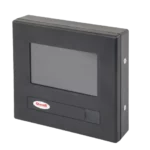
Overview
Every diesel engine crankcase carries the potential for a catastrophic explosion if oil mist concentrations reach the explosive range without early warning. On vessels with multiple engines — main propulsion, generator sets, auxiliary machinery — the challenge of monitoring every crankcase bay on every engine simultaneously, from a single centralised position, has historically required complex pipe-based sampling systems that are both maintenance-intensive and slow to respond. The Graviner MK7 Oil Mist Detection System was developed specifically to solve that problem: delivering comprehensive, real-time crankcase oil mist monitoring across multi-engine vessel installations without the sample pipe infrastructure that defined the previous generation of systems.
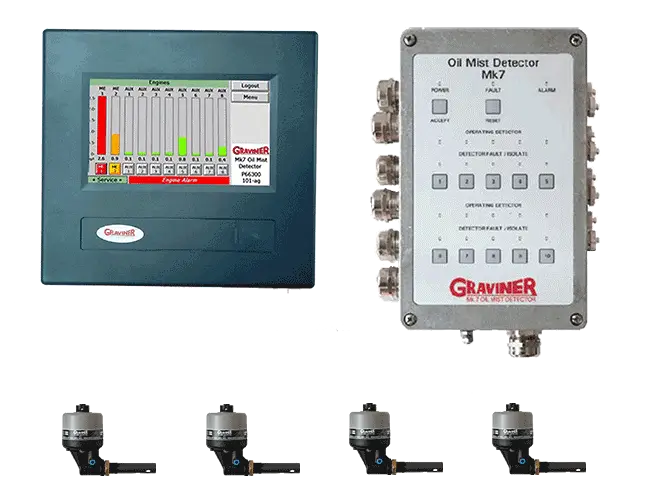
The Kidde Graviner MK7 Oil Mist Detection System is a complete, auto-addressed distributed oil mist detection platform for marine diesel engines. Each MK7 detector head mounts directly at a single crankcase space — monitoring oil mist concentration at the point of generation using a light scattering measurement technique — and communicates its readings to an engine-mounted control unit via a digital data bus. The control unit manages up to 10 detector heads per engine, sets alarm levels, and drives alarm outputs independently. Up to 10 control units can be connected within a single system, enabling the MK7 to provide crankcase protection across up to 100 individual crankcase spaces — covering the full detector count of even the largest multi-engine vessel installations from a single integrated system.
The MK7’s defining advantage over pipe-based predecessors is the complete elimination of sample pipe runs. In systems like the Graviner MK-5, sample pipes from each crankcase point to a central analyser are the most common source of maintenance faults: blockages, condensation, joint leaks, and flow faults that generate nuisance alarms and maintenance demands disproportionate to the actual oil mist detection function. The MK7 removes that entire infrastructure layer — each detector operates locally, at the crankcase, with no pipes to block, no airflow to lose, and no sample dilution or delay between the mist condition and the detection response.
Key Features
Auto-Addressed Distributed Detection — Up to 10 Detectors Per Control Unit
Each MK7 detector head is auto-addressed on the system data bus — meaning the system automatically identifies and assigns each detector to its position without manual address configuration during installation or replacement. Each control unit manages up to 10 detector heads, with each detector monitoring a single crankcase space on the engine. For large bore two-stroke main engines with multiple crankcase bays, this means every individual crankcase section has its own dedicated detector providing direct, real-time measurement — not a shared sample drawn from across multiple bays through a pipe network.
Up to 10 Control Units Per System — Scalable Multi-Engine Coverage
The MK7 system architecture supports up to 10 control units connected within a single integrated system — enabling centralised monitoring of up to 100 crankcase spaces across multiple engines from a single Remote Display Unit in the engine control room. For vessels with a main engine, multiple generator sets, and auxiliary machinery engines, this scalability means the entire vessel’s crankcase protection system operates as one integrated platform rather than a collection of separate detectors with separate monitoring requirements. The watch officer in the ECR sees the complete picture across all engines on one display.
Light Scattering Oil Mist Measurement — Early Detection Before Alarm Thresholds
The MK7 detector uses a light scattering measurement technique — assessing the degree to which oil mist particles scatter a light beam within the crankcase atmosphere — to determine oil mist concentration continuously and in real time. This measurement principle provides early warning of a rising oil mist density before concentrations reach the pre-set alarm threshold, giving the crew visibility of a developing condition — a bearing running warm, oil carryover beginning to increase — before the situation escalates to a full alarm. The graduated response this enables, from observation to precautionary action to full alarm, is a meaningful operational advantage over systems that provide only a binary alarm/no-alarm output.
Engine-Mounted Control Unit — Local Control and Indication at the Engine
Each MK7 control unit mounts directly on the engine it monitors, providing local display of oil mist levels, local alarm indication, and local system configuration access at the engine itself. This means an engineer working at the engine during maintenance or fault investigation has direct access to the system’s local control and indication functions without relying on the remote display in the ECR. The engine-mounted control unit sets alarm levels and alarm output configuration independently, and can be configured from the control unit itself or from the optional Remote Display Unit.
Remote Display Unit — Centralised ECR Monitoring Across All Engines
The optional but strongly recommended Remote Display Unit — available as the 53836-K271 touchscreen display — provides centralised monitoring of all connected MK7 control units from a single 7.5-inch LCD touchscreen panel in the engine control room or any other designated monitoring location. In an alarm condition, the display automatically switches to show the oil mist levels for the alarming engine, with individual detector readings displayed on demand and automatically under alarm conditions. Individual faulty detectors can be isolated from the Remote Display Unit without affecting the function of remaining detectors on the engine.
No Sample Pipes — Eliminates the Primary Maintenance Burden of Pipe-Based Systems
The MK7’s direct-detection architecture requires no sample pipe runs from crankcase sample points to a central analyser. Each detector operates at the crankcase, measuring oil mist concentration locally and transmitting data digitally to the control unit. The installation cost saving from eliminating sample pipe fabrication, routing, and fitting is significant on a new installation — and the ongoing maintenance cost saving from eliminating sample pipe blockages, condensation management, joint leak investigation, and flow fault call-outs is equally significant over the operational life of the system.
Compatible with Both 2-Stroke and 4-Stroke Engines
The MK7 system is specified for use on both two-stroke slow-speed and four-stroke medium-speed diesel engines — covering the full range of propulsion and auxiliary engine types found on merchant vessels. This cross-compatibility means a ship management company can standardise on the MK7 platform across a mixed fleet with different engine types, simplifying spare parts inventory, crew familiarity, and system service requirements across the fleet rather than managing different oil mist detection platforms for different engine types.
Technical Specifications
Model: Graviner MK7 Oil Mist Detection System
Manufacturer: Kidde Graviner (UTC Fire & Security / Carrier Global)
Detection Principle: Light scattering (optical oil mist density measurement)
Detector Architecture: Distributed — direct crankcase mounting, no sample pipes
Addressing: Auto-addressed detector heads
Detectors Per Control Unit: 1 to 10 (configurable)
Control Units Per System: Up to 10
Maximum Crankcase Spaces Monitored: Up to 100 (10 control units × 10 detectors)
Engine Compatibility: 2-stroke and 4-stroke diesel engines
Alarm Setting: Configurable alarm levels via control unit or Remote Display Unit
Remote Display: Optional — 53836-K271 7.5-inch LCD touchscreen Remote Display Unit
Alarm Response: Per-engine and per-detector; automatic display switching on alarm
Condition: New
Benefits
Comprehensive crankcase protection across every engine on the vessel from a single integrated system. With up to 10 control units and up to 10 detectors per unit, the MK7 system can monitor every crankcase space on every engine aboard — main engine, generators, auxiliary machinery — as a single connected system with centralised display in the ECR. The watch officer sees the complete crankcase protection picture across the entire vessel in one place, rather than monitoring separate systems with separate displays for each engine type.
Eliminates sample pipe maintenance — the highest-frequency maintenance demand in conventional oil mist detection. Sample pipe blockages, condensation accumulation, joint leaks, and flow fault call-outs are the routine maintenance reality of pipe-based systems like the MK-5. The MK7 removes all of it. No pipes means no pipe maintenance, no flow faults, no condensation to manage, and no nuisance alarms caused by sampling circuit issues rather than actual oil mist conditions. For vessels transitioning from MK-5 to MK7, the reduction in oil mist detector maintenance calls is one of the most immediately measurable operational benefits.
Early warning of rising oil mist density before alarm threshold is reached. The MK7’s light scattering measurement provides continuous, graduated oil mist concentration data — not just a threshold alarm. Watch engineers can see oil mist levels rising on individual detectors before any alarm fires, enabling precautionary investigation of a developing bearing condition or oil carryover issue before the situation reaches alarm intensity. This graduated visibility is what gives the crew the maximum possible response time — and maximum possible opportunity to prevent a developing condition from escalating.
Fleet standardisation on a single oil mist detection platform across mixed engine types. Two-stroke main engines and four-stroke generator engines can both be protected by the MK7 system, under the same control architecture, with the same detector type, the same spare parts, and the same crew training requirement. For ship management companies managing fleets with diverse engine specifications, this standardisation simplifies spare parts procurement, crew familiarisation, and system service — all of which carry real cost and operational efficiency implications across a managed fleet.
Reduced installation cost on new builds compared to pipe-based systems. Eliminating sample pipe fabrication, routing, penetrations, and fitting from the installation scope reduces both the material cost and the skilled labour time required to commission an oil mist detection system on a new vessel. On a large vessel with multiple engines and multiple crankcase bays, that installation cost saving is material — and it is realised entirely without compromising the quality or coverage of the crankcase protection system.
Who It’s For
The Marine Superintendent or Technical Manager Specifying a New Oil Mist Detection System
You’re specifying the crankcase protection system for a new vessel build or planning a full system replacement during a drydock programme. The MK-5 systems on your existing fleet are generating disproportionate maintenance demands and spare parts costs, and you’re evaluating the MK7 as the platform for the next maintenance cycle. You need a system that covers both the main engine and the generator sets under a single architecture, provides centralised ECR monitoring, and can be maintained without the sample pipe infrastructure that has been the ongoing maintenance headache on the MK-5 fleet. The MK7 answers all of those requirements.
The Newbuilding Project Manager Procuring Engine Room Safety Systems
You’re managing procurement for a new vessel build where the class-specified crankcase oil mist detection system needs to cover a large bore two-stroke main engine with eight crankcase bays plus three generator engines — a total of eleven crankcase spaces requiring continuous monitoring. You need a single integrated system with a recognised class approval, an ECR remote display, and an installation scope that doesn’t require a complex sample pipe network throughout the engine room. The MK7’s two-control-unit, eleven-detector configuration covers your requirement as a clean, pipe-free installation with centralised ECR display.
Possible Applications
- Large bore two-stroke main engine crankcase protection — MK7 system installation on slow-speed main propulsion engines with multiple crankcase bays aboard container ships, bulk carriers, tankers, and VLCCs
- Multi-engine generator room monitoring — MK7 system covering multiple four-stroke generator engines aboard a vessel under a single system with centralised ECR display, eliminating separate detector systems per engine
- New vessel builds specifying current-generation crankcase protection — MK7 as the class-approved oil mist detection platform for newbuilding projects, replacing MK-5 as the standard installation specification
- Drydock MK-5 to MK7 system upgrades — Complete system replacement during class renewal drydock for vessels where MK-5 maintenance demands or system age justify transition to the MK7 platform
- Offshore platform and FPSO power generation systems — MK7 installation on offshore diesel generator engines where sample pipe maintenance in remote or restricted machinery spaces is particularly impractical
- Ferry and passenger vessel engine room safety — Multi-engine MK7 installation on high-frequency ferry services where engine room maintenance windows are limited and crankcase monitoring system reliability is critical
- Naval and coast guard vessel propulsion engine protection — MK7 system installation for military vessel main and auxiliary diesel crankcase monitoring where system reliability and self-diagnostic capability are specified requirements
- Fleet-wide oil mist detection standardisation programmes — MK7 as the common platform for ship management companies standardising crankcase protection across mixed fleets with two-stroke and four-stroke engine combinations
Trust and Certifications
Kidde Graviner — Over 50 Years of Marine Crankcase Safety Leadership
Graviner introduced the first marine oil mist detector over five decades ago and has developed every successive generation of the platform — from the MK-4 through the MK-5 to the current MK7 — in direct response to the operational experience accumulated across tens of thousands of marine engine installations worldwide. The MK7 is not a first-generation product; it is the current expression of a continuous engineering development programme backed by more practical marine crankcase safety experience than any other manufacturer in the category. That depth of operational and engineering experience is what gives the MK7 its reliability credibility in a safety-critical application where the consequences of system failure are severe.
IMO Resolution A.1050(27) — Performance Standards for Crankcase Oil Mist Detectors
IMO Resolution A.1050(27) sets the international performance standard for crankcase oil mist detectors on seagoing vessels, covering detection response, alarm threshold performance, self-monitoring requirements, and system output specifications. The Graviner MK7 is designed and approved in full compliance with IMO A.1050(27) requirements — providing the detection performance, alarm logic, and system integrity monitoring that the resolution mandates for class-compliant crankcase oil mist detection installations.
Classification Society Type Approval — All Major Societies
The Graviner MK7 oil mist detection system carries type approval from all major classification societies, including Lloyd’s Register, DNV, Bureau Veritas, ClassNK, ABS, and RINA. Type approval means the MK7 system has been independently assessed against the applicable crankcase oil mist detection requirements and found to meet them — providing the third-party technical assurance that class surveyors require when inspecting oil mist detection systems during machinery surveys. Specifying the MK7 for a new installation or system upgrade eliminates the type approval uncertainty that can affect newer or less-established systems.
SOLAS Chapter II-1 — Machinery Safety Requirements
SOLAS Chapter II-1 establishes mandatory safety requirements for vessel machinery systems, including crankcase protection. Oil mist detectors installed under SOLAS requirements must meet applicable class society rules and IMO performance standards. The Graviner MK7, as a type-approved system meeting IMO A.1050(27) requirements, provides the compliance foundation that SOLAS Chapter II-1 machinery safety requirements demand for crankcase oil mist detection on applicable engines.
Supplied by Alright Engineering Solutions
The Kidde Graviner MK7 Oil Mist Detection System is supplied through Alright Engineering Solutions Pte. Ltd., a specialist distributor of marine safety equipment and gas detection systems based in Singapore. Alright Engineering Solutions provides complete system procurement support — from individual component sourcing through to full system configuration consultation — for Graviner MK7 installations across the Singapore and regional marine market.
Accessories and Variants
MK7 Remote Display Unit — 53836-K271 Touchscreen Display
The 53836-K271 Remote Display Unit provides a 7.5-inch LCD touchscreen interface for centralised MK7 system monitoring from the engine control room or any remote monitoring position. The display shows oil mist levels per engine and per detector, switches automatically to the alarming engine on alarm activation, allows individual detector isolation, and provides three-level password-protected access. Strongly recommended for vessels with multiple engine monitoring requirements or where ECR visibility of crankcase protection status is a watch-keeping requirement.
MK7 Detector Heads — Black Label (Latest Revised Version)
Individual MK7 crankcase detector heads (black label, current production standard) are available new for new system installations, additional engine coverage, and individual detector replacement. Auto-addressed and fully interchangeable with all previous MK7 detector versions.
MK7 Engine-Mounted Control Unit
The engine-mounted MK7 control unit provides local alarm management, detector data processing, and alarm output relay functions for each monitored engine. Available as a standalone component for system expansion or control unit replacement.
Graviner MK-5 System Components — Legacy System Support
For vessels maintaining Graviner MK-5 systems pending a planned MK7 upgrade, Alright Engineering Solutions stocks refurbished MK-5 spare components — main PCB assemblies, pressure switch assemblies, and complete MK-5 control bulk units — to support continued MK-5 operation through the transition period.
Related Marine Engine Room Safety Products
GTYQ-DX 102 Fixed Combustible Gas Detector — Fixed gas detection for engine room and machinery space hydrocarbon monitoring
GX-8000 Sample Draw Multi Gas Monitor — Portable marine multi-gas monitor for confined space entry and engine room gas surveys
RX-8700 Portable Gas Detector — Portable multi-gas monitor with ATEX/IECEx/MED certification for marine applications
Get in Touch
If you are specifying the Graviner MK7 Oil Mist Detection System for a new vessel build, a drydock system upgrade from MK-5, or a multi-engine fleet standardisation programme — contact Alright Engineering Solutions to discuss your system configuration requirements and request a formal quotation.
Our team can provide system-level configuration guidance, individual component sourcing, and procurement support for complete MK7 installations across single vessels and managed fleets.
📍 3791 Jalan Bukit Merah #06-01, E-Centre @ Redhill, Singapore 159471