Cart (
Overview
In a busy engine room control room, the ability to read oil mist detection system status quickly and accurately is not a convenience — it is an operational requirement. When an oil mist alarm triggers, the officer on watch needs to know immediately which engine is alarming, which detector is elevated, and what the current mist levels are across all sample points. A system that buries that information in a small numeric display or requires menu navigation during an alarm condition is a system that slows down the crew response at the exact moment when speed matters most. The Graviner MK7 Remote Display Unit addresses that problem directly — putting the full oil mist detection system status on a large, readable touchscreen that can be mounted where the crew actually needs it.
The Graviner MK7 Touch Screen Display — Part No. 53836-K271 is the Remote Display Unit for the Graviner MK7 oil mist detection system. It houses a 7.5-inch LCD touchscreen that provides a continuous, real-time display of oil mist levels for each monitored engine and each individual detector, along with system status and fault information — all accessible from a single panel that can be installed in the engine control room, bridge, or any location where system monitoring and operator access are required. In an alarm condition, the display automatically shifts to show the relevant engine’s detector readings without requiring any operator input.
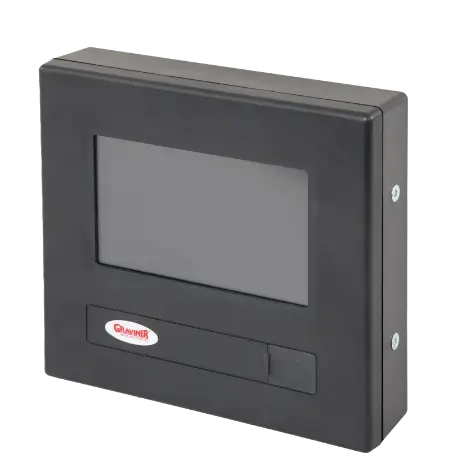
What sets this Remote Display Unit apart from basic status panels is its combination of alarm-driven automatic display switching, individual detector isolation capability, and three-level password-protected access control — all in a compact wall-mounted enclosure that carries the Graviner brand logo visible in the product image. For vessels where the MK7 system monitors multiple engines from a centralised control position, or where watch officers need immediate visual access to crankcase safety system status without physically visiting the engine room, the 53836-K271 Remote Display Unit is the component that makes that possible.
Key Features
7.5-Inch LCD Touchscreen — Full System Status at a Glance
The Remote Display Unit’s 7.5-inch LCD touchscreen provides a significantly larger and more readable display surface than the indicator panels found on conventional oil mist detector control units. The screen shows oil mist levels for each monitored engine and each individual detector — not just a summary alarm status — giving the watch officer a full picture of crankcase conditions across the entire MK7 system without navigating through sub-menus. For engine control rooms monitoring multiple engines simultaneously, the larger display area is particularly valuable: it provides enough screen real estate to present multiple engine channels in a format that is readable at normal working distance.
Automatic Alarm Display Switching
When an oil mist alarm activates on any monitored engine, the Remote Display Unit immediately switches to show the oil mist levels for the alarming engine — including the individual readings from each detector on that engine — without requiring any operator action. This automatic switching ensures that the watch officer’s attention is directed to the relevant information the moment an alarm condition develops, rather than requiring the operator to navigate to the correct engine channel while an alarm is active. In a developing oil mist situation where every second of crew response time matters, automatic display switching is a functional safety feature, not a user interface convenience.
Individual Detector Isolation — Fault Management Without System Downtime
If a detector fault occurs on any of the MK7 detectors connected to the system, the Remote Display Unit allows that individual detector to be isolated from the display without affecting the function of the remaining detectors on the engine. This means a single faulty detector does not require the entire engine’s MK7 monitoring to be taken offline while the fault is investigated or the detector is replaced. The remaining detectors continue providing crankcase coverage, and the fault condition is clearly indicated on the display for the maintenance team to address without creating an unnecessary system-wide gap in crankcase monitoring.
Three-Level Access Control — User, Engineer, and Service
The Remote Display Unit operates three distinct access levels: user level for routine monitoring and alarm acknowledgement; engineer level (password protected) for system configuration, detector threshold adjustment, and maintenance functions; and service level (password protected) for advanced system diagnostics and calibration. This tiered access structure ensures that routine watch-keeping crew can access the display information and acknowledge alarms without being able to inadvertently alter system configuration settings, while engineering and service personnel have the access they need for maintenance and commissioning functions. It is the kind of access architecture that classification society surveyors expect to see in safety-critical system operator interfaces.
Diagnostic Access for Fault Identification
In the event of a system failure, the Remote Display Unit provides the ship’s crew with access to diagnostic features that allow faults to be identified and characterised without specialist service equipment. The diagnostic interface allows the maintenance engineer to determine whether a fault is at the detector level, the system communication level, or the control unit level — narrowing down the fault location before committing to component replacement. This capability reduces the time between fault identification and resolution, and reduces the risk of replacing a component that is not actually the cause of the fault — a common and costly mistake when diagnostic information is limited.
Compact Wall-Mounted Enclosure — Flexible Installation Location
The Remote Display Unit is housed in a compact, flat-panel wall-mounted enclosure — as visible in the product image — designed for installation in any location where power and system communication connections can be provided. The slim profile and standard wall-mount format mean the unit can be installed in the engine control room, on the bridge, in a machinery control station, or at any operator position where continuous MK7 system status monitoring is required. The Graviner branded front panel and two physical buttons below the touchscreen provide a professional, purpose-built operator interface suited to permanent installation in a vessel’s control environment.
New Condition — Full OEM Warranty
The 53836-K271 Remote Display Unit is supplied new, carrying the manufacturer’s full warranty for new OEM components. New condition is the appropriate specification for a display and operator interface unit that will serve as the primary crew-facing interface for a vessel’s crankcase safety system — particularly for new MK7 installations, vessel newbuilds, and system upgrade programmes where the display unit will be in continuous service for the duration of the vessel’s next maintenance cycle.
Technical Specifications
Model: Graviner MK7 Remote Display Unit
Part Number: 53836-K271
Manufacturer: Graviner (Kidde / UTC Fire & Security)
Compatible System: Graviner MK7 Oil Mist Detection System
Display: 7.5-inch LCD touchscreen
Display Function: Oil mist levels per engine and per detector; system status; fault information
Alarm Response: Automatic display switching to alarming engine on alarm activation
Detector Isolation: Individual detector isolation without system shutdown
Access Levels: Three — User, Engineer (password), Service (password)
Diagnostic Access: System fault identification and diagnostic interface
Installation: Wall-mounted, compact flat-panel enclosure
Category: Oil Mist Detector
Condition: New
Benefits
Gives watch officers immediate, actionable oil mist system status without visiting the engine room. A Remote Display Unit installed in the engine control room means the officer on watch has continuous visibility of crankcase oil mist levels across all monitored engines from the primary control position. In a developing alarm situation, they are not waiting for an alarm beacon and then walking to the engine room to check the MK7 control unit — they are already looking at the relevant engine’s detector readings on a 7.5-inch screen, with the information they need to make an immediate protective decision.
Automatic alarm switching eliminates the operator response delay during active alarm conditions. When the display automatically switches to the alarming engine’s detector readings the moment an alarm fires, the crew’s response chain starts from a position of full information rather than from a position of “which engine, which detector, how bad.” That reduction in the time between alarm activation and informed crew response is a direct contribution to the MK7 system’s protective function — and it is a capability that a standard control unit indicator panel does not provide.
Individual detector isolation prevents a single fault from generating a system-wide monitoring gap. On a vessel where crankcase monitoring cannot be fully suspended during a detector fault investigation, the ability to isolate a single faulty detector while keeping the remaining detectors operational is a meaningful operational advantage. The maintenance engineer can investigate and resolve the fault without the vessel operating without any crankcase oil mist detection on that engine — a position that would be both a safety concern and a class compliance issue.
Password-protected access levels protect system configuration from inadvertent changes. A watch officer acknowledging an alarm cannot accidentally alter detector thresholds or system configuration settings that require engineer-level access. This separation of routine operator functions from engineering and service functions is a basic but important safeguard for a safety-critical system where configuration changes have direct consequences for alarm sensitivity and system behaviour.
Onboard diagnostic capability reduces fault resolution time and minimises unnecessary component replacement. The diagnostic interface gives the ship’s engineer enough information to characterise a system fault without waiting for a Graviner service engineer to come on board. For vessels operating in remote routes or tight port call schedules where service engineer availability is limited, onboard diagnostic capability directly reduces the time a system spends in a fault condition — and reduces the cost of unnecessary component replacement based on guesswork rather than diagnostic data.
Who It’s For
The Chief Engineer or Second Engineer Managing MK7 System Operations
Your vessel has a Graviner MK7 system installed on the main engine, and the current setup requires the watch engineer to go down to the engine room to check detector status whenever the system annunciates. You’re evaluating the Remote Display Unit to give the engine control room continuous visibility of MK7 system status — so that when an alarm fires, the watch officer has the full detector-level picture on the control room display before they even start moving. The 53836-K271 is the component that closes that operational gap.
The Newbuilding Project Manager or Marine Consultant Specifying MK7 Systems
You’re specifying the oil mist detection system for a new vessel build or a major machinery upgrade, and the MK7 is the selected platform. The engine control room layout includes a designated position for the oil mist detection remote display, and the specification calls for a touchscreen remote display unit with alarm-driven automatic switching and password-protected access levels. The 53836-K271 Remote Display Unit meets that specification as a new OEM component with a clearly documented part number for procurement and class documentation.
Possible Applications
- Engine control room monitoring on deep-sea merchant vessels — Remote Display Unit installation providing the engine control room watch with continuous MK7 system status visibility on main engine and auxiliary engine crankcase oil mist detection
- Multi-engine vessel installations — Remote display for MK7 systems monitoring multiple engines simultaneously, where the 7.5-inch touchscreen provides per-engine and per-detector status in a single display interface
- Bridge or integrated bridge system integration — Remote Display Unit installation at a bridge monitoring position for vessels where oil mist detection system status is required at the navigation bridge in addition to the engine control room
- New vessel builds specifying MK7 as the crankcase protection platform — New OEM Remote Display Unit supply for newbuilding projects where the engine control room design includes a dedicated MK7 system display position
- MK-5 to MK7 system upgrade programmes — Remote Display Unit supply as part of a complete MK7 system installation during drydock or class renewal upgrade from pipe-based MK-5 to MK7 direct-detection platform
- Offshore platform and FPSO engine room control stations — Remote display providing continuous MK7 system status at offshore power generation control positions where engine room access is restricted or distance from the engine makes direct panel reading impractical
- Marine engineering service companies commissioning MK7 systems — New Remote Display Unit supply for MK7 system installation and commissioning projects carried out on behalf of vessel owners under service agreement
Trust and Certifications
Graviner MK7 — Current-Generation Marine Crankcase Safety Platform
The Graviner MK7 is Kidde Graviner’s current-generation oil mist detection platform — the successor to the long-established MK-5 and the system against which Graviner’s engineering resources are now directed for new installations, vessel builds, and system upgrades. The MK7’s distributed direct-detection architecture and touchscreen remote display interface represent the current state of the art in marine crankcase oil mist detection, and the 53836-K271 Remote Display Unit is the display component through which the crew interfaces with that system.
IMO Resolution A.1050(27) — Oil Mist Detector System Requirements
IMO Resolution A.1050(27) establishes performance requirements for crankcase oil mist detectors on seagoing vessels, including requirements for alarm display, operator interface, and system status indication. The Graviner MK7 system — and the 53836-K271 Remote Display Unit as its operator interface component — is designed in accordance with these IMO requirements, providing the alarm display, status monitoring, and access control functions that the resolution’s requirements for crankcase detection system operator interfaces encompass.
Classification Society Type Approval
The Graviner MK7 oil mist detection system carries type approval from all major classification societies including Lloyd’s Register, DNV, Bureau Veritas, ClassNK, ABS, and RINA. The 53836-K271 Remote Display Unit, as a designated OEM component of the type-approved MK7 system, maintains the system’s type-approved configuration when used as the remote display interface for an MK7 installation. For vessels where class surveyors verify that the oil mist detection system is installed and configured in accordance with its type approval documentation, using OEM system components is the straightforward compliance path.
New Condition — Full OEM Warranty
The 53836-K271 Remote Display Unit is supplied new, with the manufacturer’s full warranty for new OEM components. New condition is the standard specification for display and operator interface units on new MK7 system installations and vessel newbuilds — providing the full original service life expectation of the display electronics and touchscreen assembly without the prior operating history uncertainty inherent in refurbished alternatives.
Supplied by Alright Engineering Solutions
The Graviner MK7 53836-K271 Touch Screen Display is supplied through Alright Engineering Solutions Pte. Ltd., a specialist distributor of marine safety equipment and gas detection systems based in Singapore. Alright Engineering Solutions provides OEM component sourcing for Graviner MK7 oil mist detection systems across the Singapore and regional marine market.
Accessories and Variants
Graviner MK7 System Components
The 53836-K271 Remote Display Unit is one component within the broader Graviner MK7 oil mist detection system. Alright Engineering Solutions can assist with sourcing the complete MK7 system component set — including MK7 detector heads (black label), control units, and associated system hardware — for new installations, system upgrades, and component-level replacement. Contact our team with your MK7 system configuration and component requirements for a complete system quotation.
MK7 Detector — Black Label (Part 53836 Series)
The individual MK7 crankcase detector units (black label, latest revised version) are the sample point components that supply oil mist concentration data to the system displayed on this Remote Display Unit. Available new from Alright Engineering Solutions for new installations and individual detector replacement.
Graviner MK-5 System Components
For vessels still operating Graviner MK-5 oil mist detection systems alongside MK7 upgrade planning, Alright Engineering Solutions stocks refurbished MK-5 spare components — main PCB assemblies, pressure switch assemblies, and complete MK-5 control bulk units — to support continued MK-5 maintenance.
Related Marine Engine Room Safety Products
Graviner MK7 Detector — Black Label — New individual crankcase detector for MK7 systems; direct sample point detection without sample pipes
Graviner MK-5 Control Bulk Unit — Refurbished complete MK-5 oil mist detector for legacy MK-5 installations
GTYQ-DX 102 Fixed Combustible Gas Detector — Fixed gas detection for engine room hydrocarbon monitoring
GX-8000 Sample Draw Multi Gas Monitor — Portable marine multi-gas monitor for confined space entry and engine room gas surveys
Get in Touch
If you need to source the Graviner MK7 53836-K271 Touch Screen Remote Display Unit for a new MK7 installation, system upgrade, or replacement — contact Alright Engineering Solutions to confirm availability and request a formal quotation. We can also assist with the full MK7 system component set if you are specifying or procuring a complete system.
Our team provides sourcing support for Graviner MK7 and MK-5 oil mist detection system components and related marine engine room safety equipment for vessels and fleets across the Singapore and regional market.
📍 3791 Jalan Bukit Merah #06-01, E-Centre @ Redhill, Singapore 159471