Cart (
Overview
An inflatable lifejacket is only as reliable as its firing mechanism. Every other specification — buoyancy rating, bladder material, harness construction — becomes irrelevant if the jacket does not inflate when the wearer enters the water. This is the fundamental procurement risk with inflatable life jackets that safety managers and HSE officers deal with in practice: a jacket that passes its annual inspection in dry storage conditions may still fail to fire in the unpredictable, high-stress conditions of an actual man-overboard event. The quality of the firing mechanism — its resistance to corrosion, its consistency across temperature extremes, and its reliability after years of storage between uses — is the specification detail that separates a professional-grade commercial inflatable lifejacket from an inadequate one.
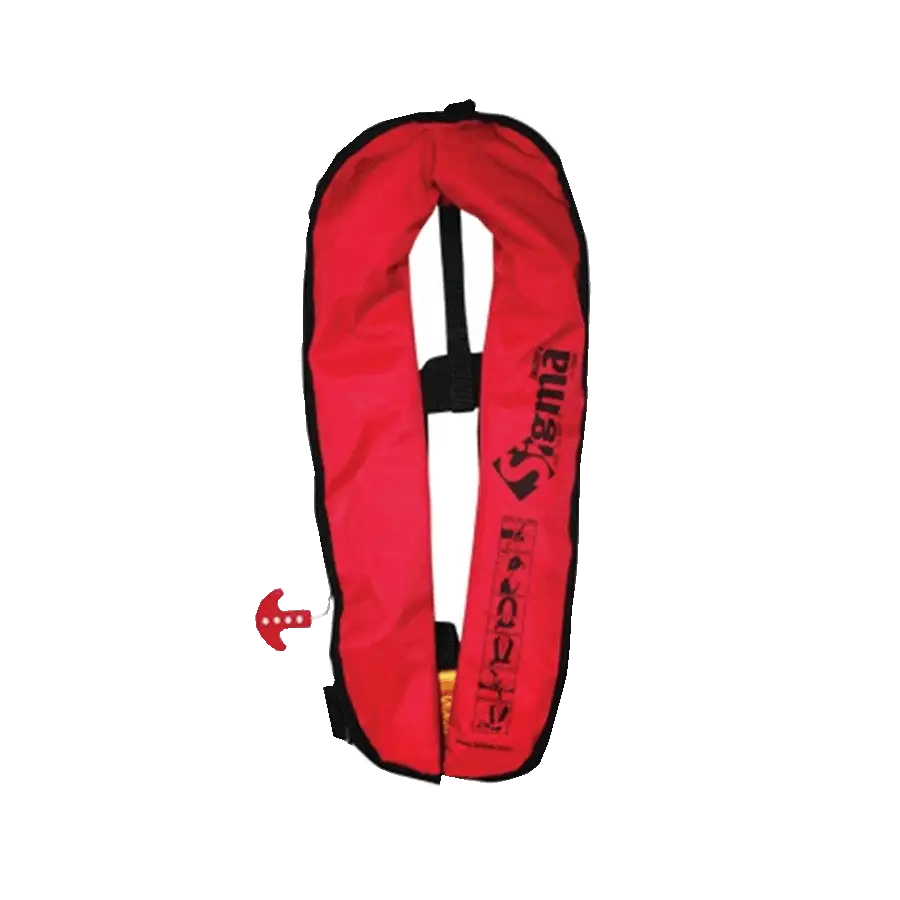
The Inflatable Lifejacket Sigma is a 170N commercial-grade inflatable lifejacket built around what the manufacturer describes as an ultra-reliable firing mechanism — a design priority that is reflected throughout the jacket’s construction. With 170 Newtons of buoyancy when fully inflated, a commercial heavy-duty outer cover, heavy-duty stainless steel D-rings for safety line attachment, and compatibility with CO2 cylinders from all major suppliers, the Sigma is specified for professional maritime use where product reliability is a non-negotiable requirement and where procurement teams need a lifejacket that performs consistently across an extended service life rather than simply passing an initial type approval test.
What makes the Sigma stand out in the commercial inflatable lifejacket category is the combination of universal CO2 cylinder compatibility and heavy-duty outer cover construction. The ability to source replacement CO2 cylinders from any major supplier — rather than being locked into a single manufacturer’s proprietary cartridge — directly reduces the operational risk of being unable to complete an annual service due to cartridge availability issues, particularly for vessels operating in ports where the original manufacturer’s service agents may not be present. For fleet managers and safety equipment procurement teams, this supply chain flexibility is a material operational advantage.
Key Features
Ultra-Reliable Firing Mechanism — The Core Performance Requirement
The Sigma’s firing mechanism is designed to the commercial reliability standard that the professional maritime market demands — not the recreational boating standard that many inflatable life jackets in the market are actually engineered to. In commercial maritime service, a lifejacket firing mechanism must perform correctly after years of storage in the varying humidity, temperature, and vibration conditions of a working vessel’s muster station locker — and it must fire consistently across the full range of water temperatures and immersion conditions that the vessel’s operating area presents. A firing mechanism that works at 25°C in a calm Mediterranean harbour must also work at 4°C in a North Sea swell. The Sigma’s mechanism is engineered to deliver that consistency.
170N Buoyancy When Fully Inflated — Open Water Performance Margin
When fully inflated, the Sigma provides 170 Newtons of buoyancy — significantly above the 150N open water standard and well above the 100N SOLAS minimum for adult emergency lifejackets. The additional buoyancy margin matters in open water emergency scenarios involving fully clothed, equipment-wearing crew members — cold water immersion suit wearers, personnel in heavy working clothing, or individuals wearing safety harnesses and additional PPE. At 170N, the Sigma provides the buoyancy reserve to support a fully equipped commercial maritime worker in the face-up position with meaningful freeboard above the waterline, even in conditions where the wearer’s clothing and equipment add significant weight drag.
Face-Up Flotation Position — Passive Airway Maintenance
The Sigma is designed to maintain the correct flotation position in the water — face-up, with the wearer’s mouth and airway above the waterline — without requiring any active effort from the wearer. This passive turning and holding capability is the defining performance requirement that separates a SOLAS-grade lifejacket from a buoyancy aid or personal flotation device. In a serious vessel emergency, crew members entering the water may be injured, in cold water shock, or exhausted. The Sigma’s bladder geometry and weight distribution are configured to achieve and maintain the face-up position for an unconscious or incapacitated casualty — not just for a conscious, active swimmer.
Commercial Heavy-Duty Outer Cover — Built for Working Vessel Conditions
The outer cover of the Sigma is constructed to a commercial heavy-duty weight specification — visibly heavier and more robust than the outer covers used on recreational-grade inflatable life jackets. In commercial maritime service, a lifejacket outer cover is exposed to the full range of working vessel conditions: rope locker dust and abrasion, deck wash and salt water spray, UV exposure at open deck muster stations, and the repeated handling associated with regular donning drills and annual inspections. A recreational-grade cover degrades under these conditions within a few years. The commercial-weight cover on the Sigma is specified to maintain its structural integrity and the protection it provides to the inflation bladder within across the longer service life expected of a commercial maritime safety appliance.
Compatible with All Major Suppliers’ CO2 Bottles — Supply Chain Independence
The Sigma firing mechanism accepts CO2 cylinders from all major lifejacket cylinder suppliers — not a proprietary cartridge format that locks the operator into a single source. In practice, this means that annual service can be completed using cylinders sourced from whichever qualified supplier is available in the vessel’s current port of call — a significant operational advantage for vessels trading across multiple ports and geographic regions where specific manufacturer service agents may not be present. For fleet managers placing large annual service orders, it also enables competitive sourcing of service consumables without being constrained to a single supplier’s pricing.
Heavy-Duty Stainless Steel D-Rings — Safety Line and Tether Attachment
The Sigma is fitted with heavy-duty stainless steel D-rings for the attachment of a safety line or tether. In commercial maritime operations — particularly on working decks, during heavy weather, and in confined spaces near open water — a safety line attached from a harness or lifejacket D-ring to a fixed point on the vessel provides a physical connection that prevents a man-overboard event from occurring in the first place. Stainless steel construction provides corrosion resistance appropriate for permanent marine service, and the heavy-duty rating of the D-rings ensures that the attachment points can sustain the load of a restraint system under fall-arrest or tether tension conditions without distortion or failure.
Technical Specifications
Product: Inflatable Lifejacket Sigma
Category: Life Jacket / Commercial Inflatable Personal Life-Saving Appliance
Buoyancy (Fully Inflated): 170 N
Buoyancy Type: Inflatable (Single Bladder)
Firing Mechanism: Ultra-Reliable Automatic / Manual Override
CO2 Cylinder Compatibility: All Major Suppliers (Universal Compatibility)
Outer Cover: Commercial Heavy-Duty Weight
Colour: Red (High-Visibility)
D-Rings: Heavy-Duty Stainless Steel (Safety Line Attachment)
Flotation Position: Face-Up (Passive Turning Capability)
Application: Commercial Maritime — Open Water / Offshore
Brand: Sigma (Lifejacket Sigma)
Regulatory Standard: SOLAS / ISO 12402 Aligned — Commercial Grade
Benefits
The practical outcome of the Sigma’s universal CO2 cylinder compatibility is a directly measurable reduction in service programme disruption risk. For a vessel fleet manager running annual lifejacket service across multiple vessels in multiple ports, the ability to source service cylinders locally from any major supplier — rather than shipping proprietary cartridges from a single manufacturer’s distributor — eliminates a category of supply chain failure that delays service completion and creates compliance gaps. A lifejacket that has passed its annual inspection date but is awaiting a proprietary cartridge from an overseas distributor is a compliance deficiency. The Sigma’s universal compatibility removes that specific risk from the service programme.
The 170N buoyancy rating provides a safety margin above the 150N open water standard that is particularly relevant for organisations operating in cold water environments, where crew members may be wearing heavy working clothing, cold water immersion suits, or personal protective equipment that adds significant effective weight in the water. At 170N, the Sigma maintains its face-up support position with the airway clear of the waterline even on a fully clothed, heavily equipped adult — the working condition that emergency lifejackets in commercial service must be able to handle.
The stainless steel D-ring fitting makes the Sigma usable as a combined lifejacket and work restraint system foundation — allowing the jacket to serve the dual function of personal flotation protection and safety line attachment point in a single piece of equipment. For organisations specifying PPE for work near open water where both man-overboard protection and fall restraint are required, the D-ring fitting consolidates two functions into one item of worn equipment, reducing the number of separate PPE components the worker needs to manage.
Who It’s For
Fleet Safety Managers — Commercial Vessel Lifejacket Specification and Service
A fleet safety manager responsible for lifejacket specification and annual service across a fleet of offshore supply vessels, cargo ships, or coastal tankers needs a commercial-grade inflatable lifejacket that performs reliably after extended storage periods, can be serviced using locally sourced cylinders in any major port, and provides documented compliance with SOLAS life-saving appliance requirements. The Sigma’s universal CO2 compatibility and commercial heavy-duty construction address both the service management practicality and the performance reliability requirements that fleet-scale lifejacket procurement demands. A product that simplifies the service programme while maintaining the performance standard — that is the procurement outcome the Sigma is engineered to deliver.
Offshore HSE Officers — Open Water and Exposed Deck Crew Protection
An HSE officer on an offshore platform or installation vessel specifying personal life-saving appliances for crew working on open decks, at crane positions, and during load transfer operations in open sea conditions needs a lifejacket rated for the buoyancy performance demanded by the operational environment. At 170N — above the 150N open water standard — the Sigma provides the buoyancy margin that offshore HSE specifications for open water working typically require, along with the D-ring safety line attachment points that offshore deck work safety protocols for tethered working near the platform edge or vessel rail also require.
Marine Safety Equipment Procurement Teams — Commercial Fleet Equipping
Procurement teams placing volume orders for commercial inflatable lifejackets across a fleet equipping project or major inventory replacement programme need a product that can be specified by a consistent, documented commercial grade standard — and whose service programme can be managed without dependency on a single proprietary service parts supplier. The Sigma’s universal cylinder compatibility provides that supply chain independence, and the commercial heavy-duty cover construction provides the service life durability that justifies the investment in a commercial-grade unit over a lower-cost recreational product that will require earlier replacement in working vessel conditions.
Possible Applications
Offshore Oil and Gas Platform Crew — Open Deck Operations
Personnel working on offshore oil and gas platform open decks, at helideck perimeters, and during crane and material handling operations at the platform edge require 150N+ rated lifejackets for open offshore water exposure. The Sigma’s 170N rating exceeds the open offshore water buoyancy standard and provides the D-ring attachment points required by offshore tethered work safety protocols.
Offshore Wind Farm Installation and Service Vessels
Technicians and crew on wind farm crew transfer vessels (CTVs), jack-up installation vessels, and service operation vessels (SOVs) working at height and near open water during turbine installation and maintenance operations require high-buoyancy inflatable lifejackets with safety line attachment capability. The Sigma’s 170N rating and stainless D-rings make it suitable for this application profile.
Commercial Fishing Vessel Crew — Open Sea Operations
Fishing vessel crew working on open deck areas during hauling, netting, and fish handling operations in open sea conditions face high man-overboard risk in environments where water temperatures, sea states, and distances from shore make rapid rescue response uncertain. A 170N inflatable lifejacket with reliable automatic firing provides the buoyancy performance and inflation reliability that open sea fishing operations demand.
Anchor Handling Tug and Supply Vessel Deck Crew
Deck crew on anchor handling tugs (AHTSs) and platform supply vessels (PSVs) performing anchor deployment, towing, and deck cargo operations in open sea and offshore environments require high-buoyancy lifejackets with tether attachment capability for working near the vessel stern and side rails. The Sigma’s 170N buoyancy and D-ring fittings are well-matched to the demanding working conditions of AHTS and PSV deck operations.
Pilot Boat Crew and Marine Pilots — Open Harbour and Coastal Approach Operations
Marine pilots and pilot boat crew operating in exposed harbour approaches, open roadsteads, and coastal boarding grounds require high-buoyancy inflatable lifejackets for the highest-risk phase of pilotage operations — the boarding and disembarkation from pilot ladders in variable sea conditions. A 170N inflatable lifejacket with automatic firing and face-up flotation capability provides the appropriate protection specification for this application.
Search and Rescue and Coastguard Crew — Operational Life-Saving Appliances
Crew on search and rescue vessels, coastguard patrol craft, and lifeboat stations require operational lifejackets that combine high buoyancy with safety line attachment capability for working near vessel rails during casualty recovery operations. The Sigma’s 170N rating, stainless D-rings, and commercial heavy-duty construction provide the performance and durability specification appropriate for SAR crew operational lifejacket use.
Port Marine Operations and Harbour Tug Crew
Crew on harbour tugs, dredgers, and port marine craft operating in partially exposed harbour and approach channel conditions require inflatable lifejackets providing open water performance buoyancy for operations that may take them outside fully sheltered harbour limits. The Sigma’s 170N rating covers the buoyancy requirement for harbour and coastal approach operations where 74N working vest buoyancy is insufficient for the exposed water conditions.
Trust & Certifications
SOLAS Chapter III — Commercial Vessel Life-Saving Appliance Standard
SOLAS Chapter III establishes the life-saving appliance requirements for commercial vessels in international trade, including the performance requirements for inflatable lifejackets used in place of or in addition to inherently buoyant foam jackets. For inflatable lifejackets to satisfy SOLAS Chapter III requirements, they must carry type approval from a recognised organisation confirming compliance with the IMO LSA Code performance requirements — including buoyancy, face-up turning capability, manual inflation backup, and oral inflation provision. Procurement teams should verify that the specific Sigma unit sourced carries a current type approval certificate acceptable to the vessel’s flag state administration and classification society.
ISO 12402-3 — International Standard for 150N+ Personal Life-Saving Appliances
ISO 12402-3 is the international product standard covering personal life-saving appliances providing 150N or greater buoyancy, appropriate for open water environments where the wearer may be unconscious and unable to assist their own rescue. Testing to ISO 12402-3 covers buoyancy performance, automatic and manual inflation function, face-up turning capability, oral inflation backup, and the performance of the bladder, harness, and attachment hardware under the stress of water entry and extended immersion. A Sigma lifejacket carrying ISO 12402-3 type approval from a recognised organisation provides the compliance basis for SOLAS Chapter III emergency lifejacket requirements.
CE Marking and MED (Marine Equipment Directive) — European Market Compliance
For vessels flagged in EU member states or operating under EU maritime regulations, lifejackets used to satisfy SOLAS Chapter III requirements must carry the Wheelmark (MED approval) — the European Union’s Marine Equipment Directive conformity mark for marine safety equipment. The MED approval process requires testing by a notified body and ongoing quality management system surveillance. Procurement teams sourcing lifejackets for EU-flagged vessel fleets should confirm MED / Wheelmark approval status for the specific Sigma model being sourced, and retain the EC Declaration of Conformity as part of the vessel’s safety management system documentation.
Universal CO2 Cylinder Compatibility — Service Programme Risk Reduction
The Sigma’s compatibility with CO2 cylinders from all major lifejacket service suppliers is an operational reliability specification, not just a procurement convenience. Proprietary cylinder dependency creates a specific compliance risk: if the designated manufacturer’s service agent or cylinder supplier is unavailable in the vessel’s port at the time of annual service, the service cannot be completed on schedule, creating a documented compliance gap. Universal compatibility eliminates this single-supplier dependency and provides procurement teams with the flexibility to manage lifejacket service across a global trading pattern without gaps driven by supply chain geography.
Accessories & Variants
Replacement CO2 Cylinder — Annual Service Consumable
The Sigma’s universal CO2 cylinder compatibility means that replacement cylinders can be sourced from any of the major lifejacket service consumable suppliers — including Halkey Roberts, Survitec, and other recognised manufacturers. Confirm the correct cylinder size and thread specification with the supplier at the point of ordering to ensure the replacement cylinder is compatible with the Sigma’s specific firing head assembly. Stocking replacement cylinders on board or at the service facility ensures that service can be completed immediately on schedule without waiting for specialist parts delivery.
Replacement Bobbin / Automatic Firing Head
The automatic firing head’s water-soluble bobbin must be replaced at each annual service to maintain the automatic inflation reliability. Bobbins have a defined service life of typically one year and must be replaced regardless of whether the jacket has been activated. Ensure that the replacement bobbin specification matches the Sigma’s firing head assembly — confirm the correct part with the supplier at the time of the annual service kit order.
Safety Line / Tether — D-Ring Connected Restraint
A safety line or tether connected to the Sigma’s stainless D-rings provides a physical tethered restraint that prevents a man-overboard event when working near vessel rails, at the platform edge, or in confined spaces near open water. Safety lines are typically specified in combination with a harness or directly to the lifejacket D-rings depending on the operational task — confirm the correct tether specification and load rating for the specific application with the HSE or safety equipment team.
Lifejacket Light — SOLAS MOB Distress Signalling
A SOLAS-compliant LED lifejacket light providing ≥0.75 cd white flash at 50–70 flashes per minute for ≥8 hours should be fitted to the Sigma for SOLAS emergency lifejacket inventory use. SOLAS Chapter III requires that commercial vessel emergency lifejackets carry a fitted light — sourcing the matching lifejacket light from the same supplier simplifies compliance documentation and annual inspection management.
Lifejacket Sigma — Available Configurations
Inflatable Lifejacket Sigma — 170N | Automatic / Manual Inflation | Universal CO2 Compatibility | Commercial Heavy-Duty Cover | Face-Up Flotation | Stainless D-Rings | Red | SOLAS / ISO 12402-3 Commercial Grade Application
For inherently buoyant foam emergency lifejacket alternatives — including the folded yoke-type adult lifejacket providing ≥103N for SOLAS vessel muster station stowage — or for 74N working vest applications in sheltered harbour environments, contact the supplier to confirm the correct product variant for the specific vessel type, operational area, and regulatory requirement.
Get in Touch
If you are specifying inflatable lifejackets for a commercial vessel fleet, offshore installation, or port maritime operation — or if you need guidance on type approval documentation, CO2 cylinder service sourcing, D-ring tether system integration, or volume procurement pricing for a fleet equipping or inventory replacement project — contact us to discuss your requirement.
Our team can confirm the correct Sigma configuration for your operational environment and regulatory requirement, advise on annual service programme design, and provide procurement documentation support for flag state, classification society, and port state control compliance purposes.
📍 3791 Jalan Bukit Merah #06-01, E-Centre @ Redhill, Singapore 159471