Cart (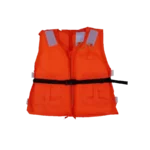

Overview
When a vessel’s crew enters the water in an emergency, the life jacket they are wearing needs to do one thing without fail: keep their airway above the waterline. That requirement — turning an incapacitated person face-up and holding them in a stable, head-supported position — is what separates a SOLAS-grade lifejacket from a general buoyancy aid or a working flotation vest. The yoke-type lifejacket design exists specifically to meet this requirement: the collar construction cradles the wearer’s head and neck, providing the passive head support that maintains the airway above water even when the wearer is unconscious, exhausted, or injured and cannot actively maintain their own position.
The Folded Yoke Type Lifejacket (Adult) is a SOLAS-compliant inherently buoyant lifejacket providing a minimum buoyancy of 103N — the performance level specified for adult life jackets under SOLAS Chapter III and ISO 12402-3 for vessels operating in open and coastal water environments. With a polyester oxford fabric outer shell, soft polyethylene foam buoyancy core, integrated collar, marine reflective tape panels, and a fitted whistle, this is a fully equipped emergency life jacket designed to meet the complete personal life-saving appliance specification for commercial vessel use without additional accessories being required.
The folded storage format — visible in the product image, with the jacket folded flat and held in a compact configuration — is specifically designed for stowage in the limited space of vessel muster station life jacket lockers, rack-mounted storage systems, and emergency equipment stations. The folded profile allows a higher density of life jackets to be stowed in a given locker volume than a bulky foam panel jacket permits — a meaningful consideration on vessels where muster station space is managed against structural constraints. When required, the jacket unfolds and is donned in the same way as a standard yoke-type lifejacket.
Key Features
Yoke / Collar Construction — Passive Head and Airway Support
The defining feature of the yoke-type lifejacket is the collar — the raised foam panel that wraps around the back and sides of the wearer’s neck when the jacket is correctly donned. In the water, this collar provides the backward tilting force on the wearer’s upper body that rotates an unconscious or face-down casualty onto their back and holds the head in a supported, face-up position. Without a collar, an unconscious casualty in a standard foam vest can float face-down, with their airway submerged. The yoke collar prevents that outcome — and it is this passive airway protection capability that distinguishes a SOLAS-specification lifejacket from a lower-rated personal flotation device. For vessels required to carry SOLAS-compliant life jackets, this is not an optional feature but a performance requirement.
≥103N Buoyancy — SOLAS Adult Lifejacket Performance Standard
The jacket provides a minimum buoyancy of 103 Newtons — the performance threshold specified for adult lifejackets under SOLAS Chapter III and the IMO Life-Saving Appliances (LSA) Code. At 103N, the jacket provides sufficient buoyancy to support an adult wearing clothing and footwear in open seawater, with adequate reserve buoyancy to maintain the face-up position with the airway clear of the waterline. The 103N minimum is the standard against which SOLAS life jacket type approvals are verified — procurement teams specifying life jackets for SOLAS vessel compliance should confirm that the specific unit sourced carries a valid type approval certificate from a recognised organisation confirming performance at or above this threshold.
Soft Polyethylene Foam Core — Inherent Buoyancy with No Inflation Requirement
Buoyancy is provided by a soft polyethylene foam core — inherently buoyant material that requires no inflation to function. In an emergency abandonment situation — fire, flooding, collision — crew members may be required to don life jackets under conditions of stress, darkness, smoke, or time pressure. An inherently buoyant foam lifejacket provides full buoyancy from the moment it is correctly donned, without any inflation step, without any activation mechanism, and without the risk of an inflation system failing to operate. For SOLAS emergency life jackets — as opposed to working vests — this reliability under the worst possible donning conditions is the primary argument for foam construction over inflatable alternatives in the emergency life-saving appliance role.
Polyester Oxford Fabric Outer Shell — Durability in Marine Storage Conditions
The outer shell is polyester oxford fabric — a woven synthetic material with good resistance to abrasion, UV exposure, salt water contact, and the humidity conditions typical of vessel life jacket lockers and muster station storage environments. Life jackets stowed aboard commercial vessels for extended periods between drills and emergency use need an outer fabric that does not degrade, mould, or lose structural integrity in marine storage conditions. Polyester oxford maintains its colour stability and structural performance through the storage periods typical of commercial vessel life jacket inventories — supporting the visual inspection compliance checks required at annual survey intervals.
Marine Reflective Tape — MOB Casualty Location at Night and in Low Visibility
Multiple reflective tape panels are fitted across the front and back of the jacket — clearly visible in the product image as the white rectangular panels on the orange shell. Marine-grade reflective tape provides retroreflective visibility under searchlight, torch, and vessel navigation light illumination at night and in reduced visibility conditions — the circumstances under which man-overboard search operations are most challenging and where rapid casualty location is most critical. SOLAS Chapter III requires that life jackets carry retroreflective material meeting performance standards for emergency visibility. The reflective tape panels on this jacket satisfy that requirement as part of the complete life-saving appliance fitting.
Integrated Whistle — Audible Distress Signalling
A whistle is fitted to the jacket as a standard component. SOLAS Chapter III requires that life jackets carried on commercial vessels be fitted with a whistle — the simplest and most reliable personal audible distress signalling device available to a casualty in the water. In harbour and coastal rescue environments, a whistle carries over vessel engine noise and wave action to alert rescue crews and vessel bridge watches to a casualty’s position when voice communication is not effective. The whistle is a mandatory SOLAS life jacket fitting and its presence — confirmed during annual inspection — is checked by flag state surveyors and port state control officers during life-saving appliance compliance inspections.
Folded Storage Format — High-Density Muster Station Stowage
The folded jacket configuration allows compact stowage in vessel muster station lockers, life jacket rack systems, and emergency equipment cabinets. On commercial vessels where muster station space is constrained by the vessel’s internal arrangement — bulk carriers, offshore supply vessels, and smaller coastal cargo vessels in particular — the ability to stow life jackets in a folded compact profile rather than a fully expanded foam panel format meaningfully increases the number of jackets that can be stored in a given locker volume. This is a practical stowage advantage that vessel owners, shipbuilders, and safety equipment specifiers consider when selecting life jacket types for new builds and refit projects.
Technical Specifications
Product: Folded Yoke Type Lifejacket (Adult)
Category: Life Jacket / SOLAS Personal Life-Saving Appliance
Buoyancy (Adult): ≥ 103 N
Buoyancy Type: Inherently Buoyant (No Inflation Required)
Buoyancy Core Material: Soft Polyethylene Foam
Outer Shell Material: Polyester Oxford Fabric
Colour: International Maritime Orange (High-Visibility)
Collar / Yoke: Integrated — Passive Head and Airway Support
Reflective Tape: Marine Reflective Tape (Front and Back Panels)
Whistle: Fitted (SOLAS Required)
Storage Format: Folded Compact Profile (High-Density Locker Stowage)
User Category: Adult
Regulatory Standard: SOLAS Chapter III / ISO 12402-3 / IMO LSA Code
Maintenance: Visual Inspection at Annual Survey (No Inflation Service)
Benefits
The most fundamental benefit the yoke-type design provides over a working vest or buoyancy aid is passive airway protection for an unconscious casualty. In a serious vessel emergency — fire, flooding, structural failure — crew members entering the water may already be injured, disoriented, or in the early stages of cold water shock. A life jacket that requires the wearer to remain conscious and physically active to keep their airway above the waterline does not provide the protection that SOLAS Chapter III emergency life jackets are intended to deliver. The collar on this jacket provides that protection passively — it is built into the design, not dependent on the casualty’s condition.
For vessel operators, the foam construction eliminates the annual inflation service requirement from the life jacket maintenance programme. On a vessel carrying twenty, forty, or sixty crew life jackets — each requiring annual cartridge replacement, bobbin inspection, and bladder pressure testing if inflatable — the shift to inherently buoyant foam construction represents a direct reduction in annual service expenditure and service management overhead. Foam life jacket maintenance is a visual inspection discipline: check the shell, the foam, the reflective tape, the whistle, and the fastening hardware — document the result and return to stowage. No service contractor required.
The complete fitting — collar, whistle, and reflective tape — means this jacket is supplied ready for SOLAS life-saving appliance inventory use without additional accessory procurement. Procurement teams sourcing life jackets for SOLAS inventory replacement or new-build equipping can specify this unit as a complete, compliant life-saving appliance rather than sourcing the jacket body and fittings separately and managing a multi-component assembly and inspection programme.
Who It’s For
Vessel Owners and Ship Managers — SOLAS Emergency Life Jacket Inventory
A ship manager responsible for equipping a fleet of cargo vessels, bulk carriers, or coastal trading ships with SOLAS-compliant emergency life jackets needs a product that can be specified confidently against SOLAS Chapter III requirements, documented with a type approval certificate, and maintained through a straightforward annual inspection process without specialist service intervention. The folded yoke-type lifejacket — providing ≥103N buoyancy, collar support, integrated whistle and reflective tape, and compact folded stowage — meets this specification profile. For a fleet manager placing a volume order to equip multiple vessels, the combination of complete SOLAS fittings and low maintenance overhead simplifies both initial procurement and ongoing safety management system compliance.
Safety Officers on Passenger and Cargo Vessels — Muster Station Life Jacket Stowage
A Safety Officer on a passenger ferry or coastal cargo vessel managing the muster station life jacket inventory faces a recurring practical problem: stowing the required number of life jackets per muster station in the locker volume available within the vessel’s structural layout. The folded storage format of this jacket provides a meaningful stowage density advantage over full-profile foam panel jackets — allowing more life jackets to be stowed per locker unit without modification to the vessel’s existing storage arrangements. For vessels where muster station design has been finalised around a specific jacket count per locker, this characteristic may determine whether the required inventory can be correctly stowed without structural alteration.
Marine Safety Equipment Distributors — SOLAS Life Jacket Stock
Marine safety equipment distributors and ship chandlers supplying SOLAS life jackets to commercial vessel operators need to stock a product that their customers can confidently specify for SOLAS Chapter III compliance — with type approval documentation available, a complete fitting specification matching SOLAS requirements, and a clearly documented maintenance profile. The folded yoke-type adult lifejacket satisfies all of these distributor stock criteria and can be supplied to vessel operators as a complete, inspection-ready SOLAS life-saving appliance from a single product line.
Possible Applications
Commercial Cargo and Bulk Carrier Crew — SOLAS Emergency Life Jacket
Crew life jackets on cargo vessels, bulk carriers, container ships, and tankers are required under SOLAS Chapter III to provide ≥100N buoyancy with collar support, whistle, and retroreflective material. The folded yoke-type adult lifejacket meets this specification and is suitable for SOLAS emergency life jacket inventory on commercial cargo vessels of all types trading internationally.
Passenger Ferry and Ro-Ro Vessel — Passenger Life Jacket Provision
Passenger life jackets on ferries and Ro-Ro passenger vessels must be provided for every person on board and must be accessible at muster stations throughout the vessel. The folded storage format is particularly suited to passenger vessel muster station stowage requirements, where large numbers of life jackets must be stowed in a compact, accessible configuration for rapid distribution to passengers unfamiliar with donning procedures.
Offshore Support Vessels — SOLAS Emergency Life Jacket Muster Stations
Offshore supply vessels, anchor handling tugs, and platform supply vessels operating in offshore environments maintain SOLAS emergency life jacket inventories at muster stations for crew use in vessel emergency situations. The yoke-type design’s passive head support capability is particularly relevant in the offshore environment, where vessel emergencies may occur in rough sea states and cold water conditions where unconscious casualty support is the critical protection requirement.
Fishing Vessel Fleet — SOLAS or National Regulation Life Jacket Compliance
Fishing vessels above the applicable gross tonnage threshold are required under SOLAS or national fishing vessel safety regulations to carry approved life jackets for each crew member. The yoke-type foam lifejacket — simple to don, no inflation mechanism to maintain, and providing the collar support required for SOLAS emergency life jacket applications — is a commonly specified type for fishing fleet life jacket inventories where robust, low-maintenance equipment is the practical priority.
Harbour Authority and Pilot Boat Operations — Emergency Life Saving Appliances
Pilot boats, harbour authority launches, and patrol craft carrying crew in open coastal and harbour approaches may be required under applicable regulations to carry emergency life jackets in addition to the working flotation vests worn by crew during normal operations. SOLAS-grade yoke-type life jackets stowed for emergency use provide the higher-performance personal life-saving appliance specification required for open or partially exposed water emergency situations.
Vessel New Build and Refit Projects — Life Jacket Inventory Specification
Shipbuilders, ship outfitters, and refit contractors equipping commercial vessels with SOLAS life-saving appliances require life jackets that can be specified by type approval reference, are available in consistent supply for fleet-scale orders, and meet the complete SOLAS fitting specification without requiring separate accessory sourcing. The folded yoke-type adult lifejacket with integrated collar, whistle, and reflective tape is suited to new build and refit life jacket inventory specification for vessels across commercial maritime sectors.
Maritime Safety Training — Emergency Lifejacket Donning Exercises
Maritime safety training centres conducting STCW basic safety training — including personal survival techniques (PST) and proficiency in survival craft and rescue boats — require SOLAS-type life jackets for donning exercises and water entry training. The yoke-type folded lifejacket provides trainees with hands-on familiarity with the SOLAS emergency life jacket type they will encounter in the vessels they serve on — making it appropriate training equipment as well as operational equipment.
Trust & Certifications
SOLAS Chapter III — International Life-Saving Appliance Requirements
SOLAS Chapter III establishes the life-saving appliance requirements for commercial vessels in international trade. Under SOLAS Chapter III regulations, life jackets carried on commercial vessels must be of an approved type meeting the performance requirements of the IMO Life-Saving Appliances (LSA) Code — including minimum buoyancy of 100N for adult life jackets, collar construction providing passive turning capability, retroreflective material, and a fitted whistle. Type approval from a recognised organisation is required before a life jacket can be used to satisfy SOLAS Chapter III requirements. Procurement teams should verify that the specific unit sourced carries a current type approval certificate from a recognised organisation acceptable to the vessel’s flag state administration.
IMO LSA Code — Life-Saving Appliances Performance Standard
The IMO’s Life-Saving Appliances Code provides the detailed performance requirements for all life-saving appliances carried on SOLAS vessels, including the buoyancy, turning capability, collar performance, and ancillary fitting specifications for life jackets. The LSA Code performance requirements for adult life jackets — ≥100N buoyancy, passive turning from face-down to face-up within five seconds, collar support maintaining the mouth above water at not less than 120mm — define what a SOLAS life jacket must actually do in the water, not just what it must weigh. The 103N buoyancy rating of this jacket exceeds the 100N LSA Code minimum, providing a buoyancy margin above the regulatory threshold.
ISO 12402-3 — International Standard for Level 150N / 100N Life-Saving Appliances
ISO 12402-3 is the international product standard covering personal life-saving appliances at the buoyancy levels appropriate for open and coastal water environments — including the 100N+ level applicable to SOLAS emergency life jackets. Testing to ISO 12402-3 covers buoyancy performance, turning capability, collar performance, donning ease, and marking requirements. Type approval against ISO 12402-3 by a recognised organisation provides the compliance basis for SOLAS Chapter III life jacket requirements on commercial vessels.
STCW Convention — Crew Familiarity and Donning Requirement
The International Convention on Standards of Training, Certification and Watchkeeping for Seafarers (STCW) requires that all seafarers be trained in the correct donning and use of the personal life-saving appliances carried on the vessels they serve on — including the yoke-type lifejacket. SOLAS Chapter III also requires that life jacket donning drills be conducted regularly with the actual life jacket types aboard. Vessels carrying this jacket type should ensure that crew donning familiarisation covers the yoke construction, collar positioning, and waist tie or fastening adjustment — the three elements of correct donning that determine the jacket’s in-water performance.
Accessories & Variants
Lifejacket Light — SOLAS Water-Activated LED Distress Light
A SOLAS-compliant LED lifejacket light providing ≥0.75 cd white flash at 50–70 flashes per minute for a minimum of 8 hours should be fitted to emergency life jackets carried on SOLAS commercial vessels. SOLAS Chapter III requires that life jackets be fitted with a light meeting IMO LSA Code specifications. For vessels stocking this jacket type for SOLAS emergency life jacket inventory use, sourcing the matching lifejacket light from the same supplier simplifies fitting, inspection documentation, and annual service management.
Personal Locator Beacon (PLB) — Individual MOB Electronic Positioning
Personal locator beacons providing AIS or DSC MOB alert capability can be fitted to SOLAS life jackets as additional distress alerting equipment — transmitting a position signal to the vessel’s AIS display or DSC receiver in a man-overboard situation. PLB integration with the life jacket inventory is a risk management enhancement for vessels operating in remote or high-traffic waterways where rapid position reporting of a MOB casualty is a critical search and rescue factor.
Life Jacket Storage Bag / Cover
Life jacket storage bags or fabric covers provide additional protection for the outer shell against UV degradation, dust accumulation, and mechanical damage during extended muster station stowage periods — particularly on open deck muster stations on vessels trading in tropical or high-UV environments. Storage covers can also carry the wearer’s name or station number for rapid distribution during muster drills and emergency musters.
Available Variants
Folded Yoke Type Lifejacket (Adult) — ≥103N | Polyester Oxford Shell | Soft PE Foam Core | Collar | Whistle | Marine Reflective Tape | International Orange | Folded Storage Format | SOLAS / ISO 12402-3 Application
For child-size lifejackets, inflatable yoke-type alternatives, or work vest applications providing 74N buoyancy for sheltered harbour environments, contact the supplier to confirm the correct variant for the specific vessel type, operating area, and crew or passenger profile being equipped.
Get in Touch
If you are equipping a commercial vessel, offshore installation, or maritime training centre with SOLAS emergency life jackets — or if you need guidance on type approval documentation, buoyancy rating selection, muster station stowage planning, or volume procurement for a fleet equipping project — contact us to discuss your requirement and request a formal quotation.
Our team can confirm the correct SOLAS life jacket specification for your vessel type and flag state requirements, advise on inspection and maintenance programme design, and support procurement documentation for classification society survey and port state control compliance purposes.
📍 3791 Jalan Bukit Merah #06-01, E-Centre @ Redhill, Singapore 159471