Cart (
Overview
When a fire breaks out on a vessel, at an industrial facility, or at a petrochemical installation, the firefighting team’s personal protective equipment is the last line of defence between the wearer and direct flame exposure, radiant heat, and the secondary hazards — steam, hot liquids, and chemical splash — that accompany structural and cargo fires. A firefighting suit that fails under thermal stress, that retains moisture and conducts heat toward the wearer, or that generates a static charge in a flammable atmosphere does not just fail to protect — it actively increases the risk to the person wearing it. In environments where the response window is measured in seconds and there is no opportunity to change equipment mid-operation, the quality of the suit determines the outcome.
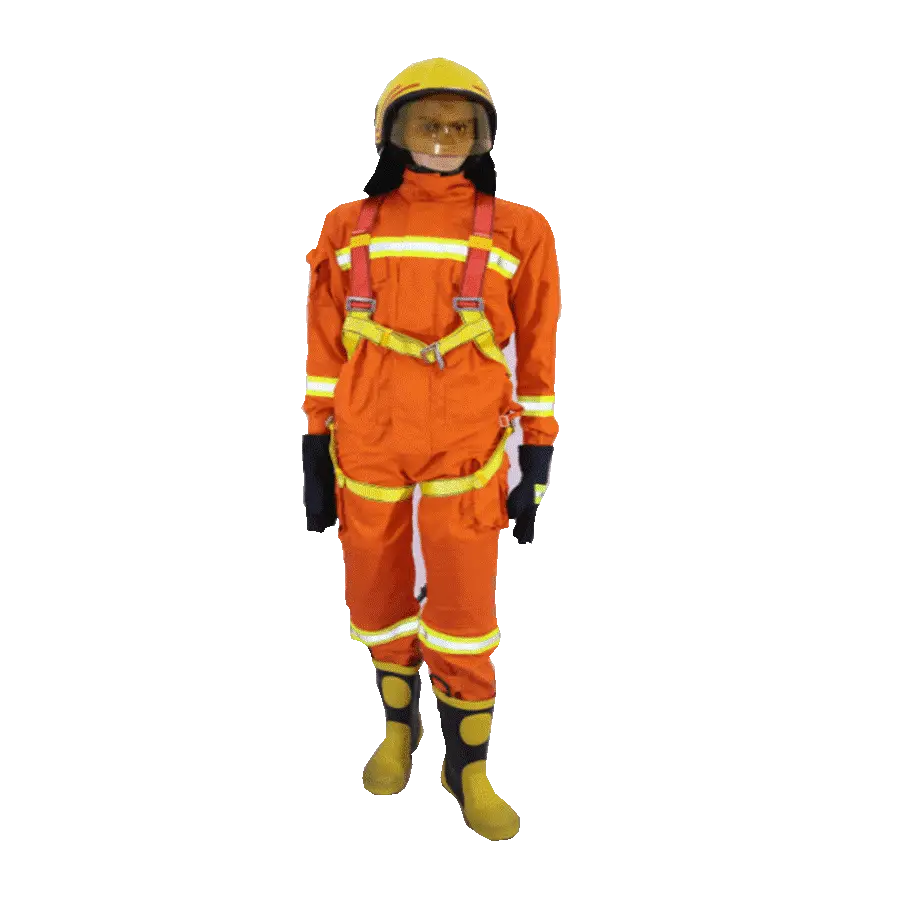
The Firefighting Suit (Nomex) is a full-body protective suit constructed from 100% Nomex fabric — DuPont’s registered flame-resistant aramid fibre material that is the established industry standard for firefighter personal protective clothing on marine vessels, offshore platforms, and industrial fire response teams. The suit weighs ≤1.8kg, incorporates 50mm reflective tape for high-visibility identification in low-light and smoke conditions, and meets the key performance parameters for marine firefighting protective clothing: moisture resistance ≥3, shrinkage ≤2.5%, and anti-static discharge time ≤3.5 seconds.
What differentiates a 100% Nomex suit from lower-specification alternatives that use Nomex blends or substitute aramid fibres is the material consistency across the entire garment. Nomex blends — where Nomex is combined with cotton, polyester, or other fibres to reduce cost — produce a suit with lower thermal protection performance than pure Nomex construction, particularly in the areas of flame resistance, shrinkage under heat, and moisture management. A 100% Nomex construction throughout ensures the suit’s stated performance parameters are achieved uniformly across all panels and seams, not only in the primary outer shell.
Key Features
100% Nomex Fabric Construction
The suit is constructed entirely from Nomex — DuPont’s meta-aramid fibre material with inherent flame resistance built into the fibre’s molecular structure, not applied as a surface treatment. Unlike flame-retardant treatments applied to standard textile fibres, Nomex’s flame resistance does not wash out, wear off, or degrade over the garment’s service life with repeated laundering and use. For HSE managers and procurement teams responsible for maintaining firefighting PPE in serviceable condition, this inherent flame resistance means the suit’s core protective performance does not diminish with age and use in the way that chemically treated alternatives do.
Flame-Retardant Performance — Does Not Sustain Combustion
Nomex fabric does not sustain combustion when the ignition source is removed — it self-extinguishes rather than continuing to burn after the flame is withdrawn. In a firefighting scenario where a suit makes momentary contact with a flame source, the difference between a fabric that self-extinguishes and one that continues to burn after contact is the difference between a manageable thermal event and a life-threatening clothing fire. Flame-retardant self-extinguishing behaviour is the fundamental performance requirement for any material used in direct firefighting protective clothing.
Anti-Static — Discharge Time ≤3.5 Seconds
The suit’s anti-static properties limit static charge accumulation and specify a discharge time of ≤3.5 seconds — meeting the anti-static performance standard for protective clothing used in flammable vapour environments. On tankers, offshore platforms, and petrochemical facilities where flammable hydrocarbon vapours may be present in the areas where firefighting operations take place, a static discharge from a non-anti-static garment creates an ignition risk. The ≤3.5 second discharge specification confirms the suit meets the anti-static performance requirement for use in these hazardous environments.
Waterproof Construction
The suit’s waterproof construction prevents liquid penetration from water used in firefighting operations — hose streams, foam application, and water spray from suppression systems. In marine firefighting, where seawater is routinely used as the primary firefighting medium, a suit that absorbs water becomes significantly heavier during the operation and conducts thermal energy toward the wearer more effectively than a dry suit — increasing heat stress and reducing protection. Waterproof construction maintains the suit’s thermal performance and manages the wearer’s physical load during extended firefighting operations involving water application.
Moisture Resistance ≥3
A moisture resistance rating of ≥3 confirms the outer shell fabric repels surface moisture effectively under the spray and splash conditions of active firefighting. Moisture resistance at this level prevents water from wetting through the outer fabric and compromising the thermal insulation layer beneath — maintaining the suit’s rated thermal protection performance throughout the operation even in high-water-exposure conditions. For marine firefighting teams operating in engine room fires, cargo hold fires, and deck fires where water is applied continuously, maintaining thermal insulation performance under wet conditions is a practical operational requirement, not just a specification parameter.
Shrinkage ≤2.5%
Shrinkage of ≤2.5% under thermal exposure confirms the suit fabric will not contract significantly when exposed to the radiant heat and elevated temperatures of a firefighting environment. Garment shrinkage under heat creates two hazards: it reduces the coverage area of the suit, potentially exposing skin at wrist, ankle, and neck areas; and it tightens the garment against the wearer’s body, reducing the air layer that provides thermal insulation and increasing the rate of heat transfer to the skin. The ≤2.5% shrinkage specification confirms the suit maintains its fit and coverage geometry under the thermal conditions of active firefighting operations.
50mm Reflective Tape — High-Visibility Identification
50mm reflective tape panels are incorporated across the suit for high-visibility identification of firefighting team members in low-light conditions, smoke-filled spaces, and night operations. In a vessel fire scenario where the firefighting team is operating in smoke-reduced visibility, the ability for team members to locate and track each other visually using reflective tape under torchlight is a meaningful safety feature — reducing the risk of team members losing contact with each other in zero-visibility conditions and supporting coordinated team withdrawal if needed.
Strong Tensile Strength and Abrasion Resistance
The Nomex fabric provides strong tensile strength and abrasion resistance — resisting tearing and surface wear from contact with rough structural surfaces, debris, and equipment during firefighting operations. In ship engine rooms, cargo holds, and industrial plant areas, firefighting teams frequently work in confined spaces with sharp edges, hot metalwork, and debris. A suit with low tensile or abrasion resistance risks tearing under these conditions — creating gaps in coverage and compromising the thermal protection the suit is designed to provide.
Technical Specifications
Product Name: Firefighting Suit (Nomex)
Fabric Material: 100% Nomex (DuPont registered meta-aramid fibre)
Weight: ≤1.8 kg
Moisture Resistance: ≥3
Shrinkage: ≤2.5%
Anti-Static Discharge Time: ≤3.5 seconds
Reflective Tape: 50mm width
Flame Resistance: Inherent (Nomex fibre) — does not wash out or degrade
Water Resistance: Waterproof
Tensile Strength: Strong
Abrasion Resistance: Yes
Anti-Static: Yes
Application: Marine Firefighting, Industrial Fire Response, Offshore Platform Fire Teams
Benefits
Inherent flame resistance that does not diminish with use and laundering. Because Nomex’s flame resistance is part of the fibre’s molecular structure rather than a chemical surface treatment, the suit’s core protective performance does not degrade over its service life. For safety managers maintaining PPE inventories, this means a Nomex suit in serviceable physical condition retains its rated flame protection — unlike treated-fabric alternatives where the flame-retardant finish degrades with washing and use, creating hidden compliance risk in aging garments that still look serviceable but have lost their original protective performance.
Low weight reduces physical fatigue during extended firefighting operations. At ≤1.8kg, the suit imposes a minimal additional physical load on the wearer. Firefighting operations are physically demanding under any conditions — heat stress, restricted movement, and breathing apparatus weight create cumulative fatigue that affects decision-making and physical capability. A suit that adds unnecessary weight to that load accelerates fatigue. The ≤1.8kg specification keeps the suit’s contribution to total PPE weight at the lower end of the range for Nomex firefighting suits.
Anti-static performance supports safe use in flammable vapour environments. The ≤3.5 second anti-static discharge specification means the suit can be used in environments where hydrocarbon vapours may be present — tanker cargo areas, pump rooms, and petrochemical plant areas — without the static ignition risk that non-anti-static garments present. For organisations where firefighting teams may need to respond to incidents in flammable atmosphere areas as well as structural fires, anti-static certification in the suit is a necessary protection layer in the overall PPE specification.
Reflective tape supports team visibility and coordination in smoke conditions. The 50mm reflective tape makes team members identifiable under torchlight in smoke-filled spaces — a practical benefit for team coordination and safe withdrawal in zero-visibility conditions. For vessel master and safety officer responsible for firefighting team safety management, a visually trackable team is a more manageable team in the high-stress conditions of an active fire emergency.
Compliant PPE for SOLAS firefighter outfit requirements on marine vessels. SOLAS Chapter II-2 requires vessels to carry firefighter outfits meeting specified performance standards for flame resistance, thermal protection, and anti-static performance. A firefighting suit constructed from 100% Nomex and meeting the moisture resistance, shrinkage, and anti-static parameters listed above provides the material performance basis for SOLAS firefighter outfit compliance documentation — supporting class survey and port state control PPE inspections.
Who It’s For
The Ship’s Safety Officer or Master Responsible for SOLAS Firefighter Outfit Compliance
You’re responsible for ensuring the vessel carries the correct number of serviceable firefighter outfits meeting SOLAS requirements, and that those outfits are inspected, documented, and replaced when they reach the end of their service life. You need a firefighting suit that meets the SOLAS performance standard for flame resistance, anti-static performance, and thermal protection — and that you can document as meeting those standards for class survey and port state control purposes. A 100% Nomex suit with documented performance parameters gives you the basis for compliant firefighter outfit records and confident survey responses.
The HSE Manager at an Offshore Platform or Petrochemical Facility
You manage PPE procurement and compliance for an offshore installation or petrochemical plant where the fire response team needs protective clothing rated for use in both structural fires and flammable vapour environments. You need suits that cover the full operational requirement — flame resistance, anti-static performance for hydrocarbon vapour areas, waterproof construction for water-intensive fire response, and physical durability for the rough working environments your team operates in. The Nomex firefighting suit’s combination of inherent flame resistance, ≤3.5 second anti-static discharge, waterproof construction, and abrasion resistance covers that requirement in a single garment.
The Procurement Manager at a Ship Management Company or Maritime Safety Equipment Supplier
You source firefighter outfits across a managed vessel fleet or for maritime safety equipment stock. You need a firefighting suit that delivers 100% Nomex construction — not a Nomex blend — at a specification that satisfies the SOLAS and class requirements for vessels across your fleet, and that is available in sufficient quantities and sizes for fleet-wide provisioning. The Nomex firefighting suit’s documented material specification and performance parameters give you the product data you need for fleet PPE procurement decisions and compliance documentation.
Possible Applications
- Marine vessel SOLAS firefighter outfits — tankers, bulk carriers, container ships — Firefighter outfit provisioning for vessels required to carry SOLAS-compliant firefighter outfits, covering cargo hold fires, engine room fires, and accommodation fires on internationally trading vessels.
- Offshore oil and gas platform fire response teams — Personal protective clothing for offshore installation fire and emergency response teams (ERT) responding to fires in process areas, accommodation modules, and drilling equipment areas.
- Petrochemical plant and refinery fire brigades — Firefighting PPE for on-site industrial fire brigades at refineries, chemical plants, and petrochemical complexes where fire response teams operate in both structural fire and flammable vapour environments.
- Tanker cargo area and pump room fire response — Anti-static rated firefighting protection for response to fires and incidents in tanker cargo tank areas, pump rooms, and cargo manifold areas where hydrocarbon vapour may be present alongside fire hazards.
- Port and terminal fire response teams — bulk liquid terminals, LNG terminals — Firefighting PPE for port fire response teams and terminal emergency response brigades operating in petroleum product, LNG, and chemical handling environments.
- Naval and coast guard vessel firefighting operations — Flame-resistant protective clothing for naval vessel firefighting crews and coast guard vessels requiring certified firefighter outfits for vessel fire response and maritime emergency operations.
- Industrial facility fire response — power generation, manufacturing, warehousing — Firefighting PPE for industrial facility in-house fire response teams at power generation plants, manufacturing facilities, and large warehousing or logistics sites with on-site fire response capability.
- Training exercises — fire response team drills and STCW firefighting training — Durable Nomex suits for use during shipboard firefighting drills, STCW basic firefighting course practical exercises, and advanced firefighting training where students and instructors require flame-resistant protective clothing during live fire exercises.
Trust & Certifications
100% Nomex — DuPont Registered Flame-Resistant Fibre Standard
Nomex is a registered trademark of DuPont, identifying the company’s meta-aramid fibre with inherent flame resistance. As a DuPont-registered material, Nomex carries a recognised material standard with a documented performance history across firefighting protective clothing, military flight suits, motorsport fire suits, and industrial flame-resistant garments globally. For procurement teams specifying firefighting PPE, the Nomex material designation provides a verifiable material standard — not a generic “flame-resistant fabric” claim — with a global track record in firefighting protective clothing applications.
SOLAS Chapter II-2 — Firefighter Outfit Requirements for Marine Vessels
SOLAS Chapter II-2 Regulation 10 requires internationally trading vessels to carry firefighter outfits meeting specified performance standards for flame resistance, thermal protection, and anti-static performance. A firefighting suit constructed from 100% Nomex and meeting the moisture resistance (≥3), shrinkage (≤2.5%), and anti-static (≤3.5s) parameters listed above provides the material performance basis for compliance with SOLAS firefighter outfit requirements. For ship operators, class surveyors, and port state control inspectors, documented material performance parameters are the reference against which firefighter outfit compliance is assessed during vessel inspections.
Anti-Static Performance — Flammable Atmosphere Safety Standard
The suit’s ≤3.5 second anti-static discharge specification meets the anti-static performance standard required for protective clothing used in environments where flammable vapours may be present — consistent with EN 1149 (European standard for electrostatic properties of protective clothing) performance intent. For tanker operators, offshore platform operators, and petrochemical facility managers specifying PPE for personnel working in or near flammable vapour zones, the anti-static performance specification is a safety compliance requirement, not an optional performance enhancement.
Supplied by Alright Engineering Solutions
The Nomex Firefighting Suit is available through Alright Engineering Solutions Pte. Ltd., an authorised distributor of marine safety equipment, personal protective equipment, and portable gas detection instruments in Singapore. Alright Engineering Solutions supports vessel operators, ship management companies, offshore operators, and industrial safety equipment procurement teams across the Singapore and regional market with PPE supply, technical product enquiries, and SOLAS compliance support.
Accessories & Variants
Firefighting Helmet
A firefighting helmet completes the head and face protection element of the firefighter outfit. For SOLAS-compliant firefighter outfit provisioning, the helmet is a required component alongside the suit — providing impact protection, radiant heat shielding for the face, and a mounting point for the visor that protects against smoke, steam, and chemical splash during firefighting operations.
Firefighting Gloves
Flame-resistant firefighting gloves protect the hands and wrists — the areas most directly exposed to flame, radiant heat, and hot surface contact during firefighting operations. Nomex or Nomex-blend firefighting gloves maintain the flame resistance and anti-static performance of the full protective ensemble at the extremities, where standard work gloves would not provide adequate thermal protection.
Firefighting Boots
Firefighting boots with heat-resistant soles, steel toe protection, and waterproof construction protect the feet and lower legs from heat, water, and impact hazards during firefighting operations. For SOLAS firefighter outfit compliance and full-body thermal protection, firefighting boots are a required component of the complete ensemble.
Self-Contained Breathing Apparatus (SCBA)
A self-contained breathing apparatus provides respiratory protection against smoke, toxic combustion products, and oxygen-deficient atmospheres during interior firefighting operations. For SOLAS firefighter outfits on marine vessels, SCBA is a required outfit component — the firefighting suit provides thermal protection while the SCBA provides the respiratory protection needed for interior firefighting in smoke-filled spaces.
Related Protective Equipment
Immersion Suits — SOLAS-compliant immersion suits for vessel abandonment and man-overboard recovery operations
Chemical Protective Suits — Full-body chemical splash and vapour protective suits for chemical tanker cargo operations and hazmat response
GX-8000 Sample Draw Multi Gas Monitor — Portable marine multi-gas monitor for pre-entry atmosphere testing before firefighting teams enter enclosed or smoke-filled spaces
RX-8700 Portable Gas Detector — Portable multi-gas monitor for post-fire atmosphere monitoring and re-entry safety assessment
Get in Touch
If you need Nomex firefighting suits for vessel SOLAS compliance, offshore fire team provisioning, or industrial fire response PPE — whether for single-vessel supply, fleet provisioning, or bulk procurement for a training or industrial facility — contact Alright Engineering Solutions to confirm availability, sizing, and request a formal quotation.
Our team can advise on complete SOLAS firefighter outfit configuration, size range availability, and related PPE components to complete your firefighter ensemble.
📍 3791 Jalan Bukit Merah #06-01, E-Centre @ Redhill, Singapore 159471