Cart (
Overview
A firefighting suit has to solve two competing problems at the same time. It must keep external thermal threats — flame, radiant heat, hot gases, and burning liquids — away from the wearer’s body. And it must allow the wearer’s body heat and perspiration moisture to escape outward, because a suit that seals the wearer inside a heat-trapping enclosure creates its own thermal injury risk through heat stress and moisture accumulation during extended firefighting operations. Suits that prioritise one at the expense of the other leave the wearer either unprotected from external heat or physically depleted from internal heat buildup — neither outcome is acceptable for operational firefighting use.
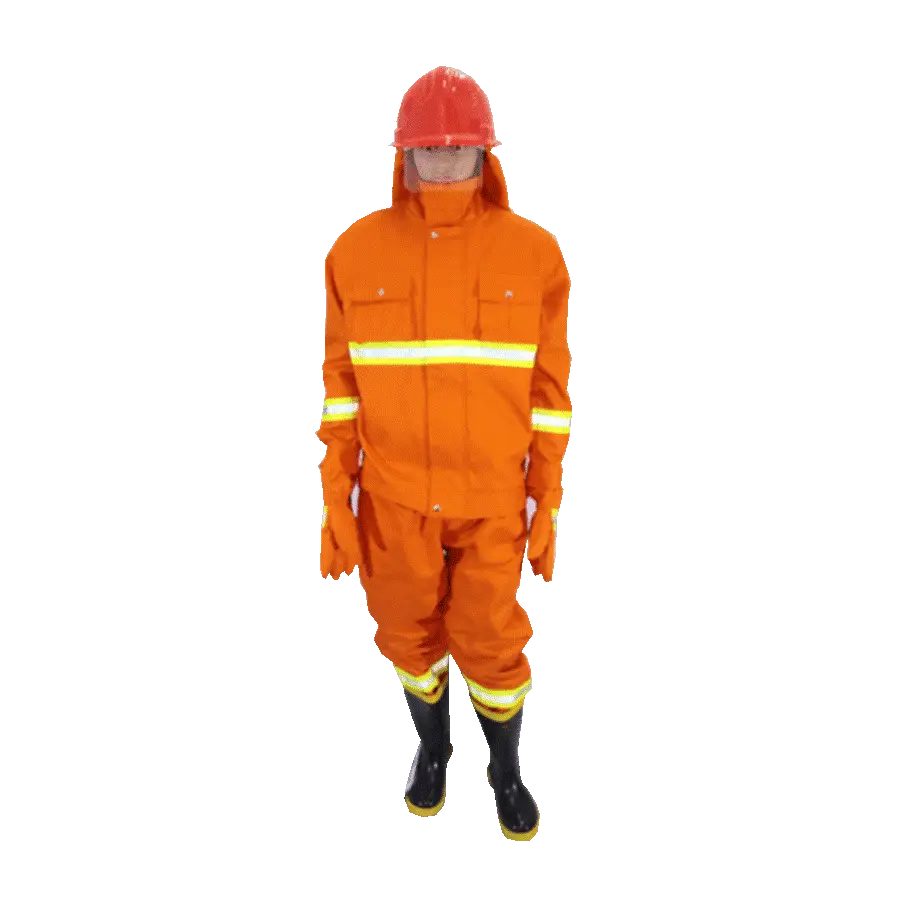
The Firefighting Suit Model No. 97 (Aramid Lattice) addresses both requirements through a multi-layer construction that separates the waterproofing and breathability functions between layers. The outer waterproof layer blocks water ingress from hose streams and foam application while allowing moisture vapour to pass outward — keeping the suit’s interior dry and the wearer’s heat stress managed. A dedicated heat insulation layer beneath provides the additional flame and thermal protection required for direct firefighting exposure. The suit is constructed with aramid sewing thread throughout, fitted with 3M reflective tape for high-visibility identification, and includes practical field features including stormplate, inner cuffs at wrists and legs, and carry pockets designed for operational firefighting use.
What differentiates the Model 97 Aramid Lattice from single-layer or basic two-layer firefighting suits is the explicit breathable waterproof layer construction — where the waterproof membrane is engineered to allow moisture vapour transmission outward while blocking liquid water inward. Many lower-cost firefighting suits use a simple waterproof coating that blocks liquid water but also traps perspiration moisture inside the suit, creating a humid, heat-retaining microclimate against the wearer’s skin during extended wear. The Model 97’s breathable waterproof layer design avoids this trade-off, providing the waterproofing required for firefighting operations without the moisture retention that accelerates heat stress in the wearer.
Key Features
Breathable Waterproof Layer — Stops Water, Passes Moisture Vapour
The outer waterproof layer of the Model 97 is engineered to block liquid water penetration while allowing perspiration moisture vapour to pass outward through the fabric. This breathable waterproof construction is the feature that prevents moisture accumulation inside the suit during extended firefighting operations involving water application — maintaining a drier, more comfortable microclimate against the wearer’s skin and reducing the rate of heat stress onset compared to non-breathable waterproof alternatives. For firefighting teams conducting extended interior firefighting operations or repeated hose-line advancement in water-intensive firefighting environments, breathability in the waterproof layer is a meaningful operational advantage.
Dedicated Heat Insulation Layer — Extra Flame and Thermal Protection
Beneath the outer shell, the Model 97 incorporates a dedicated heat insulation layer that provides an additional barrier against flame and radiant heat transfer to the wearer’s body. In a multi-layer firefighting suit, the heat insulation layer is the component that extends the time-to-pain and time-to-injury thresholds when the suit is exposed to thermal radiation and direct flame contact — giving the wearer more time to withdraw from a thermal exposure before the heat reaches a level that causes injury. A suit with only an outer shell and a moisture barrier, without a dedicated insulation layer, transfers heat to the wearer more rapidly under the same thermal exposure conditions.
Aramid Sewing Thread Throughout
The Model 97 is sewn with aramid sewing thread at all seams. In a firefighting suit, the seams are the structural weak points of the garment — they are where the outer shell, insulation layers, and inner liner are joined, and where heat transfer and garment failure under thermal stress are most likely to occur first. Using standard polyester or cotton thread at the seams of a flame-resistant outer shell creates a contradiction: the fabric may resist flame, but the thread holding it together may melt or burn, causing seam failure and loss of garment integrity under the exact conditions where the suit’s protection is most critical. Aramid thread maintains seam integrity under thermal exposure consistent with the garment’s outer shell performance.
Front Stormplate — Blocks Fire Incursion at Fastening
A specially designed front stormplate covers the suit’s front closure fastening. Front closures — zips, velcro, or button systems — are another structural vulnerability in a firefighting suit: direct flame or radiant heat impinging on an exposed front fastening can heat the closure hardware, degrade the fastening material, or create a heat channel through the suit front that bypasses the outer shell insulation layers. The stormplate provides a protective flap over the front closure, blocking direct flame and radiant heat contact with the fastening system and maintaining the closure’s function and the suit’s front-facing protection during firefighting operations.
Inner Cuffs at Wrists and Legs — Stops Fire Incursion at Extremities
The suit is fitted with inner cuffs at both wrist openings and leg openings. The wrist and ankle areas are the points where firefighting suit coverage meets glove and boot coverage — gaps at these junctions are common points of heat and flame entry in poorly designed suits, particularly when the wearer is moving, reaching, or working in confined positions that pull the suit away from the extremity. The inner cuffs create a secondary closure at these junction points, blocking fire incursion at the wrists and legs and maintaining coverage continuity between the suit and the glove/boot ensemble even when the outer cuff is displaced during movement.
3M Reflective Tape — High-Visibility Identification
3M reflective tape is fitted to the suit for high-visibility identification of firefighting team members in low-light, smoke-filled, and night operation conditions. 3M is a recognised brand in reflective safety material with a documented luminance performance specification — specifying 3M reflective tape rather than generic reflective material provides a verifiable performance reference for the suit’s high-visibility identification capability. For team leaders and safety officers managing firefighting teams in zero-visibility fire environments, reflective tape that performs consistently under torchlight is a practical team tracking and safety management tool.
Cargo Pockets and Carry Capacity
The suit includes cargo pockets designed to provide carry capacity for equipment — torches, communication devices, tools, and other items firefighting team members need accessible during operations. Firefighting operations frequently require personnel to carry equipment on their person because hands-free access to stored items is not practical in fire conditions. Integrated cargo pockets with secure closures allow essential equipment to be carried without requiring additional carry equipment that would add bulk or restrict movement in confined firefighting spaces.
Technical Specifications
Product Name: Firefighting Suit Model No. 97 (Aramid Lattice)
Construction: Multi-layer — outer shell, breathable waterproof layer, heat insulation layer
Primary Fibre: Aramid (lattice construction)
Sewing Thread: Aramid throughout
Waterproof Layer: Breathable waterproof — blocks liquid water, passes moisture vapour
Thermal Protection: Dedicated heat insulation layer
Reflective Tape: 3M reflective tape
Front Closure Protection: Specially designed front stormplate
Cuff Design: Inner cuffs at wrists and legs (fire incursion prevention)
Pockets: Cargo pockets (carry capacity)
Flame Resistance: Aramid fibre — inherent flame resistance
Application: Marine Firefighting, Industrial Fire Response, Offshore Platform Fire Teams
Benefits
Reduces heat stress during extended firefighting operations in water-intensive environments. The breathable waterproof layer’s moisture vapour transmission prevents perspiration accumulation inside the suit — the primary mechanism through which non-breathable waterproof suits accelerate heat stress during extended wear. For firefighting teams conducting prolonged interior firefighting or repeated hose-line operations, reduced internal moisture buildup translates to lower physiological heat stress, better maintained cognitive function, and extended operational endurance before heat-related fatigue becomes a safety concern.
Multi-layer construction extends time-to-injury under thermal exposure. The combination of the outer aramid shell, breathable waterproof layer, and dedicated heat insulation layer provides a more effective thermal barrier than single- or two-layer suits of equivalent outer shell specification. Each layer contributes to the total thermal resistance of the garment — the insulation layer in particular slows the rate of heat transfer to the wearer’s skin, extending the time available for safe withdrawal from a thermal exposure before tissue damage occurs.
Aramid seam integrity maintains garment protection under thermal stress. Suits sewn with standard thread risk seam failure at the same temperatures where the aramid outer shell is still providing thermal protection — creating a failure mode where the garment’s protective layers separate rather than the outer shell failing. Aramid sewing thread eliminates this failure mode, ensuring the suit maintains its structural integrity and thermal barrier continuity at temperatures consistent with the outer shell’s rated performance.
Design features close the heat entry points that basic suits leave unaddressed. The stormplate, inner wrist cuffs, and leg cuffs address the specific vulnerabilities — front closure gaps and extremity junction gaps — that allow heat and flame to enter firefighting suits during active operations. These are details that distinguish a suit designed by people who understand how heat enters a garment during actual firefighting from a suit that meets minimum fabric specifications but ignores the practical failure points that occur in operational use.
3M reflective tape provides reliable team visibility identification across operational conditions. Specifying 3M reflective tape — rather than unmarked generic reflective material — gives safety managers and procurement teams a verifiable performance reference for the suit’s high-visibility capability. In operational firefighting conditions where team tracking and safe withdrawal depend on visual identification, the performance consistency of a specified reflective tape material matters in ways that generic “reflective tape” claims do not address.
Who It’s For
The Vessel Safety Officer Equipping a Shipboard Firefighting Team
You’re outfitting the vessel’s firefighting team with the protective clothing required for SOLAS firefighter outfit compliance and operational readiness. You need a suit that provides genuine multi-layer thermal protection, handles the water-intensive conditions of shipboard firefighting operations without trapping the wearer in a heat-retaining moisture envelope, and is built with the construction details — inner cuffs, stormplate, aramid thread — that prevent the heat entry points that basic suits leave unaddressed. The Model 97 Aramid Lattice provides the multi-layer protection construction and operational design details that make it a practical choice for shipboard firefighter outfit provisioning.
The HSE Manager Procuring Firefighting PPE for an Industrial Fire Response Team
You manage PPE procurement for an industrial facility’s in-house fire response team — a refinery, petrochemical plant, or large manufacturing site where the fire response team conducts regular training drills and may respond to actual incidents. You need suits that provide the thermal protection required for industrial fire response, are comfortable enough for regular training use without creating heat stress problems, and are built to last through the physical demands of both training and operational use. The Model 97’s breathable waterproof construction, multi-layer thermal protection, and durable aramid seaming make it a viable choice for industrial fire response team PPE that will see regular active use.
The Maritime Safety Equipment Procurement Manager Sourcing Fleet PPE
You source firefighter outfits across a managed vessel fleet, balancing PPE quality requirements against procurement cost across multiple vessels and varying budget constraints. You need a suit that delivers multi-layer thermal protection, breathable waterproof construction, and operational design features at a specification level appropriate for SOLAS firefighter outfit compliance — and that represents a credible step up from minimum-specification single-layer suits without the premium cost of full Nomex construction. The Model 97 Aramid Lattice provides a multi-layer aramid construction with operational design features at a specification positioned between basic single-layer suits and full Nomex alternatives.
Possible Applications
- Marine vessel SOLAS firefighter outfit provisioning — cargo ships, tankers, bulk carriers — Multi-layer firefighter suit supply for SOLAS-required firefighter outfit compliance on internationally trading vessels across all vessel categories.
- Offshore oil and gas platform emergency response team (ERT) PPE — Firefighting protective clothing for offshore installation fire and emergency response teams operating in process areas, accommodation modules, and drilling equipment environments.
- Industrial facility in-house fire brigade — refineries, chemical plants, power generation — Fire response PPE for on-site industrial fire brigades at facilities where the fire response team conducts regular training drills and may respond to actual plant fire incidents.
- Port and terminal fire response — container terminals, bulk liquid terminals — Firefighting suit supply for port fire response teams and terminal emergency response brigades covering berth fires, vehicle fires, and warehouse or storage incidents.
- STCW basic and advanced firefighting training — practical live fire exercises — Durable multi-layer aramid suits for firefighting course practical exercises where students and instructors require flame-resistant protective clothing during live fire training scenarios.
- Municipal and commercial fire brigade supplementary suit procurement — Multi-layer aramid firefighting suits for municipal fire brigades, industrial fire contractors, and fire response service providers requiring additional suit capacity or cost-effective fleet expansion.
- Naval vessel and coast guard firefighting crew protective clothing — Flame-resistant suit provisioning for naval vessel firefighting crews and coast guard vessels requiring multi-layer thermal protection for vessel fire response operations.
- Petrochemical facility turnaround and hot work fire watch PPE — Fire-resistant protective clothing for fire watch personnel during hot work operations, vessel entry, and turnaround maintenance activities at petrochemical and refinery installations.
Trust & Certifications
Aramid Fibre Construction — Inherent Flame Resistance Standard
Aramid fibres — the fibre category that includes Nomex (DuPont) and Kevlar (DuPont) — are characterised by inherent flame resistance built into the fibre’s molecular structure rather than applied as a surface treatment. This inherent flame resistance does not wash out, wear off, or degrade over the garment’s service life with repeated use and laundering — providing consistent protective performance throughout the suit’s operational lifetime. Aramid fibres are the established material standard for structural firefighter protective clothing, military flight suits, and high-temperature industrial protective garments globally.
3M Reflective Tape — Documented Performance Reference
3M is a globally recognised manufacturer of reflective safety materials with documented luminance and retroreflective performance specifications. Specifying 3M reflective tape on the Model 97 provides a verifiable material reference for the suit’s high-visibility performance — relevant to procurement teams specifying PPE against visibility performance standards and to HSE managers who need to demonstrate that the suit’s reflective tape meets a recognisable performance benchmark rather than an undocumented generic specification.
SOLAS Chapter II-2 — Firefighter Outfit Requirements
SOLAS Chapter II-2 Regulation 10 specifies the performance requirements for firefighter outfits carried on internationally trading vessels — covering flame resistance, thermal protection, waterproofing, and anti-static performance. A multi-layer aramid suit meeting these construction standards provides the material performance basis for SOLAS firefighter outfit compliance documentation. For vessel operators, class surveyors, and port state control inspectors reviewing firefighter outfit PPE records, documented suit construction and material specification are the reference against which compliance is assessed.
Aramid Sewing Thread — Seam Integrity Standard
The use of aramid sewing thread throughout the Model 97 confirms that the suit’s seam construction meets the same flame-resistance standard as the outer shell fabric. EN 469 (European structural firefighter protective clothing standard) requires that all components of a firefighting suit — including sewing thread — meet the suit’s overall flame resistance performance requirements. Aramid thread fulfils this requirement, ensuring that the garment’s seam integrity is maintained under the same thermal exposure conditions that the outer shell is rated to handle.
Supplied by Alright Engineering Solutions
The Firefighting Suit Model No. 97 (Aramid Lattice) is available through Alright Engineering Solutions Pte. Ltd., an authorised distributor of marine safety equipment, personal protective equipment, and portable gas detection instruments in Singapore. Alright Engineering Solutions supports vessel operators, ship management companies, offshore operators, and industrial safety equipment procurement teams across the Singapore and regional market with PPE supply, technical product enquiries, and compliance support.
Accessories & Variants
Firefighting Helmet with Visor
A full-brim firefighting helmet with visor completes the head and face protection element of the firefighter ensemble, providing impact protection, radiant heat shielding, and smoke and splash protection at the face — the areas not covered by the suit collar. For SOLAS-compliant firefighter outfits, the helmet is a required outfit component alongside the suit.
Firefighting Gloves — Aramid or Leather Construction
Flame-resistant firefighting gloves extend the suit’s thermal protection to the hands and wrists, maintaining ensemble coverage continuity at the wrist junction where the suit’s inner cuffs provide secondary closure. Aramid or leather firefighting gloves with thermal insulation provide the hand protection required for direct firefighting contact and equipment handling in fire environments.
Firefighting Boots — Heat-Resistant, Steel-Toed
Firefighting boots with heat-resistant soles, steel toe protection, and waterproof construction protect the feet and lower legs at the ankle and leg junction where the suit’s inner leg cuffs provide secondary closure. For complete lower-extremity protection continuity, firefighting boots should provide coverage that overlaps with the suit leg at the inner cuff.
Self-Contained Breathing Apparatus (SCBA)
SCBA provides respiratory protection against smoke, toxic combustion products, and oxygen-deficient atmospheres during interior firefighting operations — the respiratory protection component of the complete firefighter outfit that the suit alone does not provide. For SOLAS firefighter outfit compliance on marine vessels, SCBA is a required outfit component.
Nomex Firefighting Suit — Alternative Full Nomex Construction
For applications requiring 100% Nomex fabric construction with documented DuPont material specification — including vessel operations where class surveyors or flag state inspectors specify Nomex by material name — the Nomex Firefighting Suit provides a full Nomex outer shell construction as an alternative to the Aramid Lattice Model 97.
Related Safety Equipment
Immersion Suits — SOLAS-compliant immersion suits for vessel abandonment and man-overboard recovery
GX-8000 Sample Draw Multi Gas Monitor — Portable multi-gas monitor for pre-entry atmosphere testing before firefighting teams enter enclosed or smoke-filled spaces
RX-8700 Portable Gas Detector — Portable multi-gas monitor for post-fire atmosphere monitoring and re-entry safety assessment
Get in Touch
If you need the Firefighting Suit Model No. 97 (Aramid Lattice) for vessel firefighter outfit provisioning, industrial fire response team PPE, or fleet safety equipment procurement — whether for immediate supply, fleet-wide provisioning, or guidance on suit sizing and complete firefighter outfit configuration — contact Alright Engineering Solutions to confirm availability and request a formal quotation.
Our team can advise on size range availability, complete SOLAS firefighter outfit configuration including helmet, gloves, boots, and SCBA, and can help you compare the Model 97 Aramid Lattice against the Nomex variant for your specific application and compliance requirements.
📍 3791 Jalan Bukit Merah #06-01, E-Centre @ Redhill, Singapore 159471