Cart (
Overview
On any commercial vessel subject to MARPOL Annex I, the bilge alarm is not an optional installation — it is a legally required system, and its approval status, calibration condition, and operational record are all subject to port state control inspection. The challenge for ship operators and technical managers is not simply meeting the requirement at installation; it is keeping the system in a reliably calibrated and verifiable condition throughout its service life, across port calls in multiple PSC regimes, and on vessels where access to specialist service technicians during routine port calls cannot always be guaranteed.
Measuring cell calibration is the point where most OCM systems create operational friction. Conventional OCMs require the measuring cell to be calibrated in place, by a qualified technician, with the system temporarily offline. On a vessel with a tight port schedule, this means either deferring calibration — creating a compliance gap — or scheduling an unplanned service call that adds cost and coordination complexity to an already pressured port turnaround.
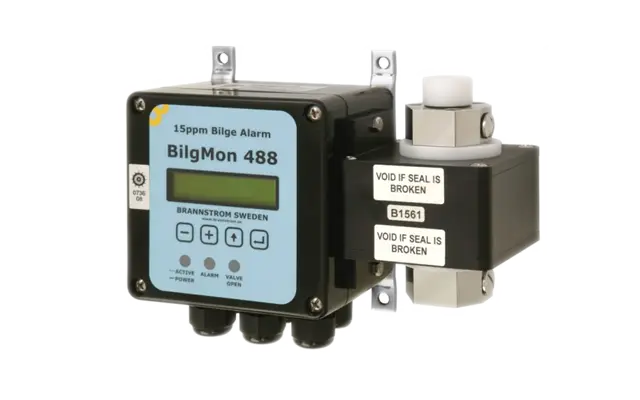
The Scanjet BilMon 488 15ppm Bilge Alarm addresses this directly. Its detachable measuring cell communicates with the control unit via wireless connection, allowing the cell to be removed and replaced with a freshly calibrated cell in minutes — without shutting down the control unit, without requiring onboard calibration equipment, and without needing a service technician onboard for the exchange. This swap-and-go calibration approach is the defining operational differentiator of the BilMon 488, and the reason it has become a practical choice for fleet operators looking to maintain MEPC.107(49) compliance without the service logistics burden of conventional OCM calibration procedures.
Key Features
Detachable Measuring Cell with Wireless Communication
The BilMon 488’s measuring cell connects to the control unit wirelessly, making it fully detachable without breaking any electrical connections. When calibration is due — or when the cell requires service — the existing cell is simply removed and replaced with a pre-calibrated replacement unit. The wireless link re-establishes automatically, and the system returns to operation without any reconfiguration. For vessels on tight port schedules or operating in regions where specialist OCM service is not readily available, this architecture converts what is normally a planned maintenance event requiring technician attendance into a straightforward crew-executable cell swap. Replacement cells can be pre-ordered, held on board as a spare, or supplied to the vessel at any port call — simplifying the logistics of maintaining a calibrated bilge alarm system across a global trading pattern.
MEPC.107(49) Type Approval — Mandatory IMO Certification
The BilMon 488 carries Type Approval under IMO Resolution MEPC.107(49), the performance standard that defines the minimum requirements for 15ppm oil content monitors used in MARPOL-compliant bilge alarm systems. MEPC.107(49) Type Approval is a mandatory requirement for any OCM fitted to a commercial vessel subject to MARPOL Annex I — without it, the system cannot be accepted by a flag state administration or classification society as compliant equipment. Type Approval also means the system has been independently tested against the IMO’s performance standard, not simply self-certified by the manufacturer. For procurement teams and technical superintendents specifying OCM equipment, MEPC.107(49) Type Approval is the non-negotiable baseline that closes the discussion on regulatory acceptability.
Compact Dimensions — Retrofit-Ready for Existing Separators
The BilMon 488 has been designed with physical dimensions that make it practical for retrofit installation on existing bilge separators as well as newbuilding outfitting. Many vessels operating with older OCM systems face a straightforward problem: the replacement unit needs to fit within an already congested engine room space, with existing piping connections that cannot easily be repositioned. The BilMon 488’s compact form factor reduces the installation constraints for retrofit projects, allowing the system to be mounted in spaces where a larger unit would not fit without significant modification to the surrounding installation.
Automatic Fresh Water Flushing
The BilMon 488 includes an automatic fresh water flushing system, supplied complete with a 3-way flushing valve and piping set. Automatic flushing clears the measuring cell and flow path between measurements, removing oil residues and suspended solids that would otherwise accumulate on the optical measurement surfaces and degrade reading accuracy over time. On vessels where bilge water composition varies significantly — from periods of low contamination to periods of heavy oil or solids loading — regular automatic flushing maintains measurement accuracy without requiring manual intervention from the crew. The complete piping set included with the system means the flushing installation can be completed without sourcing additional components, reducing installation complexity for both newbuilding outfitters and retrofit project teams.
Dual Power Supply — 115/230 VAC and 24V AC/DC
The BilMon 488 accepts both 115/230 VAC mains supply and 24V AC/DC, giving it a broad compatibility range across different vessel electrical configurations. This dual-voltage capability is particularly relevant for retrofit installations, where the available power supply at the installation location may be 24V DC (typical of control panel and instrument power circuits on many vessels) rather than the 115/230V AC supply required by some competing OCM systems. For outfitting engineers specifying the system for a newbuilding series or a fleet retrofit programme, the dual power supply option reduces the number of installation variants that need to be managed across different vessel types and electrical configurations.
LCD Display and Keypad — Straightforward User Interface
The BilMon 488 uses an LCD display and keypad for the primary user interface. The LCD provides a clear, direct readout of current oil content in ppm — no interpretation required. The keypad allows alarm setpoint configuration, system status checking, and data retrieval access without requiring a connected laptop or external device. For engine room crew managing the bilge alarm system as one element of a broader engine room watchkeeping routine, a direct-read display with keypad access is faster and more practical than a menu-driven interface requiring a connected device. The system also supports data retrieval via USB port for documentation purposes and shore-based record transfer.
5ppm Clean Design Variant Available
On special request, the BilMon 488 is available as a 5ppm version meeting the requirements of the DNV Clean Design class notation. DNV Clean Design is a voluntary environmental notation applied to vessels designed and operated to reduce their environmental impact beyond mandatory MARPOL requirements. For vessel owners pursuing Clean Design notation as part of a broader environmental strategy — increasingly relevant in the context of charterer and financier ESG requirements — the 5ppm BilMon 488 variant provides the tighter discharge threshold required by the notation, within the same physical system that satisfies standard 15ppm MARPOL requirements on the rest of the fleet.
Technical Specifications
Model: BilMon 488
Oil Content Range: 0 – 30 ppm
Analogue Output: 0–20 mA or 4–20 mA
Power Supply: 115/230 VAC or 24V AC/DC
Display: LCD display with keypad
Wireless Connectivity: Wireless communication — measuring cell to control unit
Measuring Cell: Detachable, wirelessly communicating, field-replaceable
Flushing System: Automatic fresh water flushing
Supplied Accessories: 3-way flushing valve, piping set, connectors
Data Retrieval: LCD display or USB port
Safety Approvals: MEPC.107(49) Type Approved
5ppm Variant: Available on special request — meets DNV Clean Design notation
Benefits
The most direct operational benefit of the BilMon 488 is the removal of on-board calibration as a maintenance constraint. On a conventional OCM, calibration requires the system to be taken offline, a technician to attend, calibration equipment to be available, and the procedure to be carried out correctly and documented. Any one of these requirements can cause a calibration to be deferred — and a deferred calibration means an uncertified system, which means a compliance gap. The BilMon 488’s replaceable cell design replaces this multi-step procedure with a single swap action that can be performed by the vessel’s own crew, using a pre-calibrated replacement cell ordered in advance. The result is a predictable, controllable calibration schedule that does not depend on port availability of specialist service technicians.
For fleet managers operating vessels across diverse trading routes, this has a compounding benefit: calibration intervals can be planned and budgeted as a fixed logistics cost — replacement cells ordered and delivered to the vessel at convenient port calls — rather than as an unplanned service event triggered by calibration failure or upcoming PSC inspection. The cost and disruption associated with emergency OCM calibration or replacement in a port without established service infrastructure is eliminated by design.
For HSE and compliance officers, the BilMon 488’s USB data retrieval capability provides a straightforward mechanism for extracting and archiving the OCM’s operational record — the data log that demonstrates continuous compliant operation for Oil Record Book purposes and PSC inspection documentation. Local retrieval via USB, without requiring network connectivity or shore-based system access, means the compliance record can be pulled and reviewed at any time, in any location.
Who It’s For
Technical Superintendents Managing Fleet OCM Compliance
A technical superintendent responsible for maintaining MARPOL compliance across a fleet of bulk carriers trading across Asia, Europe, and the Americas knows that coordinating OCM calibration across vessels at different ports on different schedules is one of the more time-consuming elements of the compliance management role. Specifying the BilMon 488 across the fleet converts calibration from a service coordination problem into a spare parts logistics problem — replacement cells can be ordered centrally, shipped to vessels at planned port calls, and swapped by the crew without technician attendance. For a superintendent managing ten or more vessels, that operational simplification translates directly into time saved and reduced risk of compliance gaps from missed or deferred calibrations.
Chief Engineers on Vessels with Tight Port Schedules
A chief engineer on a container feeder or short-sea trader operating on a schedule where port calls are measured in hours, not days, faces real constraints when the OCM calibration falls due. Arranging a service technician attendance in a short turnaround port is often impractical — and the alternative, departing with an uncalibrated or overdue OCM, creates a PSC inspection risk at the next port. With the BilMon 488, the chief engineer can hold a spare calibrated cell onboard, swap the cell during cargo operations without interrupting engine room watch duties, and depart with a fully calibrated and compliant system — the entire procedure taking minutes rather than a half-day service event.
Newbuilding Project Teams at Shipyards
A project engineer outfitting a series of general cargo vessels at a regional shipyard needs an OCM that satisfies Class plan approval requirements, fits within the engine room layout without requiring bespoke pipework modifications, and can be delivered on the outfitting schedule. The BilMon 488’s compact dimensions, complete piping set inclusion, and MEPC.107(49) Type Approval make it a low-friction specification choice for newbuilding outfitting — one system covers the standard 15ppm Class requirement, with the 5ppm Clean Design variant available for owners pursuing the DNV environmental notation on the same vessel series.
Possible Applications
Bulk Carriers on Global Trading Routes — Continuous bilge water monitoring on vessels calling at ports across multiple PSC regimes; the replaceable cell design supports calibration compliance without specialist service access at every port of call.
Container Feeders and Short-Sea Traders — OCM installation on high-frequency port call vessels where conventional calibration scheduling is impractical; crew-executable cell replacement allows calibration to be maintained on tight turnaround schedules.
Offshore Support Vessels — Bilge monitoring on vessels operating in environmentally sensitive offshore locations where continuous certified operation is required and shore-based service access between campaigns is limited.
DNV Clean Design Vessels — 5ppm variant installation on vessels pursuing or maintaining DNV Clean Design class notation, providing a tighter discharge threshold within the same system platform.
Retrofit Installations on Existing Separators — Replacement of aging or non-compliant OCM systems on vessels where engine room space constraints would prevent installation of a larger unit; the BilMon 488’s compact dimensions make it a practical retrofit candidate without pipework modification.
Tankers and Chemical Carriers — MARPOL-compliant bilge monitoring with documented data logging for Oil Record Book Part I, supporting PSC inspection requirements in USCG and Paris MOU port state control regimes.
Newbuilding Series Outfitting — Standard OCM specification across vessel series where a single MEPC.107(49)-approved model with simple post-delivery calibration maintenance reduces lifecycle service complexity for fleet operators.
Trust & Certifications
MEPC.107(49) Type Approval — IMO Mandatory OCM Standard
IMO Resolution MEPC.107(49) establishes the revised performance and testing standards for 15ppm oil content meters used in MARPOL bilge alarm systems. Type Approval under this resolution is the mandatory certification that any OCM must hold to be accepted as compliant equipment by a flag state administration or classification society. The BilMon 488’s MEPC.107(49) Type Approval confirms independent verification of its measurement accuracy, alarm performance, data recording capability, and all other requirements of the IMO standard — providing the regulatory baseline required for installation on any commercial vessel subject to MARPOL Annex I.
DNV Clean Design Notation Compliance — 5ppm Variant
DNV’s Clean Design class notation is a voluntary environmental designation awarded to vessels designed to reduce pollution beyond MARPOL’s mandatory requirements. The notation includes a requirement for an oil content monitor with a 5ppm discharge threshold rather than the standard 15ppm MARPOL limit. The BilMon 488’s 5ppm variant meets the Clean Design notation requirement, making it the appropriate OCM choice for owners pursuing or maintaining this notation — increasingly relevant as charterers and financiers apply ESG criteria to vessel selection and fleet investment decisions.
Scanjet — Established Marine Equipment Manufacturer
Scanjet is a Swedish marine equipment manufacturer with a long-standing presence in the commercial shipping market, producing a range of tank cleaning, bilge monitoring, and fluid handling systems for vessels worldwide. The BilMon 488 is part of Scanjet’s established OCM product line, supported by a global service and distribution network. For ship operators and procurement teams, Scanjet’s established market presence and documented service infrastructure provide confidence that replacement cells, technical support, and spare parts will remain available throughout the system’s operational life — a practical consideration when specifying equipment for vessels with 20–25 year service lives.
Accessories & Variants
Pre-Calibrated Replacement Measuring Cell
The key service accessory for the BilMon 488 is the pre-calibrated replacement measuring cell. Ordered in advance and delivered to the vessel at a convenient port call, the replacement cell allows the vessel’s crew to perform the calibration exchange without technician attendance. Holding a spare calibrated cell on board eliminates the risk of calibration-related compliance gaps on vessels operating in regions where specialist service is not readily available.
3-Way Flushing Valve and Piping Set
Supplied as standard with the BilMon 488, the 3-way flushing valve and piping set form the automatic fresh water flushing circuit. For retrofit installations where the existing pipework configuration may differ from the standard installation, additional or alternative piping components may be required — these can be specified at the time of order based on the vessel’s existing separator and bilge system layout.
USB Data Retrieval
Data retrieval via USB port allows IMO-required operational records to be extracted to a USB storage device for transfer to shore management systems, flag state documentation requirements, or PSC inspection files. No dedicated software installation is required for basic data transfer, keeping the documentation process straightforward for vessel crews.
BilMon 488 — 5ppm Clean Design Variant
Available on special request, the 5ppm variant of the BilMon 488 shares the same platform, installation footprint, and replaceable cell architecture as the standard 15ppm system, with a tighter detection and alarm threshold that meets DNV Clean Design notation requirements. For fleet operators running both standard and Clean Design vessels, the common platform simplifies crew training, spare cell logistics, and service procedures across the fleet.
Get in Touch
If you are specifying a MARPOL-compliant bilge alarm for a newbuilding project, replacing an ageing OCM on an existing vessel, or looking for an OCM solution that simplifies calibration maintenance across a trading fleet — contact us to discuss your requirements and request a formal quotation for the BilMon 488.
Our team can advise on the standard 15ppm configuration or the 5ppm Clean Design variant, confirm replacement cell availability for your fleet’s trading routes, and support installation planning for both newbuilding and retrofit projects.