
 Cart (
Pressure & Temperature Instrument Calibration in Singapore
On-board calibration of pressure gauges, switches, transmitters and temperature sensors on ships alongside or at anchorage in Singapore. We test against traceable reference standards, check the alarm and shutdown set points they feed, and issue a certificate with as-found and as-left readings.
- ISO 9001:2015
- ISO 45001:2018
- bizSAFE Level 4
- bizSAFE Star
- Alongside & anchorage
- As-found / as-left certificate
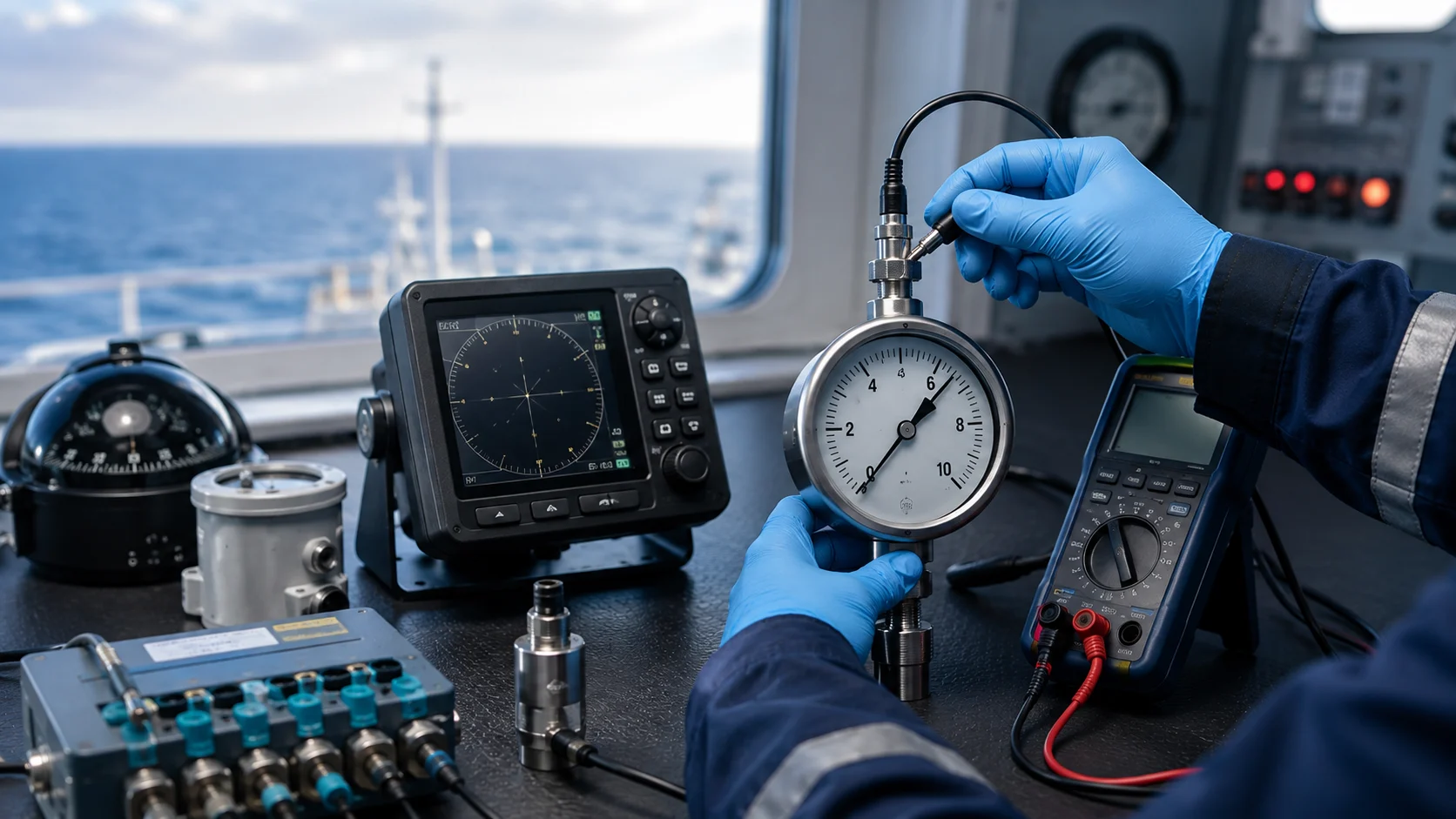
Pressure and temperature calibration in Singapore, in short: Alright Engineering Solutions (AES) calibrates pressure gauges, pressure switches, pressure transmitters, thermometers, RTDs and thermocouples on ships in Singapore. Each instrument is compared with a traceable reference at several points, adjusted where it can be, and recorded as found and as left. Where an instrument feeds an alarm or shutdown, we check that the set point trips where it should.
Pressure and Temperature Instruments We Calibrate
From the engine room gauge board to the cargo control room, one attendance can cover the instruments your planned maintenance system says are due.
Pressure gauges
Bourdon tube and digital gauges on main and auxiliary engines, boilers, compressors, pumps and hydraulic systems, plus test gauges.
Pressure switches
Low lube oil, low cooling water and high pressure switches, checked for switching and reset points against the alarm list.
Pressure transmitters
4–20 mA and smart transmitters checked at the sensor and at the alarm monitoring system display, so the loop agrees end to end.
Temperature sensors
PT100 RTDs and thermocouples, including exhaust gas, jacket cooling water, lube oil and cargo pump temperature monitoring.
Indicators & controllers
Temperature indicators, transmitters and controllers, plus thermometers and temperature gauges on local panels.
Calibrators & test tools
Pressure calibrators, manometers, temperature calibrators, multimeters, torque wrenches and tachometers carried on board.
How Each Instrument Type Is Checked
A single reading at one point tells you very little. We check across the range the instrument actually works in. More detail in our guide to pressure gauge, switch and transmitter calibration for vessels.
| Instrument | Reference used | What we check |
|---|---|---|
| Pressure gauge | Calibrated reference gauge or pressure calibrator on a hand pump or comparator | Readings at several points rising and falling, to catch error and hysteresis |
| Pressure switch | Pressure calibrator | Pressure at which the contact changes over and resets, against the set point |
| Pressure transmitter | Pressure calibrator plus mA meter | Output at 0, 25, 50, 75 and 100% of range, and the AMS reading |
| RTD / PT100 | Reference probe in a dry-block or bath | Resistance or reading against the reference at several temperatures |
| Thermocouple | Reference probe or temperature calibrator | Sensor response, compensation and indicator reading |
| Thermometer / temp gauge | Reference probe in a dry-block or bath | Indication at several points across its scale |
Most of These Instruments Protect an Engine, Not Just Show a Number
A low lube oil pressure switch that trips late, or an exhaust temperature sensor reading 20°C low, won't show up on a walk-round. It shows up when the engine is already in trouble. That's why we calibrate the sensor and then confirm the alarm or slowdown it feeds.
- Switch and transmitter set points checked against your alarm and shutdown list
- Sensor reading compared with what the AMS or local panel actually displays
- Faulty sensors, capillaries and cabling flagged with the readings to back it up
- Records ready for the machinery and alarm system checks at class surveys
Not sure what's due? Our marine instrument calibration interval table sets out common intervals by instrument type.
How an On-Board Calibration Job Runs
Planned around your port stay and the machinery that can be isolated.
Send the list
Tag numbers, ranges and locations from your PMS, plus ETA, ETD and berth or anchorage.
Plan isolation
We agree with the chief engineer which systems can be isolated and when, so nothing critical is taken out at the wrong time.
As-found test
Each instrument is checked against the reference before any adjustment, so the drift is on record.
Adjust or replace
Zero and span are adjusted where the design allows. Instruments outside tolerance that can't be adjusted are flagged for replacement.
Loop & alarm check
Transmitters are checked through to the AMS, and switches through to the alarm or shutdown they trigger.
Certificate & labels
As-left readings go on the certificate, each instrument gets a calibration label, and the list is ready for your PMS.
Large gauge list? Send it ahead and we'll plan the attendance around your port window.
On-Board Calibration vs Sending Instruments Ashore
Fixed instruments are best done where they're installed. Portable test tools can go either way.
| On board | Ashore | |
|---|---|---|
| Best for | Fixed gauges, switches, transmitters and sensors | Portable calibrators, test gauges and spare instruments |
| Loop and alarm check | Yes, through to the AMS and shutdowns | No, instrument only |
| Removal needed | Usually not, or only briefly | Yes |
| Time on board | Planned around isolation windows | None for the ship |
What We Find When Ship Instruments Are Tested
Gauges reading high at zero
Vibration and pressure pulses bend the Bourdon tube and shift the pointer. The gauge looks fine but reads wrong.
Switches tripping late
Worn diaphragms and stiff contacts move the switching point away from the alarm set point.
Transmitter vs AMS mismatch
The transmitter is correct, but scaling in the AMS isn't, so the display and the real pressure disagree.
Thermocouple drift
Exhaust gas thermocouples age in high heat and start reading low, hiding a cylinder running hot.
Damaged capillaries
Kinked or broken capillary lines on temperature gauges give slow or frozen readings.
Blocked impulse lines
Sludge in gauge lines and snubbers dampens the reading or stops it moving.
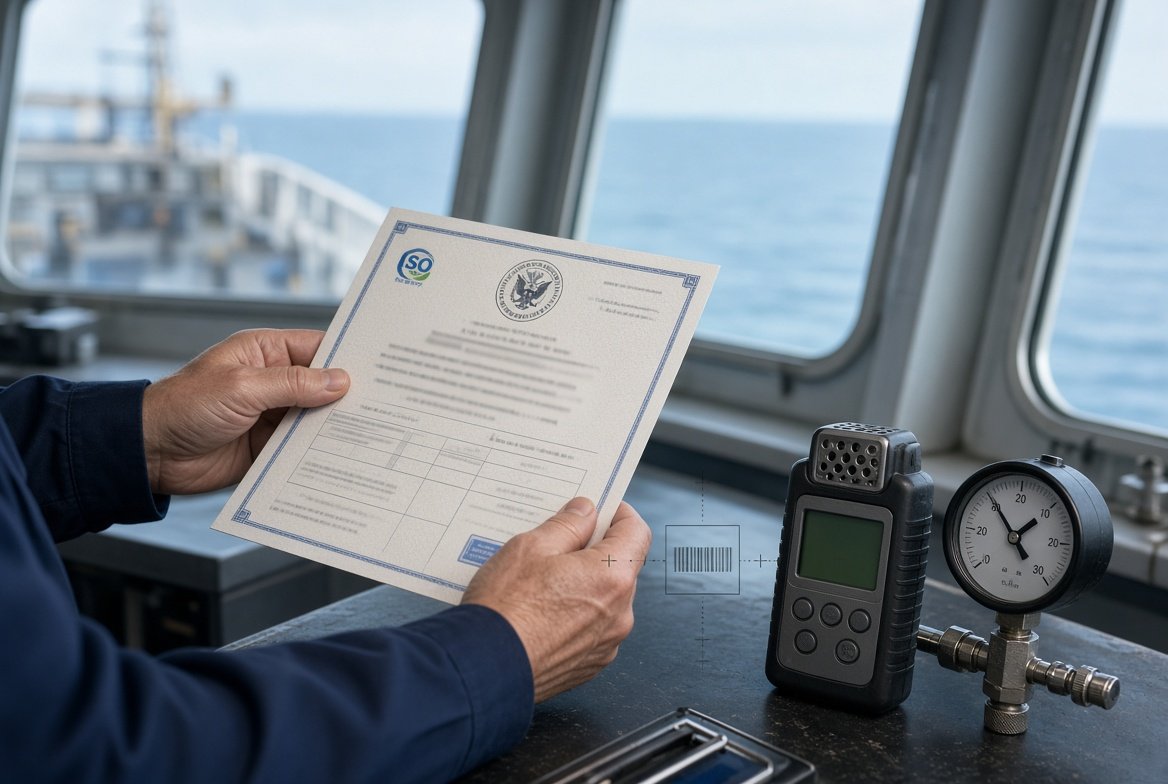
What's on Your Calibration Certificate
- Instrument tag, make, model, serial number and range
- Reference standard used, with its own certificate details
- As-found and as-left readings at each test point
- Switch set and reset points, where applicable
- Pass or fail against the stated tolerance
- Date, vessel, next due date and engineer's signature
See what inspectors check in our guide to marine calibration certificates.
Booking checklist — send us these
- Vessel name and IMO number
- Instrument list from your PMS: tag, type, range, location
- Alarm and shutdown set points for switches and transmitters
- Berth or anchorage, ETA and ETD
- Any instruments already known to be faulty
Why Ship Managers Use AES for Instrument Calibration
- Marine-first. We calibrate instruments where they work, on board, and check the alarms they feed.
- Quality system that covers it. ISO 9001:2015 certified, with a scope that includes ship fixed machinery instruments and control automation.
- Safe work on board. ISO 45001:2018, bizSAFE Level 4 completed and bizSAFE Star.
- Alongside and at anchorage. Planned around your port stay and isolation windows.
- More done per port call. Combine with gas detector, ODME and OWS or UTI meter calibration.
See all our marine calibration services in Singapore.

Pressure & Temperature Calibration in Singapore: Common Questions
How often should ship pressure gauges and temperature sensors be calibrated?
Follow the maker's recommendation and your planned maintenance system. Many operators work to a yearly cycle, with safety-critical switches and test gauges checked more often. Our interval table lists common intervals.
Can you calibrate instruments without removing them?
Often, yes. Many gauges and transmitters can be tested in place through a test connection or isolating valve. Where an instrument has to come off, we refit it the same day.
Do you check the alarm or shutdown as well as the sensor?
Yes. For switches and transmitters we confirm the set point against your alarm list and check that the alarm or shutdown actually responds.
Are your certificates SAC-SINGLAS accredited?
Our certificates are traceable calibration certificates issued under our ISO 9001:2015 quality system. If your class, flag or charterer specifically asks for an ISO/IEC 17025 accredited certificate for an instrument, tell us when you book and we'll advise on the right route. Our article on ISO 17025 vs manufacturer calibration explains when each is accepted.
Can you calibrate at anchorage?
Yes. We attend ships at Singapore anchorages as well as alongside at terminals and shipyards. Your agent usually arranges the launch.
What happens if an instrument fails calibration?
We record the as-found reading, adjust it if the design allows, and flag it for replacement if not. The certificate shows the result either way, so your PMS stays accurate.
How much does pressure and temperature calibration cost?
It depends on the number of instruments, their types and where the ship is. Send your list through the contact form or WhatsApp and we'll price it before we board.
Get Your Pressure and Temperature Instruments Calibrated in Singapore
Send the vessel details and your instrument list. We'll confirm timing and price, then attend alongside or at anchorage.
Email sales@alrightes.com · 3791 Jalan Bukit Merah #06-01, E-Centre @ Redhill, Singapore 159471