
 Cart (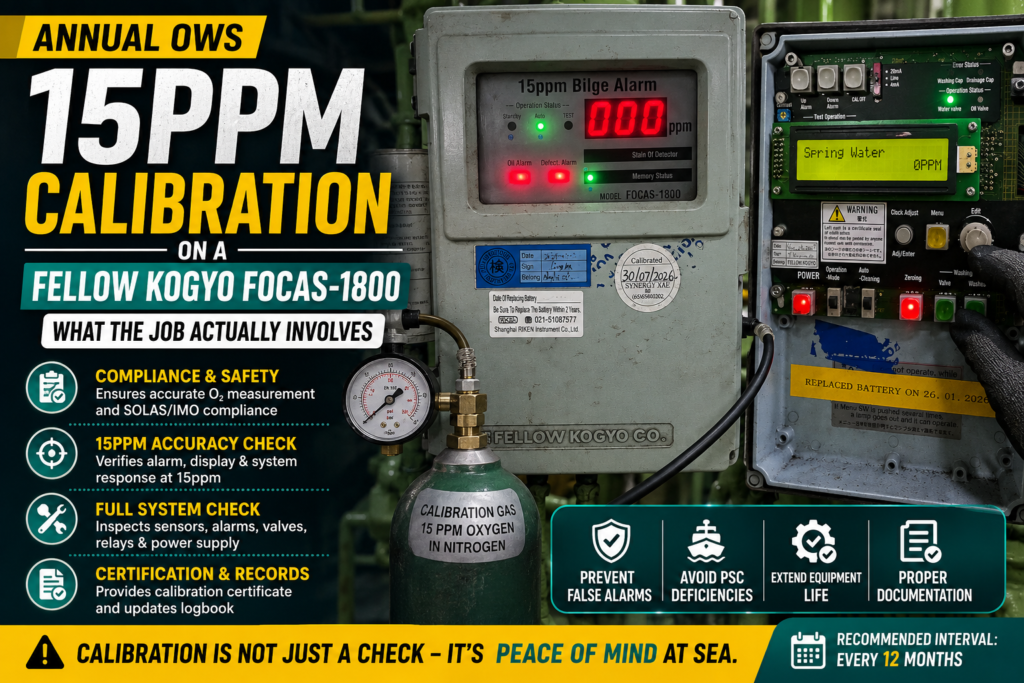
Annual OWS 15ppm Calibration on a Fellow Kogyo FOCAS-1800 — What the Job Actually Involves
The calibration record on a 15ppm bilge alarm matters more than most Chief Engineers expect until the first time an inspector asks for it. Port State Control officers routinely pull calibration documentation during MARPOL inspections, and the difference between a valid certificate and a bump test entry in the engine room log is the difference between a closed inspection and a deficiency notation that follows the vessel to the next port. We see this come up more often than it should.
This post covers a recent annual calibration attendance on a Fellow Kogyo FOCAS-1800 15ppm bilge alarm, carried out by our engineer on board at a Singapore port. The method below is standard for this model. The broader principle, what a full calibration actually involves and why it can’t be substituted by a functional check, applies across most approved OWS bilge alarm designs in the fleet.
The Equipment
The Fellow Kogyo FOCAS-1800 is a widely installed oil content monitor used as the 15ppm bilge alarm on the oily water separator discharge line. It works on an optical measurement principle: the oil content in the sample stream is measured continuously against the alarm set point of 15ppm, and the overboard discharge valve shuts automatically if that threshold is reached or exceeded.
Like all 15ppm bilge alarms installed under MARPOL Annex I, this unit must be approved to IMO Resolution MEPC.107(49) and calibrated at the interval specified by the manufacturer and flag state, using the reference method set out in the approval documentation. For the FOCAS-1800, that’s a two-point verification: fresh water for zero, and formazine reference liquid at the 15ppm set point for span.
Step 1: Fresh Water Zero Test
Before any adjustments are made, the instrument is run on fresh water (displayed on the FOCAS-1800 as “Spring Water”) to establish the baseline zero reading. At a clean zero, the display should confirm 0ppm against the fresh water reference.
This step tells us the condition of the instrument as found, before we touch anything. An instrument that won’t zero on fresh water has a sensor or optical path problem that has to be resolved first. Running the span check before fixing that produces a meaningless result and a certificate that doesn’t reflect actual performance.
Step 2: Zero Adjustment
Once the fresh water reading is confirmed stable, the zeroing procedure runs through the unit’s menu. The FOCAS-1800 displays “The End of Zero Revise” on screen when the zeroing step is accepted and saved. This is the instrument confirming that the zero reference has been locked.
This is not a bump test. The reference point is being set against a known standard and recorded, not just checked for a response. That’s what separates a calibration entry from a functional check, and it’s the distinction inspectors are looking for when they review your documentation.
Step 3: Formazine Span Test at the 15ppm Set Point
With zero confirmed, the span check is run using formazine reference liquid at 15ppm concentration. Formazine is the reference standard specified for this instrument because its optical scattering properties are calibrated to simulate oil-in-water at the target concentration. Using an alternative reference, including actual bilge water, doesn’t satisfy the approval requirement, regardless of how close the reading looks.
The instrument reading at the formazine reference is checked against the set point. If it’s within tolerance, it’s confirmed and recorded. If sensor drift has occurred, the span is adjusted to match the reference concentration before anything is signed off.
Step 4: Functional Check: Overboard and Slop Tank Recirculating Valves
Calibrating the sensor alone isn’t the full scope. The functional check covers the O/B (overboard) discharge valve and the Slop Tank recirculating valve, confirming that at the 15ppm alarm set point both valves respond as designed: the overboard path closes, and the recirculating valve opens to direct flow back to the slop tank rather than overboard.
A sensor that reads correctly at 15ppm but fails to trigger the valve closure is still a non-compliant installation. The functional check is what confirms the system works end-to-end, not just the measurement unit in isolation. We run it every time, not just when there’s a reason to suspect a problem.
Certificate Issued
On completion, an annual calibration certificate is issued. It records the instrument identification and serial number, the reference standards used and their traceability chain, the as-found readings before any adjustment, the as-left readings after adjustment, ambient conditions at the time of calibration, the calibration date, the next-due date, and the attending engineer’s name.
This is what goes into the vessel’s records and is produced on request to Port State Control, class surveyors and vetting inspectors. It satisfies the MARPOL Annex I requirement for a calibration record. A bump test entry in the engine room log doesn’t, and it’s worth making sure the crew understands that distinction before the inspection happens rather than during it.
What This Means in Practice
Annual OWS 15ppm calibration isn’t complicated work, but it does require the correct reference standard, a traceable calibration instrument, and proper documentation of as-found and as-left readings. Most of the inspection problems we see with bilge alarms aren’t sensor failures. They’re documentation failures. The instrument was probably working fine. The record just wasn’t there.
If your vessel is calling Singapore and the FOCAS-1800 or another 15ppm bilge alarm is due for annual calibration, send us the equipment list with your ETA and ETD. We’ll come back with scope, timing and cost.