Cart (
Overview
Every diesel engine running on a commercial vessel carries a baseline crankcase explosion risk. The physics are straightforward: hot bearing surfaces, lubricating oil under pressure, and combustion blow-by gases create an environment where, if oil mist concentration climbs above the lower explosive limit, a single ignition source is enough to cause a crankcase pressure event. On a large main engine, that means ruptured crankcase doors, oil fires, and the potential for serious crew injury. The engineering answer has always been continuous crankcase monitoring — but the quality of that monitoring, and the information it gives the crew at the moment of alarm, varies considerably between detector systems.
The Specs Oil Mist Detector OMM is a self-contained crankcase oil mist monitoring unit built around a compact, wall-mounted enclosure with a dual LED digital display. Where the Specs TPM and BWM systems use the SpecsVision graphical interface for multi-cylinder fleet installations, the OMM is designed for installations where a standalone, independently housed monitoring unit with direct LED numerical readout is the preferred or specified solution — on auxiliary engines, smaller main engines, or in installations where a compact, ruggedised local monitor is required alongside or in place of a centralised display system.
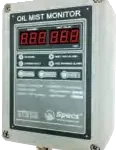
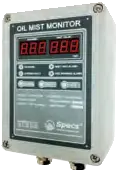
The OMM’s front panel makes its purpose immediately clear: two large red LED numerical displays — one showing current oil mist concentration, one showing the pre-set alarm threshold — alongside clearly labelled status indicators for alarm and pre-alarm conditions. There are no menus, no touchscreens, no software interface to navigate. The information an engineer needs to assess crankcase status is displayed directly on the unit face in large, easy-to-read numerical format. In an engine room environment where vibration, noise, and time pressure all work against complex instrument interaction, that simplicity is a genuine operational advantage over systems that bury the key numbers in a display menu.
Key Features
Dual LED Digital Display — Simultaneous Reading and Threshold
The OMM’s front panel carries two independent LED numerical displays mounted in a single enclosure: the left display shows the current measured oil mist concentration in real time; the right display shows the pre-set alarm threshold value. Displaying both values simultaneously — rather than requiring the operator to scroll between screens or recall a set point from memory — allows any engineer to assess the crankcase condition and its margin to alarm in a single visual check. For duty engineers making a fast assessment during a rounds inspection, or for watchkeepers responding to an alert in low-light conditions, this two-number display format is practical and unambiguous.
Pre-Alarm and Main Alarm Outputs
The OMM provides both a pre-alarm output — triggered at a user-configurable concentration below the main alarm threshold — and a main alarm output triggered at the full alarm threshold. The pre-alarm condition gives engineering staff an early advisory warning that oil mist concentration is rising toward the alarm level, allowing a first-stage response — increased monitoring frequency, preliminary investigation of bearing temperatures or lube oil consumption — before the main alarm triggers and a more immediate response is required. This two-stage alarm architecture reduces the risk of an engineer’s first warning being a full-alarm condition that demands immediate engine load reduction or stop.
Compact Wall-Mounted Enclosure
The OMM is housed in a compact, robustly constructed wall-mounted enclosure designed for direct installation in the engine room environment. The self-contained enclosure format means the OMM can be installed as a standalone local monitor — mounted adjacent to the engine being monitored — without requiring a separate display cabinet, control panel space, or connection to a centralised monitoring system to provide functional local readout. For engine room retrofits, auxiliary engine installations, or vessels where panel space is limited, the OMM’s compact standalone format is a practical fit where larger centralised display systems are not appropriate.
Direct Numerical Concentration Readout
The OMM displays oil mist concentration as a direct numerical value on the LED display — not as a bar graph percentage or a relative alarm indicator, but as an actual measured concentration figure. Direct numerical readout allows engineering staff to track the specific concentration trend over time during an investigation, to compare readings against engine manufacturer alarm thresholds specified in numerical terms, and to document actual measured values in maintenance records and class survey logs. For vessels where the classification surveyor requires evidence of oil mist detector function and alarm threshold settings, the OMM’s direct numerical display provides the clear, unambiguous readout that supports that documentation.
Alarm Indicator Panel with Labelled Status Outputs
Below the dual LED displays, the OMM’s front panel carries clearly labelled indicator lights for alarm status conditions — including pre-alarm, main alarm, and pre-burner alarm indicators as visible on the unit face. The labelled indicator format means status conditions are identifiable without reference to a manual or display key — each indicator is marked with its function directly on the panel. In an engine room emergency situation, where time pressure and stress are factors in every decision, panel indicators that require no interpretation are safer and more reliable than those that depend on the operator’s memory of what each light colour or position means.
Built for Engine Room Environmental Conditions
The OMM’s enclosure construction and component selection are appropriate for the temperature, vibration, humidity, and oil mist exposure conditions of a commercial marine engine room. Electronic instruments not designed for engine room installation can develop display faults, connector corrosion, and sensing drift accelerated by the combination of heat, vibration, and airborne contamination that the engine room environment presents continuously. The OMM’s design addresses the engine room as its primary installation environment — not as a secondary or incidental application of an instrument designed for a less demanding industrial setting.
New and Refurbished Availability
The Specs OMM is available in both new and refurbished condition. New units are appropriate for fresh installations, class-required replacements following end-of-life assessment, or new vessel outfitting. Refurbished units — inspected and tested before supply — provide a cost-effective alternative for in-service replacements where the existing OMM has developed a fault and vessel operational or budget constraints favour a tested refurbished unit over a new-unit order. Both conditions are available through Alright Engineering Solutions with appropriate supply documentation for class survey purposes.
Technical Specifications
Maker: Specs
Model: OMM
Description: Specs Oil Mist Monitor OMM
Application: Marine diesel engine crankcase oil mist monitoring
Display Type: Dual LED numerical — current concentration and alarm threshold
Alarm Outputs: Pre-alarm and main alarm (labelled front panel indicators)
Enclosure: Compact wall-mounted, engine room rated
Installation: Standalone local monitor — no centralised display system required
Readout Format: Direct numerical concentration value
Condition: New & Refurbished
Benefits
Two-stage alarm architecture provides earlier warning before the critical threshold is reached. The pre-alarm output gives engineering staff an advance advisory — time to investigate lube oil temperatures, check bearing conditions, and increase monitoring frequency — before the main alarm demands an immediate protective action decision. That additional response window can be the difference between a bearing inspection at the next port and an emergency engine stop in the middle of a voyage.
Direct numerical display eliminates ambiguity in critical moments. A bar graph showing 75% of alarm threshold and a numerical display reading 42 mg/m³ against a threshold of 56 mg/m³ convey the same data — but the numerical format is immediately comparable against engine manufacturer alarm thresholds, recordable in maintenance logs as an exact figure, and unambiguous to any engineer regardless of prior experience with the specific display format. Numerical readout reduces the risk of threshold misinterpretation under the time pressure of an alarm response.
Standalone format simplifies installation and reduces retrofit complexity. The OMM does not require connection to a centralised display system or dedicated panel space to provide a functional local readout. For auxiliary engine installations, engine room retrofits, or vessels where the existing monitoring system does not have provision for an additional crankcase monitor input, the OMM can be installed as a fully functional standalone unit with minimal integration requirements — reducing installation engineering time and cost.
Supports class society survey documentation with direct readable values. Class surveyors conducting UMS surveys or machinery surveys require evidence that oil mist detectors are functional and that alarm thresholds are correctly set. The OMM’s simultaneous display of current concentration and alarm threshold on the front panel provides direct visual confirmation of both values without requiring access to software or configuration menus — simplifying the survey inspection process and reducing the documentation burden on the vessel’s engineering staff.
Refurbished availability supports cost-effective compliance maintenance on older tonnage. For operators maintaining vessels with ageing engine room equipment on constrained maintenance budgets, a tested refurbished OMM unit provides a class-compliant crankcase monitoring solution at a lower procurement cost than a new unit — without compromising functional reliability or class acceptability.
Who It’s For
The Second Engineer Responsible for Auxiliary Engine Maintenance
You’re responsible for the auxiliary diesel generators on a vessel that runs three generators continuously in port and two at sea. The oil mist monitor on generator number two has been giving intermittent display faults — the LED segments are starting to fail and the unit is no longer giving a reliable reading. You need a replacement that mounts in the same wall-mounted location, gives you a direct numerical readout you can check on your engine room rounds without stopping at a separate display panel, and that will satisfy the class surveyor at the next scheduled survey. The Specs OMM fits that requirement directly — available in refurbished condition for a cost-effective replacement within your maintenance budget.
The Chief Engineer on a Vessel with Mixed Crankcase Monitoring Systems
Your main engine has a centralised SpecsVision TPM installation that works well. But your two auxiliary generators have older standalone monitors — one of which has failed and needs replacing, and neither of which provides a pre-alarm stage. You want a standalone replacement for the failed auxiliary monitor that gives a two-stage alarm output, a direct numerical display, and that is class-acceptable as a like-for-like functional replacement. You don’t need or want another centralised system for two auxiliary engines — a compact, independently mounted OMM unit does exactly what you need without adding complexity to your existing monitoring arrangement.
The Technical Superintendent Sourcing Replacement Monitors for Older Fleet Vessels
You manage a fleet of older bulk carriers and tankers — most built in the 1990s and 2000s — where the original oil mist monitors are reaching end of service life or developing faults with increasing frequency. You need a reliable replacement option that class surveyors will accept, that your engineers across different vessels can operate without specific training, and that is available in refurbished condition at a procurement cost appropriate for vessels in the later stages of their economic service life. Alright Engineering Solutions can supply Specs OMM units in tested refurbished condition with class documentation support to assist your fleet maintenance programme.
Possible Applications
- Auxiliary diesel generator engines on commercial vessels — Standalone crankcase oil mist monitoring on vessel generators where a compact wall-mounted local monitor is preferred over connection to the main engine monitoring system
- Medium bore diesel main engines on coastal and short-sea vessels — Direct numerical crankcase monitoring on main engines of coastal cargo vessels, harbour tugs, and short-sea ferries where a compact standalone monitor is appropriate for the engine size and installation space available
- Engine room retrofits on older tonnage — Replacement of life-expired or obsolete oil mist monitors during planned maintenance periods on vessels where the original installed monitor is no longer serviceable and a compact, standalone replacement is required
- Offshore support vessels and platform supply vessels — Crankcase monitoring on auxiliary and emergency diesel engines on offshore vessels where reliable local readout in the engine room is required independently of any centralised control system
- Vessels with multiple small diesel engines — Individual standalone crankcase monitoring on vessels operating multiple smaller diesel engines — fire pumps, emergency generators, deck machinery drives — where per-engine local monitoring is required without centralised system integration
- Class renewal survey compliance — Replacement installation for vessels where the class surveyor has identified the existing oil mist monitor as defective or non-compliant during a scheduled survey, requiring a confirmed replacement before the vessel can continue trading
- Ship repair yards and drydock programmes — Supply of replacement OMM units to vessels undergoing drydocking and special surveys where oil mist detector replacement is part of the class-required machinery survey work scope
- Inland waterway and river trade vessels — Crankcase monitoring on diesel engines of inland waterway cargo vessels and passenger vessels subject to national or international class requirements for oil mist detection
Trust and Certifications
Specs — Dedicated Marine Oil Mist Detection Manufacturer
Specs is a manufacturer with a focused specialisation in marine crankcase oil mist monitoring equipment. The OMM, alongside the TPM and BWM models, forms part of a product range built specifically for the marine diesel engine monitoring application — not adapted from a general industrial instrument catalogue. That engineering focus means the OMM’s design reflects the specific installation conditions, maintenance requirements, and operational demands of the marine engine room environment. Class surveyors and marine engineering teams working with Specs equipment benefit from a manufacturer whose entire product focus is on the application they’re procuring for.
Class Society Acceptance for Crankcase Monitoring
Oil mist monitoring equipment installed on classed vessels is subject to class society review as part of the vessel’s periodic machinery surveys and — for UMS-notated vessels — as a condition of the UMS notation. The Specs OMM is designed to meet crankcase oil mist detection requirements as specified by the major international classification societies for commercial vessels. Procurement teams sourcing an OMM as a class-required replacement should confirm the specific documentation requirements with their vessel’s class society before ordering — Alright Engineering Solutions can assist with documentation support for class survey purposes.
SOLAS Chapter II-1 — Diesel Engine Crankcase Protection
SOLAS Chapter II-1 Regulation 26 requires diesel engines above specified bore and crankcase volume thresholds to be fitted with oil mist detectors or equivalent crankcase protection devices. Continuous oil mist monitoring with automatic alarm is the standard technical solution for compliance with this regulation on commercial vessels operating on international voyages. The Specs OMM satisfies the continuous automatic monitoring requirement — providing the SOLAS compliance basis required for flag state certification of the vessel’s machinery installation.
Supplied Through Alright Engineering Solutions — Authorised Singapore Distributor
The Specs Oil Mist Detector OMM is supplied through Alright Engineering Solutions Pte. Ltd., an authorised distributor of marine engine room safety monitoring equipment based in Singapore. Alright Engineering Solutions provides procurement support, technical documentation, and marine safety equipment sourcing services for vessel operators, ship managers, and marine procurement teams across the Singapore and Southeast Asia region — with delivery capability to vessels in port and at regional ship repair and drydock facilities.
Accessories and Variants
Replacement Optical Sensing Elements
Optical sensing components within the OMM’s detection circuit require periodic cleaning and scheduled replacement as part of the unit’s planned maintenance programme. Clean, calibrated sensing elements are essential for accurate concentration measurement and reliable alarm triggering — a contaminated sensing element can produce false readings in either direction, masking a genuine oil mist rise or triggering nuisance alarms that reduce crew confidence in the system. Alright Engineering Solutions can assist with sourcing compatible replacement sensing components for the OMM — contact our team with your unit details for parts availability confirmation.
Sampling Connection Fittings and Tubing
The OMM’s sampling connection to the engine crankcase requires appropriate fittings and tubing appropriate for the installation configuration. Replacement fittings and sampling line components may be required during maintenance or following physical damage. Contact Alright Engineering Solutions with your OMM installation details for compatible sampling system components.
Related Specs Oil Mist Detector Models
Specs Oil Mist Detector TPM — Per-cylinder monitoring system with SpecsVision bar-graph display for large bore main engines where individual cylinder fault resolution is required; available new and refurbished
Specs Oil Mist Detector BWM — Multi-bay crankcase monitoring system with SpecsVision display for engine types where the BWM sampling architecture is specified; available new and refurbished
Related Products from Alright Engineering Solutions
GX-8000 Sample Draw Multi-Gas Monitor — Portable confined space entry gas monitor for engine room, pump room, and cargo hold gas testing
RX-8700 Portable Multi-Gas Detector — ATEX/IECEx/MED-certified portable gas detector for marine engine room and enclosed space safety applications
Fixed Combustible Gas Detection Systems — Fixed point gas detectors for engine room bilge monitoring, battery room ventilation safety, and fuel handling space protection
Get in Touch
If you need to source the Specs Oil Mist Detector OMM — for an in-service auxiliary engine replacement, a planned drydock programme, or a class survey deficiency rectification — contact Alright Engineering Solutions to confirm unit availability and request a formal quotation.
Our team can assist with class documentation requirements, compatible spare parts sourcing, and delivery coordination to vessels in Singapore and regional ports.
📍 3791 Jalan Bukit Merah #06-01, E-Centre @ Redhill, Singapore 159471