Cart (
Overview
On any vessel with a diesel propulsion plant, the crankcase is one of the highest-risk spaces in the engine room. Under normal operating conditions it contains a mixture of hot lubricating oil vapour, combustion blow-by gases, and mechanical heat from bearing and journal surfaces — the exact combination that, if oil mist concentration rises above the lower explosive limit, creates the conditions for a crankcase explosion. These events are rare, but when they occur on a large bore main engine they are violent: pressure wave damage, ruptured crankcase doors, oil fires, and — in the most serious cases — fatalities and total loss of propulsion. The engineering response to that risk is continuous, automatic oil mist monitoring, and it is a requirement under SOLAS and class society rules for any vessel operating with diesel engines above a specified cylinder bore.
The Specs Oil Mist Detector TPM is a continuous crankcase oil mist monitoring system designed for diesel main engines and auxiliary engines on commercial marine vessels. Manufactured by Specs — a specialist in marine engine room safety monitoring — the TPM model represents Specs’ approach to per-cylinder oil mist measurement: rather than sampling a mixed crankcase atmosphere, the TPM monitors each individual cylinder unit independently, providing a level of fault resolution and early-stage detection that aggregate monitoring systems cannot match.
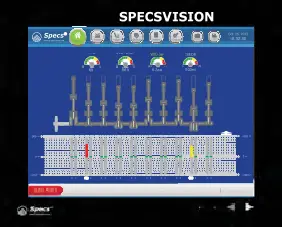
The distinguishing feature of the TPM — visible in the SpecsVision operator display — is its individual cylinder bar-graph presentation. Each cylinder’s oil mist concentration is displayed as a separate bar on the SpecsVision screen, with alarm threshold lines and colour-coded status indicators showing at a glance which cylinder unit is elevated and by how much. For a chief engineer responding to an oil mist alarm in the early hours of a night watch, the difference between “oil mist alarm on the main engine” and “oil mist elevated on cylinder unit 4, rising” is the difference between a blind emergency stop decision and a controlled, informed response. That diagnostic clarity at the point of alarm is what the TPM is built around.
Key Features
Individual Per-Cylinder Oil Mist Measurement
The TPM measures oil mist concentration at each individual cylinder unit independently, rather than drawing a mixed sample from a common crankcase drain or header. In a large bore diesel engine with six, eight, or ten cylinder units, oil mist generated by a failing bearing or deteriorating piston ring on one cylinder will be diluted when mixed with the atmosphere from the other units — potentially delaying alarm triggering until concentrations have risen significantly higher than the local source. Per-cylinder measurement detects that localised elevation at the source unit, giving engineering staff earlier warning and precise fault location before the condition progresses.
SpecsVision Bar-Graph Cylinder Display
The SpecsVision display presents the TPM’s measurement data as a real-time bar graph — one bar per cylinder unit — with alarm threshold lines and colour-coded status overlays. Green bars indicate normal operation; yellow indicates elevated concentration approaching the alarm threshold; red triggers alarm status. This visual format allows the duty engineer to assess the entire engine’s crankcase condition at a single glance, and immediately identify which cylinder unit is the source of any elevated reading. The SpecsVision interface requires no navigation through menus or sub-screens to access per-cylinder data — the full picture is on the home screen, available in seconds.
Continuous Automatic Monitoring with Alarm Output
The TPM operates continuously and automatically without requiring manual sampling or periodic test cycles, providing uninterrupted crankcase monitoring throughout the voyage. Alarm outputs integrate with the vessel’s engine room alarm and monitoring system — triggering bridge and ECR alarms simultaneously when any cylinder unit’s oil mist concentration exceeds the pre-set threshold. For vessels operating under UMS (Unmanned Machinery Space) class notation, continuous automatic monitoring with remote alarm output is a class requirement, not an option. The TPM’s architecture satisfies that requirement directly.
Optical Detection with Per-Cylinder Sampling Architecture
The TPM uses optical measurement principles — detecting changes in light transmission caused by oil mist particles in the sampled crankcase atmosphere — applied to individual cylinder unit samples drawn through the system’s multi-point sampling arrangement. The optical sensing method provides stable, repeatable measurement of oil mist concentration that is not significantly affected by normal variations in crankcase temperature or pressure, and does not require consumable electrochemical sensing elements that degrade over time. Optical sensing elements require periodic cleaning as part of routine maintenance, and the TPM’s system design supports in-situ maintenance access.
Scalable to Engine Configuration
The TPM system can be configured to match the cylinder count of the monitored engine — whether a four-cylinder auxiliary engine or a ten-cylinder main engine. This scalability means the same TPM platform can be applied across different engine types and sizes within a fleet, supporting fleet standardisation of crankcase monitoring equipment without requiring different detector models for different engine configurations. For ship management companies maintaining mixed fleets with different main engine types, a single detector platform reduces spare parts inventory complexity and crew familiarisation requirements.
New and Refurbished Condition Availability
The Specs TPM is available in both new and refurbished condition. New units suit newbuild vessel outfitting, class-required replacements, or fleet upgrades from older generation detectors. Refurbished units — inspected and functionally tested before supply — provide a cost-effective procurement option for in-service replacements where the existing TPM installation has developed a fault but the vessel’s operational and budget constraints do not support full new-unit pricing. Both conditions are available through Alright Engineering Solutions with appropriate supply documentation.
Technical Specifications
Maker: Specs
Model: TPM
Description: Specs Oil Mist Detector TPM
Application: Marine diesel engine crankcase oil mist detection — per-cylinder monitoring
Detection Method: Optical (light transmission / obscuration)
Monitoring Architecture: Individual per-cylinder measurement, continuous
Display System: SpecsVision bar-graph per-cylinder display
Alarm Output: Local and remote integration with engine room alarm system
Configuration: Scalable to engine cylinder count
Suitable Operation: UMS (Unmanned Machinery Space) compliant
Condition: New & Refurbished
Benefits
Earlier detection of developing faults through per-cylinder resolution. A bearing failure or piston ring fault will elevate oil mist concentration locally — at the affected cylinder unit — before the overall crankcase atmosphere reaches alarm concentration. The TPM’s individual cylinder measurement detects that localised rise earlier than aggregate monitoring systems, giving engineering staff more time to assess the condition, reduce engine load, and take controlled protective action. Earlier intervention means the difference between a managed load reduction and an emergency stop — or between a bearing replacement at the next port and a catastrophic crankcase failure at sea.
Precise fault location reduces diagnostic time and unnecessary engine shutdowns. When the TPM alarm triggers on cylinder unit 4, the engineer knows exactly where to look. There is no need to open multiple crankcase inspection covers to locate the source of elevated oil mist — the SpecsVision display points directly to the affected unit. That diagnostic precision reduces the time between alarm and informed action, and reduces the risk of an unnecessary full engine shutdown when only one cylinder unit is showing an elevated condition that may be manageable at reduced load.
Supports UMS class notation compliance with integrated alarm architecture. Continuous automatic crankcase oil mist monitoring with bridge and ECR alarm output is a class requirement for UMS notation. The TPM satisfies this requirement with its continuous monitoring architecture and integrated alarm outputs — without requiring additional relay panels or interface equipment to achieve class compliance in most installation scenarios.
Reduces crew training burden through intuitive SpecsVision display. The bar-graph per-cylinder display format requires no specialist training to interpret — the visual presentation of cylinder status is immediately understandable to any qualified marine engineer, regardless of prior experience with Specs equipment specifically. For vessels with crew rotation, an intuitive display format reduces the risk of alarm misinterpretation or delayed response from crew members encountering the system for the first time.
Refurbished availability reduces procurement lead time and cost for in-service maintenance. For vessels requiring a TPM replacement within a tight port-call window, a tested refurbished unit available through a Singapore-based distributor with regional delivery capability provides a faster and more cost-effective procurement solution than waiting for a new-unit order through the OEM supply chain.
Who It’s For
The Chief Engineer Managing a UMS Deep-Sea Vessel
You’re running the engine room on a vessel in the middle of a long Pacific passage. The machinery space is on UMS watch, your engineers are off watch, and your existing oil mist detector has been giving intermittent faults for the past two weeks. At the next port call in Singapore, you need it replaced with a system that works reliably, satisfies class requirements for UMS operation, and that your watch engineers can use without having to read a manual. The Specs TPM’s SpecsVision display gives your engineers clear, per-cylinder data without complexity — and Alright Engineering Solutions can have a unit ready for collection or delivery to the vessel during your port turnaround.
The Technical Superintendent Overseeing a Fleet with Mixed Engine Types
Your fleet includes bulk carriers with MAN B&W main engines, tankers with Wärtsilä installations, and a couple of older vessels with Sulzer units. You need to maintain crankcase monitoring compliance across all of them, and you’re tired of sourcing different detector models for different engine types from different suppliers. The TPM’s scalable per-cylinder architecture can be configured for different cylinder counts across your fleet — reducing the number of detector platforms you’re maintaining spares for, and simplifying the crew familiarisation process when engineers rotate between vessels.
The Marine Safety Equipment Procurement Manager
A vessel manager has come to you with an urgent requirement: the main engine oil mist detector on one of their managed vessels has failed, the vessel is due to arrive in Singapore in four days, and the class surveyor has flagged the defect. You need to source a replacement TPM, confirm it’s class-acceptable, arrange delivery to the vessel in port, and have the paperwork ready for the surveyor’s follow-up inspection. Alright Engineering Solutions handles exactly these kinds of time-critical marine safety equipment procurement situations — contact our team with the vessel details and we’ll confirm availability and coordinate delivery.
Possible Applications
- Large bore two-stroke diesel main engines on bulk carriers and tankers — Per-cylinder crankcase monitoring on MAN B&W, Wärtsilä, and Sulzer two-stroke main engines where individual cylinder unit fault resolution is critical for informed engine management decisions
- Medium speed four-stroke main engines on offshore vessels and ferries — Continuous crankcase monitoring on four-stroke propulsion engines where bearing and piston conditions vary between cylinder units under variable load operation
- Auxiliary diesel generator engines — Crankcase oil mist monitoring on vessel auxiliary generators, where continuous power generation reliability is essential and early fault detection prevents unplanned generator shutdowns during critical operations
- Container ships and ro-ro vessels — Main engine crankcase monitoring on high-utilisation commercial vessels where per-cylinder fault resolution supports controlled load management rather than emergency stops, protecting on-time delivery commitments
- LNG and LPG gas carriers — Propulsion plant crankcase monitoring on gas carriers where engine room safety standards are subject to heightened flag state and class society scrutiny
- Offshore platform supply vessels in dynamic positioning operation — Continuous crankcase monitoring on DP vessels where an unplanned engine shutdown during station-keeping can create a hazardous situation relative to the installation being served
- Class renewal surveys and drydock replacement programmes — Scheduled replacement of life-expired or defective oil mist detectors during drydocking, special surveys, and planned maintenance periods as part of the vessel’s class-required safety system maintenance
- Fleet upgrade programmes from older generation detectors — Replacement of older single-point or aggregate monitoring detectors with per-cylinder TPM systems on vessels where engineering management wants improved crankcase fault resolution as part of a planned safety system improvement programme
Trust and Certifications
Specs — Marine Crankcase Monitoring Specialist
Specs is a recognised specialist manufacturer of oil mist detection systems for marine diesel engines, with installations across a wide range of commercial vessel types and engine makes internationally. The TPM and BWM detector platforms have accumulated an operational track record across the global commercial fleet — providing the installation history and field reliability data that engineering teams and class surveyors expect when evaluating safety-critical crankcase monitoring equipment. Specs’ focus on engine room oil mist detection — rather than the broad portfolio approach of larger instrumentation manufacturers — means the TPM reflects engineering priorities specific to marine crankcase monitoring.
Class Society Acceptance — UMS Crankcase Monitoring Requirements
Oil mist detectors installed on UMS-notated vessels are evaluated by classification societies as part of the UMS certification and survey process. The Specs TPM is designed to meet crankcase oil mist detection requirements for UMS operation as specified by the major international classification societies including Lloyd’s Register, DNV, Bureau Veritas, ClassNK, and ABS. Buyers procuring a replacement oil mist detector for a classed vessel should confirm the specific class society requirements applicable to their vessel with Alright Engineering Solutions before ordering — our team can assist with documentation support for class survey purposes.
SOLAS Chapter II-1 — Crankcase Explosion Protection
SOLAS Chapter II-1 Regulation 26 addresses the protection of diesel engines against the risk of crankcase explosions, including the requirement for oil mist detection or equivalent safety devices on diesel engines with cylinder bores exceeding 200mm or crankcase volumes exceeding 0.6 cubic metres. Continuous automatic oil mist monitoring with alarm is the established standard for compliance with this regulation. The Specs TPM satisfies the continuous automatic monitoring requirement — providing the SOLAS compliance basis that is a flag state requirement for vessels on international voyages.
Supplied Through Alright Engineering Solutions — Singapore Authorised Distributor
The Specs Oil Mist Detector TPM is supplied through Alright Engineering Solutions Pte. Ltd., an authorised distributor of marine engine room safety monitoring equipment based in Singapore. Alright Engineering Solutions provides procurement support, class documentation assistance, and marine safety equipment sourcing services for vessel operators, ship managers, and marine procurement teams across Singapore and the Southeast Asia region — with delivery capability to vessels in port and regional ship repair facilities.
Accessories and Variants
Replacement Optical Sensing Elements
The optical sensing cells within the TPM sampling system require periodic cleaning and eventual replacement as part of the detector’s maintenance schedule. Alright Engineering Solutions can assist with sourcing replacement optical sensing elements and associated maintenance consumables for the TPM to support your planned maintenance programme. Maintaining sensing element cleanliness is the most important routine maintenance task for optical oil mist detectors — contaminated sensors produce false readings and missed alarms. Contact our team to confirm compatible sensing elements for your TPM installation.
Sampling Tube and Connection Fittings
The per-cylinder sampling architecture of the TPM requires individual sampling connections at each cylinder unit. Replacement sampling tubes, fittings, and connection components may be required during maintenance or following physical damage to the sampling lines. Alright Engineering Solutions can assist with sourcing compatible sampling system components for TPM installations — contact our technical team with your installation details for parts availability confirmation.
SpecsVision Display and Controller Components
For vessels where the SpecsVision display or TPM controller has developed a fault independently of the sampling and sensing hardware, Alright Engineering Solutions can assist with enquiries for display and controller spare parts. Provide our team with your SpecsVision display model and fault description for availability enquiry and sourcing support.
Related Products from Alright Engineering Solutions
Specs Oil Mist Detector BWM — Specs’ multi-bay crankcase oil mist detector for engine types where the BWM sampling architecture is specified; available new and refurbished
GX-8000 Sample Draw Multi-Gas Monitor — Portable sample-draw gas monitor for engine room confined space entry, pump room inspections, and cargo hold gas testing
RX-8700 Portable Multi-Gas Detector — ATEX/IECEx/MED-certified portable gas detector for marine engine room and enclosed space safety
Fixed Combustible Gas Detection Systems — Fixed point gas detectors for engine room bilge monitoring, battery room ventilation safety, and fuel handling space gas detection
Get in Touch
If you need to source the Specs Oil Mist Detector TPM — for an in-service replacement, a drydock maintenance programme, or a fleet standardisation project — contact Alright Engineering Solutions to confirm availability, discuss your specific engine configuration requirements, and request a formal quotation.
Our team can also support class documentation requirements, source compatible spare parts, and coordinate delivery to vessels in Singapore and regional ports.
📍 3791 Jalan Bukit Merah #06-01, E-Centre @ Redhill, Singapore 159471