Cart (
Overview
Hydrogen chloride and chlorine gas are among the most aggressively corrosive substances handled in industrial environments. At any concentration, both gases attack standard brass and stainless steel regulator components — degrading seats, diaphragms, and body threads at a rate that compromises pressure control accuracy long before visible signs of damage appear. The consequences range from unstable outlet pressure to uncontrolled gas release: neither outcome is acceptable in a chemical plant, water treatment facility, or laboratory setting where these gases are in active use.
The answer is material selection, and in corrosive gas service, the material that consistently performs where others fail is Monel — a nickel-copper alloy with exceptional resistance to chlorine, hydrogen chloride, and their aqueous derivatives. Monel does not simply slow corrosion; across a broad range of concentrations and temperatures, it resists it at a level that brass and even many stainless grades cannot match. For pressure regulation on HCL and CL gas lines, a Monel-wetted regulator is not a premium option — it is the correct engineering choice.
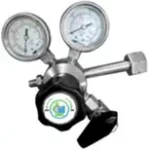
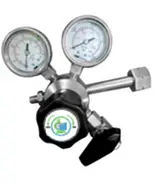
This Single Stage Monel Regulator for HCL/CL Gas is purpose-built for hydrogen chloride and chlorine gas service — with Monel construction across all gas-contact components, a dual-gauge configuration for clear inlet and outlet pressure visibility, and a working range of 0–30 Kg/Cm² inlet pressure and 0–15 Kg/Cm² outlet pressure with flow capacity up to 100 LPM. It is the regulator specified when the application is corrosive, the gas is hazardous, and the installation needs to hold its performance reliably over time.
Key Features
Full Monel Wetted Parts — Engineered for Chlorine and HCL Service
All components that come into direct contact with the process gas — body, seat, diaphragm, and internal trim — are constructed from Monel, a nickel-copper alloy with well-documented resistance to chlorine gas, hydrogen chloride, and hydrochloric acid. This is not a plated or coated surface: Monel is the bulk material throughout the wetted path. In practical terms, this means the regulator maintains its dimensional tolerances, seating integrity, and pressure control accuracy in continuous HCL and CL service — without the seat erosion and diaphragm degradation that cause brass and stainless regulators to drift out of calibration in the same service conditions.
Dual Pressure Gauges — Inlet and Outlet Monitoring at a Glance
Two independent pressure gauges are mounted on the regulator body — one reading cylinder or line supply pressure (inlet), one reading the regulated delivery pressure (outlet). The inlet gauge covers 0–30 Kg/Cm² and serves as a cylinder content indicator and a line pressure reference for system sizing. The outlet gauge covers 0–15 Kg/Cm² and provides a direct, real-time read of regulated delivery pressure to the downstream process. Having both readings at the point of regulation eliminates the need to read pressure remotely or interpret system behaviour indirectly — an important operational advantage when working with toxic or hazardous gas systems where verification of correct delivery pressure before opening a downstream valve is a routine safety step.
Single Stage Regulation — Direct and Responsive Pressure Control
Single stage regulation reduces inlet supply pressure to the delivery set point in one step. For HCL and CL gas applications operating from cylinder supply at 0–30 Kg/Cm², single stage regulation delivers the outlet pressure control and flow response needed for the majority of industrial and laboratory applications. The single stage design also means fewer internal gas-contact components compared to a two-stage unit — a meaningful consideration in highly corrosive service, where every additional seating surface and diaphragm represents a potential wear and failure point. Where supply pressure is relatively stable and delivery pressure requirements are within the 0–15 Kg/Cm² range, single stage regulation is the correct — and more maintainable — choice.
Flow Capacity to 100 LPM — Suited to Industrial Process and Analytical Applications
Regulated flow capacity of 0–100 LPM covers the supply requirements of water treatment dosing systems, chemical process gas feeds, laboratory analytical instruments, and calibration gas delivery applications. The 100 LPM upper limit is not a constraint in most HCL and CL gas applications — it is the appropriate working range for the supply configurations and process demands where single stage cylinder regulators are typically installed. For high-volume bulk process applications with significantly higher flow demand, this specification should be verified against process flow requirements before selection.
Robust Body Construction — Built for Industrial Site Conditions
Beyond the Monel wetted path, the regulator body is constructed for the physical demands of industrial gas handling environments — where regulators are installed in fixed positions, may be subject to vibration from nearby equipment, and are connected to cylinder valves with the mechanical loads that come with standard gas connection practice. The dual-gauge mounting arrangement is integrated into the regulator body design rather than added as an afterthought — maintaining structural integrity and gauge alignment under normal operational conditions.
Technical Specifications
Product Name: Single Stage Monel Regulator for HCL/CL Gas
Gas Service: HCL (Hydrogen Chloride) / CL (Chlorine)
Regulator Type: Single Stage
Wetted Material: Monel (Nickel-Copper Alloy)
Inlet Pressure: 0–30 Kg/Cm²
Outlet Pressure: 0–15 Kg/Cm²
Flow Rate: 0–100 LPM
Gauges: Dual (Inlet + Outlet)
Product Category: Span Gas and Regulator
Application: Industrial gas supply, water treatment, laboratory, chemical process
Benefits
Maintained Performance in Corrosive Gas Service
The most direct benefit of Monel construction is that the regulator continues to perform as specified in HCL and CL service — not just at commissioning, but across its working service life. Brass and standard stainless regulators installed on corrosive gas lines drift: outlet pressure creeps, flow becomes inconsistent, and seat leakage develops as corrosion progresses. Monel construction removes the primary failure mechanism. For process operations where stable delivery pressure is a production requirement — and for analytical or dosing applications where pressure variation directly affects measurement accuracy or chemical dosing rates — this is the outcome that justifies the material choice.
Reduced Maintenance Overhead and Unplanned Downtime
A regulator that corrodes in service creates a maintenance problem that compounds over time: increased inspection frequency, earlier-than-expected replacement, and the safety considerations that come with handling a corroded gas regulator on a hazardous gas line. Monel regulators in appropriate service conditions require significantly less reactive maintenance than non-Monel alternatives. For facilities teams managing gas system maintenance programmes across multiple installations, the reduction in regulator-related maintenance interventions has a direct effect on maintenance labour, spare parts spend, and planned downtime scheduling.
Personnel Safety in Hazardous Gas Environments
Hydrogen chloride and chlorine are classified as toxic gases with defined exposure limits — TLV-C for chlorine is 1 ppm, and the IDLH (Immediately Dangerous to Life and Health) concentration is 10 ppm. A regulator failure on a CL or HCL gas line is not a process inconvenience; it is a potential emergency. Corrosion-resistant Monel construction reduces the likelihood of seat failure, diaphragm breach, and fitting degradation that are the primary mechanisms of uncontrolled gas release from regulators in corrosive service. For HSE officers and safety managers responsible for gas handling risk assessments, material selection at the regulator is a recognised control measure — not a specification detail.
Regulatory and MSDS Compliance for Corrosive Gas Handling
Material safety data sheets for HCL and CL gas routinely specify Monel or similarly resistant alloys for gas contact components in pressure regulation equipment. Specifying a Monel regulator for HCL/CL service is alignment with the material recommendations that come with the gas itself — supporting compliance with occupational health and safety requirements that govern compressed gas handling in industrial and laboratory settings, and providing a clear documented basis for the equipment selection decision in risk assessments and safety audits.
Who It’s For
Water Treatment Plant Operators and Engineers
Chlorine gas is widely used for disinfection in water treatment and wastewater processing — delivered from cylinder supply through a regulator and into a water injection system or chlorinator. The regulator on a chlorine dosing line is a critical component: incorrect delivery pressure means incorrect dosing rates, and a failing regulator on a chlorine line creates both a process problem and a safety emergency in a working facility. Water treatment engineers and plant operators specifying replacement regulators for chlorine dosing systems need Monel construction as a baseline requirement — the process gas demands it, and most site HSE protocols will specify it.
Chemical Plant Process Engineers and HSE Teams
In chemical manufacturing environments where HCL or CL gas is a process input, the gas supply train from cylinder to process point is subject to regular inspection and audit. A process engineer reviewing gas regulator specifications for a new installation or a replacement order needs to be able to demonstrate that the selected equipment is appropriate for the gas service — material specification, pressure range, and flow capacity all form part of that justification. This regulator’s Monel construction, documented inlet and outlet pressure range, and defined flow capacity provide a clear, auditable equipment specification that supports the engineering justification for process safety documentation.
Industrial Safety and Laboratory Gas Supply Managers
Laboratories using HCL or CL gas for analytical, calibration, or synthesis applications manage gas systems that are typically lower-volume than industrial process lines but no less demanding in terms of delivery pressure stability and equipment integrity. A laboratory gas supply manager specifying a regulator for an HCL gas cylinder connection needs the same Monel construction as an industrial installation — the corrosive behaviour of the gas does not change with scale. The 0–100 LPM flow range and 0–15 Kg/Cm² outlet pressure range of this regulator cover typical laboratory supply requirements without over-specifying for industrial-scale flow demand.
Possible Applications
Chlorine Gas Dosing in Drinking Water and Wastewater Treatment
Municipal and industrial water treatment facilities use chlorine gas from cylinder supply for disinfection and treatment applications. Monel regulators are the standard material specification for chlorine dosing regulator installations in water treatment — both for corrosion resistance and for compliance with site safety requirements governing chlorine gas handling equipment.
HCL Gas Supply for Chemical Synthesis and Process Reactions
Chemical manufacturing processes that use hydrogen chloride as a reactant or process gas require controlled delivery from cylinder or bulk supply at a defined pressure and flow rate. Single stage Monel regulators provide the corrosion resistance and pressure control accuracy required for HCL process gas feed lines in organic synthesis, catalyst preparation, and chemical intermediate production.
Calibration Gas Delivery for Industrial Gas Detectors
Portable and fixed HCL and CL gas detectors require regular calibration against certified span gas mixtures containing hydrogen chloride or chlorine at defined concentrations. Span gas delivery from calibration gas cylinders requires a regulator capable of handling trace concentrations of corrosive gas without contaminating the gas stream — Monel construction prevents regulator corrosion products from affecting calibration gas purity and ensures consistent delivery pressure for repeatable calibration results.
Chlorine Gas Supply for Semiconductor and Electronics Manufacturing
Semiconductor fabrication processes use chlorine gas in plasma etching, chamber cleaning, and surface treatment applications. Gas purity and delivery pressure consistency are critical process parameters — regulator material selection that prevents corrosion-related contamination of the gas stream is an engineering requirement for these applications.
Pharmaceutical and Fine Chemical Laboratory Gas Supply
Pharmaceutical synthesis and fine chemical research laboratories use HCL gas for hydrochlorination reactions, pH adjustment, and analytical applications. Monel regulators on laboratory HCL cylinder connections provide reliable pressure control and material compatibility for research-grade gas handling where contamination from regulator corrosion products is not acceptable.
Industrial Refrigeration and HVACR Maintenance (CL-based Refrigerants)
Certain older industrial refrigeration systems and specialty HVACR applications use chlorine-containing refrigerant gases or require CL gas for maintenance and cleaning procedures. Monel regulator construction provides the material compatibility required for chlorine-exposure service in refrigeration maintenance and industrial HVACR contexts.
Emergency Response and Hazmat Team Equipment Calibration
Emergency response teams and industrial hazmat units that respond to chlorine or HCL incidents use detection equipment that must be regularly calibrated against certified span gas. Reliable span gas delivery through a Monel regulator ensures calibration gas integrity and accurate detector performance for emergency response readiness.
Trust & Certifications
Monel Alloy — Recognised Standard for Corrosive Gas Regulator Service
Monel (UNS N04400 / N05500 series nickel-copper alloy) is specified by gas manufacturers, industrial gas associations, and compressed gas safety standards as the appropriate wetted material for hydrogen chloride and chlorine gas regulators. The Compressed Gas Association (CGA) and equivalent standards bodies in Europe and Asia routinely reference Monel as a compatible material for CL and HCL gas contact — a recognition built on decades of documented service performance in industrial gas systems. Specifying a Monel regulator for HCL/CL service is alignment with the recognised industry standard for this gas category, not simply a premium product selection.
Span Gas and Regulator Category — Purpose-Built for Specialty Gas Service
This regulator is supplied within the Span Gas and Regulator product category — a classification that reflects equipment specifically designed and selected for specialty and corrosive gas applications, including calibration gas and toxic industrial gas service. Regulators in this category are specified with explicit attention to gas compatibility, material selection, and pressure range — not drawn from general-purpose compressed gas regulator inventories where gas compatibility may not be a primary specification criterion.
Procurement Documentation and Material Traceability
For procurement teams and HSE departments that require documented material confirmation as part of their equipment approval process, Monel construction can be specified as a verifiable material requirement in purchase documentation. Material certificates confirming Monel composition are available for supply chain and audit purposes — supporting the documented equipment selection rationale required in safety management systems for hazardous gas handling facilities.
Accessories & Variants
Span Gas Cylinders — HCL and CL Calibration Gas
HCL and CL Span Gas Cylinders — Certified calibration gas mixtures in hydrogen chloride and chlorine are available as companion products for gas detector calibration. When used with this Monel regulator, span gas cylinders provide a complete, material-compatible calibration gas supply solution for fixed and portable HCL/CL gas detectors.
Regulator Variants — Pressure Range and Connection Options
Single Stage Monel Regulator — Standard (0–30 Kg/Cm² inlet / 0–15 Kg/Cm² outlet / 0–100 LPM) — Standard configuration for cylinder supply HCL and CL gas service; suits the majority of industrial and laboratory applications.
Two Stage Monel Regulator (where available) — For applications requiring tighter outlet pressure control across varying cylinder supply pressures, or where supply pressure variation is wider than single stage regulation can accommodate without outlet pressure drift.
Custom Inlet Connection Variants — Available for specific cylinder valve connection requirements; confirm your cylinder valve type and connection standard when placing an order to ensure correct inlet fitting specification.
Compatible Gas Detection Equipment
Portable HCL Gas Detectors — For personnel monitoring and confined space entry checks in HCL gas handling areas; calibration against certified HCL span gas using this Monel regulator ensures accurate detector response.
Fixed CL Gas Detection Systems — Area monitoring for chlorine gas in water treatment plants, chemical facilities, and industrial refrigeration plant rooms; require regular span gas calibration using CL-compatible supply equipment including Monel regulators.
Get in Touch
If you are specifying a Monel regulator for a hydrogen chloride or chlorine gas application — whether for a new installation, a replacement on an existing gas line, a calibration gas supply system, or a procurement enquiry from a safety or HSE team — contact us to confirm the correct regulator configuration for your specific gas service and request a formal quotation.
Our team can assist with regulator selection for your specific gas, pressure, and flow requirements; confirm inlet connection compatibility with your cylinder valve specification; and support procurement documentation requirements for hazardous gas handling equipment approvals.