Cart (
Overview
In a toxic gas emergency on board a vessel or in an industrial facility, the time available to escape before exposure reaches an incapacitating level can be measured in seconds to minutes. An Emergency Escape Breathing Device that requires preparation, assembly, or conscious activation steps before it delivers oxygen is a device that may fail the user at the moment it is most needed — not because it is defective, but because the user is already impaired, panicked, or operating in a zero-visibility smoke environment where fine motor tasks are nearly impossible.
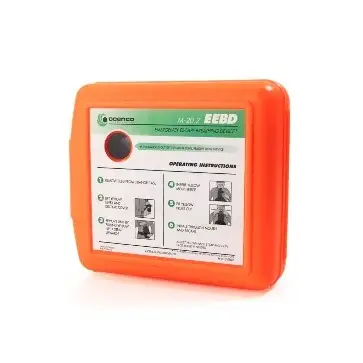
The M-20.2 EEBD Breathing Device eliminates that problem by design. It is a self-contained, closed-circuit compressed oxygen apparatus that activates automatically the moment it is removed from its clear storage case — no separate activation step, no valve to open, no button to press. The demand regulator delivers oxygen immediately when donned, providing up to 100 litres per minute during high work rate escape, with a performance duration of 10 minutes under NIOSH approval and 15 minutes under CE marking. At under 10 seconds to don and 1.0kg as worn, it is designed to be on a worker’s face and delivering oxygen before a toxic atmosphere has time to cause incapacitation.
What sets the M-20.2 apart from comparable EEBDs is the combination of automatic activation on case removal — eliminating the activation step that represents the critical failure mode in emergency escape breathing equipment — with a 15-year service life, visual inspection simplicity through a clear case design, and approval under MED Wheelmark, CE/EN13794, and NIOSH. For marine operators, offshore safety managers, and industrial facility HSE officers specifying escape breathing equipment, the M-20.2’s automatic activation design directly addresses the operational scenario where a manual activation step would most likely be missed.
Key Features
Automatic Activation on Case Removal
The M-20.2’s compressed oxygen delivery system activates automatically when the device is removed from its clear storage case. There is no separate activation step, no valve to manually open, and no button to press before donning. In a toxic gas emergency where cognitive impairment, panic, zero visibility, and physical urgency are all simultaneously present, an activation step that the user might fail to complete is a critical safety gap. Automatic activation on case removal eliminates that gap — the device is delivering oxygen as soon as the user reaches for it.
Demand-Regulated Oxygen Delivery — Up to 100 L/min
The demand regulator delivers oxygen in response to the user’s breathing demand — providing up to 100 litres per minute during high work rate escape activity. Demand regulation means the user receives the oxygen flow rate their physiological exertion requires — higher during rapid escape movement, lower during slower movement — rather than a fixed flow rate that may be insufficient during physical exertion or wasteful during lower activity. Efficient oxygen delivery is what provides the maximum effective escape duration from the available oxygen supply.
10-Minute NIOSH / 15-Minute CE Performance Duration
The M-20.2 provides a 10-minute performance duration under NIOSH (US National Institute for Occupational Safety and Health) approval and a 15-minute performance duration under CE/EN13794 marking. The difference reflects the different test protocols and work rate assumptions used by each approval body. For marine operators, the 15-minute CE duration aligns with SOLAS requirements for Emergency Escape Breathing Devices carried on board vessels. For industrial and US market applications, the 10-minute NIOSH approval satisfies OSHA and US regulatory requirements. Both durations are available from the same device — appropriate approval selected according to the regulatory framework of the deployment environment.
Under 10-Second Donning Time
The M-20.2 is designed to be fully donned and delivering oxygen in under 10 seconds. In a rapidly developing toxic gas emergency where escape time is measured in minutes, every second between reaching for the EEBD and having it operational matters. A donning time under 10 seconds — achievable without prior training refresher under emergency stress conditions — is a design requirement that the M-20.2 satisfies through a simplified donning procedure combined with automatic activation on case removal.
Clear Case — Visual Inspection Without Opening
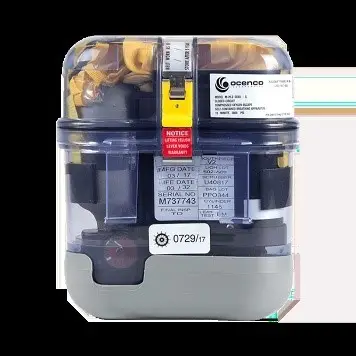
The clear storage case allows the operational readiness of the device to be assessed visually without opening the case or disturbing the automatic activation mechanism. Annual inspection for stored units and daily inspection for deployed units can be completed by visual check — confirming the device is present, undamaged, and showing no signs of depletion or case compromise without the risk of inadvertently triggering the automatic activation during inspection. The clear case design makes inspection compliance straightforward for large numbers of deployed units on board vessels or in industrial facilities.
15-Year Service Life
The M-20.2 carries a 15-year service life from date of manufacture — one of the longest service lives available for an EEBD in this class. For vessel operators and industrial facilities managing large numbers of EEBDs across multiple locations, a 15-year service life significantly reduces the frequency of device replacement compared to EEBDs with 6–10 year service lives — directly reducing the long-term cost of maintaining EEBD coverage across a fleet or facility over a multi-decade operational period.
Belt-Worn or Stored Configuration
The M-20.2 can be either belt-worn for immediate personal access or stored at fixed locations on board vessels or in industrial facilities. Belt-worn deployment ensures the device is with the worker at all times in environments where emergency escape breathing equipment is required to be personally carried. Fixed storage deployment at escape route stations, muster points, and emergency equipment lockers provides accessible EEBD coverage for workers who do not carry the device personally. Both deployment configurations are supported by the same device — reducing the inventory complexity of maintaining separate belt-worn and storage-deployed EEBD models.
1.0kg as Donned — Lightweight Escape Equipment
The M-20.2 weighs 1.0kg as donned — 2.1 lbs — which is light enough to be worn on the face and carried on the belt without significantly impeding escape movement in emergency conditions. For emergency escape equipment, where rapid movement through confined spaces, stairways, and emergency exits may be required during use, device weight directly affects the user’s ability to move quickly during an escape scenario.
Technical Specifications
Model: M-20.2
Type: Emergency Escape Breathing Device (EEBD) — self-contained closed-circuit compressed oxygen
Oxygen Delivery: Automatic on removal from case, demand regulated, up to 100 L/min
Performance Duration: 10 minutes (NIOSH Approved) / 15 minutes (CE Marked)
Donning Time: Less than 10 seconds
Weight (as donned): 1.0 kg (2.1 lbs)
Product Dimensions: 2.75″ × 7″ × 6.1″ (6.9 × 16.7 × 15.5 cm)
Storage Case Dimensions: 8.2″ × 9.2″ × 4.2″ (21 × 23 × 10 cm)
Service Life: 15 years
Storage Temperature: 10–149°F (-12.2°C to 65°C)
Inspection: Visual — annually for stored units, daily for deployed units
Deployment: Belt-worn or stored
Approvals: MED Wheelmark, CE/EN13794, NIOSH
Benefits
Automatic activation removes the most likely failure point in an emergency. In a toxic gas emergency, the steps a user must consciously complete before the device delivers oxygen are potential failure points. Automatic activation on case removal reduces that to zero conscious steps — the device is active the moment it is reached for, regardless of the user’s physiological or cognitive state at that moment.
Dual NIOSH/CE approval covers both US regulatory and SOLAS marine requirements from a single device. Operators deploying EEBDs across international fleets and facilities that must satisfy both US OSHA and international maritime SOLAS requirements can use the M-20.2 for both application environments — avoiding the procurement complexity and inventory management overhead of maintaining separate EEBD models for different regulatory frameworks.
15-year service life reduces long-term replacement cost across a large deployment. For a vessel carrying 20 EEBDs or a facility stocking 50 units, the difference between a 10-year and 15-year service life is a 33% reduction in replacement frequency across the deployment. Over a 30-year operational period, that difference compounds into a meaningful total cost of ownership reduction for large-scale EEBD programmes.
Clear case simplifies inspection compliance across distributed deployments. Visual inspection without opening the case makes daily and annual EEBD inspection a fast, straightforward task for safety officers managing large numbers of deployed units across a vessel or facility. Inspection compliance is more likely when inspection is simple — and a clear case makes it as simple as possible.
Belt-worn and stored deployment flexibility supports diverse facility layouts. The ability to deploy the same M-20.2 device either personally on a worker’s belt or at fixed storage locations provides operational flexibility for facilities with different escape route configurations, risk profiles, and workforce movement patterns — without maintaining separate product inventories for each deployment method.
Who It’s For
The Marine Safety Officer Managing EEBD Compliance on Board Vessels
You’re responsible for maintaining SOLAS-compliant EEBD coverage across all required locations on board an oil tanker, chemical tanker, gas carrier, or passenger vessel. You need EEBDs with MED Wheelmark certification for SOLAS compliance, a minimum 15-minute duration for SOLAS-required locations, and a practical inspection schedule that can be maintained across all deployed units without excessive maintenance burden. The M-20.2’s MED/CE approval, 15-minute CE duration, 15-year service life, and visual inspection simplicity address all four of those requirements directly.
The HSE Manager at an Industrial Facility with Toxic Gas Risk
You manage EEBD deployment across a chemical plant, refinery, or industrial facility where workers may need emergency escape breathing protection in toxic gas areas. You need devices that can be either personally carried on belts in high-risk zones or stored at escape route stations throughout the facility, with NIOSH approval for US regulatory compliance, simple visual inspection for the facility safety team, and a long service life to minimise the replacement overhead across a large installation. The M-20.2 provides all of those features in a single device specification.
The Procurement Manager Sourcing EEBD Equipment for a Fleet or Multi-Site Operation
You’re specifying EEBDs for a fleet of vessels or multiple industrial facilities across international markets where both SOLAS marine requirements and US industrial regulations may apply. A single EEBD model with MED Wheelmark, CE/EN13794, and NIOSH approval covers all three regulatory frameworks without requiring separate procurement, inventory management, and replacement tracking for different EEBD models across different deployment environments.
Possible Applications
- Marine vessel SOLAS EEBD requirements — EEBD coverage at required locations on oil tankers, chemical tankers, gas carriers, bulk carriers, and passenger vessels under SOLAS regulations
- Offshore platform and FPSO emergency escape — Personal and station-deployed EEBD coverage for offshore oil and gas workers in toxic gas risk areas
- Chemical and petrochemical plant emergency escape — EEBD deployment at escape route stations and as personal belt-worn devices for workers in toxic gas handling areas
- Petroleum refinery operations — Emergency escape breathing coverage for workers in H2S, SO2, and hydrocarbon gas risk areas during normal operations and maintenance
- Mining — underground operations — Personal EEBD provision for underground workers as part of self-rescue emergency equipment
- Industrial confined space emergency escape — EEBD provision at confined space entry stations for emergency escape coverage during confined space maintenance and inspection work
- Fire service and emergency response — Emergency escape breathing equipment for first responders requiring short-duration personal oxygen protection during evacuation from hazardous atmospheres
- Power plants and utilities — Emergency escape breathing device provision for workers in enclosed plant areas with toxic gas risk from fuel systems, transformer cooling gases, and process chemicals
Trust and Certifications
MED Wheelmark — SOLAS Marine Equipment Directive
MED Wheelmark certification confirms the M-20.2 meets the EU Marine Equipment Directive requirements for EEBD equipment carried on board SOLAS-class vessels. For vessel operators deploying EEBDs to satisfy SOLAS Chapter II-2 requirements, MED Wheelmark is the certification that confirms regulatory compliance. Without MED Wheelmark, an EEBD cannot be used to satisfy SOLAS EEBD requirements on vessels operating under EU flag state requirements.
CE/EN13794 — European Emergency Escape Breathing Device Standard
CE marking to EN13794 is the European standard for self-contained open or closed-circuit compressed air or oxygen breathing apparatus for escape. EN13794 compliance confirms the M-20.2 meets the European performance standard for emergency escape breathing equipment — including the test protocols that establish the 15-minute performance duration referenced in the CE marking. For EU market deployments in industrial and marine applications, CE/EN13794 is the relevant product standard certification.
NIOSH — US National Institute for Occupational Safety and Health
NIOSH approval is the US regulatory certification for self-contained breathing apparatus and escape breathing equipment. NIOSH approval to a 10-minute performance standard satisfies US OSHA requirements for emergency escape breathing devices in industrial applications — including chemical plants, refineries, and industrial facilities operating under US federal safety regulations. For operators deploying EEBDs across US facilities alongside international marine deployments, the M-20.2’s dual NIOSH/CE/MED approval covers all regulatory frameworks from a single device.
15-Year Service Life — Manufacturer Certified
The 15-year service life is a manufacturer-certified performance specification that provides the longest EEBD service life in this class — directly affecting total cost of ownership calculations for large-scale EEBD deployment programmes over multi-decade operational periods.
Authorised by Alright Engineering Solutions
The M-20.2 EEBD is supplied through Alright Engineering Solutions Pte. Ltd., an authorised distributor of personal and portable gas detection equipment and marine safety equipment in Singapore. Alright Engineering Solutions provides local procurement support, SOLAS compliance guidance, and after-sales service for the Singapore and regional market.
Accessories and Variants
Belt Clip / Carrying Holster
Enables the M-20.2 to be belt-worn for immediate personal access in high-risk areas — keeping emergency escape breathing equipment on the worker at all times rather than requiring a separate retrieval step from a wall-mounted storage location.
Wall-Mounted Storage Bracket
For fixed deployment at escape route stations, muster points, and emergency equipment locations — allowing the M-20.2 to be stored at defined accessible locations throughout a vessel or facility for immediate retrieval by any worker who needs it during an emergency.
Inspection Documentation Tags
Inspection record tags for documenting annual inspection compliance for stored units — supporting ISM Code safety management system maintenance records for vessel operators and OSHA-required inspection records for industrial facilities.
Related Products from Alright Engineering Solutions
BELLMINI Single Gas Detectors — Personal portable monitors for CO, H2S, O2, and other toxic gases — used alongside EEBDs in toxic gas risk environments
GX-8000 Sample Draw Multi Gas Monitor — Marine multi-gas monitor for vessel confined space pre-entry atmospheric assessment
RX-8700 Portable Gas Detector — Multi-gas monitor with MED/ATEX/IECEx certification for marine applications
Riken Keiki GX-3R Multi Gas Detector — World’s smallest 4-gas personal monitor with MED/ATEX/IECEx/CSA certification
Get in Touch
If you’re specifying emergency escape breathing devices for SOLAS marine compliance, industrial facility deployment, or offshore operations — and need equipment that combines automatic activation, dual NIOSH/CE/MED approval, and a 15-year service life in a sub-1kg device — the M-20.2 EEBD is worth a detailed evaluation.
Contact Alright Engineering Solutions to request a formal quote, discuss deployment quantities for your vessel or facility, or get guidance on EEBD placement requirements for your specific application.
📍 3791 Jalan Bukit Merah #06-01, E-Centre @ Redhill, Singapore 159471