Cart (
Overview
Continuous oil concentration monitoring in bilge and wastewater systems is a fundamental MARPOL compliance requirement on commercial vessels — and the reliability of that monitoring depends almost entirely on the measurement technology at the core of the OCM system. Many conventional bilge alarm systems use optical detection methods that are sensitive to interference from colour, turbidity, and suspended solids in the sample water. When bilge water composition changes — as it routinely does on working vessels, from clear separator effluent to heavily contaminated bilge accumulation — optical systems can produce unreliable readings that either fail to detect genuine oil exceedances or trigger false alarms that interrupt bilge management operations.
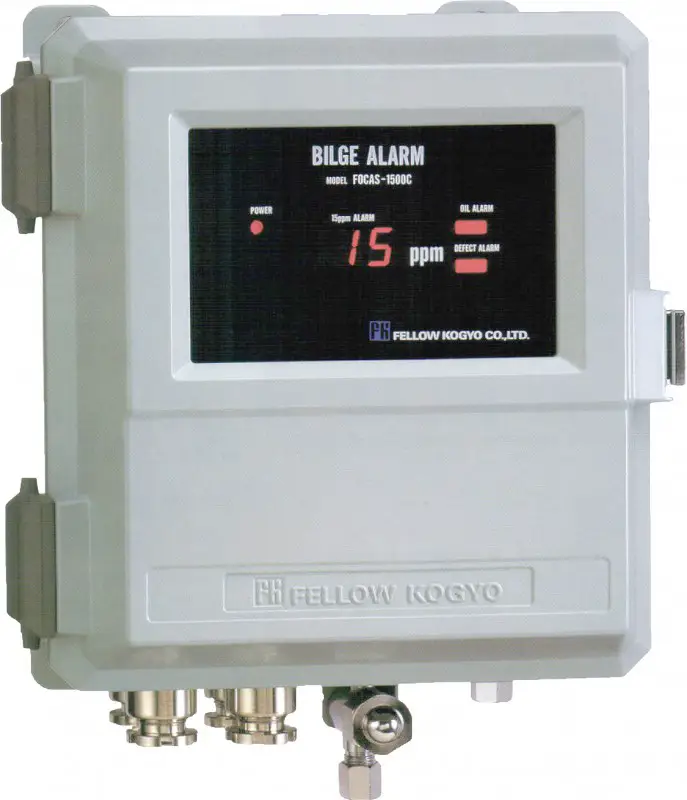
The Fellow Kogyo FOCAS-1500c 15ppm Bilge Alarm uses ultrasonic turbidity measurement rather than optical detection, applying a fundamentally different physical measurement principle to the oil content monitoring problem. Ultrasonic measurement is not affected by sample water colour or visual turbidity in the way that optical methods are — the acoustic signal interacts with oil droplets in the sample stream on the basis of their physical properties, independently of the visual appearance of the water. This gives the FOCAS-1500c a measurement foundation that remains stable across a wider range of real-world bilge water compositions than optical OCMs can reliably handle.
Developed and manufactured by Fellow Kogyo Co., Ltd. — a Japanese marine instrument manufacturer — the FOCAS-1500c meets the requirements of IMO Resolution MEPC60(33) and holds type approvals from Japan’s classification society (JG) and the United States Department of Transportation (DOT). For vessel operators and technical managers who need a certified, continuously operating bilge alarm with a proven measurement method and a documented regulatory approval history, the FOCAS-1500c provides a straightforward and technically differentiated option in the 15ppm OCM category.
Key Features
Ultrasonic Turbidity Measurement — Non-Optical Detection Method
The FOCAS-1500c measures oil concentration using turbidity measurement by ultrasonic waves — a detection method that operates independently of sample water colour and visual characteristics. Where optical OCMs direct a light beam through the sample water and measure attenuation or scattering, the FOCAS-1500c uses acoustic energy to detect the presence of oil droplets in the water stream. Bilge water on commercial vessels is rarely clean or visually consistent: it contains varying concentrations of rust particles, soot, cleaning chemical residues, and mixed oil types that can interfere with optical measurement. Ultrasonic measurement is not subject to the same colour and visual turbidity interference, giving the FOCAS-1500c a measurement principle that handles real-world bilge water compositions more consistently than optical alternatives in contaminated sample conditions.
Continuous Measurement — 17-Second Measuring Cycle
The FOCAS-1500c operates on a continuous measurement cycle of approximately 17 seconds, providing a near-real-time oil concentration reading throughout bilge pump operation. A 17-second cycle means the system takes a fresh reading every 17 seconds — so any rise in oil concentration toward the 15ppm alarm threshold is detected promptly, giving the bilge management system and the engine room watch sufficient time to respond before a compliant discharge becomes a non-compliant one. For MARPOL compliance purposes, the short measurement cycle directly supports the vessel’s ability to demonstrate active, continuous monitoring of overboard bilge water discharge rather than periodic spot-check monitoring.
Fixed 15ppm Alarm Setpoint — MARPOL Compliance Threshold
The FOCAS-1500c is configured with a fixed alarm setpoint at 15ppm — the MARPOL Annex I limit for overboard bilge water discharge outside special areas. When measured oil concentration reaches 15ppm, the alarm activates and triggers the overboard discharge isolation function, stopping the pump before non-compliant water is discharged. The fixed setpoint is consistent with the MEPC60(33) performance standard requirements for bilge alarms, providing a defined and auditable alarm threshold that satisfies the regulatory requirement without ambiguity. For PSC inspectors reviewing the vessel’s bilge alarm system, a fixed 15ppm alarm with a clear activation record is a straightforward compliance demonstration.
Wide Measuring Range and Pressure Tolerance
The FOCAS-1500c measures across a range of 0–30ppm, with measurement accuracy of within ±5ppm at 15ppm. The system accepts sample water at pressures from 0.2 to 3.0 bar (approximately 0.02–0.3 MPa) and water temperatures from 2°C to 45°C — covering the range of conditions encountered in bilge and separator sample streams on vessels operating in both warm and cold water regions. The pressure range compatibility means the FOCAS-1500c can be installed on the separator outlet sample line without requiring a pressure reducing arrangement in most standard bilge separator configurations, simplifying the installation.
Vibration and Inclination Tolerance — Built for the Marine Environment
The FOCAS-1500c is specified to operate correctly under vibration conditions of ±0.7G and at angles of inclination up to 22.5° from the horizontal plane. Engine room installations on commercial vessels are subject to continuous machinery vibration, and vessels in heavy weather routinely exceed 10° of roll and pitch — conditions under which instrument accuracy and alarm reliability must be maintained. The specified vibration and inclination tolerances reflect the MEPC60(33) testing requirements for bilge alarm equipment and confirm that the FOCAS-1500c has been tested to perform under the physical conditions of the marine environment, not just under laboratory conditions.
Wide Ambient Temperature and Humidity Range
The system operates across an ambient temperature range of 0°C to 55°C and tolerates relative humidity up to 90% — the upper end of typical engine room ambient conditions, including machinery spaces on vessels operating in tropical climates. Engine rooms are among the most demanding environments for instrumentation, with heat from machinery, humidity from bilge accumulation and engine room cleaning operations, and condensation from temperature differentials all present. The FOCAS-1500c’s environmental specification covers the realistic upper bounds of these conditions, supporting continuous reliable operation without requiring special environmental controls around the installation location.
Multiple AC Supply Voltage Options
The FOCAS-1500c accepts four AC supply voltages — 100V, 110V, 115V, and 220V at 50/60Hz — covering the range of standard marine electrical supply voltages in use across the global fleet. This broad voltage compatibility is a practical installation advantage for vessels with non-standard supply voltages, for fleet managers specifying a single OCM model across vessels with different electrical configurations, and for retrofit projects where the existing power supply at the installation location may not match a narrow-voltage-range instrument requirement.
Technical Specifications
Model: FOCAS-1500c
Measuring Method: Turbidity by ultrasonic waves
Measuring Range: 0 – 30 ppm
Measuring Accuracy: Within ±5 ppm (at 15 ppm)
Measuring Cycle: Approx. 17 seconds
Alarm Setpoint: 15 ppm (fixed)
Measuring Pressure: 0.2 – 3.0 bar (0.02 – 0.3 MPa)
Measuring Water Temperature: 2 – 45°C
Ambient Temperature: 0 – 55°C
Allowable Humidity: Max. 90% RH
Sample Water Flow Rate: 0.2 – 3 litres/min (0.0002 – 0.003 m³/min)
Vibration Tolerance: ±0.7G
Angle of Inclination: 22.5° from horizontal plane
Power Supply: AC 100 / 110 / 115 / 220V, 50/60 Hz
Power Consumption: 40W average (150VA max.)
Weight: Approx. 7.5 kg
Dimensions (W×H×D): 255 × 290 × 158 mm
Display: Digital LED display (ppm readout)
Safety Approvals: MEPC60(33) — JG (Japan), DOT (USA)
Benefits
The primary operational benefit of the FOCAS-1500c’s ultrasonic measurement method is stability of readings across varying bilge water compositions. Engine rooms accumulate bilge water from a range of sources — engine drip trays, shaft seal leakage, tank cleaning drainage, condensate — and the oil and solids content of that water changes continuously depending on what maintenance has been done, what fuel is in use, and how the bilge spaces have been managed. An optical OCM calibrated for one oil type or one visual turbidity baseline will drift in accuracy as bilge water composition changes; the FOCAS-1500c’s ultrasonic measurement principle does not carry the same optical calibration dependency, providing a more consistent measurement baseline across these varying real-world conditions.
For chief engineers and ETO officers managing engine room compliance documentation, a bilge alarm that produces stable, consistent readings across normal operational variation reduces the time spent investigating anomalous readings, resetting false alarms, and documenting exceptions in the Oil Record Book. Every unexplained alarm activation that has to be investigated and documented represents time taken away from other engine room duties — and every false alarm that triggers an unnecessary pump stop creates an operational disruption with a real cost in bilge accumulation management. A measurement system that behaves predictably reduces both types of disruption.
The FOCAS-1500c’s JG and DOT type approvals — alongside its MEPC60(33) compliance — provide the certification documentation that procurement teams and technical superintendents need to confirm regulatory acceptability to a flag state or classification society. For vessels trading between Japanese and US ports, where JG and USCG/DOT approval documentation may both be relevant to port state control inspections, the FOCAS-1500c’s dual-authority approval status is a directly relevant procurement consideration.
Who It’s For
Chief Engineers on Vessels with Mixed or Heavily Contaminated Bilge Water
A chief engineer on a bulk carrier or tanker with an older engine room — where bilge accumulation contains a mixture of HFO residues, lubricating oil, rust particles, and cleaning chemical residue — knows from experience that optical bilge alarms can be inconsistent in these conditions. False alarms during high-solids periods, and sluggish response during genuine oil exceedances when the optical path is partially fouled, are practical problems that affect daily bilge management. The FOCAS-1500c’s ultrasonic measurement principle is the technically motivated alternative for engineers who have experienced optical OCM reliability issues and need a system whose measurement foundation is not subject to the same optical interference modes.
Procurement Officers Sourcing OCMs for Japanese-Built Vessels
A procurement officer sourcing a replacement OCM for a Japanese-built vessel operating under Japanese flag — or calling regularly at Japanese ports — will find that Japan’s classification society (JG) type approval is the relevant certification for confirming system acceptability to Japanese maritime authorities. The FOCAS-1500c’s JG approval, combined with DOT (US) approval, makes it a straightforward procurement choice for vessels where Japanese regulatory acceptability is a procurement requirement. For vessels in Japanese-operated fleets or those frequently calling at Japanese ports, sourcing an OCM from a Japanese manufacturer with Japanese classification approval simplifies the procurement and installation approval process.
Technical Superintendents Managing Older Vessels with Non-Standard Supply Voltages
A technical superintendent overseeing a fleet that includes older vessels with 100V or 110V AC electrical systems — common on Japanese-built vessels from earlier build periods — faces a practical constraint when specifying OCM replacements: many current OCM models accept only 115/230V or 24V DC supply, requiring a transformer or supply modification for these vessels. The FOCAS-1500c’s four-voltage AC supply compatibility (100, 110, 115, 220V) resolves this issue, making it a direct fit for a wider range of vessel electrical configurations without additional supply conditioning equipment.
Possible Applications
Bulk Carriers and General Cargo Vessels — Engine Room Bilge Monitoring — Continuous 15ppm monitoring on separator outlet sample lines; 17-second measurement cycle provides active monitoring throughout bilge pump operation on vessels with high bilge water accumulation rates.
Tankers — MARPOL Annex I Compliance — Bilge alarm installation on product tankers and chemical carriers operating under flag state administrations that recognise MEPC60(33) type approvals, supporting Oil Record Book Part I compliance documentation.
Japanese-Built and Japanese-Flagged Vessels — OCM installation where JG (Nippon Kaiji Kyokai / ClassNK) type approval is a flag state or Class requirement; the FOCAS-1500c’s Japanese manufacturer origin and JG approval support a straightforward approval documentation chain for Japanese-registry vessels.
Vessels Calling at US Ports — DOT Compliance — For vessels subject to USCG port state control inspection where DOT-approved bilge alarm equipment is required, the FOCAS-1500c’s DOT type approval provides the US authority certification required for PSC inspection documentation.
Heavily Contaminated Engine Room Bilge Conditions — Engine rooms with high suspended solids loading, mixed oil types, or cleaning chemical residues in bilge accumulation, where optical OCM performance has historically been inconsistent; ultrasonic measurement provides a more stable reading baseline in these conditions.
Vessels Operating in Tropical Climates — The 55°C ambient temperature ceiling and 90% humidity tolerance make the FOCAS-1500c suitable for installation in engine rooms on vessels operating in Southeast Asian, Middle Eastern, and West African trading routes where engine room ambient temperatures regularly exceed the operating range of less environmentally tolerant instruments.
Retrofit Installations on Existing Separators — Replacement of end-of-life or non-compliant OCM systems; the FOCAS-1500c’s wide pressure and flow rate compatibility (0.2–3 bar, 0.2–3 litres/min) gives it broad compatibility with existing separator outlet sample connections across different separator makes and models.
Trust & Certifications
MEPC60(33) — IMO Resolution Compliance Standard
IMO Resolution MEPC60(33) establishes the performance standard for oil content monitors used in MARPOL Annex I bilge alarm systems. Compliance with MEPC60(33) is the regulatory baseline for OCM type approval — without it, a bilge alarm system cannot be accepted as compliant equipment by a flag state or classification society. The FOCAS-1500c meets the requirements of MEPC60(33), providing the foundational certification required for installation on any commercial vessel subject to MARPOL Annex I regulations. Vessels seeking to comply with the more recent MEPC.107(49) standard should confirm the applicable requirement with their flag state administration, as flag state acceptance of MEPC60(33)-approved equipment varies.
JG (Japan) — Japanese Classification Society Type Approval
JG type approval — issued by Nippon Kaiji Kyokai (ClassNK), Japan’s leading classification society — is the relevant certification for vessels operating under Japanese flag or classed by ClassNK. ClassNK is one of the world’s major classification societies, with a large classed fleet including significant numbers of bulk carriers, tankers, and container vessels built in Japan or operated by Japanese shipping companies. The FOCAS-1500c’s JG type approval confirms ClassNK’s acceptance of the system as compliant OCM equipment, supporting installation on ClassNK-classed vessels without requiring additional flag state approval documentation beyond the standard type approval certificate.
DOT (USA) — United States Department of Transportation Approval
DOT (Department of Transportation) type approval covers the FOCAS-1500c’s acceptability under US maritime regulations governing bilge alarm systems on vessels calling at US ports. The United States maintains active port state control enforcement of MARPOL requirements through the USCG, and DOT-approved OCM equipment provides the regulatory documentation that supports PSC inspection compliance for vessels entering US waters. For operators trading to US ports — particularly in the Gulf of Mexico, Atlantic seaboard, and Pacific coast — DOT approval on the FOCAS-1500c is the specific US authority certification relevant to PSC inspection requirements.
Fellow Kogyo Co., Ltd. — Japanese Marine Instrument Manufacturer
The FOCAS-1500c is manufactured by Fellow Kogyo Co., Ltd., a Japanese company specialising in marine instrumentation and measurement equipment. Japanese manufacturing standards and quality control practices are internationally recognised in the marine equipment sector — Japanese-manufactured marine instruments are widely used on commercial vessels worldwide for their reliability and build consistency. Fellow Kogyo’s focus on marine measurement instrumentation means the FOCAS-1500c is a purpose-built marine OCM from a specialist manufacturer, rather than an adaptation of an industrial instrument to a marine application.
Accessories & Variants
Sample Water Piping and Connection Set
The FOCAS-1500c requires a sample water connection from the bilge separator outlet, sized within the system’s specified flow rate range of 0.2–3 litres/min. The installation typically includes isolation valves, a sample line filter to remove gross solids, and a flow control arrangement to maintain sample flow within the specified pressure and flow range. These components are site-specific and matched to the vessel’s separator outlet configuration at the time of installation.
Alarm Output Interface
The FOCAS-1500c’s alarm output connects to the vessel’s overboard discharge pump control circuit and to the engine room alarm panel, providing automatic pump isolation on 15ppm alarm activation and alarm indication at the engine room monitoring station. The interface wiring requirements depend on the vessel’s specific alarm and pump control system configuration and are confirmed at installation.
FOCAS-1500c — Standard 15ppm Variant
The FOCAS-1500c is available as a standard 15ppm bilge alarm system meeting MEPC60(33) requirements with JG and DOT type approvals, configured for the standard MARPOL Annex I 15ppm overboard discharge limit. For vessels requiring a different alarm threshold or a variant meeting a different IMO resolution, contact us to confirm the available specification options for your specific vessel and flag state requirement.
Get in Touch
If you are sourcing a MARPOL-compliant 15ppm bilge alarm for a vessel operating under Japanese flag or calling at US ports — or if your vessel operates in conditions where optical OCM performance has been inconsistent and you are looking for an ultrasonic measurement alternative — contact us to discuss your vessel’s specific requirements and request a formal quotation for the FOCAS-1500c.
Our team can advise on installation configuration for your separator type, confirm JG and DOT approval documentation for your flag state and class requirements, and support procurement and delivery for planned port call or dry-dock installation.