Cart (
Overview
Class A, Class B, and Class F fires — covering solid combustibles, flammable liquids, and cooking oil fires — represent the three most common fire risk categories in commercial kitchens, vessel galleys, offshore platforms, coastal installations, and general industrial environments. Managing these risks with a single extinguisher unit simplifies procurement, reduces the number of units required per installation, and removes the possibility of a first responder reaching for the wrong extinguisher type under pressure. Most portable extinguishers in this multi-class category are powder types — effective in terms of fire rating numbers, but with a significant operational drawback: the powder cloud created on discharge obscures the operator’s vision, blankets the surrounding area in residual agent, and creates a secondary cleanup and equipment damage problem that foam extinguishers do not.
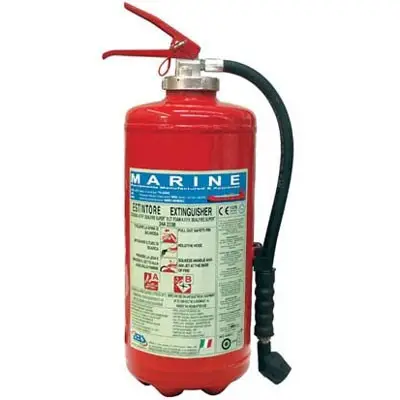
The ABS 9 Liter Foam Fire Extinguisher (Cartridge) addresses Class A, B, and F fires without the visibility and contamination problems associated with dry powder alternatives. The foam agent is applied as a coherent, directional discharge — the operator maintains full vision of the fire throughout the discharge, which is a meaningful safety advantage when working at a 5-metre standoff distance from a Class B liquid fire or a Class F cooking oil fire. The foam blanket formed over a Class B or F fire source suppresses vapour release and prevents flashback, providing a more stable post-discharge result than powder in scenarios where re-ignition risk persists.
What distinguishes this unit from comparable foam extinguishers is the cartridge-operated design. Refilling after discharge requires no pressurised workshop, no specialist recharge equipment, and no shoreside service contractor. The crew or maintenance team replaces the spent 55g CO2 cartridge and refills the foam agent — and the extinguisher is back in service. On a vessel weeks from port, at an offshore installation, or at a remote industrial site, this independent recharge capability is not a convenience feature. It is an operational necessity.
Key Features
Triple Fire Class Rating — Class A, B, and F Coverage
The ABS 9L Foam extinguisher carries a fire rating of 34A 233B 75F — covering Class A (solid combustibles: wood, paper, textiles), Class B (flammable and combustible liquids: fuel, oil, solvents), and Class F (cooking oils and fats). A single unit addresses the three fire classes most frequently encountered in commercial kitchens, vessel galleys, hotel and hospitality facilities, offshore catering areas, and light industrial environments where all three risk types may be present in the same space. For procurement teams and HSE officers, the triple-class rating reduces the number of extinguisher types required per installation — simplifying inventory management, crew training, and annual service scheduling.
Cartridge-Operated Recharge — No Workshop Required
Propellant is delivered by a separate 55g CO2 cartridge rather than stored pressure within the cylinder. After discharge, the unit is recharged by replacing the spent cartridge and refilling the foam agent — both tasks that can be completed in the field by trained maintenance personnel without specialist equipment. On board a vessel on a multi-week voyage, at an offshore platform between supply vessel calls, or at an industrial site remote from a fire equipment service contractor, this means the extinguisher is returned to full operational status immediately following a discharge event — without a site visit, without factory return, and without waiting for a service appointment.
Full Operator Visibility During Discharge — Foam vs Powder
Unlike dry powder extinguishers, which create a dense, obscuring cloud that eliminates the operator’s view of the fire within seconds of discharge, the foam agent is applied as a directed, coherent stream that does not degrade operator visibility. The person operating the extinguisher can see the fire, see where the agent is landing, correct their aim, and assess whether the fire is responding — throughout the full 34-second discharge time. In a real fire response situation, especially for a non-specialist operator responding to an incident in a kitchen, galley, or plant room, this visibility advantage directly improves discharge effectiveness and operator safety.
Foam Flashback Protection — Post-Discharge Fire Suppression
The foam agent forms a coherent blanket over the surface of a Class B liquid fire or Class F cooking oil fire, sealing the fuel surface from oxygen contact and suppressing the vapour release that sustains combustion. This foam blanket persists after discharge ends, providing a period of continued suppression while the fuel surface cools — reducing the risk of re-ignition from residual heat, hot surfaces, or continued heat input from adjacent equipment. Powder agents do not form a persistent blanket and do not provide comparable flashback protection on liquid surface fires, making foam the preferred agent type for Class F cooking oil fires and Class B pooling liquid fire scenarios.
34-Second Discharge Time — Extended First-Attack Window
The 34-second discharge time — substantially longer than the 8–12 seconds typical of smaller portable extinguishers — gives the operator the time to work the fire systematically: sweeping the base of a Class B liquid fire, building up the foam blanket progressively over a Class F cooking surface, or directing agent at the root of a Class A combustible fire. For a first responder without extensive firefighting training, the extended discharge window reduces the pressure to deliver a perfect first-sweep — there is time to correct aim, reposition, and confirm suppression before agent is exhausted.
Wide Cylinder Opening — In-Field Powder/Agent Condition Inspection
The cylinder is fitted with a wide opening that allows maintenance personnel to inspect the internal condition of the foam agent charge using an adjustable spanner — without specialist inspection tools or a service technician. Foam agent can degrade over time in high-humidity environments or following partial discharge, and the ability to visually confirm agent condition at each periodic maintenance check ensures the unit is confirmed serviceable rather than assumed serviceable. This is a directly practical maintenance feature for vessels and remote installations where fire equipment inspection is carried out by crew or in-house maintenance teams rather than contracted service engineers.
Ecological Agent — 98% Biodegradable
The foam agent is 98% biodegradable — a specification relevant for vessel and offshore operators subject to MARPOL environmental regulations governing discharge of substances to sea, and for industrial facilities with environmental management system requirements governing agent selection for fire suppression equipment. Where a fire event results in agent discharge in a sensitive or regulated environment, the biodegradable agent specification reduces the environmental impact assessment burden and supports compliance documentation for post-incident reporting. For organisations with ISO 14001 environmental management commitments or ESG reporting obligations, agent biodegradability is an increasingly relevant procurement consideration.
Technical Specifications
Model: 14392_1
Extinguishing Agent: 9L Foam
Propellant: 55g CO2 Cartridge
Test Standard: EN 3
Fire Rating: 34A 233B 75F
Fire Classes Covered: Class A, Class B, Class F
Discharge Distance: 5 m
Approx. Discharge Time: 34 seconds
Working Pressure: 15 bar
Test Pressure: 26 bar
Operating Temperature: 0°C to +60°C
Body Diameter: 190 mm
Height: 540 mm
Approx. Total Weight (Charged): 14.7 kg
Operation Method: Cartridge Operated
Agent Biodegradability: 98%
Benefits
The most immediate benefit for the organisation operating this extinguisher is the reduction in post-discharge recovery time. A powder extinguisher discharge in a commercial kitchen, vessel galley, or equipment room results in residual powder contamination across all surfaces, equipment, and food preparation areas — requiring a full shutdown, deep clean, and equipment inspection before the space can return to operation. A foam discharge is contained to the fire zone: the area is cleaned, the extinguisher is recharged, and the space is returned to service. For a vessel galley or offshore catering facility, this distinction between a powder and foam discharge can mean the difference between a two-hour recovery and a two-day shutdown.
For HSE officers and safety managers, the EN 3 certification basis provides a documented compliance trail for fire equipment specification, annual inspection records, and fire authority or flag state survey submissions. The 34A 233B 75F fire rating provides a clear performance reference for risk assessment documentation — specifying not just that a foam extinguisher is installed, but that the installed unit has been performance-verified to suppress fires of a defined size in each class category.
For procurement teams managing fleet or multi-site fire equipment inventories, the cartridge-operated recharge design reduces the total cost of maintaining a serviceable first-attack capability. Annual service costs for stored-pressure extinguishers include labour, refill agent, and pressure recharge at each service interval. Cartridge-operated units reduce in-service maintenance costs because the recharge is simpler and can be completed in-house — and because the cylinder body does not require the same pressure test frequency as stored-pressure cylinders, since it is not under continuous internal pressure between deployments.
Who It’s For
Vessel Chief Officers and Marine Safety Officers
A vessel chief officer responsible for fire safety equipment inventory on a commercial vessel operating multi-week voyages faces a specific maintenance challenge: portable extinguishers that are discharged at sea cannot be returned to a shoreside service facility until the next port call. The cartridge-operated ABS 9L Foam extinguisher resolves this directly — replacement cartridges and foam agent refill stock can be carried as ship’s stores, and the vessel’s crew can complete the recharge in the machinery space or bosun’s store without specialist equipment. For SOLAS-applicable vessels carrying class-rated foam extinguishers in galley, accommodation, and cargo areas, this is the product category that addresses both the fire performance requirement and the in-service maintenance reality of extended sea passages.
Offshore Platform HSE Officers
An HSE officer on a fixed or floating offshore platform is responsible for maintaining a fully serviceable fire equipment inventory across all platform areas — from accommodation modules and galley areas to drilling deck and process equipment areas. Helicopter and supply vessel access constraints mean that fire equipment service contractors cannot be called in on short notice, and platforms carry fire equipment service capability in-house as a result. The cartridge-operated foam extinguisher fits directly into this self-maintained equipment model: recharge stock is carried on platform, recharge is completed by platform personnel, and the equipment audit trail is maintained through the platform’s own HSE management system.
Facilities Managers — Commercial Kitchens, Hotels, and Hospitality
A facilities manager responsible for a hotel, commercial catering facility, or restaurant group carries specific fire safety obligations for Class F cooking oil fire risk in kitchen areas — and general Class A and B first-attack provision throughout the premises. The ABS 9L Foam extinguisher’s triple-class rating (34A 233B 75F) makes it the single-unit solution for kitchen areas where all three fire classes are present: solid fuel combustibles from packaging and furnishing materials, flammable liquid risk from fuel storage and cleaning chemicals, and cooking oil risk from the cooking equipment itself. The foam agent’s non-contaminating discharge profile also means that a kitchen discharge event does not automatically result in a full kitchen shutdown and deep clean — a direct operational cost saving compared to a powder discharge event in the same space.
Possible Applications
Commercial Vessel Galleys and Accommodation Spaces
Vessel galley areas present Class A, B, and F fire risk simultaneously — cooking equipment, fuel storage, and combustible furnishing materials in a confined space. The ABS 9L Foam extinguisher’s triple-class rating and cartridge-recharge design make it the appropriate first-attack unit for galley mounting on commercial vessels where SOLAS fire equipment requirements and in-service maintenance constraints both need to be met from the same product specification.
Offshore Oil and Gas Platforms — Accommodation and Catering Modules
Accommodation modules on fixed and floating offshore platforms carry Class A fire risk from furnishing materials and electrical equipment, and Class F risk in catering areas. The foam extinguisher’s non-contaminating discharge and independent recharge capability match the operational environment of offshore platforms where equipment serviceability between supply vessel visits is a primary specification consideration.
Commercial Kitchens — Restaurants, Hotels, Catering Facilities
The 75F Class F rating specifically addresses cooking oil fire risk — the primary fire hazard in commercial kitchen environments. Combined with 34A and 233B ratings, the ABS 9L Foam extinguisher provides complete first-attack coverage for commercial kitchen fire risks from a single unit, simplifying kitchen fire safety provision and reducing the number of extinguisher types staff need to be trained to use.
Coastal Installations — Port Facilities, Jetties, Marine Workshops
Port facilities and coastal marine workshops combine flammable liquid risk from fuel handling and vessel maintenance operations with general Class A risk from workshop and storage areas. The foam extinguisher’s Class B capability — rated at 233B — provides substantial flammable liquid fire suppression capacity for fuel spill fire events at jetty transfer areas and workshop fuel storage zones, while the Class A and F ratings cover the broader facility risk profile.
Industrial Manufacturing — Light Industry and Food Processing
Food processing facilities combine Class A risk from packaging and raw material storage with Class F risk in cooking and processing areas. The foam extinguisher’s triple-class rating and ecologically responsible agent specification — 98% biodegradable — aligns with the environmental management requirements of food processing facilities where agent selection for fire suppression equipment is reviewed as part of ISO 14001 compliance and food safety management system assessments.
Warehousing and Distribution — Ambient and Temperature-Controlled Facilities
Warehousing facilities handling mixed goods — including packaged food products, cleaning chemicals, and general consumer goods — carry Class A and Class B first-attack fire risk at racking bay access points and loading bay areas. The foam extinguisher’s extended 34-second discharge time and 5-metre throw distance provide the first-attack window and standoff distance needed for a warehouse operative responding to a developing racking bay fire before the fire load exceeds single-unit first-attack capability.
Military and Government Vessels and Facilities
Military vessel operators and government facility managers specifying fire extinguishers for demanding operational environments require products tested to recognised international standards with documented performance ratings. The ABS 9L Foam extinguisher’s EN 3 certification, defined fire rating, and cartridge-operated design — enabling field recharge without external support — match the operational self-sufficiency requirements of military vessel and remote government facility fire safety specifications.
Trust & Certifications
EN 3 — European Standard for Portable Fire Extinguishers
EN 3 is the European standard series governing the design, construction, performance testing, and marking of portable fire extinguishers. Testing to EN 3 covers fire suppression performance (the fire rating tests), operating mechanism reliability, pressure containment, temperature cycle resistance, corrosion resistance, and agent compatibility. The 34A 233B 75F fire rating assigned to this unit is the direct result of standardised EN 3 fire test performance — providing procurement teams, fire authority inspectors, and insurance assessors with a documented, comparable performance basis for extinguisher specification and installation acceptance. EN 3 compliance is the baseline requirement for portable fire extinguisher specification across EU member states and in international projects aligning to European fire safety standards.
34A 233B 75F Fire Rating — Performance-Verified Suppression Capability
The fire rating is assigned following successful completion of standardised fire test arrays: the 34A rating reflects Class A combustible fire suppression performance; the 233B rating reflects Class B flammable liquid fire suppression performance; the 75F rating reflects Class F cooking oil fire suppression capability. These are not marketing claims — they are the direct output of standardised test fires conducted under EN 3 conditions. For HSE officers and fire safety consultants preparing fire risk assessments and specifying first-attack fire equipment against identified risk profiles, the fire rating provides the quantitative basis for confirming that a specified extinguisher is adequate for the fire sizes present in the risk assessment — rather than relying on nominal agent volume alone.
SOLAS Chapter II-2 Alignment — Marine Fire Fighting Equipment
The International Convention for the Safety of Life at Sea (SOLAS) Chapter II-2 specifies fire protection, detection, and extinction requirements for commercial vessels by vessel type and space category. Portable fire extinguishers carried on SOLAS vessels must be maintained to the manufacturer’s service schedule and meet defined performance requirements. EN 3-tested foam extinguishers with documented fire ratings provide the compliance evidence basis for SOLAS Chapter II-2 fire fighting equipment requirements, supporting flag state inspection, classification society survey, and port state control verification processes.
ABS — Fire Safety Equipment Brand for Harsh Environments
The ABS brand is associated with fire extinguisher products engineered and tested for demanding commercial, marine, and industrial environments. The 14392_1 model number provides an unambiguous procurement reference for repeat orders, service parts sourcing, and fire equipment inventory audit trails — supporting the documentation requirements of vessel safety management systems, HSE management systems, and institutional procurement processes where product traceability is a compliance requirement.
Accessories & Variants
Replacement CO2 Propellant Cartridge — 55g
The ABS 9L Foam Cartridge extinguisher uses a 55g CO2 propellant cartridge. Replacement cartridges should be stocked alongside the extinguisher — particularly on vessels and offshore platforms — to enable immediate field recharge following discharge. Confirm the correct cartridge specification (55g CO2) with your supplier to ensure compatibility with model 14392_1.
Foam Agent Refill — 9 Litre
Following discharge, the foam agent charge is replaced with fresh foam solution. Stocking a 9-litre foam agent refill alongside the unit ensures immediate recharge capability following a discharge event. Confirm the correct agent specification with the supplier to ensure the refilled unit retains its EN 3 fire rating compliance.
Wall Bracket and Mounting Hardware
Dedicated wall mounting brackets secure the extinguisher in a fixed, identifiable position for immediate access in an emergency. Bracket selection should consider the mounting surface material (steel bulkhead, concrete wall, timber partition) and the installation environment (exposed deck, indoor passageway, cabinet housing) to ensure the unit is held securely against vessel motion, vibration, and physical impact in the operating environment.
Fire Extinguisher Cabinet — Protective Housing
A protective cabinet provides weatherproof housing for extinguishers in semi-exposed environments — outdoor covered areas, vessel deck positions, and coastal installations subject to salt air and direct weather. Cabinet installation also supports fire equipment identification requirements in public buildings and commercial premises where clearly marked, identifiable fire equipment positions are required by fire safety regulations.
Available Variant
Model 14392_1 — ABS 9L Foam | Cartridge Operated | 55g CO2 | EN 3 | 34A 233B 75F | 0°C to +60°C | 14.7 kg charged
For foam extinguisher requirements below 9L (6L portable) or above 9L (wheeled trolley foam units), or for alternative agent types (CO2, BC powder, ABC powder) covering different fire class combinations, contact the supplier to confirm available model options and fire ratings for your specific risk assessment requirements.
Related Fire Safety Products
CO2 Extinguishers (2 kg / 5 kg) — Clean-agent electrical fire suppression for switchgear rooms, server rooms, and control panel areas where foam or powder agent discharge would damage sensitive equipment
BC Powder Extinguishers (6 kg / 9 kg) — Class B and C rated dry powder units for flammable gas and liquid fire risk in process areas and equipment rooms where Class F risk is not present
Fire Blankets — Immediate suppression of small Class F cooking oil fires and clothing fires in galley, kitchen, and laboratory environments; complement foam extinguisher provision for small-scale first attack before a developing fire requires extinguisher deployment
Get in Touch
If you are specifying foam fire extinguishers for a vessel, offshore platform, commercial kitchen, industrial facility, or multi-site property portfolio — or if you need to confirm the correct model, fire rating, agent type, and quantity for a specific risk assessment or fire safety schedule — contact us to discuss your requirement and request a formal procurement quotation.
Our team can assist with product selection against your fire safety specification, confirm EN 3 certification documentation for flag state or fire authority submission, and support procurement documentation for HSE compliance and audit purposes.
📍 3791 Jalan Bukit Merah #06-01, E-Centre @ Redhill, Singapore 159471