Cart (
Overview
Foam fire extinguishers and dry powder extinguishers are both effective against Class B flammable liquid fires, but they are not interchangeable tools. Powder extinguishers knock down a fire fast — but the agent cloud they create is dense enough to completely obscure the operator’s vision, making it extremely difficult to confirm suppression, identify re-ignition, or navigate the area during and after discharge. Foam extinguishers work differently: the agent is applied as a blanket over the burning surface, suppressing vapour release and sealing the fuel from oxygen, while the operator maintains full visual awareness throughout the discharge. That visibility advantage is not a comfort feature — it is the difference between a controlled suppression operation and a disoriented firefighter discharging agent into a cloud with no idea whether the fire is out.
For vessels operating in high-latitude waters and cold climate regions, there is a second and more fundamental problem with standard foam agents: they freeze. A foam extinguisher charged with standard AFFF or protein foam concentrate becomes inoperable below approximately 0°C — the agent thickens, stratifies, or freezes solid, and when the unit is needed it either discharges ineffectively or fails to discharge at all. The ABS 50 LTR Anti Freeze Foam Trolley is specifically formulated to address this failure mode. Its anti freeze foam agent remains fluid and operationally effective down to -20°C in the standard formulation and -30°C in the low-temperature variant — covering the operating temperature range of vessels transiting the North Atlantic, Northern Pacific, Baltic, Arctic approaches, and other cold water shipping routes where standard foam agents are a known reliability risk.
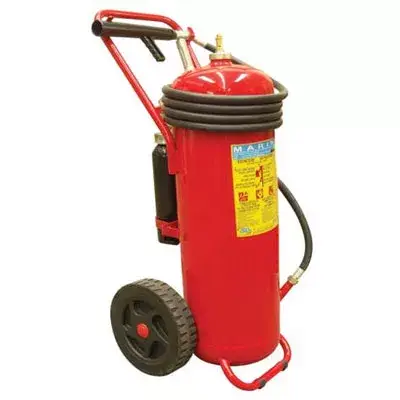
Beyond the cold-climate capability, the ABS 50 LTR Anti Freeze Foam Trolley Cartridge delivers the full operational profile of the ABS marine trolley extinguisher range: 50 litres of agent in a wheeled mobile format, cartridge-operated N2 propellant design for field recharge without workshop facilities, wide cylinder opening for on-site agent condition inspection, and rigorous testing for suitability in marine, offshore, and coastal installation environments. For HSE officers, vessel masters, and procurement managers specifying foam mobile extinguishers for cold climate or multi-season marine operations, this is the product that covers the scenarios standard foam trolleys cannot.
Key Features
Anti Freeze Foam Agent — Rated to -20°C / -30°C Operating Temperature
The defining feature of this extinguisher is its anti freeze foam formulation, which retains full operational fluidity and discharge effectiveness at temperatures down to -20°C (standard) or -30°C (low-temperature variant) — compared to standard foam agents which begin to lose effectiveness below 0°C and freeze solid in sustained sub-zero conditions. For vessels operating in northern hemisphere winter conditions, cold-weather port calls, or any route that takes the vessel into sub-zero ambient temperatures, this operating temperature range directly determines whether the foam extinguisher in the fire point locker is actually serviceable at the moment it is needed. Anti freeze foam is not an upgrade for cold climate operations — it is the correct specification.
Class A, Class B, and Class F Coverage — Three Fire Classes in One Unit
The ABS Anti Freeze Foam Trolley is rated for Class A (solid combustible materials), Class B (flammable liquids), and Class F (cooking oils and fats) fires. For marine environments, the Class B rating is the primary specification driver — engine room fuel oil fires, lubricant fires, and hydraulic fluid fires are the Class B scenarios this unit is positioned to address. The Class A and Class F ratings provide additional coverage that makes this extinguisher a genuinely versatile first-response tool across different vessel spaces and operational scenarios — including galley areas where Class F fire risk is present alongside the Class B and Class A risks of other shipboard locations.
Full Operator Visibility During Discharge — No Agent Cloud Obscuration
Unlike dry powder agents, which create a dense obscuring cloud on discharge that effectively blinds the operator, foam is applied as a directed, visible stream that allows the operator to see the fire, confirm suppression progress, and identify re-ignition throughout the discharge. In a confined shipboard space — an engine room, a machinery compartment, a cargo hold — operating an extinguisher in conditions of zero visibility is both inefficient and unsafe. Foam’s visibility advantage means the operator can aim accurately, adjust attack angle, maintain situational awareness, and confirm that the agent blanket has covered the burning surface — all while the discharge is happening.
Long Discharge Time — Approximately 45 Seconds at 8-Metre Range
With an approximate discharge time of 45 seconds and a discharge distance of 8 metres, the ABS Anti Freeze Foam Trolley gives the operator significantly more time on target than a comparable powder extinguisher. Longer discharge time means more margin for positioning, aiming adjustment, and ensuring complete surface coverage — particularly important when dealing with a spreading flammable liquid fire where incomplete blanket coverage allows re-ignition. The 8-metre discharge range allows the operator to attack the fire from a safe standoff distance, reducing heat exposure and improving operational safety in large fuel fire scenarios.
N2 Cartridge Propellant — Field-Repairable Without Workshop Access
The propellant system uses a replaceable nitrogen (N2) cartridge rather than stored pressure, which means the extinguisher body is unpressurised during storage and the propellant charge can be replaced on-site after discharge without workshop facilities. On a vessel at sea, this field-recharge capability means a deployed extinguisher can be returned to service by the crew — refilling the foam agent charge and fitting a replacement N2 cartridge — without waiting for a port call and professional service contractor visit. For vessels on extended voyages, this is the operational difference between a recoverable asset and an extinguisher that remains out of service for weeks.
Wide Cylinder Opening — Agent Condition Inspection by Crew
Foam concentrate can degrade, separate, or become contaminated over time — particularly in variable temperature environments where the agent is cycled between sub-zero and ambient temperatures repeatedly across a voyage. The wide cylinder opening allows crew to visually inspect the foam agent condition and confirm it remains homogeneous and properly mixed during routine maintenance checks. Catching foam degradation during inspection — before the unit is deployed in an emergency — is the kind of preventive capability that vessel HSE programmes depend on for maintaining genuine extinguisher readiness between professional service visits.
EN1866 Tested — European Standard for Mobile Fire Extinguishers
The ABS Anti Freeze Foam Trolley is tested to EN1866, the European standard for mobile fire extinguishers, which covers construction, performance, discharge testing, and suitability for use. EN1866 testing provides an independent verification of the extinguisher’s performance claims — discharge distance, discharge time, fire rating — and its structural integrity under working and test pressures. For procurement teams specifying mobile extinguishers for SOLAS-regulated vessels, offshore platforms, and facilities requiring documented product compliance, EN1866 testing is the appropriate European standard credential.
Technical Specifications
Product Name: ABS 50 LTR Anti Freeze Foam Trolley Cartridge
Extinguishing Agent: Anti Freeze Foam
Agent Capacity: 50 Litres
Propellant: N2 Cartridge (nitrogen, replaceable)
Fire Classes: Class A, Class B, Class F
Fire Rating: 233 IV B
Discharge Distance: 8 metres
Approximate Discharge Time: 45 seconds
Operating Temperature: -20°C (standard) or -30°C (low-temperature variant) to +60°C
Working Pressure: 13 Bar
Test Pressure: 30 Bar
Height: 1,140 mm
Width: 455 mm
Depth: 550 mm
Approximate Total Weight: 80 KG
Test Standard: EN1866
Extinguisher Type: Wheeled mobile, cartridge-operated
Mobility: Two-wheel trolley
Tested Environments: Onboard vessels, coastal installations, oil rigs, offshore platforms
Product Category: Fire Extinguishers & Accessories
Benefits
Anti freeze formulation eliminates the cold-temperature reliability gap that makes standard foam extinguishers a specification risk on cold-route vessels. A standard AFFF trolley extinguisher that freezes at -5°C is not a serviceable fire safety asset on a vessel transiting the North Sea in January — it is an item of fire fighting equipment that will fail at the moment the ambient conditions make Class B fire risk highest. The ABS Anti Freeze Foam Trolley removes this gap: the agent remains effective at -20°C or -30°C, covering the temperature range of the most demanding cold-climate marine routes without requiring the operator to assess whether the extinguisher is frozen before attempting to deploy it.
Full operator visibility throughout discharge improves suppression accuracy and post-fire situational awareness. A firefighter who can see what they are doing can aim better, confirm coverage, detect re-ignition, and navigate the space safely after discharge. A firefighter operating in a dense powder cloud cannot. For confined shipboard spaces where accurate agent placement is critical and safe egress after suppression matters, the visibility advantage of foam over powder is a genuine safety improvement — not a marginal preference.
Foam blanket protection against flashback reduces the risk of fire re-ignition after initial knockdown. A foam blanket applied over a burning fuel surface does not just suppress the active flame — it continues to suppress vapour release from the fuel surface after the fire is out, providing a window of protection against re-ignition from residual heat sources. This flashback protection is the reason foam is the preferred agent for large fuel spill fires where re-ignition from hot surfaces or sparks is a realistic post-knockdown risk.
Field-recharge capability keeps the unit in the operational inventory on extended voyages. The N2 cartridge propellant system and wide-opening cylinder design mean crew can recharge the extinguisher after deployment without professional service support. For vessels on voyages measured in weeks rather than days, a 50-litre foam trolley extinguisher that can be returned to service by the crew is a fundamentally more valuable operational asset than one that requires a shoreside workshop to restore.
EN1866 certification supports procurement documentation and SOLAS compliance evidence. For vessel procurement teams and HSE managers who need to demonstrate that fire fighting equipment meets a recognised European product standard — for class society survey, SOLAS compliance documentation, or port state control inspection readiness — the EN1866 test standard provides the product credential that procurement records and maintenance documentation require.
Who It’s For
The Chief Officer on a Vessel Operating Cold-Climate or High-Latitude Routes
Your vessel operates North Atlantic, Baltic, or Northern Pacific routes — seasonal routes that regularly take you into sub-zero ambient temperatures for weeks at a stretch. You carry foam trolley extinguishers at your engine room and main deck fire points, and you have always had a concern about whether standard foam agents are genuinely serviceable in the cold conditions your vessel encounters. If you have ever opened a foam extinguisher in cold weather and found the agent thickened or stratified, that concern is well-founded. The ABS Anti Freeze Foam Trolley, charged with agent rated to -30°C, is the specification that removes that concern from your cold-weather fire preparedness planning.
The HSE Manager at an Offshore Platform in Arctic or Sub-Arctic Waters
Your platform operates in the Barents Sea, the Norwegian Sea, or another sub-arctic offshore sector where ambient temperatures below -20°C are routine in winter months. Fire fighting equipment on your platform must be operationally reliable across the full seasonal temperature range — and foam extinguishers specified without anti freeze capability are a compliance and operational risk in your environment. The ABS 50 LTR Anti Freeze Foam Trolley, with its -30°C operating temperature rating and EN1866 certification, is the appropriate specification for Class A, B, and F fire coverage in your operating environment. Field-recharge capability is an additional advantage in an offshore location where getting a service contractor on platform at short notice is not always feasible.
The Fire Safety Equipment Procurement Officer for a Shipping Company
You manage fire safety equipment procurement across a fleet of vessels trading worldwide — including routes that take vessels into cold-climate waters for significant portions of the year. Your current foam trolley specification uses standard AFFF, and you are reviewing whether that specification is appropriate for the temperature range your fleet actually operates in. The ABS Anti Freeze Foam Trolley, available in -20°C and -30°C operating temperature variants, gives you a fleet-wide foam trolley specification that is genuinely serviceable across the full range of routes and seasons your vessels encounter — without needing to maintain a separate cold-climate specification for specific vessels or seasonal operations.
Possible Applications
- Marine vessel engine rooms on cold-climate routes — Primary Class B first-response suppression at engine room fire points on vessels operating North Atlantic, Baltic, North Sea, and Northern Pacific routes where sub-zero ambient temperatures are routine in winter months
- Arctic and sub-arctic offshore platforms — Class A, B, and F fire coverage at process area and accommodation fire points on offshore production platforms, drilling rigs, and FPSOs operating in Barents Sea, Norwegian Sea, and other sub-arctic offshore sectors
- Ferry and passenger vessel operations in cold-climate regions — Engine room and vehicle deck fire point specification on Baltic Sea ferries, Norwegian fjord vessels, and other passenger ferries operating in seasonal sub-zero temperature conditions
- Coastal installations in cold-climate regions — Fire point coverage at fuel terminals, marine fuel bunkering facilities, and coastal industrial installations in northern European, Canadian, or Alaskan coastal environments
- Refrigerated cargo vessels and reefer ships — Class B fire coverage on vessels carrying refrigerated cargo where the operating environment — both on deck and in refrigerated holds — involves sustained sub-zero temperatures throughout the voyage
- Naval vessels and coastguard cutters in cold-water operations — Anti freeze foam trolley specification on naval and government vessels operating in cold-climate patrol areas where year-round operational readiness of fire fighting equipment is a readiness requirement
- Cold-storage and food processing facilities — Class A, B, and F mobile extinguisher coverage in commercial cold storage warehouses, food processing plants, and industrial refrigeration facilities where operating temperatures are below standard foam agent performance thresholds
- Post-discharge recharge on extended ocean voyages — Field recharge by vessel crew after deployment during a voyage, using spare N2 cartridge and foam concentrate stock — restoring operational status without requiring a port call for professional service
Trust and Certifications
EN1866 — European Standard for Mobile Fire Extinguishers
EN1866 is the European harmonised standard governing the design, construction, performance, and testing of mobile (wheeled) fire extinguishers. Testing to EN1866 covers fire performance ratings, discharge distance and time, working and test pressure integrity, and environmental suitability — providing independent verification of the extinguisher’s claimed performance. For procurement teams specifying mobile extinguishers for SOLAS-regulated vessels, class society survey compliance, or regulated industrial premises, EN1866 certification is the recognised European product standard credential that supports procurement documentation and maintenance records.
SOLAS Chapter II-2 — Marine Fire Safety Equipment
SOLAS Chapter II-2 specifies fire safety equipment requirements for commercial vessels, including the type, capacity, and positioning of mobile fire extinguishers in machinery spaces and other high-risk areas. The ABS 50 LTR Anti Freeze Foam Trolley, with its EN1866 certification, Class B rating, and cartridge-operated field-repairable design, provides the combination of agent type, capacity, and operational characteristics appropriate for SOLAS-compliant mobile foam extinguisher specification on commercial vessels. The anti freeze formulation specifically addresses the cold-climate serviceability requirement for vessels operating in sub-zero temperature conditions.
ABS — Tested for Hostile Marine and Offshore Environments
ABS fire extinguisher products are subject to rigorous testing for suitability in the hostile environments where they are deployed — onboard vessels subject to motion, vibration, and marine atmospheric conditions; coastal installations; and offshore platforms with extended service intervals in corrosive environments. The ABS Anti Freeze Foam Trolley’s tested environmental suitability is the basis for its specification across marine and offshore applications — a product credential that is particularly significant for cold-climate marine applications where equipment must perform reliably across a wide temperature range.
Supplied by Alright Engineering Solutions
The ABS 50 LTR Anti Freeze Foam Trolley Cartridge is supplied through Alright Engineering Solutions Pte. Ltd., a Singapore-based fire safety and gas detection equipment distributor serving marine, offshore, and industrial clients across Singapore and the Asia Pacific region. Alright Engineering Solutions can advise on the correct operating temperature variant (-20°C or -30°C) for your specific vessel route or installation environment, confirm product availability, and provide a formal supply quotation for vessel procurement and industrial maintenance programmes.
Accessories and Variants
Operating Temperature Variants
-20°C Operating Temperature Variant — Standard anti freeze foam formulation; suitable for vessels and installations operating in temperate cold-climate environments including North Atlantic, North Sea, and Baltic winter conditions
-30°C Operating Temperature Variant — Low-temperature anti freeze foam formulation; suitable for vessels and installations operating in sub-arctic environments including Arctic approaches, Barents Sea, and Northern Pacific cold-climate routes where temperatures regularly fall below -20°C
Replacement N2 Propellant Cartridges
N2 Cartridges for Mobile Fire Extinguishers — Replacement nitrogen propellant cartridges for the ABS Anti Freeze Foam Trolley; the consumable component required for on-site post-discharge recharge; stocking spare N2 cartridges and foam concentrate aboard is essential for field-recharge capability on extended voyages
Related ABS Mobile Fire Extinguisher Products
ABS 50KG Monnex BC Powder Trolley — High-performance Monnex BC dry powder trolley extinguisher for Class B and Class C fires at high-risk flammable liquid and gas sites; for vessels and installations requiring BC powder coverage alongside foam capability
CO2 Cartridges for Mobile Fire Extinguishers — CO2 propellant cartridges for wheeled mobile cartridge-operated extinguishers across the ABS and other brand range; for sites carrying mixed mobile extinguisher types
Portable Extinguisher CO2 Cartridges
CO2 Cartridges for Portable Fire Extinguishers (Japanese, European, Asia Pacific brands) — For vessels and facilities carrying portable cartridge-type extinguishers alongside the ABS foam trolley; available across Japanese (Yamato Protec, Hatsuda), European (Unitor, Gloria, Desaulter), and Asia Pacific (Hercules, SRI, Eversafe) brand specifications
Fire Extinguisher Mounting Accessories
Marine Fire Extinguisher Brackets (Small / Regular / Large) — Adjustable marine-rated bulkhead brackets for portable extinguishers on vessels carrying the ABS foam trolley as the primary mobile suppression asset
Universal Heavy Duty Bracket / L Hook Brackets — Wall mounting solutions for portable extinguishers at industrial and commercial sites where the ABS foam trolley is positioned at key fire risk locations
Get in Touch
If you are specifying foam trolley extinguishers for a vessel operating cold-climate routes, an offshore platform in sub-arctic waters, or any installation where standard foam agent temperature performance is a concern — contact Alright Engineering Solutions to confirm the correct operating temperature variant for your environment and request a formal supply quotation.
Our team can advise on the -20°C versus -30°C variant selection for your specific route or installation, confirm EN1866 certification documentation, and assist with procurement and delivery for Singapore-based and regional marine and offshore clients.
📍 3791 Jalan Bukit Merah #06-01, E-Centre @ Redhill, Singapore 159471