Cart (
Overview
When a fire breaks out in a server room, electrical switchgear building, control room, or marine navigation space, the suppression agent used matters as much as the speed of response. Powder and foam agents suppress fire effectively — but they also coat every surface, component, and circuit board they contact. In a server room or switchgear room, a powder discharge that successfully suppresses the fire can cause secondary equipment damage that runs into tens of thousands in repair and replacement costs, and may take the facility offline for days while the affected space is cleaned and equipment inspected. In a vessel chart room or radio room, a powder discharge can render navigation and communication systems inoperable at sea.
Carbon dioxide extinguishers eliminate this secondary damage risk entirely. CO2 discharges as a gas, suppresses the fire by displacing oxygen in the immediate fire zone, and leaves zero residue on discharge. The space is safe to re-enter once the gas disperses, equipment can be inspected and returned to service without cleaning, and the operational impact of the fire event is limited to the fire damage itself — not compounded by suppression agent contamination. For electrical fire risk areas and sensitive equipment rooms, CO2 is the specified agent type precisely because of this clean-discharge characteristic.
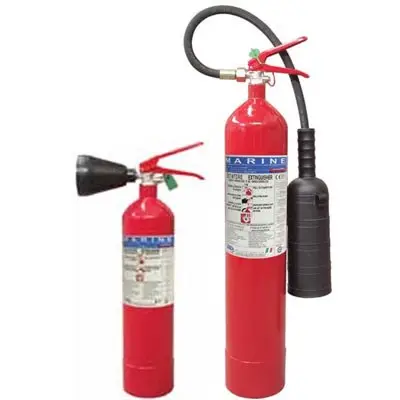
The ABS 2KG and 5KG Carbon Dioxide Fire Extinguisher is a stored-pressure CO2 extinguisher tested to EN 3, rated for Class B and electrical fire use, and designed for the demanding operating environments of marine vessels, offshore installations, coastal facilities, and industrial clean rooms. Both variants carry a -30°C to +60°C operating temperature range and a 51.7 bar working pressure — specifications that reflect a product designed for the full range of environments where sensitive equipment fire risk is encountered, from Arctic offshore installations to tropical vessel engine rooms and equatorial data centres. The distinguishing feature of the ABS CO2 range is the same rigorous hostile-environment testing that underpins the entire ABS fire extinguisher product line — providing procurement teams with a CO2 unit specification that covers both the clean-discharge requirement and the environmental durability requirement from a single product.
Key Features
Zero-Residue CO2 Agent — No Secondary Equipment Damage on Discharge
Carbon dioxide suppresses fire by displacing oxygen in the fire zone rather than by chemical agent application to the burning surface. On discharge, CO2 transitions from stored liquid to gas, rapidly fills the space around the fire source, and extinguishes the fire without depositing any agent residue on equipment, surfaces, cabling, or circuit boards. Once the gas disperses — which occurs naturally within minutes in a ventilated space — the area is clean. For server rooms, switchgear buildings, UPS rooms, marine chart rooms, radio rooms, and any space where equipment contamination from a fire suppression agent would create secondary damage, operational downtime, and remediation costs, the zero-residue characteristic of CO2 is the primary specification driver over powder and foam alternatives.
Two Capacity Options — 2KG and 5KG for Space and Risk-Appropriate Specification
The 2KG unit (6.5 KG total weight, 560mm height, fire rating 34A 113B) is suited to personal-issue positions, desk-adjacent placement in server rooms and control rooms, vehicle mounting, and space-constrained installations where a compact unit is required. The 5KG unit (15 KG total weight, 785mm height, fire rating 113B) provides a larger agent charge for wall-mounted positions in higher-risk electrical equipment areas — switchgear rooms, generator rooms, UPS rooms, and vessel electrical distribution spaces — where a greater agent volume is warranted by the size of the electrical equipment installation and the fire risk assessment findings. Both units share the same agent type, operating procedure, and EN 3 certification basis, simplifying specification and training standardisation across mixed-capacity deployments.
EN 3 Tested — Documented Performance for Electrical Fire Specification
Both variants are tested to EN 3, the European standard for portable fire extinguishers, with fire ratings assigned on the basis of standardised performance testing. The EN 3 test basis provides the performance documentation required by fire authority inspectors, classification society surveyors, building control officers, and insurance risk assessors reviewing fire protection adequacy in sensitive equipment areas. For procurement teams and HSE officers specifying CO2 extinguishers against fire risk assessment findings and regulatory requirements, EN 3 certification is the foundational compliance evidence required for installation acceptance across EU member states and international projects aligning to European fire safety standards.
-30°C to +60°C Operating Temperature — Reliable Across All Climates
Both the 2KG and 5KG units are rated across a -30°C to +60°C operating temperature range — covering Arctic offshore installations and cold-climate vessel operations through to tropical data centres, equatorial coastal installations, and desert industrial facilities. CO2 extinguishers are sensitive to temperature at the extremes: stored CO2 pressure is directly affected by cylinder temperature, and units rated to narrower temperature ranges may deliver reduced performance or become over-pressurised in conditions outside their rated range. The -30°C to +60°C specification of the ABS CO2 range supports procurement standardisation across globally deployed vessel fleets and multi-climate facility portfolios without requiring climate-specific product variants.
51.7 Bar Working Pressure / 250 Bar Test Pressure — High-Integrity Cylinder Construction
The 51.7 bar working pressure reflects the stored CO2 charge pressure at operating temperature — significantly higher than the 13–15 bar working pressures of powder and foam extinguishers, as CO2 is stored as a liquefied gas under its own pressure. The 250 bar test pressure applied during manufacture confirms the structural integrity of the cylinder at pressures far exceeding working conditions — providing the safety margin required for a high-pressure vessel carried in occupied spaces on vessels, in buildings, and in sensitive equipment rooms. For procurement teams and facilities managers specifying high-pressure fire equipment, the test pressure documentation is the basis for pressure vessel compliance verification in relevant regulatory frameworks.
Horn Nozzle — Directed CO2 Discharge for Electrical Equipment
Both units are fitted with a horn nozzle — the standard discharge device for CO2 extinguishers — which shapes the expanding CO2 gas into a directed discharge cone rather than an uncontrolled omnidirectional release. The horn allows the operator to direct CO2 at the base of an electrical fire, at a specific equipment cabinet, or into a defined fire zone, rather than dispersing agent throughout the room indiscriminately. The non-conductive discharge from a CO2 horn is the standard first-attack method for electrical panel fires, switchgear fires, and equipment rack fires — allowing the operator to apply agent directly to the fire source without creating an electrical hazard from a conductive suppression agent stream.
Suitable for Training Use — No Post-Exercise Cleanup Required
CO2 extinguishers are widely used as training equipment for fire response exercises because the discharged agent disperses without residue — there is no powder contamination of the training area, no foam agent to clean up, and no surface contamination requiring decontamination after the exercise. For vessel fire drills, industrial HSE training exercises, and building fire warden training programmes, CO2 extinguishers allow repeated, realistic first-attack drills in the workplace without the cleanup and equipment protection requirements that powder and foam exercise discharges impose.
Technical Specifications
Model: 14221 (2KG) | 14251 (5KG)
Part No: FEM-AB-CO2 (2KG) | FEM-AB-CO5 (5KG)
Extinguishing Agent: Carbon Dioxide (CO2)
Agent Capacity: 2 KG | 5 KG
Propellant: Carbon Dioxide (self-propelled stored pressure)
Test Standard: EN 3 (both variants)
Fire Rating: 34A 113B (2KG) | 113B (5KG)
Fire Classes Covered: Class B, Electrical (both variants)
Discharge Distance: 3 m (both variants)
Approx. Discharge Time: 8 seconds (2KG) | 14 seconds (5KG)
Working Pressure: 51.7 bar (both variants)
Test Pressure: 250 bar (both variants)
Operating Temperature: -30°C to +60°C (both variants)
Body Diameter: 105 mm (2KG) | 136 mm (5KG)
Height: 560 mm (2KG) | 785 mm (5KG)
Approx. Total Weight (Charged): 6.5 KG (2KG) | 15 KG (5KG)
Nozzle Type: Horn Nozzle (both variants)
Benefits
The operational impact of specifying CO2 extinguishers in sensitive equipment areas is most clearly understood when compared with the alternative. A powder extinguisher discharge in a server room or switchgear building suppresses the fire — and simultaneously coats every server rack, switchboard, cable tray, and control panel in the room with dry chemical powder. The post-discharge recovery process involves powered-down systems, manual cleaning of every affected surface and component, equipment inspection, and a controlled restart sequence that typically takes hours to days depending on the extent of the contamination. The fire event that triggered the discharge may have been minor — a single server overheating, a small cable fault. The powder discharge that suppressed it may have caused more operational disruption than the fire itself.
CO2 discharge in the same scenario suppresses the fire, disperses within minutes, and leaves the room clean. Equipment that was not directly fire-damaged can be inspected and returned to service immediately. The operational recovery from the fire event is proportionate to the fire damage — not compounded by suppression agent remediation. For data centre operators, financial trading floors, vessel navigation centres, and any facility where equipment uptime is operationally critical, this distinction between CO2 and powder discharge outcomes is a direct financial and operational risk management consideration — not just a product specification preference.
For HSE compliance, the EN 3 certification and documented fire ratings provide the audit-ready evidence chain for fire authority inspections, SOLAS surveys, and insurance risk assessments. The two part numbers — FEM-AB-CO2 and FEM-AB-CO5 — provide unambiguous procurement references for inventory records, repeat orders, and service documentation, supporting traceability requirements in vessel safety management systems and ISO-certified facility HSE management systems.
Who It’s For
Data Centre and IT Facility Managers
A data centre manager responsible for a co-location facility or enterprise server room carries specific fire protection obligations for the server and network equipment that represents the core operational and financial asset of the facility. Powder extinguishers at server room access points create a residual risk: any accidental or emergency discharge — whether in a genuine fire event or during a maintenance incident — contaminates the server environment. CO2 extinguishers at server rack positions and room access points provide the electrical fire suppression capability required by the fire risk assessment without creating a secondary contamination risk from the suppression agent itself. The 2KG unit at individual rack positions and the 5KG unit at room access points represent a practical, risk-proportionate deployment configuration for most server room layouts.
Vessel Electrical Officers and Marine Engineers
A vessel electrical officer responsible for the fire safety of the main switchboard room, emergency switchboard, shore connection panel, and navigation equipment spaces needs CO2 extinguishers — not powder — at these positions. A powder discharge on a main switchboard at sea is a serious secondary incident: the powder contamination of switchgear, bus bars, and control wiring creates an electrical fault risk that may require the switchboard to be taken out of service for inspection before power can be safely restored. CO2 at the switchboard room and navigation spaces ensures that a first-attack discharge in these areas suppresses the fire without creating an additional electrical system risk that the vessel’s crew must manage on top of the fire event itself.
Industrial Facility HSE Officers — Clean Rooms and Process Control Areas
An HSE officer managing fire equipment provision in a pharmaceutical manufacturing facility, electronics production clean room, or process control building is specifying extinguishers for spaces where agent contamination of the production environment or control equipment is categorically unacceptable. CO2 extinguishers at clean room access points and process control panel positions satisfy the electrical fire risk assessment requirement without creating any contamination risk to the controlled production environment or sensitive process instrumentation in the event of a discharge — whether in a fire event or due to accidental activation.
Possible Applications
Server Rooms and Data Centres
CO2 extinguishers are the standard specified agent for server room and data centre fire protection where electrical and Class B fire risk is present and equipment contamination from a powder or foam discharge is unacceptable. The 2KG unit at individual server rack positions and the 5KG unit at room entry points cover the fire risk profile of a typical server room from a single extinguisher type — providing first-attack suppression capability without secondary contamination risk.
Electrical Switchgear Rooms and Main Switchboards
Main switchboard rooms, emergency switchboard rooms, and high-voltage electrical distribution buildings require CO2 extinguishers at access points and within the switchgear area. CO2’s non-conductive discharge and zero-residue characteristic make it the appropriate first-attack agent for switchgear fires — suppressing the fire without creating conductive agent pathways across live electrical components or depositing contaminating residue on bus bars, contactors, and relay panels.
Marine Vessel Chart Rooms and Radio Rooms
Navigation and communication equipment spaces on commercial vessels — chart rooms, radio rooms, GMDSS stations, and integrated bridge systems spaces — require CO2 first-attack coverage. A powder discharge in a chart room or radio room at sea renders navigation and communication systems contaminated and potentially inoperable: CO2 suppresses the fire and leaves the equipment clean and inspectable without the vessel losing navigation or communication capability in the immediate aftermath of the fire event.
Offshore Platform Control Rooms and Instrument Rooms
Offshore platform control rooms, instrument rooms, and DCS/SCADA equipment spaces contain process control systems and safety system instrumentation that cannot tolerate powder or foam contamination. CO2 extinguishers at control room access points provide the electrical fire first-attack coverage required by the platform fire safety case without creating a secondary contamination risk to the process control environment that could impair platform safety system operability following a discharge.
UPS Rooms and Battery Rooms
UPS battery rooms and large uninterruptible power supply installations carry electrical fire risk from battery cell failures, inverter faults, and wiring overloads. CO2 extinguishers at UPS room access points provide clean electrical fire first-attack coverage for these spaces — which typically also serve as the power supply for critical safety systems, making continued operability following a fire event and suppression discharge a direct safety consideration.
Fire Training Exercises — Industrial and Marine HSE Programmes
CO2 extinguishers are used in fire response training exercises because the agent disperses cleanly after discharge — no residue to clean up, no surface contamination, no production area or equipment protection required before the exercise. For vessel fire drills under SOLAS crew training requirements, and for industrial HSE fire response training programmes, CO2 exercise discharges allow realistic first-attack practice in actual workplace environments without the operational disruption associated with powder or foam exercise discharges.
Pharmaceutical Manufacturing and Electronics Clean Rooms
Controlled production environments in pharmaceutical manufacturing, medical device production, and electronics fabrication require fire extinguishers that will not contaminate the production environment if discharged. CO2 extinguishers at clean room access points and within production areas satisfy the electrical fire risk assessment requirement for first-attack provision without introducing any contamination risk to the controlled production environment, clean room classification, or product integrity in the event of discharge.
Trust & Certifications
EN 3 — European Standard for Portable Fire Extinguishers
EN 3 is the European standard series governing design, construction, performance testing, and marking of portable fire extinguishers. Both ABS CO2 variants are tested to EN 3, with fire ratings (34A 113B for the 2KG unit; 113B for the 5KG unit) assigned on the basis of standardised fire test performance. EN 3 test compliance is the foundational performance verification requirement for portable fire extinguisher specification and installation acceptance across EU member states, and is widely referenced in international fire safety standards for marine and industrial applications.
34A 113B and 113B Fire Ratings — Class B and Electrical Performance Verification
The fire ratings are the direct output of standardised EN 3 fire test array performance. The 113B rating common to both variants reflects Class B flammable liquid fire suppression capability verified in standardised test conditions. The 34A rating of the 2KG unit additionally confirms Class A solid combustible fire suppression performance for that variant. For HSE officers and fire safety consultants specifying extinguishers against electrical fire risk assessments, the fire rating provides the quantitative performance basis for confirming the specified unit is adequate for the identified electrical fire hazard — not just categorically appropriate as a CO2 unit.
SOLAS Chapter II-2 Alignment — Marine Fire Fighting Equipment
SOLAS Chapter II-2 specifies fire protection and extinction requirements for commercial vessels, including requirements for portable extinguisher provision in electrical equipment spaces and control rooms. EN 3-tested CO2 extinguishers with documented fire ratings meet the performance requirements for SOLAS-applicable vessel electrical fire protection specification — supporting flag state inspection, classification society survey, and port state control verification for CO2 extinguisher installations in vessel electrical and navigation spaces.
Pressure Vessel Safety — 250 Bar Test Pressure Certification
CO2 extinguisher cylinders are high-pressure vessels operating at 51.7 bar working pressure — significantly higher than powder or foam extinguisher cylinders. The 250 bar hydraulic test pressure applied to each cylinder during manufacture confirms structural integrity at a pressure safety factor well above working conditions. Periodic cylinder re-testing (typically every 5–10 years depending on jurisdiction) is required under pressure vessel regulations in most countries — the documented test pressure and cylinder certification provide the baseline for periodic re-test scheduling and regulatory pressure vessel compliance management.
ABS — Fire Safety Equipment for Hostile Marine and Industrial Environments
The ABS brand is associated with fire extinguisher products engineered and tested for demanding commercial, marine, and industrial operating environments. Both CO2 variants carry model numbers (14221, 14251) and part numbers (FEM-AB-CO2, FEM-AB-CO5) that provide unambiguous procurement references for inventory management, repeat orders, and pressure vessel re-test scheduling — supporting documentation requirements in vessel safety management systems and facility HSE management systems where equipment traceability is a compliance requirement.
Accessories & Variants
Wall Mounting Bracket — Standard and Marine Grade
Dedicated wall mounting brackets secure CO2 extinguishers in fixed, identified positions for immediate access. For marine installations, marine-grade brackets with corrosion-resistant hardware are appropriate for damp and salt-air environments in vessel spaces and coastal installations. Bracket selection should account for the cylinder diameter and weight of the specific variant: the 5KG unit at 15 KG charged requires a heavier-duty mounting than the 2KG unit at 6.5 KG.
Protective Boot / Base Guard
A protective base boot or cylinder guard prevents bottom-of-cylinder corrosion and physical impact damage for extinguishers mounted in positions subject to floor-level moisture, cleaning water, or physical traffic. Particularly relevant for 5KG units mounted at floor level in plant rooms, switchgear buildings, and vessel machinery spaces where the base of the cylinder is exposed to deck wash or bilge moisture.
CO2 Discharge Horn — Spare / Replacement
The discharge horn is the primary operational component at the nozzle end of a CO2 extinguisher and should be inspected at each annual service for cracks, blockages, and physical integrity. Replacement horns appropriate for each unit size should be available in the maintenance stock for immediate replacement following discharge or damage — without returning the cylinder to a service facility for a minor component replacement.
Available Variants — Part Number Reference
FEM-AB-CO2 — 2 KG CO2 | Model 14221 | EN 3 | 34A 113B | -30°C to +60°C | 51.7 bar working pressure | 6.5 KG charged | 560mm height
FEM-AB-CO5 — 5 KG CO2 | Model 14251 | EN 3 | 113B | -30°C to +60°C | 51.7 bar working pressure | 15 KG charged | 785mm height
Related Fire Safety Products
ABS ABC Dry Powder Extinguisher (6KG / 9KG / 12KG Cartridge) — ABC-rated dry powder units for general industrial, vessel, and commercial building positions where Class A, B, and C coverage is required and equipment contamination is not a constraint
ABS BC Karate Powder Extinguisher (6KG / 12KG Cartridge) — BC-rated dry powder units for engine rooms, flammable liquid stores, and electrical equipment areas where Class A risk is absent and higher Class B performance per kg is the specification priority
Fixed CO2 Suppression Systems — Total flooding CO2 systems for enclosed machinery spaces, switchgear rooms, and cargo pump rooms where fixed suppression provides the primary fire protection layer and portable CO2 extinguishers provide the supplementary first-attack and post-suppression monitoring provision
Get in Touch
If you are specifying CO2 fire extinguishers for a data centre, server room, electrical switchgear building, vessel, offshore installation, or sensitive equipment facility — or if you need to confirm the correct capacity variant, fire rating, and quantity for a specific risk assessment, SOLAS fire safety schedule, or facility fire protection specification — contact us to discuss your requirement and request a formal procurement quotation.
Our team can assist with product selection against your fire safety specification, confirm EN 3 certification and pressure vessel documentation for regulatory submission, and support procurement and traceability documentation for HSE compliance and audit purposes.
📍 3791 Jalan Bukit Merah #06-01, E-Centre @ Redhill, Singapore 159471