Cart (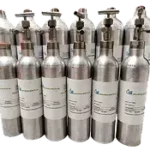
Overview
Carbon monoxide is one of the most dangerous gases encountered in occupational environments precisely because it gives no warning. It is colourless, odourless, and capable of incapacitating a worker before they are aware of any exposure. For this reason, CO detector calibration is not a procedural formality — it is the foundational check that determines whether a gas monitor will actually alert personnel in time to evacuate or take protective action. A detector that has not been correctly spanned against a verified calibration gas concentration may underread CO levels, delay alarm activation, or fail to alarm at concentrations that should trigger an immediate response.
The Carbon Monoxide (CO) Balanced Air Span Gas range is available in three concentrations — 5 ppm, 10 ppm, and 50 ppm — and across five cylinder sizes from 34 litres up to 116 litres. The air-balanced formulation replicates the atmospheric matrix that CO detectors — particularly electrochemical sensor types — are designed to operate in, producing calibration conditions that closely reflect real-world exposure scenarios. For safety managers and instrument technicians specifying calibration gas for portable personal monitors, fixed detector systems, and occupational hygiene instruments across industrial and marine environments, this range provides the concentration and cylinder size options to match the specific calibration requirements of each instrument in the programme.
The concrete differentiator here is the combination of three operationally relevant concentrations in a single product family. The 5 ppm concentration addresses the low-range calibration requirements of personal CO monitors used in office-adjacent or lower-exposure industrial settings. The 10 ppm concentration covers the most widely deployed portable CO monitor calibration point. The 50 ppm concentration serves industrial process environments and instruments with higher-range detection requirements. Sourcing all three from a single supplier — in matched cylinder sizes — eliminates the split-sourcing complexity that typically comes with managing a CO calibration gas inventory across multiple instrument types.
Key Features
Three Concentrations — 5 ppm, 10 ppm, 50 ppm CO — Covering Low to Industrial-Range Calibration
The 5 ppm concentration is appropriate for spanning CO monitors where alarm thresholds are set at or near occupational exposure limits for general industry and office-adjacent environments — including HVAC-integrated CO monitors, car park ventilation systems, and indoor air quality monitoring instruments. The 10 ppm concentration is the most widely used CO calibration point for portable personal monitors deployed in confined space entry programmes, industrial maintenance, and marine applications — aligning with the alarm threshold concentrations most commonly specified by instrument manufacturers for their portable CO sensor calibration procedures. The 50 ppm concentration serves fixed and portable CO detectors used in environments where higher CO concentrations are operationally relevant — including forge shops, foundries, engine test cells, and industrial combustion process environments where CO alarm thresholds are set above standard TWA levels. Specifying the correct concentration for each instrument type is not a preference — it is a calibration accuracy requirement.
Air Balance Gas — Matched to Electrochemical Sensor Operating Conditions
The balance gas for this range is synthetic air — a mixture of oxygen and nitrogen in atmospheric proportions. CO electrochemical sensors are oxygen-dependent: the electrochemical reaction that generates the sensor’s output signal requires oxygen to be present in the gas stream at a concentration consistent with the atmospheric conditions the sensor is designed to operate in. Calibrating with a nitrogen-balanced CO gas on an electrochemical sensor introduces an oxygen deficit that can produce a calibration response that does not accurately reflect the sensor’s behaviour in real atmospheric conditions. Air-balanced CO calibration gas eliminates that variable — producing calibration conditions that match the sensor’s normal operating environment and a span result that accurately reflects the instrument’s real-world detection performance.
Five Cylinder Sizes — 34L, 58L, 103L, 110L, 116L — Scalable to Programme Volume
The range is available across five cylinder sizes from 34 litres to 116 litres — covering calibration gas requirements from low-volume single-site applications through to high-volume multi-site or fleet calibration programmes. The 34L cylinder suits occasional calibration use, project-based requirements, or confined space entry programmes with a small instrument count. The larger 103L–116L cylinders are appropriate for instrument hire operations, industrial facilities with high fixed detector counts, or safety equipment maintenance contractors performing scheduled calibration across multiple client sites. Matching cylinder size to actual gas consumption reduces dead gas waste from oversized cylinders and avoids unplanned stockout from undersized ones — both of which have a direct impact on calibration programme operating cost.
Aluminium Cylinder Construction — Lightweight for Field Transport
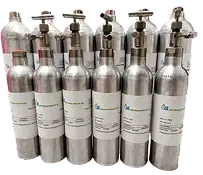
All cylinders are manufactured from aluminium — materially lighter than steel equivalents at the same gas capacity, and corrosion-resistant for use in the humid, salt-air, and chemically active environments common in marine, offshore, and coastal industrial settings. For instrument technicians carrying calibration equipment to field locations — vessel engine rooms, offshore platform decks, or industrial plant access points — the weight difference between aluminium and steel cylinders is a practical handling consideration, particularly when transporting multiple cylinders to a single calibration event.
Certified Concentration — Documented Traceability for Calibration Records
Each cylinder is supplied with a certificate of analysis confirming the verified CO concentration against traceable reference standards. For CO detector calibration in particular — where the accuracy of the calibration record may be reviewed during incident investigation, regulatory inspection, or management system audit — the certificate of analysis is the only documentary evidence that the instrument was exposed to a known CO concentration during the calibration event. An uncertified or nominally specified calibration gas provides no defensible basis for the calibration record, regardless of the care taken during the calibration procedure itself.
Technical Specifications
Cylinder: C10 — Aluminium
Available Sizes: 34L / 58L / 103L / 110L / 116 Litres
Carbon Monoxide (CO): 5 ppm / 10 ppm / 50 ppm
Balance Gas: Air (synthetic — atmospheric O2/N2)
Benefits
Air-balanced formulation produces calibration conditions that match the sensor’s real operating environment. CO electrochemical sensors are among the most widely deployed gas sensor technologies in portable and fixed gas detection — and they are also among the most sensitive to the composition of the gas stream during calibration. Calibrating with air-balanced CO gas rather than nitrogen-balanced alternatives ensures the sensor is spanned under conditions that reflect normal atmospheric operation. The practical result is a calibration outcome that accurately represents the instrument’s detection performance in the field — not an artificially produced response that diverges from real-world behaviour once the calibration gas is removed.
Correct concentration selection eliminates systematic alarm threshold error. A CO detector spanned at a concentration that does not align with the instrument manufacturer’s specified calibration point will produce alarm thresholds that are offset from the intended setting — potentially delaying alarm activation at the concentration the alarm was designed to trigger at. For CO detectors where the difference between the alarm threshold and the immediately dangerous to life and health (IDLH) concentration is narrow, that offset is not a minor calibration imprecision — it is a safety margin reduction. Selecting the correct certified span concentration for each instrument removes that variable from the calibration programme.
Three-concentration range from a single supplier simplifies procurement and inventory management. Managing CO calibration gas procurement across multiple suppliers — one for low-range, one for standard portable monitor calibration, another for high-range industrial detectors — multiplies purchase orders, certificates, and supplier relationships without adding any technical value. This range consolidates 5 ppm, 10 ppm, and 50 ppm CO calibration gas under one product family from one supplier, with matching cylinder size options across all three concentrations. For procurement teams managing calibration consumable supply across multi-instrument or multi-site programmes, that consolidation reduces administrative overhead with no trade-off in technical specification.
Cylinder size selection optimises calibration gas cost per event across programmes of any scale. Calibration gas is consumed in fixed quantities per calibration event — the cost-per-event is determined by the cylinder size relative to the number of calibrations performed per cylinder. Specifying a cylinder size that matches the programme’s actual gas consumption rate — rather than defaulting to a standard size that may be oversized or undersized for the actual usage pattern — is a straightforward cost optimisation that accumulates across every calibration cycle in the programme life.
Who It’s For
The HSE Officer Managing a Confined Space Entry Programme with CO Monitoring Requirements
Your confined space entry procedure requires pre-entry atmosphere testing with a calibrated multi-gas monitor that includes a CO channel. Monitors must be bump tested before each entry and formally calibrated on a scheduled maintenance cycle — and the calibration record must show the instrument was spanned against a certified calibration gas at the correct concentration. You need a reliable supply of 10 ppm CO balanced air calibration gas in a cylinder size that covers your site’s calibration frequency without requiring constant replacement. When the confined space entry programme covers multiple sites or vessels, the ability to source the same certified calibration gas across all locations from one supplier is a procurement simplification you notice in the time spent managing consumable stock.
The Instrument Technician Calibrating CO Detectors Across a Mixed Industrial Fleet
You maintain gas detectors across a facility or client portfolio that includes personal CO monitors for maintenance workers, fixed CO detectors in plant areas, and high-range CO instruments in combustion process environments. Each instrument type may have a different specified calibration concentration — 10 ppm for the portable monitors, 50 ppm for the fixed high-range detectors. Having the correct certified calibration gas for each instrument type available from a single supplier, in cylinder sizes that match the calibration frequency for each location, means the calibration schedule runs without the stockout delays and multi-supplier coordination that come with sourcing each concentration separately.
Possible Applications
- Marine vessel engine room and enclosed space CO monitoring — Span calibration of portable CO monitors used for pre-entry atmosphere testing in engine rooms, pump rooms, generator spaces, and enclosed machinery spaces on commercial and offshore vessels
- Confined space entry programmes — industrial maintenance and utilities — Calibration of multi-gas personal monitors with CO channels used by maintenance workers, contractors, and utilities technicians entering manholes, tanks, tunnels, and process vessels where CO accumulation from combustion sources or biological activity is a credible hazard
- Car park and tunnel ventilation monitoring — Span calibration of fixed CO detectors integrated into car park and road tunnel ventilation control systems, where CO concentration drives automatic fan activation and is monitored against regulatory occupancy limits
- Forge, foundry, and metal casting facility safety — Calibration of fixed and portable CO detectors deployed in high-temperature metal processing environments where combustion of fuel gases and partial oxidation of carbon-containing materials produces elevated CO concentrations in work areas
- Boiler room and combustion plant maintenance — Span calibration of CO monitors used during boiler servicing, burner commissioning, and combustion efficiency testing in industrial and commercial heating plant, where CO is produced during incomplete combustion and must be monitored during maintenance activities
- Occupational hygiene and personal exposure monitoring — Calibration of direct-reading CO instruments used by occupational hygienists assessing worker CO exposure in industrial environments, vehicle workshops, loading docks, and other settings where TWA and STEL monitoring is required under occupational health programmes
- Safety equipment hire and calibration service operations — Bulk CO calibration gas supply for instrument hire companies and third-party calibration service providers maintaining large portable CO monitor fleets requiring regular scheduled recalibration
Trust and Certifications
Certified Calibration Gas — Traceable Concentration Accuracy
Each cylinder is supplied with a certificate of analysis confirming the verified CO concentration against traceable reference standards. Calibration gas traceability is a requirement under ISO 17025 accredited calibration programmes and is an expected element of gas detector calibration records reviewed during regulatory inspections, incident investigations, and management system audits. The certificate of analysis provides the only documented evidence that the calibration event was performed with a gas of known and verified composition — without it, the calibration record cannot be fully substantiated regardless of the technician’s procedure.
Aluminium Cylinder — Pressure Vessel Compliant Construction
Cylinders are manufactured and tested to applicable pressure vessel standards and should be handled, stored, and transported in accordance with compressed gas cylinder safety requirements — including secure upright storage away from heat and ignition sources, use of cylinder caps or valve guards during transport, and connection only via compatible calibration gas regulators rated for the cylinder pressure and gas service. Cylinder re-qualification intervals must be observed in accordance with local compressed gas cylinder regulations applicable to the country of use.
Supplied by Alright Engineering Solutions
The CO Balanced Air span gas range is supplied through Alright Engineering Solutions Pte. Ltd., an authorised distributor of portable and fixed gas detection equipment, calibration gas, and marine safety system components based in Singapore. Alright Engineering Solutions provides procurement support for calibration gas, gas detection instruments, and associated safety equipment across the Singapore and regional market.
Accessories and Variants
Calibration Gas Regulator
A single-stage calibration gas regulator is required to connect the cylinder to the instrument under calibration. Regulator compatibility depends on the cylinder valve outlet configuration and the instrument’s calibration gas inlet. Alright Engineering Solutions can advise on compatible regulator options for your specific instrument make and model — contact our team with your instrument and cylinder configuration details for guidance.
Available Concentration Variants
CO 5 ppm Bal Air — For low-range CO monitors used in indoor air quality, HVAC-integrated, and car park ventilation monitoring applications
CO 10 ppm Bal Air — For portable personal CO monitors used in confined space entry, marine, and standard industrial safety monitoring programmes
CO 50 ppm Bal Air — For fixed and portable CO detectors deployed in high-range industrial process environments, combustion plant, and forge or foundry applications
Related Products from Alright Engineering Solutions
SO2 160ppm / CO2 8%Vol Bal N2 Span Gas — Multi-component calibration gas for combined SO2 and CO2 sensor calibration in a single cylinder
CO2 1%–15% Vol Bal N2 Span Gas Range — CO2 calibration gas across five concentrations and five cylinder sizes for confined space, process, and cargo atmosphere monitoring
GX-8000 Sample Draw Multi Gas Monitor — Portable marine sample draw multi-gas monitor with CO sensor option for vessel confined space entry
RX-8700 Portable Gas Detector — Portable multi-gas monitor with ATEX/IECEx/MED certification for marine and industrial applications including CO detection
Fixed Gas Detection Systems — Fixed point CO detectors and system components for permanent installation in marine, commercial, and industrial environments
Get in Touch
If you need to source CO calibration span gas — whether for a specific concentration and cylinder size, a scheduled maintenance programme, or ongoing consumable supply across multiple sites or vessels — contact Alright Engineering Solutions to confirm availability and request a formal quotation.
Our team can assist with concentration selection, cylinder size specification, and compatible regulator sourcing for your specific CO detector models and calibration programme requirements.
📍 3791 Jalan Bukit Merah #06-01, E-Centre @ Redhill, Singapore 159471