Cart (
Overview
Smoke inhalation and toxic gas exposure are among the leading causes of fatality in shipboard fires — not the flames themselves. By the time a fire has developed enough heat to be immediately life-threatening at distance, the surrounding atmosphere has typically already been rendered unsurvivable by combustion gases, oxygen depletion, and smoke particulate. For crew members whose escape route passes through a compromised atmosphere, the difference between surviving and not surviving often comes down to whether a functional, ready-to-use emergency escape breathing device was available at the right location and deployed correctly in the first moments of the emergency.
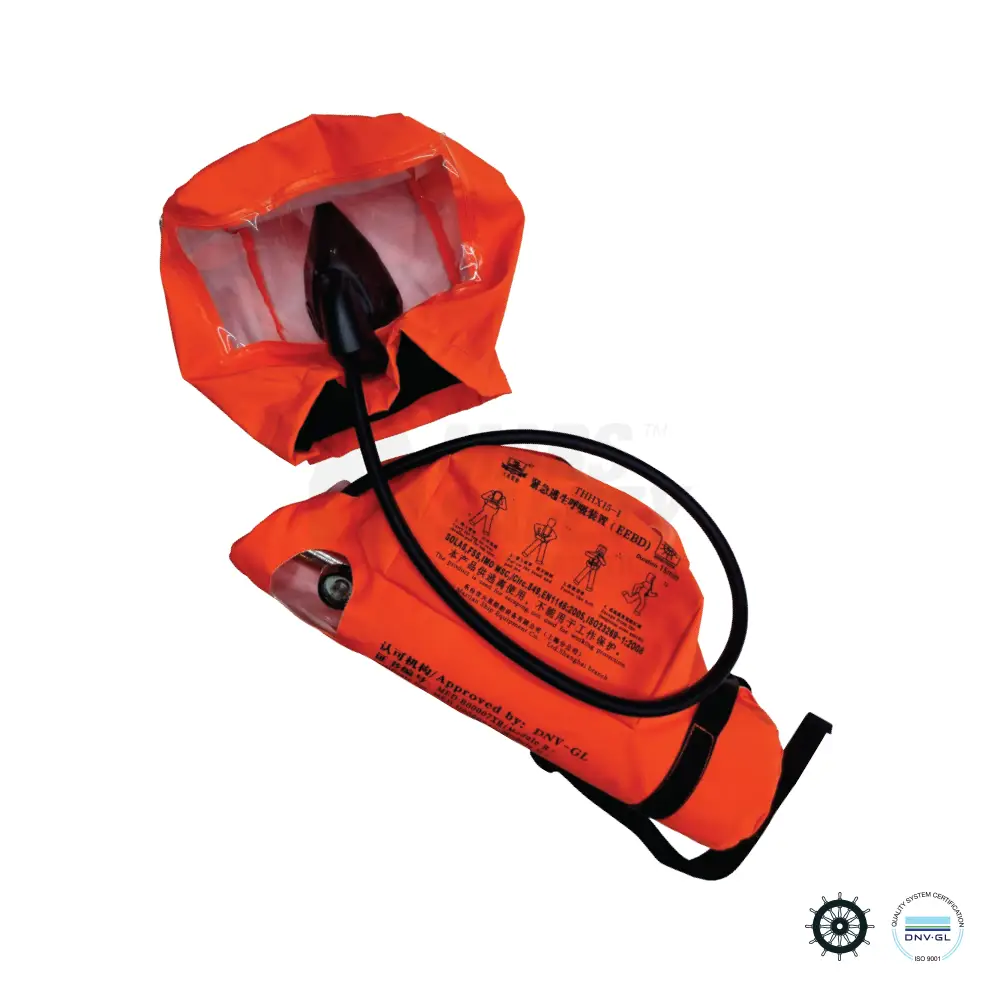
The Emergency Escape Breathing Device THA1015-1 is a MED and SOLAS approved EEBD delivering a rated working duration of 30 minutes from a 3-litre compressed air cylinder at 210 Bar — significantly exceeding the 15-minute LSA Code minimum and providing extended evacuation time for complex vessel layouts, large passenger ships, and offshore installations where escape routes may span multiple decks or significant horizontal distances. With an output flow of ≥65 L/min and inhalation resistance of ≤500 Pa, the device is engineered to deliver breathable air at a rate that supports normal physiological breathing exertion during active evacuation — not merely at rest.
What distinguishes the THA1015-1 from 15-minute EEBD alternatives in this category is its rated 30-minute working duration from the same 3-litre / 210 Bar cylinder configuration — a duration achieved through engineering of the pressure reducer output and delivery system rather than increased cylinder size. This matters practically because the THA1015-1 maintains the compact, portable form factor of a standard-cylinder EEBD while providing double the rated evacuation time of the SOLAS minimum — covering scenarios where 15 minutes is a compliance threshold rather than a risk-matched duration for the actual escape route length on the vessel it is fitted to.
Key Features
≥30-Minute Rated Working Duration — Extended Evacuation Coverage
The THA1015-1 provides a rated working duration of 30 minutes or more — twice the IMO LSA Code minimum for EEBDs on SOLAS-convention passenger vessels. For safety officers conducting escape route time studies on larger vessels — passenger ferries, cruise ships, large tankers, or offshore platforms — the 30-minute duration provides meaningful additional margin over the 15-minute baseline, particularly for crew members stationed in the deepest machinery spaces, lowest accommodation decks, or most remote working positions where the escape route transit time to fresh air may credibly approach or exceed 15 minutes under emergency conditions with degraded visibility and physical obstacles.
3.0L / 210 Bar Compressed Air Cylinder — Standard Form Factor, Extended Duration
The THA1015-1 achieves its 30-minute rated duration from a standard 3-litre compressed air cylinder at 210 Bar working pressure — the same cylinder configuration used in 15-minute EEBDs by other manufacturers. The extended duration is delivered through the engineering of the pressure reducer system (export pressure 0.65±0.3 MPa) and the airflow delivery optimisation rather than by increasing cylinder size or weight. This means the THA1015-1 maintains a compact ≤7.5 kg total weight and 545mm × 165mm × 270mm pack dimensions — compatible with standard EEBD wall-mounting bracket configurations without requiring oversized mounting hardware or additional storage footprint.
Output Flow ≥65 L/min — Physiologically Adequate Delivery Rate
The device delivers a minimum output flow of 65 litres per minute — a flow rate that exceeds the typical adult minute ventilation during moderate physical exertion (approximately 30–40 L/min at rest, 60–80 L/min during active evacuation). An output flow of ≥65 L/min ensures the wearer receives breathable air at a rate that matches actual breathing demand during evacuation activity — not a minimal trickle that would create CO2 accumulation in the hood assembly during sustained physical exertion. For crew members moving quickly through a vessel during emergency evacuation — climbing ladders, ducking through hatches, supporting injured colleagues — adequate flow rate directly affects how physiologically effective the device is throughout its rated duration.
Low Inhalation and Exhalation Resistance — Reduced Breathing Effort
Inhalation resistance is rated at ≤500 Pa and exhalation resistance at ≤1000 Pa — values that are specified in EN 145:2005, the European standard for self-contained closed-circuit compressed air breathing apparatus, and equivalent escape apparatus standards. Low breathing resistance means the wearer does not need to exert significant additional respiratory effort to breathe through the device — which matters particularly for personnel who may already be physically stressed, partially panicked, or have underlying respiratory conditions at the time of deployment. High-resistance EEBD devices can cause fatigue and hyperventilation in users unaccustomed to additional breathing load — low resistance minimises that risk throughout the 30-minute operating duration.
15-Year Service Life — Reduced Long-Term Replacement Cost
The THA1015-1 carries a rated service life of 15 years — significantly longer than the 5–10 year service life of many competing EEBD products. For ship managers and procurement officers calculating the total cost of EEBD ownership across a fleet over a 20–25 year vessel service life, a 15-year device service life means the EEBD may only require one replacement cycle during the vessel’s operational life rather than two or three. The extended service life also reduces the administrative overhead of tracking replacement intervals across multiple EEBD locations on multiple vessels — a not-insignificant operational benefit for fleet safety management programmes managing large EEBD inventories.
IMPA Code 330348 — Standard Marine Procurement Reference
The THA1015-1 carries IMPA Code 330348 — the International Marine Purchasing Association’s catalogue reference for this product within the marine procurement system. IMPA codes are the standard product identification system used by ship chandlers, marine suppliers, and vessel procurement departments globally. For procurement officers ordering EEBDs through standard marine supply channels, the IMPA code provides an unambiguous product identifier that eliminates ordering errors and enables price comparison across multiple marine suppliers carrying the same IMPA-coded product — simplifying procurement within the standard marine supply chain workflow.
Technical Specifications
Model: THA1015-1
Cylinder Volume: 3.0L
Working Pressure: 210 Bar (21 MPa)
Output Flow: ≥65 L/min
Export Pressure of Pressure Reducer: 0.65±0.3 MPa
Inhalation Resistance: ≤500 Pa
Exhalation Resistance: ≤1000 Pa
Rated Working Duration: ≥30 minutes
Service Life: 15 years
Weight: ≤7.5 kg
Packing Size: 545mm × 165mm × 270mm
Approval: EN (European Norm)
Regulations / Testing Standards: SOLAS 74 as amended, Regulation 2-2/13; IMO Res. MSC/Circ. 848; ISO23269-1(2008); EN 145:2005
IMPA Code: 330348
Benefits
30-minute duration closes the gap between compliance threshold and actual evacuation risk. Specifying a 15-minute EEBD satisfies the SOLAS LSA Code minimum — but minimum compliance is not the same as risk-matched specification. On vessels where escape route time studies or drill analysis shows that the longest credible evacuation time approaches or exceeds 15 minutes under degraded-visibility emergency conditions, the THA1015-1’s 30-minute rated duration provides the additional margin that converts a compliance document into a device that is actually fit for the specific evacuation scenario it is staged to support.
15-year service life reduces fleet EEBD replacement cycle overhead. For a fleet of 15 vessels with an average of 6 EEBDs per vessel, a 15-year service life versus a 10-year service life translates to 90 fewer replacement units required over the fleet’s 20-year operating horizon — with corresponding reductions in procurement administration, disposal documentation, and inventory management workload. The extended service life is not just a cost item — it is an operational simplification for safety management programmes that manage EEBD replacement as part of a broader LSA maintenance programme.
IMPA code enables frictionless procurement through standard marine supply channels. EEBD procurement through ship chandlers and marine suppliers is simplified when the product has an established IMPA code — eliminating the product identification ambiguity that can occur when ordering non-coded products through standard marine supply workflows. The IMPA 330348 reference means the THA1015-1 can be ordered through any IMPA-catalogue-based marine supplier globally without requiring additional product description or specification documentation beyond the code reference.
Low breathing resistance reduces physiological stress during extended use. A 30-minute EEBD is only effective if the wearer can maintain it through the full operating duration without physiological distress from breathing effort. The THA1015-1’s ≤500 Pa inhalation and ≤1000 Pa exhalation resistance ratings ensure the device imposes minimal additional respiratory load on the wearer during the full 30-minute duration — supporting sustained effective use even by crew members who are physically stressed, anxious, or less physically conditioned.
MED and SOLAS dual approval covers EU-flagged and international vessel requirements. The combination of MED approval and SOLAS compliance provides the dual regulatory coverage required for vessels operating under the Marine Equipment Directive on EU flag registration and under SOLAS convention requirements for international trading — within a single product specification and single procurement reference.
Who It’s For
The Safety Officer on a Large Passenger Ferry or Ro-Ro Vessel
Your vessel carries 800–1,200 passengers and a crew of 150 across multiple decks, with crew accommodation and duty stations spread from the bridge deck to the car deck level. Your escape route time studies — conducted as part of your ISM Code safety management system documentation — show that crew members stationed at the deepest working positions have evacuation times to the open deck that, under drill conditions with full visibility, already approach 12–14 minutes. Under emergency conditions with smoke-filled corridors, reduced lighting, and physical obstacles from a fire or flooding event, that transit time increases materially. The THA1015-1’s 30-minute duration gives those crew members the air supply time that their actual escape route demands — not the minimum threshold that a 15-minute EEBD provides.
The Fleet Procurement Manager Calculating Long-Term LSA Ownership Cost
You’re responsible for LSA equipment procurement across a managed fleet of 12 vessels on 20-year management contracts. You’re reviewing the EEBD specification across the fleet as part of a periodic safety equipment tender and comparing total cost of ownership — not just unit price. The THA1015-1’s 15-year service life, standard IMPA code procurement reference, and combined MED/SOLAS approval documentation reduce your total ownership cost calculation — fewer replacement cycles, standard procurement channel availability, and a single approval document covering both EU-flagged and internationally-flagged vessels in your fleet — over the management contract horizon.
The HSE Manager at an Offshore Platform or FPSO
Your installation has escape routes from the lower process deck levels to the muster stations on the helideck or sea level that span 4–6 deck levels and pass through multiple process areas where simultaneous gas release and fire could create an extended compromised atmosphere. Your existing 15-minute EEBDs were specified when the platform was first commissioned against a route time study that assumed clean corridors and functioning emergency lighting. Your most recent emergency preparedness audit has flagged that 15 minutes may be insufficient for the worst-case evacuation scenario from the lowest working positions. The THA1015-1 is the single-product response to that audit finding — same cylinder form factor, same procurement channel, doubled rated duration.
Possible Applications
- Large passenger vessel and cruise ship crew station EEBD provision — 30-minute duration EEBD fitment at crew duty stations on passenger ferries, cruise ships, and ro-ro vessels where escape route length from deep crew working positions may approach or exceed 15-minute evacuation time under emergency conditions
- Engine room and machinery space access points on SOLAS vessels — staged at engine room entry ladders and within machinery spaces on cargo and tanker vessels where deep machinery space locations create longer credible evacuation times than upper deck crew positions
- Offshore platform process deck and lower-level escape routes — deployed along designated escape routes on fixed and floating offshore installations where multiple deck levels and potential simultaneous gas and fire emergency conditions create evacuation time scenarios beyond the 15-minute baseline
- FPSO and FSO vessel machinery and cargo areas — emergency escape provision on floating production and storage vessels where process area complexity and extended escape route length to muster points require extended-duration EEBD coverage
- Fleet-wide EEBD upgrade from 15-minute to 30-minute specification — replacement of 15-minute EEBD inventories on vessels where escape route time studies, emergency preparedness audits, or classification society recommendations have identified 15-minute duration as insufficient for the specific vessel’s worst-case evacuation scenario
- Tunnel and underground infrastructure with extended escape routes — emergency escape provision for maintenance and operational teams in long-tunnel environments where the distance to fresh air from the deepest working position exceeds the 15-minute evacuation time window
- Marine procurement through IMPA-catalogue supply channels — standard IMPA Code 330348 procurement for vessels ordering EEBDs through ship chandlers and marine equipment suppliers using the IMPA catalogue as the primary product procurement reference
- ISM Code safety management system documentation programmes — EEBDs specified and documented as part of a vessel’s SMS spare parts and safety equipment inventory under SOLAS ISM Code requirements, with 15-year service life supporting simplified replacement cycle tracking
Trust and Certifications
MED Approved — Marine Equipment Directive 2014/90/EU
The THA1015-1 carries MED (Marine Equipment Directive) approval — the EU regulatory framework governing safety equipment fitted on EU-flagged commercial vessels. MED approval requires independent type-testing by an EU notified body against the performance standards specified in IMO instruments, confirming the equipment meets the mandatory regulatory standard for EEBD fitment on EU-flagged vessels. For port state control inspections and class society surveys of EU-flagged vessels, MED approval is the type-approval credential referenced by inspectors — not a manufacturer’s self-declaration of compliance.
SOLAS 74 as Amended, Regulation 2-2/13 — International Convention Compliance
The THA1015-1 is manufactured in compliance with SOLAS 74 as amended, Regulation 2-2/13 — the SOLAS regulation that specifies EEBD requirements for fixed fire detection and alarm systems and emergency escape provisions in machinery spaces and other shipboard locations. Compliance with this regulation is the SOLAS basis for EEBD fitment on applicable vessel types and is directly referenced by flag state administrations and classification societies in their EEBD compliance requirements for SOLAS-convention vessels.
IMO Res. MSC/Circ. 848 — IMO Circular on EEBD Performance Standards
IMO Resolution MSC/Circ. 848 provides revised performance standards and specifications for emergency escape breathing devices adopted by the IMO Maritime Safety Committee. The THA1015-1’s testing against MSC/Circ. 848 confirms the device meets the IMO’s own detailed EEBD performance specification — providing compliance evidence beyond the broad SOLAS chapter reference for procurement officers and safety managers who need to confirm the device meets the specific IMO technical standard for EEBDs.
ISO 23269-1(2008) — International Standard for Escape Breathing Apparatus
ISO 23269-1:2008 specifies the minimum requirements for emergency escape breathing devices for use in maritime applications. ISO standard compliance provides an internationally recognised performance benchmark that is accepted across flag states and classification societies globally — including those operating outside the EU MED framework — supporting procurement on vessels under non-EU flag registration where MED approval is not the primary regulatory reference.
EN 145:2005 — European Standard for Self-Contained Compressed Air Breathing Apparatus
EN 145:2005 specifies the requirements and test methods for self-contained closed-circuit compressed air breathing apparatus — the European harmonised standard framework within which the THA1015-1’s inhalation and exhalation resistance ratings (≤500 Pa and ≤1000 Pa respectively) are specified and tested. EN 145 compliance provides the European technical standard basis for the device’s breathing performance specifications, supporting procurement justification for EU-based industrial and offshore applications alongside its marine regulatory approvals.
15-Year Service Life — Manufacturer Rated
The manufacturer-rated 15-year service life is the longest service life rating commonly available in the commercial EEBD market and provides the procurement basis for long-term fleet ownership cost calculations. Service life ratings are issued by the manufacturer on the basis of design testing and material durability assessment — a 15-year rating reflects the manufacturer’s confidence in the device’s component integrity over that period when maintained in accordance with the specified periodic service schedule.
Accessories and Variants
EEBD Wall-Mounting Bracket — Fixed Station Installation
Purpose-designed wall-mounting brackets for the THA1015-1 packing dimensions (545mm × 165mm × 270mm) ensure correct SOLAS-compliant fixed installation at designated EEBD stations. Compatible with standard shipboard EEBD mounting bracket configurations, the bracket supports monthly visual inspection of the cylinder pressure gauge without removing the unit from its storage position.
Replacement 3.0L / 210 Bar Compressed Air Cylinders
Replacement cylinders for the THA1015-1 are available for post-deployment recharge and periodic hydrostatic pressure testing compliance. Cylinder hydrostatic testing at manufacturer-specified intervals (typically every 5 years, flag state dependent) is a mandatory element of EEBD maintenance — replacement cylinders maintain the assembled device at its type-approved specification and provide the cylinder service documentation required for SOLAS maintenance records.
Related EEBD Products from Alright Engineering Solutions
Dräger Saver CF15 EEBD — CE-marked, EN 13794-approved EEBD from Dräger with configurable 10/15/30-minute duration variants
LALIZAS EEBD Rescue-Air L15 — MED-approved EEBD with flame retardant hood and automatic activating valve for SOLAS marine applications
FANGZHAN EEBD — SOLAS EEBD with dark-readable pressure gauge, anti-fog PC visor, and 7 kg complete assembly
HWAYAN EEBD TH15B — Custom-made SOLAS EEBD with MOQ-1 availability and 15-day delivery for urgent single-unit procurement
RX-8700 Portable Multi-Gas Detector — ATEX/IECEx/MED-certified personal gas monitor for continuous atmospheric monitoring in hazardous marine and industrial environments
Get in Touch
If you’re procuring the THA1015-1 EEBD for a vessel, fleet programme, offshore installation, or industrial facility — whether for initial fitment, scheduled replacement under a 15-year service life cycle, or an upgrade from 15-minute to 30-minute duration specification — contact our team to confirm availability and request a formal quotation.
We can also assist with escape route duration assessment, EEBD placement planning, and complementary life-saving appliance procurement for your vessel or facility safety programme.
📍 3791 Jalan Bukit Merah #06-01, E-Centre @ Redhill, Singapore 159471