Cart (
Overview
Fixed single-point gas detectors cover one gas at one location. That’s the right specification for a dedicated combustible gas monitoring point or a single toxic gas hazard at a known source. But in process facilities where multiple gases create overlapping hazard profiles at the same location — a confined space with both oxygen deficiency risk and combustible gas accumulation, a chemical plant area with CO, H2S, and LEL hazards simultaneously — single-gas fixed detectors require multiple separate installations at each monitoring point, with the associated wiring, power supply, and maintenance overhead multiplied accordingly.
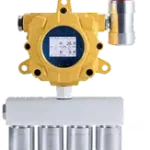
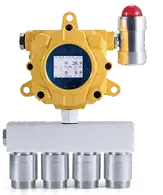
The K-G60-S4 Fixed Multi Gas Detector addresses that directly. It is a fixed installation multi-gas detector that monitors combustible gas (EX), oxygen (O2), carbon monoxide (CO), and hydrogen sulfide (H2S) simultaneously from a single detector head — supporting five sensor technology types (electrochemical, catalytic, semiconductor, infrared, and PID) to allow the sensor configuration to be matched to the specific detection requirements and environmental conditions of each installation point.
What sets the K-G60-S4 apart from fixed single-gas alternatives in this application is the multi-gas capability in a single wall or pipeline-mounted unit. One installation point, one power supply wiring run, one maintenance address, and one relay output wiring connection — covering the four gas categories that account for the majority of industrial atmospheric hazards at that location. For safety engineers and facilities managers designing fixed detection coverage across a large facility, the operational and cost difference between one multi-gas detector and four single-gas detectors at each monitoring point is significant across a multi-point installation.
Key Features
Simultaneous EX, O2, CO, H2S Detection
The K-G60-S4 monitors combustible gas (EX), oxygen (O2), carbon monoxide (CO), and hydrogen sulfide (H2S) simultaneously from a single fixed detector head. All four gas channels are monitored and reported continuously — providing comprehensive atmospheric protection at each installation point without requiring separate detector installations for each gas. In confined space entry areas, process maintenance zones, and underground infrastructure monitoring points where all four hazard categories are relevant, this integrated multi-gas capability directly reduces installation complexity and ongoing maintenance overhead.
Five Sensor Technology Options
The K-G60-S4 supports five sensor technologies: electrochemical, catalytic bead, semiconductor, infrared (IR), and PID (photoionisation detection). This sensor flexibility allows the detector configuration to be matched to the specific detection requirements of the installation environment. Infrared sensors for combustible gas offer superior stability and resistance to sensor poisoning in hydrocarbon-heavy atmospheres. PID sensors extend detection capability to VOCs (volatile organic compounds) where standard electrochemical or catalytic sensors have limited response. Electrochemical sensors provide high sensitivity for O2, CO, and H2S detection at low PPM concentrations. Selecting the appropriate sensor technology for each gas channel — rather than accepting a single fixed technology — is a meaningful system design decision that the K-G60-S4’s flexibility supports.
Dual Relay Output — Free Contact 30V DC 2A / 125V AC 0.3A
Two independent relay outputs with free contact ratings of 30V DC 2A or 125V AC 0.3A allow the K-G60-S4 to be wired directly into external alarm, ventilation interlock, and gas shutoff systems without additional relay interface modules. Dual independent relays allow different alarm thresholds on different gas channels to trigger different physical safety responses — for example, low alarm triggering ventilation activation and high alarm triggering gas shutoff — providing a graduated automated safety response architecture from a single detector.
±3% FS Accuracy with ≤2% Repeatability
The K-G60-S4 achieves ±3% full scale measurement accuracy with ≤2% repeatability across all gas channels. For fixed detectors used as inputs to safety instrumented functions, permit-to-work decision support, or automated process interlock logic, stated accuracy and repeatability specifications are direct inputs into the safety function performance assessment. ≤2% repeatability means the detector produces consistent readings for the same atmospheric concentration across repeated measurements — a specification relevant for continuous monitoring applications where drift over time needs to be bounded.
Wall-Mounted and Pipeline Installation Options
The K-G60-S4 supports both wall-mounted installation and pipeline-type installation via M20×1.5 internal thread G1/2 inner tube thread connection. Pipeline installation allows the detector to be mounted directly onto a process pipe or distribution manifold — positioning the sensor in close proximity to the potential leak source rather than at a general area monitoring position. For gas detection at specific equipment or pipeline connection points, pipeline mounting provides more responsive detection than wall-mounted area monitoring at distance from the hazard source.
T90 Response Time ≤30 Seconds
A T90 response time of 30 seconds or less across all gas channels means the detector reaches 90% of the actual gas concentration within 30 seconds of exposure — fast enough to provide a timely alarm signal to the control system and local personnel. For safety function applications where detector response time is an input to the safety function performance calculation, a specified T90 ≤30s across all four gas channels provides the performance data required for formal assessment.
DC 24V Supply — 1.6W Power Consumption
Standard DC 24V instrumentation supply with 1.6W total power consumption for the complete four-gas detector head. Low power consumption simplifies power distribution design for multi-point installations and reduces operating cost across the detection system’s service life. DC 24V compatibility means the K-G60-S4 connects directly to standard instrument loop power supplies without voltage conversion.
Technical Specifications
Model: K-G60-S4
Target Gases: EX (combustible), O2 (oxygen), CO (carbon monoxide), H2S (hydrogen sulfide)
Sensor Technologies: Electrochemical / Catalytic / Semiconductor / Infrared / PID (configurable)
Relay Output: 2 relays — Free contact: 30V DC 2A / 125V AC 0.3A
Accuracy: ≤ ±3% FS
Repeatability: ≤ 2%
Response Time: T90 ≤ 30 seconds
Sampling Method: Natural diffusion
Installation Method: Wall-mounted / Pipeline type (M20×1.5 / G1/2)
Power Supply: DC 24V ±3.6V
Power Consumption: 1.6W
Cable: > 4×1.5mm² shielded wire
Weight: Approximately 2600g
Dimensions: 261 × 177 × 90mm
Working Temperature: -10°C to 50°C
Working Humidity: ≤ 95% RH (non-condensing)
Benefits
One installation point covers four gas hazard categories simultaneously. Replacing four separate single-gas fixed detectors with one K-G60-S4 at each monitoring point reduces wiring runs, power supply connections, conduit installations, and maintenance addresses by a factor of four. For large-scale fixed detection installations across refineries, chemical plants, and wastewater facilities, this consolidation produces a meaningful reduction in installation cost, commissioning time, and ongoing maintenance overhead.
Sensor technology selection matches detection performance to the environment. Specifying IR sensors for combustible gas in hydrocarbon-heavy atmospheres, electrochemical sensors for high-sensitivity toxic gas detection, or PID sensors for VOC monitoring — rather than accepting a single fixed technology — means each gas channel performs at its best for the specific detection requirement. The K-G60-S4’s multi-sensor technology support is what enables that optimised sensor selection in a single fixed detector.
Dual relay enables graduated automated safety response. Two independent relay outputs with different alarm threshold assignments allow different gas channels and alarm levels to trigger different physical safety responses automatically — ventilation on low alarm, gas shutoff on high alarm, or different responses for different gas channels. This graduated response capability reduces unnecessary process disruption from nuisance low alarms while ensuring rapid automated response to high-concentration events.
Pipeline mounting option for source-proximity detection. Direct pipeline mounting positions the sensor at the gas source — the pipe joint, valve, or equipment connection — rather than at a wall-mounted area monitoring position that may be metres away. Source-proximity detection responds faster to an actual leak at the monitored component and reduces the concentration build-up time between leak onset and alarm trigger compared to area-mounted alternatives.
Stated accuracy and repeatability for safety function assessment. ±3% FS accuracy and ≤2% repeatability are defined performance parameters that can be used directly in safety instrumented system performance calculations. For facilities where fixed gas detectors form part of a formally assessed safety instrumented function, having stated sensor performance specifications — rather than unstated or qualitative claims — is a requirement of the assessment process.
Who It’s For
The Safety Engineer Designing Multi-Gas Fixed Detection for a Process Facility
You’re specifying fixed gas detection for a refinery, chemical plant, or wastewater facility where multiple gas hazards coexist at each monitoring point. You need a fixed multi-gas detector that covers EX, O2, CO, and H2S simultaneously, supports sensor technology selection for optimal performance in your process environment, and provides dual relay output for integration into your safety interlock architecture. The K-G60-S4’s multi-gas capability, five sensor technology options, and dual relay output directly address your system design requirements.
The Facilities Manager Responsible for Confined Space Entry Area Monitoring
You manage fixed gas detection coverage for confined space entry areas at a water utility, industrial facility, or processing plant. Each monitoring point needs to cover oxygen deficiency, combustible gas, CO, and H2S — the four gases required by confined space entry safety protocols. Installing one K-G60-S4 per monitoring point rather than four separate single-gas detectors reduces your installation cost, simplifies your ongoing calibration and maintenance programme, and produces a cleaner, more maintainable detection system architecture.
The Instrumentation Engineer Specifying Fixed Detection for a Multi-Hazard Zone
You’re adding fixed gas detection to an existing facility section where EX, O2, CO, and H2S hazards are all present. You need a detector that integrates with your DC 24V instrument loop power supply, provides relay output compatible with your existing safety interlock wiring, and offers the sensor technology options to match your specific process gas environment. The K-G60-S4’s DC 24V compatibility, dual relay output ratings, and multi-sensor technology support cover those integration requirements in a single device specification.
Possible Applications
- Confined space entry area fixed monitoring — Permanent EX, O2, CO, H2S coverage at confined space entry points in industrial facilities, wastewater utilities, and underground infrastructure
- Oil and gas production facility process areas — Multi-gas fixed detection at wellheads, separators, compressor buildings, and enclosed process areas with overlapping gas hazard profiles
- Petrochemical and refinery process units — Fixed multi-gas monitoring at process equipment locations where hydrocarbon, toxic gas, and oxygen deficiency hazards coexist
- Wastewater treatment plants — Permanent H2S, CO, O2, and LEL monitoring at pump stations, digester areas, and enclosed treatment structures
- Mining — surface and underground — Fixed multi-gas detection at underground workings, ventilation monitoring points, and equipment areas with multiple simultaneous gas hazards
- Chemical manufacturing process areas — Multi-gas fixed detection at chemical process equipment locations with EX, toxic gas, and oxygen displacement hazards
- Power generation facilities — Fixed detection in turbine halls, boiler plant areas, and enclosed process spaces with natural gas, CO, and oxygen hazards
- Pipeline and gas distribution infrastructure — Pipeline-mounted detection directly at valve stations, compressor outlets, and distribution equipment connection points
Trust and Certifications
Five Sensor Technology Types — Manufacturer Verified
Support for electrochemical, catalytic, semiconductor, infrared, and PID sensor technologies is a manufacturer-verified capability that covers the full range of fixed gas detection sensor approaches used in industrial installations. This breadth of sensor technology support means the K-G60-S4 can be configured for virtually any combination of fixed gas detection requirements across EX, O2, CO, H2S, and extended VOC detection — without requiring separate detector platforms for different sensor technology needs.
±3% FS Accuracy and ≤2% Repeatability — Specified Performance Parameters
Stated measurement accuracy and repeatability specifications provide defined performance parameters for safety function assessment, system commissioning verification, and procurement comparison. For safety instrumented system applications, these parameters are direct inputs into the sensor performance element of the SIL assessment — making them essential procurement information rather than optional marketing claims.
Dual Relay Free Contact Ratings — Industry Standard Interface
Free contact relay ratings of 30V DC 2A and 125V AC 0.3A cover the standard control voltage ranges used in industrial safety interlock systems — both 24V DC safety PLC digital input circuits and 120V AC interlock wiring. Free contact relay output is the standard hardwired signal interface for safety interlock systems, providing direct compatibility with existing safety wiring infrastructure without additional interface modules.
DC 24V Supply Compatibility
DC 24V is the universal standard supply voltage for industrial instrumentation. Compatibility with existing DC 24V instrument loop power supplies means the K-G60-S4 installs directly into standard instrument power distribution infrastructure without voltage conversion equipment — simplifying installation design and reducing integration cost.
Authorised by Alright Engineering Solutions
The K-G60-S4 is supplied through Alright Engineering Solutions Pte. Ltd., an authorised distributor of fixed and portable gas detection equipment in Singapore. Alright Engineering Solutions provides local procurement support, sensor technology selection guidance, system integration assistance, and after-sales service for the Singapore and regional market.
Accessories and Variants
Sensor Module Options
Electrochemical sensors — O2, CO, H2S: high sensitivity at low PPM concentrations, standard for toxic gas and oxygen detection
Catalytic bead sensors — EX/LEL: cost-effective combustible gas detection for standard hydrocarbon environments
Infrared (IR) sensors — EX/LEL: superior stability and resistance to poisoning in hydrocarbon-heavy environments, longer sensor lifespan
PID sensors — Extended VOC detection capability for facilities with volatile organic compound hazards beyond standard combustible gas sensor response range
Wall Mounting Hardware
Mounting brackets and hardware for wall-mounted installation in process areas, plant rooms, and enclosed industrial spaces. Mounting position guidance for each gas type (based on vapour density relative to air) is available from Alright Engineering Solutions.
Pipeline Connection Fittings
M20×1.5 and G1/2 fittings for pipeline-type installation directly onto process pipework, manifolds, or equipment connections — positioning the sensor at the leak source rather than at a general area monitoring position.
4×1.5mm² Shielded Cable
The K-G60-S4 requires shielded instrumentation cable of greater than 4×1.5mm² cross-section for signal integrity in industrial environments. Using the specified cable type maintains relay output reliability and measurement signal quality across the installation wiring run.
Calibration Gas Kits
Multi-gas calibration kits available for periodic verification across all four gas channels — EX, O2, CO, H2S — against certified reference concentrations. Regular calibration maintains ±3% FS accuracy and ≤2% repeatability specifications throughout the detector’s service life.
Related Products from Alright Engineering Solutions
GTYQ-DX 102 Fixed Gas Detector — Fixed single-gas detector with 4–20mA and RS485 output for process control integration
GTYQ-S10 Fixed Gas Detector — Fixed single combustible gas detector with relay output and calibration-free modular sensor
BELL LITE Multi Gas Detector — Personal portable 4-gas monitor for workers in areas covered by fixed detection systems
S40 Portable Multi Gas Detector — Connected portable multi-gas monitor with 4G and pump sampling for field inspection
Get in Touch
If your facility requires fixed multi-gas detection across points where EX, O2, CO, and H2S hazards coexist — whether for confined space monitoring, process area detection, or safety instrumented system applications — the K-G60-S4 is worth a detailed evaluation against a multi-detector single-gas approach.
Contact Alright Engineering Solutions to request a formal quote, discuss sensor technology selection for your specific gas environment, or get technical guidance on installation configuration for your facility.
📍 3791 Jalan Bukit Merah #06-01, E-Centre @ Redhill, Singapore 159471