Cart (
Overview
Carbon monoxide detectors are common on industrial sites — but not all of them are measuring what you think they’re measuring. Standard CO sensors are susceptible to cross-interference from hydrogen gas, which means in environments where both gases may be present — battery charging rooms, certain chemical processes, fuel cell operations — a conventional CO monitor can trigger false alarms on H2 alone, or worse, give misleading readings that undermine confidence in the entire monitoring system.
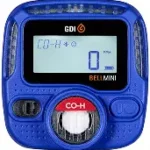
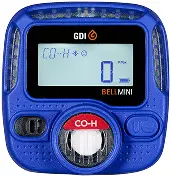
The BELL MINI CO-H Single Gas Detector (POR-GDIS-CO-H) is specifically engineered to solve that problem. Using a hydrogen-compensated electrochemical sensor, it filters out H2 cross-sensitivity and reports only true carbon monoxide concentrations — across a detection range of 1–500 ppm. This makes it the correct choice for any site where both CO and H2 may be present simultaneously, and where alarm credibility matters as much as alarm sensitivity.
Manufactured by International Gas Detectors (IGD) in the UK, the BELL MINI CO-H sits within the same platform as the wider BELL MINI range — which means the same IP68 build quality, the same two-year battery life, and the same BELLCONNECT app ecosystem. For HSE teams that already use BELL MINI detectors for other gas types, adding CO-H monitoring means no new training, no new software, and no new management overhead.
Key Features
Hydrogen-Compensated CO Sensor (1–500 ppm)
The defining feature of the CO-H variant is its H2-compensated sensor technology. Conventional CO sensors produce a measurable response to hydrogen gas, which can generate false alarms in environments where both gases coexist. The BELL MINI CO-H’s sensor architecture specifically filters this interference, so alarm events reflect actual CO concentrations — not H2 cross-sensitivity artefacts. For sites with battery banks, hydrogen generation processes, or fuel cell infrastructure, this distinction is operationally critical.
Triple-Mode Alarm System (Audible, Visual, Vibrating)
When CO concentration crosses an alarm threshold, the BELL MINI CO-H activates a 100 dB audible buzzer, flashing LED indicators, and a physical vibration alert — simultaneously. In industrial environments where background noise is high or workers are wearing hearing protection, a single-mode alarm is not reliably perceived. The combined triple-mode response ensures the warning reaches the worker regardless of the conditions. Alarm levels are independently configurable for Low, High, TWA, and STEL thresholds through the BELLCONNECT app.
Two-Year Battery Life Without Charging
The BELL MINI runs on a single 3.6V lithium 2/3 AA battery with a 24-month operational life. There is no charging routine, no docking station required, and no risk of a flat battery at the start of a shift. For safety managers overseeing large monitor fleets across multiple teams and shifts, this removes a persistent and well-documented compliance gap. A confidence beep sounds at regular intervals to confirm the device is powered and monitoring — providing quiet reassurance without requiring the worker to check a screen.
IP68 Dustproof and Waterproof Construction
The BELL MINI CO-H housing is rated IP68 — fully sealed against dust ingress and tested for continuous immersion in water. In environments where CO monitoring is most critical — boiler rooms, tunnels, enclosed plant areas, or outdoor industrial sites — conditions are rarely clean or dry. IP68 protection means the detector continues operating through the kind of exposure that would compromise a lesser-rated device, without degrading sensor performance or triggering false readings from moisture ingress.
BELLCONNECT App — Calibration, Data and Fleet Management
Via Bluetooth Low Energy (BLE) and NFC, the BELL MINI CO-H connects to the BELLCONNECT app on iOS and Android. The app provides full remote management of each device: calibration and bump test workflows with automatic certificate generation, alarm setpoint configuration, device assignment to named personnel or site zones, real-time gas readings, and data export. For safety managers running compliance programmes across large teams, BELLCONNECT consolidates what would otherwise be a fragmented, manual record-keeping process into a single auditable platform.
200-Event Log and 5,000-Point Data Log
The device stores up to 200 alarm event logs and 5,000 individual gas concentration readings on board. Data log intervals are configurable through the app. For incident investigation, occupational hygiene assessments, or regulatory reporting, this on-device record provides a structured, timestamped data trail without relying on manual entry or external logging systems. This level of data capability in a pocket-sized portable CO gas monitor is genuinely useful, not just a specification to list.
One-Button Operation and Field-Replaceable Sensor
All standard functions operate through a single button, keeping the user interface simple enough for consistent, error-free operation in the field. When the CO-H sensor reaches its end of life — typically several years from commissioning — it can be replaced in the field without returning the full instrument for service. This keeps both downtime and replacement costs predictable and manageable over the device’s operational lifetime.
SAFE Mode Atmospheric Confirmation
Enabled through the BELLCONNECT app, SAFE Mode displays a clear on-screen confirmation that no CO concentration above the monitored threshold has been detected. For permit-to-work systems, confined space entry procedures, or pre-entry atmospheric checks, this positive confirmation is more meaningful than simply relying on the absence of an alarm — and it provides a documented reference point for safety records.
Technical Specifications
Model: BELLMINI
Target Gas: Carbon Monoxide — Hydrogen Compensated (CO-H)
Detection Range: 1–500 PPM
Weight: 105g (with belt clip)
Display: FSTN LCD (1.6 inch)
Battery Life: 24 months (3.6V Lithium, size 2/3 AA)
IP Rating: IP68
Alarm Types: Visual (LED), Audible (100dB@10cm), Vibration — Low, High, TWA, STEL
Wireless: Bluetooth Low Energy (BLE), NFC
Response Time: 20 seconds
Data Logging: Up to 200 alarm events, 5,000 data logs
Humidity Range: 5%–95% RH (non-condensing)
Self-Test: Breakdown of sensor and circuitry, Battery
Safety Approvals: ATEX, IECEx, KCs
App: BELLCONNECT (iOS & Android)
Warranty: 2 years (please refer to sensor data sheet)
Benefits
For workers in environments where CO and H2 coexist, the practical benefit of the CO-H variant is alarm credibility. When a monitor triggers, people act — they evacuate, they investigate, they stop work. False alarms from H2 cross-sensitivity erode that response over time, training workers to second-guess their equipment at exactly the moments when they shouldn’t. The BELL MINI CO-H removes that uncertainty by ensuring every alarm reflects a genuine CO event.
For HSE managers, the BELLCONNECT ecosystem transforms individual devices into a coordinated monitoring programme. Calibration is documented automatically, bump test records are stored centrally, and alarm events are logged with timestamps and assigned personnel names. When an auditor or regulator asks for evidence of a functioning gas monitoring programme, that evidence is already compiled — not assembled retrospectively from paper records and memory.
For procurement teams assessing hydrogen-compensated CO detectors for a fleet rollout, the total cost of ownership case is straightforward. A two-year battery life eliminates charging infrastructure and reduces the risk of undetected equipment downtime. Field-replaceable sensors extend the usable life of each unit beyond what’s typical for sealed personal monitors. And the IP68 build quality reduces damage-related replacements in the environments where CO monitoring is most likely to be needed.
Who It’s For
Electrical and Facilities Manager — Battery Room Environments
You manage a facility with large battery banks — UPS systems, forklift charging stations, or standby power infrastructure. These environments produce both hydrogen gas during charging cycles and carry CO risk from adjacent plant or fuel-powered equipment. A standard CO detector in this environment will respond to the hydrogen, generating alarms that the team learns to ignore. You need a CO-H compensated monitor that reports only what it’s supposed to detect, so when it does alarm, people take it seriously.
Confined Space Entry Supervisor — Tunnelling or Utility Infrastructure
Before your team enters a tunnel, culvert, or utility vault, you need atmospheric monitoring you can rely on. CO is a credible risk from diesel plant, nearby traffic, or decomposing organic matter — and the last thing you need is a monitor that creates alarm fatigue through H2 false triggers before the real work begins. The BELL MINI CO-H gives you a clean, reliable CO reading you can use to make an actual entry decision, and SAFE Mode gives you visible documentation that the check was completed.
HSE Officer at a Chemical Processing or Fuel Cell Facility
Your site handles processes where hydrogen and CO may both be present in the working environment. You’re responsible for ensuring every worker in at-risk zones carries a calibrated, correctly specified personal monitor — and that the monitoring data is available for incident reporting and regulatory compliance. The BELLCONNECT platform gives you fleet-level visibility of calibration status and event history, while the CO-H sensor specification ensures the data you’re collecting is actually CO, not hydrogen interference.
Possible Applications
Battery Charging Rooms and UPS Infrastructure — Industrial battery banks generate hydrogen during the charging cycle. Personnel working in or near these areas need CO monitoring that isn’t triggered by H2 — making the CO-H compensated variant the technically correct choice for these environments.
Tunnel Construction and Underground Civil Works — Diesel-powered plant in enclosed tunnel environments produces CO as a combustion byproduct. Workers and supervisors in these settings require personal CO monitoring throughout their time underground, with fast response times and reliable alarm performance.
Fuel Cell Manufacturing and Testing Facilities — Hydrogen fuel cell production and testing environments carry both H2 and CO exposure risks. Standard CO detectors cross-sensitise on H2 in these settings; the CO-H variant provides accurate, interference-free CO detection.
Power Generation and Utilities — Generator rooms, boiler houses, and plant rooms in power generation facilities carry CO risk from combustion processes. Maintenance engineers and operators working in these areas benefit from continuous personal CO monitoring during inspection, servicing, and operational rounds.
Petrochemical and Refinery Operations — CO is generated as a byproduct in several refinery processes, and hydrogen is present across many areas of the same sites. ATEX-certified CO-H monitoring is appropriate for maintenance workers and contractors operating in these dual-gas environments.
Vehicle Maintenance and Fleet Workshops — Enclosed vehicle workshops — particularly those servicing diesel or hydrogen-powered vehicles — carry CO risk from exhaust emissions and potential CO-H cross-sensitivity issues. Personal monitoring for mechanics and workshop staff provides individual-level protection beyond fixed gas detection systems.
Steel and Metals Production — CO is produced during blast furnace operations and certain metal processing steps. Workers in furnace areas, casting floors, and process control environments require reliable personal CO detection as part of a layered monitoring approach.
Trust & Certifications
ATEX: Ex II 1G Ex ia IIC T4 Ga
ATEX certification is the mandatory European standard for equipment deployed in potentially explosive atmospheres. The BELL MINI CO-H’s Zone 0 classification — the highest hazard rating — confirms it is approved for continuous use in environments where explosive atmospheres may be present at all times. For procurement on petrochemical, refinery, utility, or chemical processing sites across the EU and UK, ATEX approval is a procurement prerequisite, not an optional feature.
IECEx: Ex ia IIC T4 Ga
IECEx is the internationally accepted equivalent of ATEX, recognised in Australia, the Middle East, Asia, and other major industrial markets. Organisations operating across multiple countries can deploy the BELL MINI CO-H with confidence that it meets local intrinsic safety requirements without needing market-specific variants.
KCs Certification
Korean Certification (KCs) confirms compliance with South Korean industrial electrical safety standards — relevant for organisations with operations or supply relationships in the Korean industrial sector.
Two-Year Instrument Warranty
IGD backs the BELL MINI CO-H with a two-year warranty on the instrument, with sensor-specific warranty terms covered in the sensor data sheet. A manufacturer warranty of this length on a personal gas monitor reflects genuine confidence in long-term product reliability.
International Gas Detectors (IGD)
IGD is a UK-based gas detection manufacturer with decades of design and production experience across fixed and portable detection systems. The BELL MINI is an IGD-exclusive product — engineered and supported by the same team that designs it. That direct relationship between manufacturer and end user matters when technical questions arise in the field or when equipment needs to be configured for a specific site application.
Accessories & Variants
BELLCONNECT App (iOS / Android)
Free and exclusive to the BELL product line. Provides complete device management — calibration workflows, bump test logging, alarm configuration, data download, and fleet assignment — from a single smartphone interface. Essential for any HSE programme that requires documented compliance evidence.
Alligator Belt Clip
Supplied with every unit. Positions the sensor at breathing zone height on clothing, harnesses, or lapels for representative gas readings. Robust enough for continuous daily use in industrial environments.
Calibration Gas (CO / CO-H)
Certified calibration gas for bump testing and full span calibration is available from IGD and approved gas suppliers. Calibration reminders and certificate generation are handled automatically through the BELLCONNECT app, keeping compliance records current without manual administration.
Available BELL MINI Variants
POR-GDIS-CO-H — CO H₂ Compensated | 1–500 ppm
POR-GDIS-CO — CO (Carbon Monoxide) | 1–1,000 ppm
POR-GDIS-COEX — CO Extended Range | 1–2,000 ppm
POR-GDIS-H2S — H₂S (Hydrogen Sulphide) | 0.1–100 ppm
POR-GDIS-HCN — HCN (Hydrogen Cyanide) | 1–50 ppm
POR-GDIS-NH3 — NH₃ (Ammonia) | 1–100 ppm
POR-GDIS-O2 — O₂ (Oxygen) | 0.1–30% Vol
POR-GDIS-O2LF — O₂ Lead-Free Sensor | 0.1–30% Vol
POR-GDIS-H2 — H₂ (Hydrogen) | 1–1,000 ppm
POR-GDIS-SO2 — SO₂ (Sulphur Dioxide) | 0.1–20 ppm
All BELL MINI variants use the same BELLCONNECT platform and physical format, so adding CO-H monitors to an existing BELL MINI fleet requires no additional training or infrastructure.
Request a Quote or Procurement Consultation
If your site has environments where hydrogen and carbon monoxide may both be present — battery rooms, tunnels, fuel cell facilities, or chemical plant — and you’re currently using standard CO detectors, it’s worth reviewing whether your monitoring is giving you accurate data or H2 cross-sensitivity artefacts.
Speak with our safety equipment team to discuss your specific application, request technical guidance on sensor selection, or get pricing for a fleet deployment. We work directly with HSE managers, procurement leads, and site safety teams — and we can support the full process from specification through to calibration gas supply and BELLCONNECT configuration.