Cart (
Overview
Most industrial gas monitoring scenarios fall into one of two categories: standard confined space entry monitoring, which requires four gases (O2, LEL, CO, H2S), and specialist monitoring for VOCs, specific toxic gases, or infrared-detected gases like CO2 and methane at percentage levels. For years, these two requirements meant two separate instruments — a standard four-gas confined space monitor for daily personal protection, and a PID or specialist detector for the specific detection task. Carrying both instruments, managing two calibration schedules, and training workers on two different devices is an overhead that many organisations simply accept because no single instrument has covered both requirements adequately.
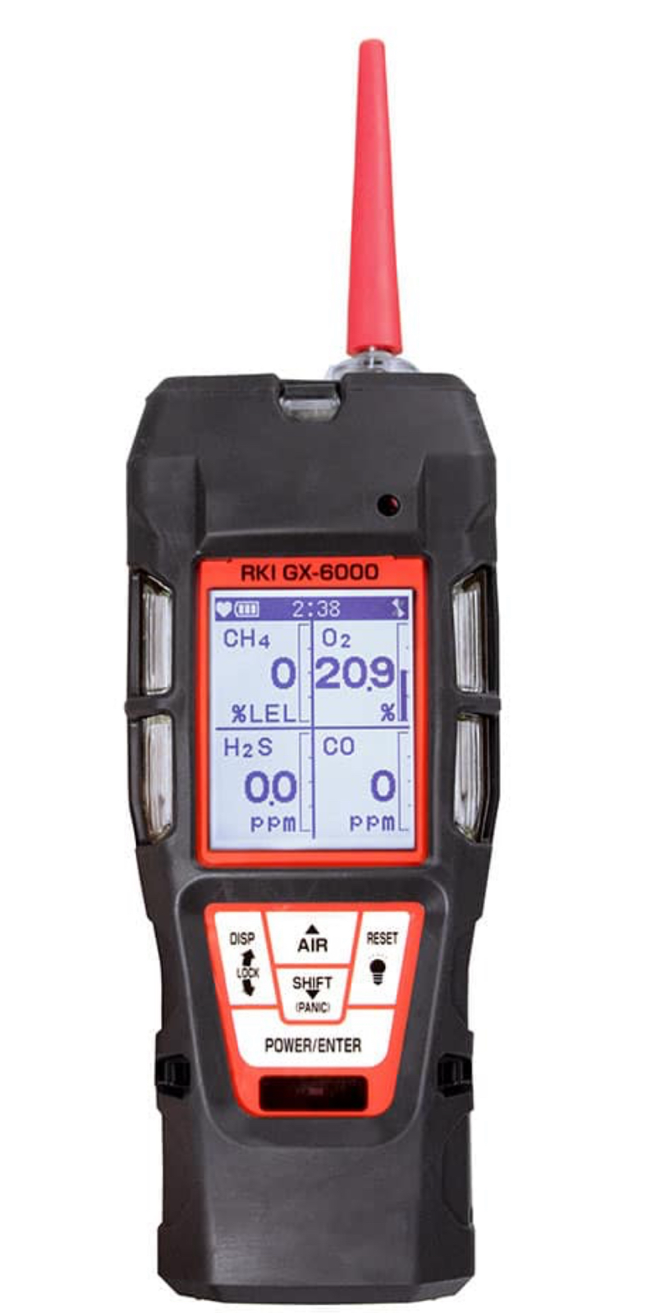
The RKI GX-6000 changes that calculation. Capable of monitoring up to six gases simultaneously, the GX-6000 combines the standard four confined space gases — LEL combustibles, O2, CO, and H2S — with two additional interchangeable smart sensor slots that accept PID (photoionisation detector) sensors for VOC detection, infrared sensors for CO2, methane, or hydrocarbons at percentage levels, or super toxic sensors for gases including Cl2, HCN, NH3, NO2, PH3, SO2, and others. A single GX-6000 configured for LEL, O2, CO, H2S, and PID replaces a standard four-gas diffusion monitor and a separate PID detector — at a fraction of the combined cost and with a single calibration and maintenance programme.
Manufactured by RKI Instruments — a US-based specialist gas detection manufacturer with decades of experience in industrial, environmental, and hazmat gas detection — and supplied by Alright Engineering Solutions Pte Ltd, Singapore-based authorised distributors of professional gas detection equipment serving the maritime and industrial sectors across the Asia-Pacific region, the GX-6000 stands apart from competing six-gas instruments through one specific differentiator confirmed by RKI as an industry first: it supports dual PID sensors, allowing the installation of two photoionisation detectors within a single unit. This means a single GX-6000 can run a broad-range 10.6 eV PID for general VOC detection simultaneously with a 10.0 eV benzene-specific sensor — delivering both general atmosphere screening and targeted benzene monitoring without any instrument change or configuration switch.
Key Features
1. Up to Six Simultaneous Gas Channels — Confined Space Plus Specialist Detection
The GX-6000 monitors up to six gases at the same time across two distinct sensor tiers. The four standard confined space gases — LEL combustibles, O2, CO, and H2S — occupy the fixed sensor positions and cover the baseline atmospheric hazard assessment required for confined space entry under OSHA 1910.146, UK HSG258, Singapore WSH Act, and equivalent frameworks. The two interchangeable smart sensor slots accept any combination of PID, IR, or super toxic sensors, allowing the GX-6000’s detection capability to be expanded beyond the standard four gases to address the specific hazards of the deployment environment. Smart sensor slots auto-recognise sensor changes — swapping a PID for a super toxic sensor is a field operation that the instrument detects and configures automatically, without requiring software reconfiguration or specialist knowledge.
2. PID Sensor Options — Four UV Lamp Choices Including Dual PID
The GX-6000 supports four PID sensor configurations: 10.6 eV (standard range), 10.6 eV (extended range), 10.0 eV, and 11.7 eV UV lamps — covering the full range of VOC detection requirements from general broad-spectrum screening to specific high-ionisation-potential compound detection. The 10.6 eV lamp is the standard choice for general VOC monitoring, responding to the majority of common industrial VOCs including benzene, toluene, xylene, and hundreds of others. The 10.0 eV lamp is benzene-selective in mixed VOC atmospheres, allowing benzene-specific monitoring where benzene is the primary concern. The 11.7 eV lamp responds to compounds that the 10.6 eV lamp cannot ionise, including some chlorinated solvents and light hydrocarbons. The dual PID capability — two PID sensors in one instrument — allows 10.6 eV and 10.0 eV sensors to operate simultaneously, providing both general VOC screening and benzene-specific readings from the same instrument at the same time.
3. PID Library of Over 600 VOCs — Customisable User List
The GX-6000’s PID channel includes a built-in library of over 600 VOC gases with response factors pre-loaded, allowing the instrument to report corrected concentrations for specific target VOCs rather than isobutylene-equivalent readings. The target VOC can be changed from a customisable user-defined favourites list or a recently used list — without navigating the full 600-compound library each time. For environmental investigators, industrial hygienists, and HAZMAT teams who need to identify and measure specific VOCs at different sites and for different tasks, this library-based approach means the correct response factor for the target compound is applied to the PID reading automatically, producing data that is directly usable for comparison against regulatory exposure limits without manual conversion calculations.
4. Man-Down Alarm and Panic Alarm — Lone Worker Safety Features
The GX-6000 incorporates a man-down alarm that activates when the instrument has remained in a horizontal or stationary position beyond a configured time threshold — indicating that the worker wearing it may have fallen and been incapacitated. The man-down alarm activates all alarm channels simultaneously and is intended to attract attention to a worker who cannot actively call for help. The panic alarm allows the worker to manually trigger a full alarm output at any time — useful when a worker needs to signal distress in a noisy or remote environment where calling out or using a radio is not practical. These two alarm types extend the GX-6000’s function beyond gas detection into worker safety monitoring — a meaningful capability for lone workers, confined space entrants, and field teams working in remote or hazardous locations where buddy-system supervision is not always practical.
5. Strong Internal Sample Draw Pump — PPM Leak Check and LEL Protection Modes
The GX-6000 incorporates a strong internal sample draw pump that actively draws gas from the surrounding atmosphere across the sensor array, improving response speed and enabling remote sampling through an attached hose. The PPM Leak Check operating mode uses the pump to provide rapid, directional leak detection capability — drawing gas actively for improved response when scanning pipe joints, valve stems, fittings, and equipment connections for low-level leaks. The LEL sensor protection mode automatically switches off the catalytic LEL sensor when concentrations are detected that could damage or poison the sensor — protecting the sensor from irreversible contamination during high-concentration exposure events such as spills, large leaks, or entry into heavily contaminated spaces.
6. Five Operating Modes — Versatile Deployment Across Multiple Applications
The GX-6000 supports five distinct operating modes selectable by the user: standard monitoring mode for personal protection and atmospheric survey work; confined space mode for pre-entry and in-space monitoring; PPM Leak Check mode for active leak detection using the pump; safe area mode for use in non-hazardous environments; and data logging mode for extended monitoring sessions with automatic data recording. This operating mode flexibility means a single GX-6000 configured for LEL, O2, CO, H2S, and PID can function as a confined space entry monitor in the morning, a leak detection instrument during a pipe survey in the afternoon, and a long-term area monitor for an evening industrial hygiene sampling session — all without changing instruments or sensor configurations.
7. LED Flashlight, Peak-Bar Display, and Auto Display Rotation
The GX-6000 includes a built-in LED flashlight — a practically useful feature for workers conducting atmospheric sampling, leak detection, or confined space work in dark or poorly lit environments where a separate torch would otherwise be required. The peak-bar display shows the highest concentration recorded since the last reset on a persistent bar indicator alongside the real-time reading, providing an immediate visual record of the maximum exposure encountered during a monitoring session without requiring menu navigation. The auto display rotation automatically adjusts screen orientation based on how the instrument is held, ensuring readings are always right-way-up whether the instrument is held upright, inverted, or at an angle during sampling operations.
8. Interchangeable Battery Packs — Li-ion and Alkaline Options
The GX-6000 accepts interchangeable battery packs in two types: a Li-ion rechargeable pack providing up to 14 hours of operation (recharging fully in 3 hours), and an alkaline battery pack providing approximately 8 hours of operation from standard AA alkaline batteries. The alkaline pack is significant for field operations in remote locations, on vessels, or in emergency response situations where mains power for Li-ion recharging is not available — the instrument continues to function from widely available standard batteries without requiring any modification. All sensors, batteries, filters, and the pump are field-replaceable — the instrument can be fully serviced in the field without returning to a service centre, which reduces downtime and maintenance costs for organisations operating the GX-6000 in geographically remote environments.
Technical Specifications
Model: RKI GX-6000 Portable Gas Detector (RKI Instruments — Supplied by Alright Engineering Solutions Pte Ltd)
Gas Channels: Up to 6 simultaneously — 4 standard confined space (LEL, O2, CO, H2S) + 2 interchangeable smart sensor slots (PID / IR / super toxic)
PID Options: 10.6 eV (2 ranges), 10.0 eV (benzene-specific), 11.7 eV UV lamps; dual PID installation supported
PID VOC Range: 0–6,000 ppm (standard); 0–4,000 ppm (some configurations)
PID VOC Library: Over 600 VOCs with response factors; customisable user list and recently used list
Super Toxic Sensor Options: Cl2, HCN, NH3, NO2, PH3, SO2, CO2, and others
IR Sensor Options: CO2, CH4, hydrocarbons at percentage concentrations
Display: Large auto-rotating colour LCD; peak-bar display; simultaneous multi-gas readout
Alarm Types: Visual (5 LED lights on 3 sides), audible, vibrating; man-down alarm; panic alarm; peak-bar display
Sampling: Internal sample draw pump; PPM Leak Check mode; LEL sensor protection mode
Operating Modes: 5 modes — standard, confined space, PPM Leak Check, safe area, data logging
Battery: Li-ion pack — up to 14 hours; recharges in 3 hours / Alkaline pack — up to 8 hours
Battery Type: Interchangeable Li-ion and alkaline packs
IP Rating: IP67 — dustproof; waterproof to 1 metre depth
Housing: Removable impact-resistant rubber boot; rugged construction
Dimensions: Approx. 200×68×52mm
Weight: Approx. 0.4 kg with Li-ion battery pack
Operating Temperature: -20°C to +50°C (-4°F to +122°F)
Safety Approvals: ATEX / IECEx / cCSAus (intrinsically safe)
Data Logging: Standard on-device event and data logging; PC download via USB
Additional Features: LED flashlight, man-down alarm, panic alarm, auto display rotation, peak-bar display, field-replaceable sensors/battery/filter/pump
Warranty: 2 years (materials and workmanship); 1 year (PID sensor); 2 months (11.7 eV lamp)
Benefits
The most direct operational benefit of the GX-6000 is instrument consolidation. Capable of monitoring up to 6 gases simultaneously — 0 to 4 confined space gases plus 2 interchangeable smart sensor slots accepting PID, IR, or super toxic sensors — the GX-6000 replaces a standard four-gas confined space monitor and a separate PID detector in a single instrument. For organisations that have historically carried two instruments for jobs requiring both confined space gas coverage and VOC or super toxic detection, this consolidation halves the instrument count, halves the calibration gas expenditure, simplifies training, and reduces the chance of a worker arriving at a job without the correct instrument for the task.
The PID library of over 600 VOCs with user-customisable favourites lists means the GX-6000 is genuinely useful for environmental investigation, industrial hygiene, and HAZMAT response work where the target compound changes from job to job. Rather than calibrating a PID to a single default gas and applying manual response factor corrections at every measurement point, the GX-6000 allows the correct target VOC to be selected from the library before sampling begins — producing directly usable concentration data for the specific compound of interest without any post-processing.
The man-down and panic alarm features extend the GX-6000’s protective function beyond gas detection for lone workers and confined space entrants. A gas detector that also monitors worker movement and allows a manual distress signal significantly increases the effective safety coverage of a single instrument — relevant for HSE managers overseeing confined space entry programmes, remote field operations, and any application where workers may be at risk from both atmospheric hazards and physical incapacitation.
The interchangeable alkaline battery pack is a specific operational advantage for remote and maritime applications where Li-ion charging infrastructure is not reliably available. The Li-ion battery pack operates up to 14 hours and fully recharges in three hours; the alkaline pack provides eight hours of operation. For vessels on passage, remote site operations, and emergency response deployments where instrument readiness cannot depend on available mains power, the ability to continue operating from standard alkaline batteries removes a logistical vulnerability from the safety programme.
Who It’s For
Environmental Investigators and Industrial Hygienists Conducting VOC Surveys: If your work involves site investigation, environmental compliance sampling, or industrial hygiene atmospheric surveys where VOC identification and quantification is the primary monitoring task — alongside baseline confined space gas coverage — the GX-6000 provides the PID capability with a 600+ compound library and dual PID option, combined with standard confined space gas protection, in a single handheld instrument. The PPM Leak Check mode and LED flashlight are specifically useful for systematic equipment leak surveys in poorly lit plant and process environments.
HAZMAT Teams and Emergency Responders: For first responders and HAZMAT teams conducting post-incident atmospheric assessments where the specific gases present may be unknown, the GX-6000’s combination of standard confined space gas coverage, PID for broad-spectrum VOC detection, super toxic sensor options for specific high-toxicity compounds, and interchangeable alkaline battery operation provides a comprehensive, field-ready detection platform that does not depend on pre-knowledge of the specific hazards present. The man-down and panic alarms add a personal safety monitoring layer appropriate for the higher-risk operational context of emergency response work.
HSE Officers in Petrochemical, Refinery, and Chemical Processing Facilities: In process environments where the standard confined space gas hazards coexist with specific VOC or super toxic gas hazards — benzene exposure in refinery work, chlorine monitoring in chemical processing, H2S and SO2 in sulphur recovery units — the GX-6000 configured for the site-specific gas combination provides a single instrument that covers the complete hazard profile without requiring workers to carry separate dedicated instruments for each gas type. The benzene-specific 10.0 eV PID option is particularly relevant for refinery environments where benzene is a regulated carcinogen with specific occupational exposure monitoring requirements.
Possible Applications
Confined Space Entry with VOC Co-Hazard — Refineries and Chemical Plants: Six-gas monitoring for confined space entry in petrochemical environments where standard four-gas hazards are accompanied by VOC exposure risk from process residues, hydrocarbon vapours, or specific chemical contaminants in tanks, vessels, and process enclosures.
Environmental Site Investigation and Remediation: VOC screening and quantification across contaminated land investigation, underground storage tank assessment, and soil/groundwater remediation sites — PID with 600+ compound library provides compound-specific concentration data; standard sensors provide simultaneous confined space safety coverage for investigation pit and borehole entry.
HAZMAT Response and Emergency Incident Assessment: Rapid post-incident atmospheric assessment across unknown gas and vapour hazards — PID for broad VOC screening, super toxic sensors for specific high-toxicity compounds, confined space sensors for standard entry hazards — all from a single instrument that first responders can carry into the incident perimeter.
Benzene Monitoring in Petroleum and Refinery Operations: Specific benzene detection using the 10.0 eV PID lamp for workers in refinery operations, crude oil handling, and fuel transfer where benzene exposure is a regulated occupational health concern with specific monitoring and documentation requirements under OSHA 1910.1028 and equivalent international regulations.
Industrial Leak Detection — PPM Leak Check Mode: Systematic equipment leak surveys in oil and gas facilities, chemical plants, and pipeline infrastructure — PPM Leak Check mode with internal pump provides rapid, directional scanning capability for pipe joints, valve glands, flange faces, and instrument connections at trace-level concentrations before they develop into alarm-level releases.
Marine Cargo and Tank Atmosphere Assessment: Atmospheric monitoring aboard vessels handling chemical cargoes, petroleum products, or liquefied gases — PID and super toxic sensor options cover the vapour hazards of a broad range of cargo types alongside the standard O2, LEL, CO, and H2S assessment required for confined space entry on vessels under SOLAS and ISM Code requirements.
Mining — VOC and Diesel Exhaust Monitoring: Monitoring for diesel exhaust VOCs (including benzene from diesel combustion), CO, combustible methane, and O2 in underground mining environments where diesel-powered equipment and geological gas sources create a complex multi-compound atmospheric hazard picture.
Industrial Hygiene — Personal and Area Monitoring: Extended data logging mode for personal exposure monitoring and area concentration profiling in workplaces with complex multi-compound VOC and toxic gas hazard profiles — providing time-weighted average concentration data for multiple compounds simultaneously from a single wearable instrument.
Trust and Certifications
ATEX and IECEx — Intrinsically Safe for Explosive Atmospheres: The GX-6000 carries both ATEX and IECEx intrinsic safety certifications, confirming it is approved for use in explosive atmospheres where flammable gases, vapours, or liquids may be present. Intrinsic safety (Ex ia) is the protection concept used for portable personal gas detectors in hazardous classified areas — the instrument’s electrical and electronic design limits energy to levels that cannot ignite an explosive atmosphere. These certifications are required for the GX-6000 to be legally deployed in ATEX-classified zones (EU and UK) and IECEx-approved hazardous areas internationally.
cCSAus — North American Safety Certification: The cCSAus marking confirms the GX-6000 has been certified to both Canadian (CSA) and US (UL/ANSI) safety standards by a CSA-accredited certification body — enabling deployment across North American industrial, oil and gas, and hazardous area applications that require third-party safety certification to North American standards.
IP67 Ingress Protection: Fully dustproof and rated for temporary water immersion to 1 metre depth — appropriate for the demanding physical conditions of confined space work, field environmental investigation, and HAZMAT response. The GX-6000 is equipped with a removable impact-resistant rubber boot and a dust and water resistant enclosure with an IP-67 rating.
Warranty — Tiered by Component: Two-year warranty for materials and workmanship; one-year warranty for the PID sensor; two-month warranty for the 11.7 eV lamp. The tiered warranty reflects the different operational lifespans of the instrument hardware, the UV lamp-dependent PID sensor, and the most sensitive high-energy UV lamp variant — providing clear warranty terms for each serviceable component.
RKI Instruments: RKI Instruments is a US-based specialist gas detection manufacturer with a long track record in industrial, environmental, and hazmat gas detection. The GX-6000 is RKI’s flagship portable multi-gas platform, described as a game changer in the company’s product positioning — reflecting the dual PID capability and six-gas simultaneous monitoring that set it apart from conventional four-gas confined space monitors in the same category.
Alright Engineering Solutions Pte Ltd — Authorised Distributor: Alright Engineering Solutions is a Singapore-based engineering solutions company serving the maritime and industrial sectors across the Asia-Pacific region. As an authorised distributor of professional gas detection equipment including the RKI GX-6000, Alright Engineering Solutions provides full product support including supply, sensor configuration advice, technical consultation, and after-sales service. Full product portfolio available through alrightes.com.
Accessories and Variants
PID Sensor Modules (10.6 eV, 10.0 eV, 11.7 eV): Interchangeable PID sensor modules for the GX-6000’s smart sensor slots — auto-recognised on installation. 10.6 eV for general VOC monitoring; 10.0 eV for benzene-specific detection; 11.7 eV for high-ionisation-potential compounds. Dual PID installation (two simultaneous PID sensors) supported.
IR Sensor Modules (CO2, CH4, Hydrocarbons): Infrared sensor modules for the smart sensor slots — providing percentage-level CO2, methane, or hydrocarbon concentration measurement using non-consumable infrared sensing technology for applications requiring long-term stable measurement without catalytic sensor poisoning risk.
Super Toxic Sensor Modules: Sensor modules for the smart sensor slots covering Cl2, HCN, NH3, NO2, PH3, SO2, and other high-toxicity gases — for deployment environments where specific super toxic compounds are process or incident hazards beyond the standard four confined space gases.
Alkaline Battery Pack: Field-interchangeable alkaline battery pack for operation from standard AA batteries — essential for remote locations, vessel operations, and emergency response scenarios where Li-ion charging infrastructure is not available. Provides approximately 8 hours of operation.
Li-ion Battery Pack and Charger: Rechargeable lithium-ion battery pack providing up to 14 hours of operation, with 3-hour charge time. Available with 115V AC or 100–240V AC charger variants depending on regional supply voltage.
Sampling Hose and Probe: Extension hose (5ft / 1.5m standard) and probe assembly for remote pump sampling — used for atmospheric testing in confined spaces, tank hatches, and locations not directly accessible to the instrument body.
Calibration Gas — Multi-Gas and PID-Specific: Calibration gas mixtures for LEL, O2, CO, H2S, and isobutylene (PID calibration reference gas) — available through Alright Engineering Solutions for field bump testing and full calibration of the GX-6000.
Available Variants by Configuration:
LEL, O2, CO, H2S (no PID): Standard four-gas confined space configuration without smart sensor occupancy — base four-gas monitor
LEL, O2, CO, H2S + PID (10.6 eV): Five-gas configuration for general VOC and confined space monitoring — the most common GX-6000 deployment configuration
LEL, O2, CO, H2S + PID (10.6 eV) + PID (10.0 eV — benzene): Six-gas dual PID configuration for simultaneous general VOC and benzene-specific monitoring
LEL, O2, CO, H2S + PID + Super Toxic: Six-gas configuration for environments with specific super toxic co-hazards alongside standard confined space gases and VOC monitoring
Custom sensor combinations across the two smart sensor slots are available — contact Alright Engineering Solutions to specify the sensor configuration for your application and confirm availability
Ready to Configure the RKI GX-6000 for Your Application?
Whether you are replacing separate confined space and PID instruments with a single consolidated platform, specifying a portable detector for environmental site investigation with VOC quantification capability, or equipping a HAZMAT team with a field-ready multi-hazard detection instrument, the GX-6000 offers the gas channel flexibility, PID library depth, and safety feature set that demanding detection applications require.
To request a formal quotation, discuss sensor slot configuration for your specific gas hazard profile, or get technical advice on PID lamp selection, VOC library setup, and alkaline versus Li-ion battery options for your deployment environment, contact the Alright Engineering Solutions team directly. We support the full specification and procurement process — from sensor configuration and calibration gas sourcing through to instrument deployment and ongoing sensor maintenance support.