Cart (
Overview
For oil tankers subject to MARPOL Annex I, the Oil Discharge Monitoring and Control (ODMC) system is not optional equipment — it is the mandatory technical and regulatory control that governs every overboard discharge of cargo-contaminated ballast and tank washing water during a sea voyage. MARPOL Annex I Regulation 31 requires all oil tankers of 150 GRT and above to have an approved oil discharge monitoring and control system installed, incorporating an oil content meter, a starting interlock, and an automatic overboard valve control system. Without a type-approved, functioning ODME in operation, the tanker cannot legally discharge oil-contaminated water overboard under MARPOL — regardless of actual oil content — and without an accurate oil content meter integrated into the system, the automatic stopping and recording functions that Regulation 31 requires cannot operate.
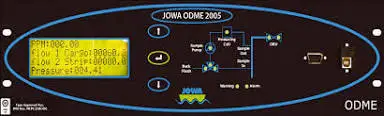
The JOWA ODME 2005 Oil Discharge Monitor is a third-generation ODMC system approved to IMO Resolution MEPC.108(49) and MEPC.240(65) — the current mandatory performance standards for oil content meters used in tanker ODME systems. With a measuring range of 0–1000 ppm, a self-cleaning analysing unit that removes the primary maintenance burden of conventional oil content meters, and a robust, field-proven construction designed for the demands of tanker engine room and cargo operations, the JOWA ODME 2005 is a complete, installation-ready ODME solution for oil tankers from 150 GRT upwards. Approvals from DNVGL, USCG, RMRS, NK, and CCS confirm acceptance across the major classification societies and flag state administrations that govern the international tanker fleet.
What sets the JOWA ODME 2005 apart from other MEPC.108(49)-approved systems is the self-cleaning analysing unit — a design feature that addresses the most common cause of ODME malfunction and maintenance downtime on tankers in commercial service. An oil content meter that keeps itself clean is one that continues to read accurately between service intervals, which is the fundamental requirement of a system that must be in operation and reading correctly every time an overboard discharge is initiated.
Key Features
MEPC.108(49) and MEPC.240(65) Dual Approval — Third-Generation Compliance
The JOWA ODME 2005 is type approved to both IMO Resolution MEPC.108(49) — which specifies the performance requirements for oil content meters in tanker ODME systems — and MEPC.240(65), the more recent resolution that updated and extended the MEPC.108(49) standard. Dual approval to both resolutions confirms that the ODME 2005 meets the “third generation” performance standard recognised by IMO and provides procurement officers and technical superintendents with the broadest possible compliance coverage for vessels whose flag states or classification societies may reference either resolution in their ODME equipment requirements.
0–1000 ppm Measuring Range — Full Tanker Discharge Window
The JOWA ODME 2005 measures oil content across a range of 0 to 1000 ppm — covering the full operational discharge window from clean water through to concentrations well above the MARPOL Annex I limit of 15 ppm for instantaneous rate of discharge in terms of oil content, and the total quantity limits that govern tanker cargo residue and tank washing discharges under MARPOL Regulation 34. The wide measuring range means the system reads accurately through the full discharge operation — from the initial discharge of water with low oil content through to any concentration exceedance that requires the automatic stopping device to activate — without range switching or measurement uncertainty near the operational limits.
Self-Cleaning Analysing Unit — Reduced Maintenance, Sustained Accuracy
The analysing unit of the JOWA ODME 2005 incorporates a unique self-cleaning mechanism that removes oil fouling from the measurement cell automatically during operation, making manual cleaning of the optical sensor virtually unnecessary under normal operating conditions. Oil content meters in tanker service are routinely exposed to oily water mixtures that deposit residue on optical surfaces, progressively degrading measurement accuracy until the sensor is manually cleaned. A self-cleaning system breaks this maintenance cycle — the analyser maintains its own measurement surfaces in a clean condition, sustaining calibration accuracy between service intervals and reducing the risk of reading drift that would compromise the accuracy of the Oil Record Book entries generated during discharge operations.
Starting Interlock and Automatic Overboard Valve Control
The JOWA ODME 2005 incorporates the starting interlock and automatic overboard valve control functions required by MARPOL Annex I Regulation 31 for tanker ODME systems. The starting interlock prevents the overboard discharge valve from opening until the ODME system has completed its initialisation and is reading correctly — preventing discharge from beginning before monitoring is active. The automatic valve control closes the overboard discharge valve when the oil content or instantaneous discharge rate exceeds MARPOL limits, stopping the discharge without requiring manual intervention. These two functions are the regulatory core of the ODME system requirement, and both are integrated into the JOWA ODME 2005 as supplied.
Three-Unit Architecture — Computer, Zener Barrier, Analysing Unit
The JOWA ODME 2005 is structured as three main components: a computer unit that handles measurement processing, data logging, and the operator interface; a Zener barrier unit that provides intrinsic safety isolation for the analysing unit installed in hazardous area locations; and the analysing unit itself where oil content measurement takes place. This modular architecture allows each component to be located where it is most appropriate for the installation — the computer unit on the bridge or cargo control room, the Zener barrier in the safe area interface panel, and the analysing unit in the cargo discharge line — and simplifies fault diagnosis and component replacement during service.
Multi-Society Approvals — DNVGL, USCG, RMRS, NK, CCS
The JOWA ODME 2005 holds type approvals from DNVGL, the United States Coast Guard (USCG), the Russian Maritime Register of Shipping (RMRS), ClassNK (NK), and the China Classification Society (CCS) — covering the major classification societies and flag state administrations that govern a substantial proportion of the international tanker fleet. For procurement teams and technical superintendents specifying ODME equipment for vessels classed with or flagged under these authorities, multi-society approval eliminates the need to verify individual society acceptance for each vessel in the fleet and confirms that the ODME 2005 is an accepted compliance solution across a geographically and commercially diverse fleet.
Robust, Long-Lifetime Construction — Designed for Tanker Service
The electrical and electronic components of the JOWA ODME 2005 are specified for long service life in the demanding environment of tanker operations — where the equipment is exposed to the temperature variation, vibration, electrical interference, and process fluid contact conditions of a working cargo or engine room installation. JOWA’s design philosophy for the ODME 2005 prioritises reliability and longevity over component complexity — a practical engineering approach for equipment that must perform correctly every time it is called upon, often with minimal technical support available during sea passages in remote areas.
Technical Specifications
Model: JOWA ODME 2005
Manufacturer: JOWA AB (Sweden)
Type: Oil Discharge Monitoring and Control System (ODMC)
Category: ODME — Oil Discharge Monitoring Equipment (Tanker)
IMO Type Approval: MEPC.108(49) and MEPC.240(65)
Classification Approvals: DNVGL, USCG, RMRS, NK (ClassNK), CCS
Measuring Range: 0 – 1000 ppm
System Components: Computer unit / Zener barrier unit / Analysing unit
Self-Cleaning: Yes — automatic analyser cleaning
Starting Interlock: Integrated
Automatic Valve Control: Integrated overboard valve stop
Applicable Regulation: MARPOL Annex I, Regulation 31
Benefits
The most direct benefit of the JOWA ODME 2005 is that it places the tanker in a position to comply with MARPOL Annex I Regulation 31 for every cargo tank ballast and washing water discharge at sea — with a type-approved system that monitors oil content continuously, stops the discharge automatically when limits are approached, and generates the Oil Record Book data that port state control inspectors and flag state surveyors will examine at the next port of call. For a tanker operator whose vessels trade to US ports — where the USCG maintains an active and well-resourced MARPOL enforcement programme — USCG type approval of the installed ODME system is not a secondary consideration; it is a basic requirement for US port entry without enforcement risk.
The self-cleaning analysing unit delivers a practical operational benefit that goes beyond compliance: it reduces the frequency of sensor fouling events that would otherwise require the ODME system to be taken offline for manual cleaning — taking it out of service and potentially requiring discharge operations to be deferred or conducted with reduced monitoring confidence. An ODME system that maintains its own measurement surfaces is one that is available and reading accurately when needed, without the maintenance intervention cycle that conventional oil content meters require in tanker bilge and cargo water service.
The modular three-unit architecture simplifies installation planning for new builds and retrofits by separating the bridge/CCR interface component, the hazardous area isolation barrier, and the process-side analysing unit into distinct components that can each be positioned appropriately for the specific vessel layout — reducing the custom engineering work typically required when fitting a single-enclosure ODME system to a vessel with a non-standard installation geometry.
Who It’s For
Chief Officers and Cargo Officers — Tanker MARPOL Discharge Operations
A chief officer on a product tanker preparing to discharge ballast water during an ocean passage needs to confirm that the ODME system is operational, initialised, and reading correctly before opening the overboard valve — and to record the ppm readings, flow rates, and discharge quantities in the Oil Record Book in the format that MARPOL Annex I and the vessel’s SMS procedures require. The JOWA ODME 2005 computer unit provides the operator interface for this procedure, and the self-cleaning analyser reduces the likelihood of a pre-discharge sensor check revealing fouling that would delay the operation. For a cargo officer whose ORB is the primary evidence of MARPOL compliance at every port of call, an ODME system that reads reliably and records accurately is operationally essential.
Technical Superintendents — Tanker Fleet ODME Compliance
A technical superintendent managing ODME compliance across a fleet of crude oil or product tankers needs equipment that is type approved for the vessels’ classification societies and flag states, serviceable in the ports and regions where the fleet trades, and reliable enough to remain in calibration between annual service visits without generating false alarms or measurement failures that disrupt cargo operations. The JOWA ODME 2005’s multi-society approvals, self-cleaning analyser, and JOWA’s established service network make it a practical choice for fleet-wide ODME standardisation — one approved system across the fleet, one service contract, one spare parts inventory.
Shipyards and Vessel Outfitters — New Build and Retrofit ODME Installation
Shipyards building new oil tankers and outfitters retrofitting ODME systems to existing vessels need equipment with clear installation documentation, modular architecture that fits the vessel’s physical layout, and type approvals accepted by the vessel’s classification society and flag state at the time of delivery. The JOWA ODME 2005’s three-unit design — computer unit, Zener barrier, and analysing unit — provides the installation flexibility to accommodate the varying bridge, cargo control room, and process deck layouts of different tanker types without custom integration engineering.
Possible Applications
Crude Oil Tankers — Cargo Tank Ballast Discharge
Crude oil tankers of 150 GRT and above engaged in international voyages are required by MARPOL Annex I Regulation 31 to operate an approved ODME system during all overboard discharges of oil-contaminated ballast water and tank washings. The JOWA ODME 2005 monitors oil content and total oil quantity discharged continuously during these operations, activating the automatic valve stop if MARPOL Regulation 34 discharge criteria are approached or exceeded.
Product Tankers and Chemical/Oil Tankers
Product tankers carrying refined petroleum products — gasoline, diesel, jet fuel, fuel oil — carry the same MARPOL Annex I ODME requirement as crude tankers. For product tankers trading to US ports under USCG jurisdiction, the USCG type approval of the JOWA ODME 2005 is directly relevant to the vessel’s MARPOL compliance status during US port entry and PSC inspection.
Combination Carriers — Ore/Oil and OBO Vessels
Combination carriers that alternate between oil and dry bulk cargoes carry MARPOL Annex I ODME requirements during oil cargo voyages. The robust construction of the JOWA ODME 2005 and its self-cleaning analyser make it appropriate for the variable service conditions of combination carrier operations, where the ODME system may be idle during dry cargo voyages and must return to reliable operation when the vessel reverts to oil carriage.
Offshore Oil Production and Storage Vessels (FPSOs)
Floating Production Storage and Offloading (FPSO) vessels and other offshore oil production and storage units that are subject to MARPOL Annex I ODME requirements for oil discharge monitoring may specify the JOWA ODME 2005 as the oil content monitoring component of their produced water and ballast water discharge monitoring systems, subject to confirmation of applicability with the relevant flag state administration.
Shuttle Tankers — North Sea and Offshore Transfer Operations
Shuttle tankers operating in the North Sea and other offshore oil production areas are subject to MARPOL Annex I requirements and, in many cases, to more stringent regional discharge standards. The DNVGL approval of the JOWA ODME 2005 is directly relevant to shuttle tanker operators whose vessels are classed with DNV or GL and trading in North Sea operating areas.
Vessel Retrofits — ODME Replacement and Upgrade
Tankers replacing ageing first or second generation ODME systems with a current MEPC.108(49) and MEPC.240(65) approved unit use the JOWA ODME 2005 as a retrofit replacement. The modular architecture and JOWA’s documented installation guidance support the retrofit process on vessels where the existing installation geometry may not match a new system’s physical envelope exactly.
New Build Tankers — Yard Specification and Class Approval
Shipyards constructing new oil tankers specify the JOWA ODME 2005 as the ODME system for vessels where multi-society approval coverage, self-cleaning maintenance reduction, and JOWA’s established service network are specification priorities. Type approval documentation from DNVGL, USCG, NK, RMRS, and CCS supports the class approval process for the installed ODME system during new build survey.
Trust & Certifications
IMO Resolution MEPC.108(49) — Tanker Oil Content Meter Performance Standard
IMO Resolution MEPC.108(49) establishes the performance requirements for oil content meters used in tanker oil discharge monitoring and control systems under MARPOL Annex I. The resolution specifies measurement accuracy, response time, operating range, and automatic stopping device integration requirements for approved oil content meters. MEPC.108(49) type approval is the mandatory certification for ODME equipment on oil tankers of 150 GRT and above subject to MARPOL Annex I Regulation 31. The JOWA ODME 2005 carries MEPC.108(49) approval — the foundational certification for legal tanker ODME operation under MARPOL.
IMO Resolution MEPC.240(65) — Updated Third-Generation ODME Standard
MEPC.240(65) is the resolution adopted at MEPC’s 65th session that updated and extended the requirements of MEPC.108(49) for third-generation oil discharge monitoring systems. Approval to MEPC.240(65) confirms that the JOWA ODME 2005 meets the most current IMO performance standard for tanker ODME equipment — relevant for vessels whose flag states or class societies reference the updated resolution in their ODME certification requirements. Dual approval to both MEPC.108(49) and MEPC.240(65) provides the widest possible compliance coverage across different regulatory frameworks.
USCG Type Approval — United States Coast Guard
The United States Coast Guard maintains an active MARPOL enforcement programme for foreign-flag vessels entering US ports, with particular scrutiny applied to ODME systems, Oil Record Books, and oil-water separator operation. USCG type approval of the JOWA ODME 2005 confirms that the system meets US Coast Guard requirements for ODME equipment on tankers entering US waters — a directly relevant certification for tanker operators whose vessels trade to US Gulf, East Coast, or West Coast ports where USCG port state control inspection of MARPOL compliance equipment is routine.
DNVGL, NK, RMRS, CCS — Classification Society Type Acceptance
Type acceptance from DNVGL, ClassNK, the Russian Maritime Register of Shipping, and the China Classification Society confirms that the JOWA ODME 2005 is accepted for installation on vessels classed by each of these societies — covering Norwegian, Japanese, Russian, and Chinese flag and class registrations that collectively represent a significant proportion of the international tanker fleet. For technical superintendents managing mixed-flag fleets, multi-society approval of a single ODME model simplifies the procurement and compliance documentation process across the fleet.
JOWA AB — Established Swedish Marine Separation and Monitoring Equipment Manufacturer
JOWA AB is a Swedish manufacturer with an established presence in the marine MARPOL compliance equipment market, producing oily water separators, oil content meters, and oil discharge monitoring systems that have been installed on commercial vessels worldwide for decades. The JOWA brand is recognised by technical superintendents, chief engineers, and classification society surveyors as an established supplier of MARPOL compliance equipment with a documented service network and long-term spare parts availability. For operators making a long-term ODME equipment commitment, JOWA’s market position and service infrastructure are relevant factors alongside the technical specification of the ODME 2005 itself.
Accessories & Variants
Flow Meter — IMO Required Discharge Rate Measurement
MARPOL Annex I Regulation 31 requires the ODME system to incorporate a flow meter to measure and record the instantaneous rate of oil discharge in litres per nautical mile. The flow meter interfaces with the JOWA ODME 2005 computer unit and provides the discharge rate data required for the Oil Record Book record and the automatic stopping device calculation. Confirm the correct flow meter specification and interface compatibility with the ODME 2005 computer unit with your supplier.
GPS Interface — Position Data for ORB Records
MARPOL Annex I Oil Record Book requirements include the vessel’s position at the time of each discharge operation. A GPS interface connected to the JOWA ODME 2005 computer unit allows position data to be recorded automatically with the oil content and flow rate data — improving the accuracy and completeness of ORB records without requiring manual position entry by the cargo officer.
Printer — Oil Record Book Data Output
A printer connected to the JOWA ODME 2005 computer unit provides hard-copy output of discharge operation records — oil content readings, flow rates, total oil discharged, and position data — which can be used to support the manual Oil Record Book entry or as a supplementary record of the discharge monitoring data. Printed records provide an additional evidence trail for port state control and flag state inspections.
Replacement Analyser Lamp and Optical Components
The optical measurement components of the analysing unit — including the light source and detector elements — are serviceable items with finite operational lifetimes. Stocking replacement optical components for the ODME 2005 analysing unit ensures that the system can be returned to service after a component failure without waiting for parts shipment — important for vessels on ocean passages or trading to ports with limited marine equipment supply infrastructure.
Available Variants
JOWA ODME 2005 — Oil Discharge Monitor | MEPC.108(49) + MEPC.240(65) | 0–1000 ppm | Self-cleaning analyser | DNVGL / USCG / RMRS / NK / CCS approved | Computer + Zener barrier + Analysing unit
For ODME systems with integrated data logging to electronic ORB format, enhanced operator interface options, or integration with vessel integrated navigation or cargo management systems, contact the supplier to confirm available JOWA ODME configuration options and compatibility with your vessel’s existing systems.
Related MARPOL Annex I Compliance Equipment
JOWA Oily Water Separator — MARPOL Annex I compliant OWS for machinery space bilge water treatment prior to overboard discharge; the OWS reduces oil content to below 15 ppm for bilge water, complementing the ODME 2005’s cargo discharge monitoring function
15 ppm Bilge Alarm (FOCAS-1800 or equivalent) — MEPC.107(49)-approved oil content meter for machinery space bilge discharge monitoring, addressing the MARPOL Annex I Regulation 14 requirement separately from the tanker cargo ODME requirement under Regulation 31
Oil Record Book (Part I and Part II) — Mandatory MARPOL Annex I records for machinery space operations (Part I) and cargo and ballast operations (Part II) on oil tankers; the ORB Part II records all cargo discharge and ballast operations monitored by the ODME system
Get in Touch
If you are specifying ODME equipment for a new build tanker, retrofitting a replacement system on an existing vessel, or managing MARPOL Annex I compliance across a tanker fleet — or if you need to confirm MEPC.108(49)/MEPC.240(65) type approval documentation, classification society acceptance for your specific vessel’s class, or JOWA service network availability in your trading area — contact us to discuss your requirement and request a formal procurement quotation.
Our team can assist with ODME 2005 specification confirmation against your vessel type, MARPOL regulation applicability, and classification society requirements, and can provide the type approval documentation package required for new build survey, flag state certification, and port state control compliance.
📍 3791 Jalan Bukit Merah #06-01, E-Centre @ Redhill, Singapore 159471