Cart (
Overview
In a man-overboard situation at night, the gap between a successful rescue and a casualty that cannot be located often comes down to a single piece of equipment: the self-igniting light fitted to the lifebuoy. The light needs to activate the moment the buoy hits the water, maintain sufficient intensity to be seen from the vessel’s bridge and from a rescue craft at range, and keep operating long enough for the search to conclude. A lifebuoy light that falls short on any of those three requirements — activation reliability, luminous intensity, or operational duration — has failed its purpose before the search begins.
This SOLAS/MED Approved Lifebuoy Light is designed to meet the self-igniting light requirements of SOLAS Chapter III and the EU Marine Equipment Directive (MED) — the two regulatory frameworks that govern life-saving appliance compliance on commercial vessels. With a minimum luminous intensity of 2 candela (2cd) in all directions of the upper hemisphere and a minimum operational duration of 2 hours at white colour output, this unit satisfies the IMO LSA Code performance requirements that define what a SOLAS self-igniting lifebuoy light must do — not just what it should aspire to.
What distinguishes this light from lower-specification alternatives is the dual regulatory approval basis. SOLAS type approval confirms compliance with international maritime life-saving appliance requirements; MED approval — the EU Marine Equipment Directive wheel mark — confirms independent third-party conformity assessment to the applicable harmonised standards for the European market. For vessels flagged in EU member states or operating under EU port state control jurisdiction, MED approval is the required approval basis — not optional, not a supplementary certificate, but the mandatory compliance route. A lifebuoy light with SOLAS type approval but without MED approval is not compliant for carriage on EU-flagged vessels. This unit carries both.
Key Features
SOLAS/MED Dual Approval — Full Regulatory Compliance Basis
The light carries both SOLAS type approval and EU Marine Equipment Directive (MED) approval — confirmed by the MED wheel mark on the product. SOLAS type approval verifies compliance with IMO LSA Code Chapter 2 requirements for self-igniting lifebuoy lights. MED approval verifies conformity assessment to harmonised EU standards by a notified body, as required for life-saving appliances placed on the market and carried on EU-flagged vessels. The combination of both approvals means the light is compliant for carriage on commercial vessels globally — including EU-flagged vessels, which require MED approval specifically — without any qualification or caveat against the flag state or class society survey standard being applied.
Minimum 2cd in All Directions of the Upper Hemisphere — IMO LSA Code Intensity Standard
The IMO LSA Code specifies that a self-igniting lifebuoy light must provide a minimum luminous intensity of 2 candela (2cd) in all directions of the upper hemisphere. This requirement exists because a lifebuoy in the water does not float in a fixed orientation — it rotates and tilts with wave action, and the light source may be angled away from the observer depending on sea state and the relative position of the casualty, vessel, and search craft. A 2cd omnidirectional specification in the upper hemisphere means the light provides compliant intensity to any observer positioned above the waterline regardless of the buoy’s orientation at any given moment — the practical performance requirement for an effective nighttime man-overboard marker.
Minimum 2-Hour Operational Duration — Search Window Coverage
The IMO LSA Code minimum operational duration for a self-igniting lifebuoy light is 2 hours at the specified luminous intensity. This duration requirement reflects the realistic timeframe for a man-overboard search operation under commercial vessel operational conditions — the time required for the vessel to complete a Williamson turn or other search pattern, return to the casualty position, and complete the recovery operation. A light that dims below the 2cd threshold or extinguishes before 2 hours have elapsed fails the regulatory requirement and, more importantly, fails the casualty whose position it is marking. The 2-hour minimum at white colour output is the performance floor — not a target, but the lowest acceptable operational standard.
4 x Size D Alkaline Batteries — Widely Available, Field-Replaceable Power Source
The light operates on 4 alkaline batteries of Size D (LR20) — one of the most commonly available battery sizes globally, stocked in marine chandleries, industrial suppliers, and general retail outlets in virtually every port worldwide. The use of a standard battery size means replacement batteries can be sourced in any port at any point in a voyage, without the procurement complexity associated with proprietary battery packs or specialised lithium cells available only through manufacturer channels. For vessels on extended passages or calling at remote ports, the ability to replace batteries from local supply is a practical operational advantage. Confirm battery replacement intervals and expiry date tracking against the vessel’s planned maintenance system requirements for life-saving appliance battery management.
Water-Activated Automatic Operation — Immediate Deployment Performance
The light activates automatically on contact with water — no manual switch, no pull-cord activation, and no action required from the crew member deploying the buoy or from the casualty in the water. Water-activated operation is an IMO LSA Code mandatory requirement for self-igniting lifebuoy lights, reflecting the reality that a manual activation step introduces a failure mode — a crew member deploying the buoy under pressure may forget, or the casualty in the water may be unable to operate a switch. Automatic water activation removes that failure mode entirely: the buoy enters the water, the light activates, and the position is marked.
High-Visibility Orange Body — Visual Identification in All Conditions
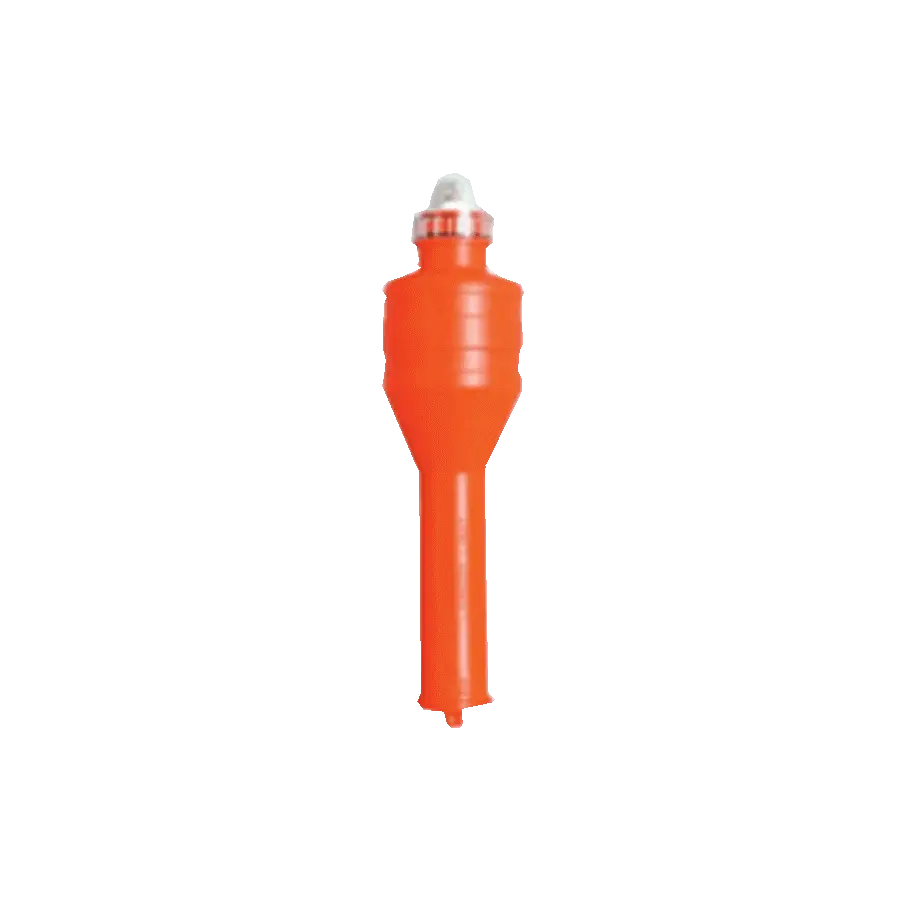
The light unit body is moulded in high-visibility international orange — the IMO-specified colour for life-saving appliances. The orange body colour provides visual identification of the deployed unit in daylight or in the sweep of a searchlight during night operations, complementing the white light output that marks the unit’s position in darkness. The elongated cylindrical form of the unit — visible in the product image — is designed for secure attachment to the lifebuoy ring and maintains the light source in an elevated position above the waterline when the buoy is deployed, maximising the operational effectiveness of the omnidirectional 2cd intensity specification.
Technical Specifications
Product Type: Self-Igniting Lifebuoy Light
Approval: SOLAS / MED (EU Marine Equipment Directive) — Wheel Mark
Luminous Intensity: Not less than 2cd in all directions of the upper hemisphere
Light Colour: White
Operational Duration: Minimum 2 hours (at white colour output)
Power Source: 4 x Alkaline Batteries, Size D (LR20)
Activation: Automatic — Water Activated
Body Colour: High-Visibility International Orange
Applicable Standard: IMO LSA Code Chapter 2 / SOLAS Chapter III
Application: SOLAS Lifebuoy Self-Igniting Light — Commercial Vessels, Offshore Installations, Port Facilities
Benefits
The most direct operational benefit of this lifebuoy light is regulatory confidence. The combination of SOLAS type approval and MED wheel mark means that when a Port State Control inspector boards the vessel and checks the lifebuoy equipment at the bridge wing, the light unit presents both of the approval marks that a PSC officer checks against the vessel’s life-saving appliance record. There is no uncertainty about whether the specific approval held by the light is recognised by the applicable flag state or port authority — SOLAS approval is globally recognised, and MED approval satisfies the EU-specific requirement that a SOLAS-only approval does not. One product, both requirements met.
For HSE officers and safety managers responsible for life-saving appliance maintenance records, the Size D alkaline battery specification provides a practically manageable maintenance interval. Battery expiry dates are tracked against the vessel’s planned maintenance system, replacement batteries are sourced from standard marine chandlery stock, and the replacement procedure is carried out by ship’s crew without specialist tools or service contractor attendance. The maintenance requirement is straightforward, well-understood, and supported by a global supply chain — which is not always the case for life-saving appliance components specified with proprietary power sources.
For procurement teams managing fleet-wide life-saving appliance standardisation, specifying a SOLAS/MED dual-approved lifebuoy light across all vessel types and flag states eliminates the need to maintain separate product specifications for EU-flagged and non-EU-flagged vessels. A single approved product covers all vessel types in the fleet — simplifying the procurement specification, the spares inventory, and the survey documentation trail across the fleet’s annual survey programme.
Who It’s For
Vessel Chief Officers — SOLAS Life-Saving Appliance Compliance
The chief officer responsible for life-saving appliance maintenance on a general cargo vessel or bulk carrier manages a checklist that includes lifebuoy light inspection at each weekly safety equipment inspection and battery replacement at the manufacturer’s specified interval. When the vessel is preparing for annual class survey or port state control inspection, the chief officer needs to confirm that every lifebuoy light carries a current approval mark recognised by the class society and any port state the vessel may enter. A SOLAS/MED dual-approved light presents a clean approval basis at any survey — no flag state qualification required, no additional documentation to source to demonstrate compliance in EU ports.
Marine Equipment Procurement Officers — EU-Flagged Fleet Supply
A procurement officer managing life-saving appliance supply for a fleet of EU-flagged vessels — container feeders, short-sea traders, or passenger ferries operating in European waters — is required to specify MED wheel-marked equipment for all life-saving appliances subject to the Marine Equipment Directive. Sourcing a lifebuoy light with SOLAS type approval but without MED wheel mark creates a compliance gap that will be identified at flag state survey and must be rectified before the vessel’s safety certificate is renewed. Specifying from a SOLAS/MED dual-approved product eliminates that gap at source — the procurement officer does not need to verify the MED status of the product after the order is placed, because the wheel mark on the unit confirms it.
Port Facility Safety Managers — Quayside Life-Saving Appliance Stations
A port facility safety manager responsible for life-saving appliance compliance at a commercial terminal or ferry berth is required under port safety regulations to maintain serviceable lifebuoy stations at all quayside positions where workers are at risk of falling into water. Lifebuoy lights at these positions must be maintained in serviceable condition with current batteries — a maintenance requirement that the safety manager includes in the facility’s periodic safety equipment inspection schedule. A SOLAS/MED approved lifebuoy light at quayside positions provides compliance with both maritime life-saving appliance standards and the workplace safety equipment standards referenced by port authority inspectors, supported by internationally recognised approval documentation.
Possible Applications
Commercial Vessel Bridge Wing MOB Station — SOLAS Mandatory Position
SOLAS Chapter III Regulation 7 requires that at least one lifebuoy on each side of the vessel be fitted with a self-igniting light. The bridge wing lifebuoy — the unit immediately accessible to the officer of the watch — is the primary man-overboard response device on every commercial vessel. The self-igniting light fitted to this unit is activated every time a lifebuoy is thrown in a man-overboard event, and it is the light that marks the casualty’s last known position while the vessel executes its return manoeuvre. SOLAS/MED dual approval at this position satisfies the survey requirement for both the international (SOLAS) and EU flag state (MED) compliance basis.
Bulk Carriers and General Cargo Vessels — Multiple Deck Lifebuoy Positions
Bulk carriers and general cargo vessels carry SOLAS-required lifebuoys at multiple deck positions in addition to the bridge wing stations — typically at forward deck positions and at the accommodation ladder area. Not all of these positions are required by SOLAS to be fitted with self-igniting lights, but operators commonly fit lights at all deck lifebuoy positions to provide consistent man-overboard response capability regardless of which deck position the responding crew member is closest to at the time of an incident. Standardising on a single SOLAS/MED approved light model across all positions simplifies the maintenance record and battery replacement programme.
Passenger Ferries and Ro-Ro Vessels — High Passenger Density MOB Response
Passenger ferries and Ro-Ro vessels carry significantly higher numbers of lifebuoys than cargo vessels, in proportion to their passenger complement and the higher risk of a passenger or crew member entering the water from a crowded vessel. Self-igniting lights are required at the SOLAS-mandated positions and are commonly fitted at additional positions for operational safety reasons. EU-flagged ferries — operating under EU passenger vessel safety regulations in addition to SOLAS — require MED wheel-marked life-saving appliances at all relevant positions, making the SOLAS/MED dual-approved light the only compliant specification for these vessels.
Offshore Support Vessels — Man-Overboard Response at Offshore Operations
OSVs operating in support of offshore oil and gas production carry life-saving appliances to SOLAS requirements applicable to their vessel type and flag state. During personnel transfer operations — where crew cross between the OSV and an offshore platform accommodation ladder or transfer basket — the risk of a person entering the water is elevated. Self-igniting lights at all deck lifebuoy positions ensure that a man-overboard response is initiated with a visible position marker regardless of time of day, with the 2-hour operational duration providing coverage through the full duration of a nighttime search and recovery operation.
Offshore Platform Perimeter Lifebuoy Stations
Fixed and floating offshore production platforms are required under their safety case and applicable flag state or coastal state regulations to carry SOLAS-equivalent life-saving appliances at deck perimeter positions. Lifebuoy self-igniting lights at these positions must meet the performance standard applicable to the platform’s regulatory framework — typically the IMO LSA Code standard as a minimum, with additional flag state or coastal state requirements applied on a case-by-case basis. SOLAS-approved lifebuoy lights provide the performance baseline that satisfies the LSA Code requirement, with battery management included in the platform’s safety equipment maintenance programme.
Port and Terminal Quayside Safety Equipment Stations
Port authority safety regulations in most jurisdictions require lifebuoy stations at specified intervals along working quaysides and cargo berths. Lifebuoy lights at these stations are maintained to ensure nighttime visibility of a deployed buoy during a fall-into-water incident at the berth. Battery management for quayside lifebuoy lights — including the Size D alkaline batteries used in this unit — is typically included in the port facility’s monthly safety equipment inspection programme, with replacement batteries sourced from standard industrial supply.
Training Vessels and Maritime Academies — Man-Overboard Drill Equipment
Maritime training vessels and academies conducting man-overboard drills require serviceable, type-approved lifebuoy light units for use in drill scenarios — particularly night drill exercises where the visible operation of the self-igniting light is part of the training outcome. SOLAS/MED approved lifebuoy lights used in the training context ensure that the equipment trainees and cadets handle in drills is identical in specification and operation to the equipment they will encounter on commercial vessels throughout their careers, reinforcing correct deployment and inspection procedures against the actual regulatory standard.
Trust & Certifications
SOLAS Chapter III — International Self-Igniting Light Requirement
SOLAS Chapter III Regulation 7 mandates self-igniting lights on designated lifebuoys carried on commercial vessels in international service. The IMO LSA Code Chapter 2 specifies the performance requirements that self-igniting lights must meet to qualify for carriage under SOLAS — including the 2cd minimum luminous intensity in the upper hemisphere, 2-hour minimum operational duration, water-activated operation, and white light output. SOLAS type approval, issued by a flag state administration or a recognised organisation acting on its behalf, confirms that the product has been independently tested and assessed to the LSA Code performance requirements. For procurement teams and safety officers, SOLAS type approval is the foundational compliance document for any lifebuoy self-igniting light specified for carriage on a commercial vessel.
EU Marine Equipment Directive (MED) — Wheel Mark Approval
The EU Marine Equipment Directive (2014/90/EU) requires that life-saving appliances placed on the market and fitted to EU-flagged vessels bear the MED wheel mark — a mark that confirms the product has undergone conformity assessment by an EU notified body against the applicable harmonised technical standards. The MED wheel mark is the EU-specific approval route for marine equipment, and it is distinct from and in addition to SOLAS type approval. A product bearing the MED wheel mark has been assessed not only to the IMO performance standard but also to the EU procedural requirements for placing marine equipment on the European market. For vessels flagged in EU member states, MED wheel-marked equipment is a mandatory requirement under EU maritime law — and the absence of the wheel mark on a life-saving appliance is a recordable non-conformity at EU flag state survey.
IMO LSA Code Chapter 2 — Performance Standard for Self-Igniting Lights
The IMO LSA Code (International Life-Saving Appliance Code), adopted under SOLAS, sets out the detailed technical performance requirements for all life-saving appliances carried on SOLAS vessels. Chapter 2 of the LSA Code covers personal life-saving appliances and includes the specific requirements for lifebuoy self-igniting lights — the 2cd minimum intensity, 2-hour minimum duration, water-activated operation, white light output, and physical construction requirements. Compliance with the LSA Code is verified through the type approval process; the approval certificate references the specific LSA Code provisions against which the product was assessed. For HSE officers and safety managers reviewing life-saving appliance compliance documentation, the LSA Code reference in the type approval certificate is the technical standard against which the product’s performance claims are independently verified.
Accessories & Variants
Size D (LR20) Alkaline Replacement Batteries — 4-Pack
The lifebuoy light operates on 4 x Size D (LR20) alkaline batteries. Replacement batteries should be sourced from a reputable brand — avoid discount or unbranded cells where battery capacity and shelf life cannot be independently verified. Batteries must be replaced at the manufacturer’s specified interval and before the marked expiry date, with replacement recorded in the vessel’s or facility’s life-saving appliance maintenance log. Stocking a supply of Size D replacement batteries onboard or at the facility ensures that battery replacement can be carried out without requiring a chandlery call.
SOLAS Rigid-Type Lifebuoy — Complete MOB Station Assembly
The self-igniting lifebuoy light is designed for use as part of a complete SOLAS man-overboard station assembly — lifebuoy, self-igniting light, and (at required positions) self-activating smoke signal. Specifying the lifebuoy and light from a single supplier ensures compatibility between the mounting bracket, lanyard attachment, and the lifebuoy ring dimensions, and simplifies the compliance documentation basis for the complete assembly at survey.
Self-Activating Smoke Signal — Daytime MOB Position Marking
SOLAS requires at least one lifebuoy per vessel to be fitted with both a self-igniting light and a self-activating smoke signal — the smoke signal providing orange smoke position marking in daylight conditions where the white LED light would not be conspicuous. The smoke signal is water-activated alongside the lifebuoy light at the designated dual-equipped position, and both devices operate simultaneously in a daytime man-overboard event. Specifying the smoke signal alongside the lifebuoy light completes the SOLAS dual-equipped requirement for the designated position on each vessel side.
Lifebuoy Mounting Bracket and Lanyard
Open-top lifebuoy mounting brackets for vessel rail and bulkhead mounting, and replacement lifebuoy lanyards for attachment of the self-igniting light to the lifebuoy ring, should be confirmed against the specific lifebuoy model and light unit dimensions when sourcing replacement hardware. Inspect bracket condition and lanyard integrity at each periodic lifebuoy inspection and replace corroded or degraded hardware before the next inspection interval.
Available Variants
SOLAS/MED Approved Lifebuoy Light — 2cd minimum / 2h minimum duration / Water Activated / White output / 4 x Size D alkaline batteries / High-visibility orange body / SOLAS Chapter III and EU MED wheel mark approved
For alternative lifebuoy light specifications — including intrinsically safe variants for hazardous area applications on tankers and chemical carriers, or extended-duration models for specific operational requirements — contact the supplier to confirm available models and applicable approval basis for your vessel type and flag state.
Get in Touch
If you are sourcing SOLAS/MED approved lifebuoy self-igniting lights for a commercial vessel fleet, offshore installation, or port facility — or if you need to confirm type approval documentation, MED wheel mark status, or battery replacement specifications for your specific vessel type or flag state requirement — contact us to discuss your requirement and request a formal procurement quotation.
Our team can assist with product selection against your life-saving appliance specification, confirm approval documentation for class survey and PSC inspection, and support your procurement and compliance requirements across your vessel fleet or facility.
📍 3791 Jalan Bukit Merah #06-01, E-Centre @ Redhill, Singapore 159471