Cart (
Overview
When a man-overboard incident occurs at night, the lifebuoy light is the only continuous visual marker that keeps a casualty locatable from the vessel’s bridge and from any search craft operating in the area. A light that fails to activate on water contact, drains its battery before rescue is complete, or — critically — triggers an ignition event in a gas-hazardous environment is not a safety device. It is a liability. The Lalizas Lifebuoy Light (Intrinsically Safe) is designed to remove all three of those failure modes from the equation.
The intrinsically safe rating means this light unit is approved for use in all potentially explosive atmospheres — the zones found on tanker decks, chemical carrier accommodation ladder areas, offshore platform perimeters, and LPG terminal quaysides where a conventional electrical device could present an ignition risk. Most lifebuoy lights on the market are not rated for use in these environments, which means vessels and facilities operating in gas-hazardous zones either carry non-compliant equipment or source a specialised unit. Lalizas resolves this with a single product that satisfies both SOLAS man-overboard light requirements and the intrinsic safety requirement for Zone 0, 1, and 2 explosive atmospheres — one specification that covers the full operational environment.
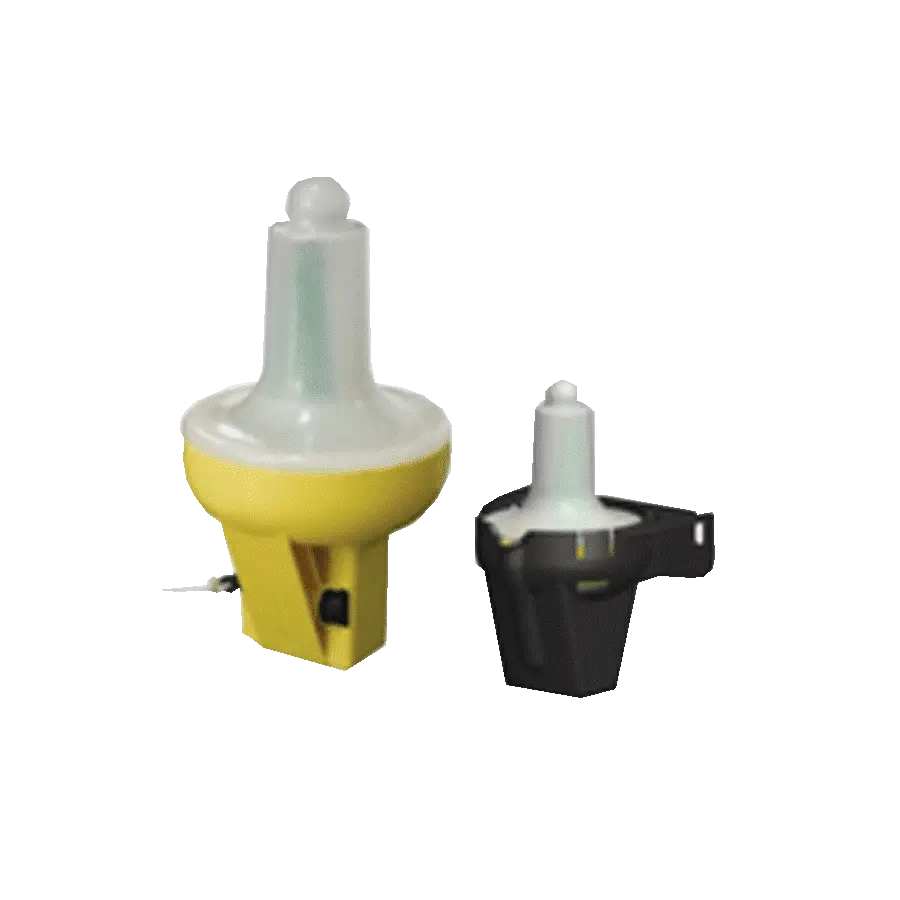
What genuinely sets this unit apart from comparable lifebuoy lights is the elimination of battery maintenance. The Lalizas intrinsically safe lifebuoy light requires no maintenance batteries and no replacement battery schedule — removing the single most common cause of lifebuoy light failure found during vessel audits and PSC inspections: an expired or discharged battery that was not replaced at the last service interval. The light is supplied complete with a mounting bracket and a 1-metre lifebuoy lanyard, ready for direct installation on the lifebuoy without additional procurement.
Key Features
Intrinsically Safe Design — Approved for Explosive Atmospheres
Intrinsic safety is an explosion protection concept in which the electrical energy within a device is limited to a level that cannot ignite a flammable gas or vapour mixture under normal or fault conditions. Unlike explosion-proof enclosures that contain an ignition event after it occurs, an intrinsically safe device is designed so that ignition cannot occur in the first place — which is the higher standard required for Zone 0 (continuous explosive atmosphere) and Zone 1 (periodic explosive atmosphere) classified locations. For a lifebuoy light mounted on the perimeter railing of a chemical tanker, an LPG carrier, or an offshore gas production platform, intrinsic safety approval is not a feature — it is the minimum acceptable specification. Without it, the light cannot legally or safely be deployed in those environments.
No Maintenance Batteries Required — Zero Battery Failure Risk
The Lalizas intrinsically safe lifebuoy light is designed to operate without periodic battery replacement — eliminating the battery maintenance interval that is the leading cause of lifebuoy light non-compliance found during vessel safety audits, class surveys, and Port State Control inspections. On vessels with large safety equipment inventories — bulk carriers, tankers, offshore support vessels — tracking battery replacement dates across every lifebuoy light, immersion suit light, and EPIRB is a significant administrative burden, and a single missed replacement can result in a deficiency notice. Removing the battery maintenance requirement from the lifebuoy light removes that risk entirely from the maintenance schedule.
Advanced LED Technology — Low Consumption, High Reliability
The light source is an advanced LED unit selected for low power consumption and long operational life. LED technology in a SOLAS lifebuoy light context means the light activates immediately on water contact without the warm-up period associated with older light technologies, maintains consistent light output throughout its operational period rather than dimming progressively as a conventional battery discharges, and draws sufficiently low current to operate within the intrinsically safe energy limits required for use in explosive atmospheres. For the officer of the watch or rescue crew searching for a casualty in the water, consistent light output that does not fade over the first minutes of a search is directly relevant to search effectiveness.
Water-Activated Automatic Operation — No Crew or Casualty Action Required
The light activates automatically on contact with water — no switch, no pull-cord, no action required by the crew member throwing the buoy or by the casualty in the water. In a real man-overboard event, the time between the alarm being raised and the lifebuoy being thrown is measured in seconds, and the condition of the casualty in the water — shock, injury, cold water immersion — may prevent any activation action. A water-activated device removes human activation from the deployment sequence entirely: the buoy hits the water, the light activates, and the position is marked. The SOLAS requirement for lifebuoy self-igniting lights specifically mandates water-activated operation for exactly this reason.
Compact Size — Minimal Impact on Lifebuoy Handling
The compact form factor of the Lalizas intrinsically safe lifebuoy light means the unit adds minimal bulk and weight to the lifebuoy assembly. A heavy or awkwardly shaped light attachment changes the throw characteristics of the lifebuoy — affecting deployment range and accuracy. The compact design maintains the lifebuoy’s handling characteristics as close to the unequipped unit as possible, which is relevant for crew members who practice man-overboard drills with the equipped lifebuoy and need the drill performance to translate accurately to a real incident. The compact size also allows the unit to fit within the storage envelope of standard open-top lifebuoy mounting brackets without modification.
Supplied with Bracket and 1-Metre Lifebuoy Lanyard — Ready for Installation
The unit is supplied as a complete assembly including mounting bracket and a 1-metre lifebuoy lanyard — the line that connects the light unit to the lifebuoy to prevent separation after deployment. SOLAS and the IMO LSA Code specify requirements for the method of attachment of self-igniting lights to lifebuoys, and the supplied lanyard and bracket are designed to meet those attachment requirements. For procurement teams and vessel crew fitting out a new vessel or replacing expired light units, a complete assembly supplied from a single source eliminates the compatibility uncertainty that arises when sourcing light, bracket, and lanyard from separate suppliers.
Technical Specifications
Brand / Model: Lalizas Lifebuoy Light — Intrinsically Safe
Light Source: Advanced LED
Battery Maintenance: None Required
Activation: Automatic — Water Activated
Explosion Protection: Intrinsically Safe
Approved Zones: All Potentially Explosive Atmospheres (Zone 0 / Zone 1 / Zone 2)
Form Factor: Compact
Supplied With: Mounting Bracket + 1m Lifebuoy Lanyard
Applicable Standard: SOLAS Chapter III / IMO LSA Code
Application: SOLAS Lifebuoy Self-Igniting Light — Tankers, Chemical Carriers, Offshore Platforms, LPG Terminals, Commercial Vessels
Benefits
The most immediate operational benefit of the intrinsically safe rating is compliance coverage. A vessel or facility that specifies the Lalizas intrinsically safe lifebuoy light can deploy those units across every deck position — including gas-hazardous zones on tanker and chemical carrier decks, on offshore platform perimeter railings adjacent to process areas, and at LPG terminal quayside positions — with a single product specification. There is no requirement to maintain separate inventories of standard and intrinsically safe units for different deck areas, no risk of a standard unit being inadvertently installed in a hazardous zone, and no compliance gap to manage.
The elimination of battery maintenance has a compounding benefit that goes beyond the convenience of a shorter maintenance checklist. In safety management system audits and class surveys, a lifebuoy light with an expired or discharged battery is a recordable deficiency — one that reflects on the vessel’s overall safety management standard and can trigger wider scrutiny. Removing the battery replacement interval from the maintenance schedule eliminates that deficiency risk at source, reducing the administrative burden on the ship’s officer responsible for life-saving appliance maintenance records and improving the vessel’s audit performance over time.
For procurement teams managing a fleet of vessels or a portfolio of offshore assets, standardising on a maintenance-free, intrinsically safe lifebuoy light across the entire fleet reduces the total cost of life-saving appliance maintenance — fewer service parts to stock, fewer maintenance man-hours to allocate, and fewer opportunities for a missed service interval to produce a compliance deficiency. The compact size and complete supplied assembly also reduce fitting time during vessel dry docking or facility safety equipment replacement programmes.
Who It’s For
Tanker and Chemical Carrier Safety Officers — Gas-Hazardous Deck Operations
The chief officer on a product tanker knows that every piece of electrical equipment on the cargo deck must be assessed against the hazardous area classification of the deck zones. A lifebuoy light mounted on the bridge wing forward railing is in or adjacent to a Zone 2 classified area; a lifebuoy mounted at the accommodation ladder position on a tanker carrying volatile cargoes may be in Zone 1. Specifying a standard, non-intrinsically-safe lifebuoy light in these positions creates a compliance gap with ATEX and IECEx zone requirements. The Lalizas intrinsically safe unit removes that gap — it can be mounted anywhere on the vessel, including in the most stringently classified deck zones, without a hazardous area equipment assessment being required for the specific position.
Offshore Platform Safety Coordinators — Perimeter and Process Deck LSA
An offshore installation safety coordinator reviewing life-saving appliance positions on a production platform faces a specific challenge: many of the deck perimeter positions where SOLAS-equivalent life-saving appliances are required are adjacent to process equipment, wellheads, or gas compression modules that are classified as Zone 1 or Zone 2 hazardous areas. Fitting a conventional lifebuoy light at those positions requires either an explosion-proof enclosure assessment or, more practically, an intrinsically safe unit. The Lalizas unit resolves the specification problem without requiring individual position-by-position hazardous area equipment assessments — a significant saving in engineering time during the LSA compliance review process.
Fleet Procurement Managers — Lifecycle Cost and Compliance Standardisation
A procurement manager responsible for life-saving appliance supply across a fleet of ten chemical tankers and six offshore support vessels is managing a significant inventory of lifebuoy lights across multiple vessel types with varying deck zone classifications. Standardising on a single intrinsically safe, maintenance-free lifebuoy light model across the entire fleet — rather than maintaining separate product lines for hazardous-zone and non-hazardous-zone positions — simplifies the procurement specification, reduces the number of SKUs in the safety spares inventory, and eliminates the risk of the wrong product being installed at the wrong deck position during a vessel replenishment in a remote port.
Possible Applications
Chemical Tanker Cargo Deck Lifebuoy Positions — Zone 1 / Zone 2 Areas
Chemical tankers carrying flammable or volatile liquid cargoes operate with hazardous area classifications across significant portions of the cargo deck and accommodation ladder areas. Lifebuoys mounted at these positions must be fitted with self-igniting lights that are approved for the applicable zone classification. The Lalizas intrinsically safe light meets the zone requirements for all cargo deck lifebuoy positions on chemical tankers and product tankers, eliminating the need for position-by-position hazardous area electrical equipment assessments.
LPG and LNG Carrier Deck Positions
LPG and LNG carriers operate in some of the most stringently classified hazardous area environments in commercial shipping — the cargo containment and manifold areas of these vessels are Zone 0 classified in operation. Lifebuoy self-igniting lights fitted on these vessels must meet the highest standard of intrinsic safety approval to be compliant with the vessel’s hazardous area equipment register. The Lalizas intrinsically safe rating covers Zone 0 environments — the most demanding classification — ensuring compliance across all deck positions regardless of proximity to the cargo area.
Offshore Oil and Gas Platform Perimeter Railings
Fixed and floating offshore production platforms are required to carry SOLAS-equivalent life-saving appliances at all deck perimeter positions, with lifebuoy self-igniting lights mandatory at man-overboard response positions. On production platforms where deck perimeter positions are classified as Zone 2 or Zone 1 due to proximity to process equipment, the Lalizas intrinsically safe light is the correct specification for all lifebuoy light positions — and its maintenance-free design reduces the workload for offshore safety technicians who must maintain life-saving appliances in a remote environment with limited access to replacement parts.
FPSO Vessels — Floating Production, Storage, and Offloading Units
FPSOs combine the deck hazardous area environment of an offshore production platform with the vessel regulatory framework of a ship — and their life-saving appliance requirements reflect both. Lifebuoy lights on FPSO deck positions adjacent to process equipment, offloading manifolds, and storage tank vent areas are subject to hazardous area equipment requirements in addition to SOLAS life-saving appliance requirements. The Lalizas intrinsically safe unit satisfies both regulatory frameworks simultaneously, simplifying the equipment approval process for FPSO operators working through classification society survey requirements.
Oil Terminal and Fuel Jetty Quayside Positions
Shore-based oil terminals, fuel jetties, and petrochemical loading berths are required under national port safety and workplace health and safety regulations to provide life-saving appliances at all quayside positions where workers are at risk of falling into water. Quayside positions at fuel transfer manifolds and tanker berth access points are classified as hazardous areas under ATEX/IECEx zone classifications for shore installations. Lifebuoy lights at these positions require intrinsic safety approval — and the Lalizas unit, with its complete bracket and lanyard supply, is directly installable at these positions without additional engineering assessment.
Commercial Vessel General SOLAS MOB Station — Bridge Wings and Deck Rails
Even on vessels without specific hazardous area classifications — general cargo vessels, bulk carriers, container ships, and passenger ferries — the Lalizas intrinsically safe lifebuoy light provides the maintenance-free operational benefit applicable to any commercial vessel. SOLAS requires at least one lifebuoy on each side of the vessel to be fitted with a self-igniting light; specifying a maintenance-free unit eliminates the battery replacement maintenance interval from the vessel’s planned maintenance system for those positions and removes a recurrent source of PSC deficiency notices.
Offshore Support Vessels and Anchor Handling Vessels
OSVs and AHVs operating in support of offshore oil and gas production regularly transit between standard commercial vessel operations and operations adjacent to offshore facilities with classified hazardous areas. A lifebuoy light specification that is compliant for both standard vessel operations and hazardous-area-adjacent offshore operations allows the vessel to maintain a single life-saving appliance standard across its entire operating profile, rather than requiring equipment changes or position-specific assessments when the vessel moves between operating modes.
Trust & Certifications
Intrinsically Safe (IS) Certification — ATEX / IECEx
Intrinsic safety certification under the ATEX Directive (EU) and the IECEx scheme (international) confirms that the device has been independently assessed and tested to confirm that its electrical energy levels cannot produce a spark or thermal effect capable of igniting a flammable gas or vapour mixture under normal or fault conditions. ATEX certification is mandatory for electrical equipment used in potentially explosive atmospheres within the European Union; IECEx certification is the equivalent internationally recognised scheme. For a lifebuoy light deployed in classified hazardous areas on tankers, chemical carriers, offshore platforms, and shore terminals, ATEX/IECEx certification is the foundational compliance requirement — and the certificate number provides the auditable documentation required by hazardous area equipment registers maintained under IEC 60079 and DSEAR/ATEX workplace regulations.
SOLAS Chapter III — Self-Igniting Light Requirement
SOLAS Chapter III Regulation 7 requires that at least one lifebuoy on each side of a commercial vessel be fitted with a self-igniting light — a water-activated light that operates for a minimum of 2 hours at a minimum luminous intensity. The IMO LSA Code Chapter 2 specifies the detailed technical requirements for self-igniting lights including luminous intensity, operational duration, activation method, and attachment requirements. Type approval against these requirements confirms that the Lalizas unit meets the SOLAS self-igniting light standard, providing the regulatory compliance basis for its specification on vessels subject to SOLAS survey.
IMO LSA Code — Type Approval
IMO LSA Code type approval for a lifebuoy self-igniting light is granted by flag state administrations or recognised organisations (classification societies acting as flag state authorised organisations) following independent testing of the light to the performance requirements of the LSA Code. Type approval provides procurement teams and vessel operators with third-party verified evidence that the product performs to the standard required for SOLAS carriage — a more robust compliance basis than relying on manufacturer declarations alone. The type approval certificate and its approval number are the documentation that class surveyors and PSC inspectors examine when verifying that carried lifebuoy lights are compliant.
Lalizas — Global Marine Safety Equipment Manufacturer
Lalizas is a Greek marine safety equipment manufacturer with over 35 years of experience supplying SOLAS-compliant life-saving appliances to the commercial shipping, offshore, and recreational marine markets worldwide. The Lalizas product range covers lifebuoys, life jackets, immersion suits, buoyancy aids, pyrotechnics, and associated safety equipment — making it one of the more complete single-source suppliers for vessel life-saving appliance requirements. The brand is recognised in the marine safety equipment supply chain globally, with distribution networks that support vessel procurement in major bunkering and supply ports. For procurement teams specifying life-saving appliances for a mixed fleet, Lalizas brand recognition provides a degree of supply chain confidence that is relevant to procurement decision-making.
Accessories & Variants
SOLAS Rigid-Type Lifebuoy — Complete MOB Station Assembly
The Lalizas intrinsically safe lifebuoy light is designed for attachment to a SOLAS-compliant rigid-type lifebuoy. Specifying the light and the lifebuoy from a single supplier — both Lalizas products — ensures compatibility between the mounting bracket dimensions, the lanyard attachment points on the lifebuoy ring, and the regulatory compliance basis of the complete assembly. A complete MOB station assembled from matched components simplifies survey documentation and eliminates the compatibility uncertainty that can arise when sourcing light and buoy from different manufacturers.
Self-Activating Smoke Signal — Daytime Position Marking
SOLAS requires at least one lifebuoy per vessel to be fitted with both a self-igniting light and a self-activating smoke signal. The smoke signal provides a visible orange smoke marker in daylight conditions when the LED light would not be conspicuous, and marks the last known casualty position during the vessel’s initial search. Specifying the smoke signal alongside the Lalizas lifebuoy light completes the SOLAS dual-equipped lifebuoy requirement for the mandated position on each vessel side.
Lifebuoy Mounting Bracket — Open-Top Rail and Wall Mount
Although a bracket is supplied with the Lalizas lifebuoy light unit, additional or replacement open-top mounting brackets for the lifebuoy itself — separate from the light bracket — may be required for new installations or for replacement of corroded deck hardware. Confirm bracket sizing against the specific lifebuoy model (4, 8, or 12-person) to ensure the lifebuoy is retained securely in the bracket and is immediately removable for deployment.
Retro-Reflective Tape — LSA Code Complement
The IMO LSA Code requires retro-reflective tape on lifebuoys in specified positions to enhance visibility in searchlight or torch illumination during night rescues. Retro-reflective tape is typically factory-applied on type-approved lifebuoys and should be inspected and replaced when condition deteriorates. Ensure retro-reflective tape condition is included in the periodic lifebuoy inspection record alongside the lifebuoy light inspection.
Available Variants
Lalizas Lifebuoy Light — Intrinsically Safe | Water-Activated LED | No Battery Maintenance | Supplied with Bracket and 1m Lanyard | Approved for All Explosive Atmospheres | SOLAS Self-Igniting Light Application
For alternative Lalizas lifebuoy light models — including standard (non-intrinsically-safe) versions for non-hazardous-zone applications — contact the supplier to confirm model availability, type approval basis, and applicable regulatory compliance scope. Where intrinsic safety is not required, a standard LED lifebuoy light may offer a cost-optimised alternative for positions in non-classified areas.
Get in Touch
If you are sourcing intrinsically safe lifebuoy lights for a tanker fleet, chemical carrier, offshore platform, LPG terminal, or any commercial vessel or facility with classified hazardous area deck positions — or if you need to confirm type approval documentation, ATEX certification scope, or SOLAS compliance basis for a specific survey requirement — contact us to discuss your requirement and request a formal procurement quotation.
Our team can assist with product selection against your hazardous area classification, confirm type approval and certification documentation, and support your LSA procurement and survey compliance requirements.
📍 3791 Jalan Bukit Merah #06-01, E-Centre @ Redhill, Singapore 159471