Cart (

Overview
Traditional oil mist detection systems monitor crankcase atmosphere from a single sampling point — meaning that a localised mist event developing around a specific cylinder or bearing can build to a dangerous concentration level before it reaches the detection threshold at a remote sampling location. For low-speed, medium-speed, and high-speed diesel engines where early-stage failure prediction at the individual cylinder level is the goal, single-point detection architecture is a fundamental limitation.
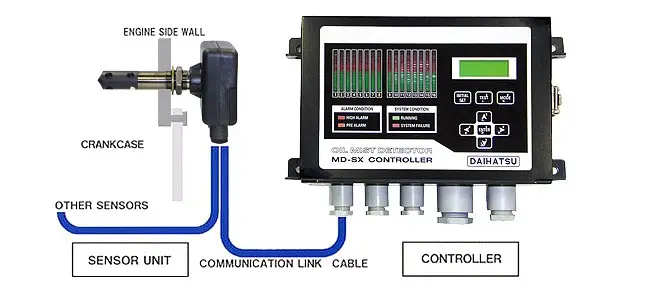
The Daihatsu MD-SX Oil Mist Detector was developed in direct response to requirements from engine builders who needed a crankcase oil mist monitoring system capable of detecting serious failures earlier and more accurately than conventional single-point systems could achieve. The MD-SX is a multi-sensor, per-cylinder detection system: individual sensor units are inserted directly through the sidewall of the crankcase at each cylinder position, so oil mist concentration is measured locally at the source — not at a remote sampling point downstream of where the mist is actually generated.
The system is controlled by the Daihatsu MD-SX Controller, which receives mist concentration data from all connected sensor units via a communication link cable and provides integrated monitoring, alarm management, and mist level display for the full engine installation. What differentiates the MD-SX from conventional oil mist detectors in the same category is this per-cylinder sensing architecture: by placing a dedicated sensor unit at each cylinder, the MD-SX can identify not just that oil mist is present in the crankcase, but specifically which cylinder or bearing is the source of the mist — giving engine room staff the information they need to take targeted corrective action rather than shutting down the entire engine in response to a system-wide alarm.
Key Features
Per-Cylinder Sensor Units Inserted Directly Through Crankcase Sidewall
Each MD-SX sensor unit is designed to be inserted directly through the engine side wall of the crankcase and fitted to an individual cylinder position. This installation method places the optical detection element at the precise location where oil mist is generated — inside the crankcase at cylinder level — rather than drawing samples from a remote location. The practical consequence is that a mist event that originates at a specific cylinder generates a local concentration elevation that is detected immediately by the sensor unit at that position, without waiting for the mist to migrate through the full crankcase volume to reach a centralised sampling point. For slow-speed two-stroke main engines with large crankcase volumes, this difference in detection speed and localisation precision is significant.
Multi-Point Detection — Up to 16 Sensor Units Per Engine
A single MD-SX controller supports up to 16 sensor units per engine, with configurations supporting up to 8 units per engine across two engines simultaneously. For large-bore diesel engines with multiple cylinders, this means every cylinder position can carry its own dedicated sensor unit — providing complete per-cylinder crankcase oil mist monitoring coverage across the full engine. For twin-engine installations, a single MD-SX controller manages both engines in an integrated monitoring configuration, reducing the controller hardware required for comprehensive dual-engine crankcase protection.
Natural Diffusion Sampling with Optical Dispersion Detection
The MD-SX sensor unit uses a natural diffusion sampling method — crankcase atmosphere enters the detection element by diffusion rather than forced suction — combined with an optical dispersion system that measures the scattering of a light beam by oil mist particles in the sampled atmosphere. The optical method provides a quantified mist concentration reading across a range of 0 to 2.0 mg/l, enabling the MD-SX controller to display actual concentration values and trend data for each sensor unit individually, rather than generating only a binary alarm output. Natural diffusion sampling means the sensor unit has no moving parts in the sampling path, reducing the maintenance requirements that suction-type sampling systems typically require over time.
Sub-Second Response Time
Each MD-SX sensor unit achieves a response time of one second or less from the point at which oil mist concentration reaches the detection threshold to the point at which the output signal is generated. Combined with the per-cylinder sensing architecture, the sub-second response time means that a rapidly developing mist event at any individual cylinder is detected and alarmed within one second of onset — giving the MD-SX system a detection speed advantage over systems that rely on crankcase atmosphere migration to reach a remote sampling point before detection can occur.
Communication Link Architecture — Controller-Managed Integrated Monitoring
The MD-SX sensor units connect to the MD-SX controller via a communication link cable rather than individual analogue signal wiring. This communication architecture simplifies the installation wiring for multi-sensor configurations compared to systems that require a separate signal cable per sensor unit, and allows the controller to manage data acquisition, alarm processing, and mist level display for all connected sensor units through a single communication link. For engine room installations where cable routing space is constrained — particularly on older vessels retrofitting modern oil mist monitoring — the communication link architecture reduces installation complexity and the amount of new cable infrastructure required.
Integrated Controller with Bar-Graph Mist Level Display and LCD
The MD-SX controller provides a 3-colour LED bar-graph mist level display and LCD panel that shows integrated mist level indication and alarm monitoring for all connected sensor units. Four-colour LED status indicators (Run, Pre-Alarm, High Alarm, Failure) provide at-a-glance system status, and a key switch on the controller panel provides secure operation control. The 5-point contact alarm output (2 × Pre-Alarm, 2 × High Alarm, 1 × Failure) allows integration with engine room alarm management systems, automatic engine protection circuits, and bridge alarm panels as required by classification society rules and vessel-specific safety system architecture.
IP55 Ingress Protection on Sensor Units and Controller
Both the MD-SX sensor units and the controller carry an IP55 ingress protection rating, confirming resistance to dust ingress and protection against low-pressure water jets from any direction. For sensor units installed directly into crankcase sidewalls — an environment that combines combustion-related oil vapour, heat cycling, mechanical vibration, and exposure to crankcase cleaning operations — IP55 protection is the practical minimum for reliable long-term sensing performance without accelerated ingress-related degradation.
Technical Specifications
Model: MD-SX Oil Mist Detector
Manufacturer: Daihatsu Diesel Mfg. Co. Ltd., Osaka, Japan
Compatible Engine Types: Low-speed, medium-speed, and high-speed diesel engines
Detection System: Optical dispersion system
Sampling Method: Natural diffusion, continuous
Response Time: ≦ 1 second
Detection Range: 0 – 2.0 mg/l oil mist concentration
Detection Points: 1 point / 1 unit; up to 16 units per engine (8 units × 2 engines)
Sensor Installation: Direct insertion through engine crankcase sidewall, per cylinder
Controller Display: 3-colour LED bar-graph (mist level); LCD; 4-colour LEDs — Run, Pre-Alarm, High Alarm, Failure
Contact Output: 5 points — 2 × Pre-Alarm, 2 × High Alarm, 1 × Failure (AC 125V / 0.4A or DC 24V / 2A)
Power Supply: DC 24V (+30% / -25%), supplied from controller
Power Consumption: Sensor unit: 60 mA max. per unit; Controller: 1.5A max. (internal 0.5A)
IP Rating: IP55 (sensor units and controller)
Weight: Sensor unit: approx. 500 g (including accessories); Controller: approx. 4.0 kg
Paint Colour: Munsell N1.0 (Black)
Benefits
Earlier fault detection — predict failures before they escalate. The MD-SX’s per-cylinder sensing architecture detects localised mist events at the cylinder where they originate, before mist has migrated through the full crankcase volume. This means the system generates a pre-alarm output at a lower actual risk level than a single-point system detecting the same event from a remote location — giving the engine room crew more time to reduce load and investigate before the high-alarm threshold is reached. For ships where unplanned engine shutdown carries significant commercial consequence, earlier detection directly translates into more intervention options and a lower probability of a shutdown event escalating to mechanical damage.
Cylinder-specific fault identification — targeted response, not blind shutdown. When the MD-SX triggers a pre-alarm, the controller can identify which sensor unit — and therefore which cylinder position — is reporting elevated mist concentration. An engineer who knows that cylinder 4 is generating elevated mist can investigate that specific bearing or piston assembly rather than shutting down the entire engine in response to an unlocated alarm. This targeted diagnostic capability is not available from single-point oil mist detection systems, and it directly affects the quality of the maintenance decision that follows an alarm event.
Supports SOLAS and class requirements for crankcase explosion protection on modern engines. Classification society rules require crankcase oil mist monitoring on diesel engines above a specified bore size, and newer rules from several class societies increasingly specify per-cylinder or multi-point monitoring for large-bore engines. The MD-SX’s per-cylinder architecture positions it well for compliance with current and emerging class requirements for crankcase explosion protection on low-speed and medium-speed main engines.
Communication link wiring simplifies retrofit installation. The MD-SX communication link architecture means that multi-sensor installations do not require individual signal cables from each sensor unit back to the controller — a significant practical advantage on vessels retrofitting modern oil mist monitoring to existing engine room cable infrastructure. For ship managers overseeing safety system upgrades during drydock, reduced new cable installation scope means reduced installation time and cost.
Developed directly from engine builder requirements — not a generic detection solution. The MD-SX was developed in direct response to requirements from diesel engine manufacturers who needed a detection system capable of meeting the performance demands of modern low-speed and medium-speed engine designs. This engine-builder-origin development means the MD-SX’s detection architecture, sensor installation method, and alarm output configuration are matched to the actual operating conditions and crankcase geometries of the engines it is designed to protect.
Who It’s For
The Marine Superintendent Specifying Safety Systems for a Newbuild Programme
You’re specifying crankcase explosion protection systems for a series of bulk carriers or tankers being built at a yard, each fitted with a large-bore low-speed two-stroke main engine. The engine builder has recommended or specified per-cylinder oil mist monitoring as part of the engine’s safety system package, and your classification society’s rules for the vessel type require multi-point crankcase monitoring. You need a detection system that meets the engine builder’s installation specification, satisfies class requirements, and is supported by a supplier who can coordinate delivery within the newbuild schedule and provide commissioning support at the yard.
The Chief Engineer on a Modern Diesel-Engine Vessel
You’ve experienced false alarms or missed pre-alarm events with conventional single-point oil mist detection on a previous vessel, and you understand that a system that can’t tell you which cylinder is generating mist is only marginally more useful than no detection at all in terms of the maintenance decision it enables. You want a detection system that gives you actionable cylinder-specific information when an alarm activates — so you can investigate and respond to the specific fault, not just shut down the engine and hope the cause reveals itself during inspection.
The Technical Superintendent Overseeing Fleet Safety System Upgrades
You’re managing a programme of crankcase protection system upgrades across a fleet of vessels with older single-point oil mist detectors that no longer meet current class requirements or the fleet’s own safety management system standards. You need a replacement system that delivers genuine detection performance improvements over the equipment being replaced, can be retrofitted within the available drydock window using the existing engine room cable infrastructure, and is backed by a supplier who can support fleet-wide procurement and installation coordination.
Possible Applications
- Low-speed two-stroke main engine crankcase monitoring on bulk carriers and tankers — Per-cylinder oil mist detection on large-bore slow-speed main engines where crankcase volume makes single-point detection inadequate for early fault identification
- Medium-speed diesel engine monitoring on RoPax and passenger vessels — Multi-point crankcase protection on medium-speed engines in vessels where passenger safety requirements demand the highest standard of engine protection system performance
- High-speed diesel generator sets on offshore vessels and platforms — Per-cylinder mist monitoring on high-speed generator engines in offshore environments where unplanned generator shutdown has significant operational and safety consequences
- Newbuild engine installations with engine-builder-specified monitoring systems — Compliance with engine builder recommendations for per-cylinder crankcase monitoring on modern low-speed and medium-speed diesel main engine designs
- Safety system retrofit during drydock on vessels with older single-point detectors — Upgrade from conventional single-point oil mist detection to per-cylinder MD-SX monitoring during scheduled drydocking to meet updated class requirements or fleet safety management system standards
- Twin-engine vessel installations requiring integrated dual-engine monitoring — Single MD-SX controller managing per-cylinder monitoring across two engines simultaneously in ferry, RoPax, or twin-shaft cargo vessel installations
- Vessels operating under class rules requiring multi-point crankcase monitoring — Compliance installations for vessels subject to classification society rules specifying per-cylinder or multi-point crankcase oil mist monitoring for engines above specified bore sizes
Trust and Certifications
Developed by Daihatsu Diesel in Response to Engine Builder Requirements
The MD-SX was developed by Daihatsu Diesel Mfg. Co. Ltd. of Osaka, Japan — an established manufacturer of marine and industrial diesel engines and associated safety systems — directly in response to requirements from engine builders who needed a more capable crankcase oil mist monitoring solution than conventional single-point systems could provide. The MD-SX’s per-cylinder sensing architecture and communication link design represent Daihatsu’s engineering response to the specific detection performance requirements of modern diesel engine protection, not an adaptation of a generic industrial gas detection platform.
IP55 Ingress Protection
Both the MD-SX sensor units and the controller carry an IP55 ingress protection rating, providing independently verified dust resistance and protection against low-pressure water jets. IP55 is the appropriate environmental protection standard for electronic safety components installed in marine engine rooms, and its verification provides class surveyors and procurement teams with documented confirmation of the system’s suitability for the operating environment.
Classification Society Acceptance for Crankcase Explosion Protection
The MD-SX oil mist detection system carries classification society acceptance for use as a crankcase explosion protection system on diesel engines subject to SOLAS and class requirements for crankcase monitoring. For vessels under class survey, the MD-SX’s accepted status means installation and survey documentation is supported by an established technical approval record, reducing the risk of survey complications associated with newer or less widely accepted detection technologies.
Daihatsu Factory Support — Sales, Testing, and After-Sales Service
Daihatsu provides complete factory support for the MD-SX system, including function testing of complete systems and individual sensor units, repair and overhaul services, and genuine spare parts supply. For vessels requiring MD-SX maintenance support over the long term, Daihatsu’s established service infrastructure provides a clear and reliable path for function testing documentation, component replacement, and technical support — important considerations for safety-critical systems where maintenance records are subject to class survey scrutiny.
Accessories and Variants
MD-SX Sensor Units (Individual Replacement)
Individual MD-SX sensor units are available as replacement components for existing MD-SX installations where a specific per-cylinder sensor unit requires replacement. Each sensor unit weighs approximately 500g including accessories and connects to the MD-SX controller via the communication link cable — replacement does not require controller reconfiguration or system-wide recalibration. Contact our team with your engine cylinder count and installation configuration to confirm the correct sensor unit quantity and specification for your installation.
MD-SX Controller Unit
The MD-SX controller — the central unit that manages communication with all connected sensor units, provides integrated mist level display and alarm outputs, and interfaces with the vessel’s engine alarm and safety systems — is available separately for installations where controller replacement is required while the sensor units remain serviceable. The controller supports up to 16 sensor units per engine (8 units × 2 engines) and provides 5-point contact alarm output for integration with engine room alarm management and automatic protection systems.
Communication Link Cable and Installation Accessories
Communication link cables, crankcase sidewall installation fittings, and mounting accessories for MD-SX sensor unit installation are available through our team. Contact us with your engine type and crankcase wall thickness details to confirm the correct installation hardware specification for your specific engine model.
Related Daihatsu Oil Mist Detection Products
Daihatsu MD-9M Oil Mist Detector — Complete single-controller, multi-sensor oil mist detection system for installations where per-cylinder sidewall insertion is not specified
Daihatsu MD-9M Detector Head — Individual replacement sensor unit for existing MD-9M installations requiring single-point sensor replacement
MD-SX Spare Sensor Units — Genuine replacement sensor units for existing MD-SX per-cylinder installations
MD-SX Internal PCB and optical components — Controller and sensor unit board-level spare parts available through Daihatsu factory service
Get in Touch
If you are specifying the Daihatsu MD-SX Oil Mist Detector for a newbuild engine installation, a safety system upgrade programme, or a drydock retrofit — or if you need to source MD-SX spare sensor units or replacement components for an existing installation — contact our team to discuss your engine configuration and request a formal quotation.
Our team can advise on sensor unit quantities, controller configuration, and installation requirements for specific engine types and crankcase layouts. We maintain stock of genuine Daihatsu MD-SX components and can support both individual vessel projects and fleet-level procurement programmes.
📍 3791 Jalan Bukit Merah #06-01, E-Centre @ Redhill, Singapore 159471