Cart (

Overview
Knowing the angle of heel or trim of a vessel at any given moment is not a minor operational detail — it is information that bears directly on stability, cargo safety, passenger comfort, and in extreme situations, the safety of the vessel itself. A vessel operating at an unexpected angle of list may be carrying an undetected stability problem; a bulk carrier or tanker with developing trim change during loading may be approaching a condition that requires immediate corrective action. Without a reliable, permanently mounted clinometer in a visible position on the bridge or in the wheelhouse, the officer on watch is working without a key piece of situational awareness that the instrument would otherwise provide continuously and at a glance.
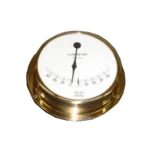
The Hanseatic Clinometer (Model 155/0911) is a precision-made, passively operated mechanical clinometer designed for permanent bridge and wheelhouse installation on commercial vessels, yachts, and workboats. The instrument requires no power source, no calibration schedule, and no electronic components — it reads the vessel’s angle of heel and trim directly and continuously through a pendulum or fluid damping mechanism, displayed on a clear 118 mm diameter dial in a polished brass case of 155 mm outside diameter. Manufactured in Germany to the quality standard expected of professional marine navigation instruments, the Hanseatic 155/0911 is a direct, dependable source of vessel inclination data in a format that has been trusted on commercial vessel bridges for generations.
What sets the Hanseatic clinometer apart from lower-cost alternatives is the combination of German manufacture — with the precision tolerances and material quality that implies — and the polished brass case construction, which provides corrosion resistance and structural durability appropriate for a permanently mounted bridge instrument with a service life measured in decades rather than years.
Key Features
Polished Brass Case — Corrosion-Resistant, Long-Service Construction
The Hanseatic 155/0911 clinometer is housed in a polished brass case with a 155 mm outside diameter. Brass is the traditional material for professional marine instruments because of its inherent resistance to saltwater corrosion, its dimensional stability across the temperature range of marine environments, and its ability to take and retain a polished finish that maintains its appearance over an extended service life without the surface deterioration that affects painted or coated steel alternatives. For a bridge instrument that will be permanently mounted and visible on the wheelhouse bulkhead for the operational life of the vessel, the polished brass case is both a functional and an aesthetic specification choice consistent with the standard of professional marine navigation instruments.
118 mm Dial — Clear, At-a-Glance Reading
The 118 mm diameter dial provides a clear, legible angle scale that can be read at normal bridge working distances without leaning in or using a magnifier. The dial layout — with a central zero position and graduated scale reading to both port and starboard — allows the watch officer to determine the vessel’s current angle of heel and the direction of list immediately, without interpretation. In a busy bridge environment during cargo operations, heavy weather, or a developing stability situation, an instrument that delivers its reading clearly and without ambiguity is an instrument that gets used — and that contributes to the officer’s situational awareness rather than being ignored because it requires effort to read.
Passive Mechanical Operation — No Power, No Maintenance Schedule
The Hanseatic clinometer operates entirely on mechanical principles — a pendulum or damped fluid mechanism responds to the vessel’s inclination and positions the needle against the dial scale without any electrical power supply, battery, or electronic component. This means the instrument reads correctly from the moment it is installed, continues reading through any power interruption or blackout, requires no periodic calibration against an electronic reference, and has no battery replacement or software update requirement. For a bridge instrument intended to provide continuous, reliable inclination data over the full operating life of the vessel, the absence of any power or maintenance dependency is a genuine long-term advantage over electronic alternatives.
155 mm Case Diameter — Standard Bridge Instrument Format
The 155 mm outside diameter of the Hanseatic clinometer case is consistent with the standard format used for bridge bulkhead instruments — barometers, thermometers, hygrometers, and clocks — in the Hanseatic range and in the professional marine instrument category generally. This standardisation allows the clinometer to be installed as part of a coordinated set of bridge instruments, with matching case dimensions and finish creating a consistent, professional appearance on the wheelhouse bulkhead. For vessels being outfitted or refitted with a complete set of bridge navigation instruments, consistent case sizing simplifies mounting and arrangement planning.
German Manufacture — Precision Quality Standard
The Hanseatic 155/0911 is manufactured in Germany, where the Hanseatic brand has produced professional marine instruments to the precision standards expected by the commercial maritime market. German manufacture in this product category is associated with tight dimensional tolerances, consistent material quality, and the quality assurance processes appropriate for instruments carried on commercial vessels subject to classification society survey and port state control inspection. For procurement officers and vessel masters specifying bridge instruments, country of manufacture is a relevant quality indicator — and German-made marine instruments have a recognised standing in the professional maritime market.
Technical Specifications
Model: Hanseatic 155/0911
Type: Marine Clinometer (Inclinometer)
Case Material: Polished Brass
Case Diameter: 155 mm
Dial Diameter: 118 mm
Operation: Passive mechanical — no power required
Country of Origin: Germany
Mounting: Bulkhead / panel mount
Category: Navigation Equipment / Bridge Instruments
Benefits
The primary operational benefit of a permanently installed clinometer is continuous, passive situational awareness of the vessel’s angle of heel — information that requires no action from the watch officer to obtain and is always current. A developing list that might otherwise go unnoticed during a busy cargo operation or heavy-weather passage is immediately visible on the dial; a trim change during ballasting or fuel transfer is readable at a glance without consulting the ship’s stability computer or asking the chief officer for a manual check. Early awareness of a developing heel or trim condition gives the officer on watch the time to investigate and respond before the situation develops further.
From a maintenance and total cost standpoint, a passive mechanical clinometer with a polished brass case and no electronic components requires no scheduled maintenance beyond routine cleaning — there are no batteries to replace, no sensors to recalibrate, no software to update, and no failure modes associated with electronic component ageing. The instrument that is installed today will still be reading correctly in twenty years if it remains undamaged. For vessel operators and fleet managers managing maintenance budgets and equipment replacement cycles, the lifetime cost of a quality mechanical bridge instrument is substantially lower than that of electronic equivalents requiring periodic service and component replacement.
The polished brass case and professional dial presentation also contribute to the standard of the bridge environment — an aspect that matters during owner inspections, class surveys, Port State Control visits, and the general professional appearance of the vessel’s navigation space.
Who It’s For
Vessel Masters and Chief Officers — Bridge Outfitting and Refitting
A chief officer planning the instrument layout for a new vessel delivery or a bridge refit needs a clinometer that matches the standard of the other navigation instruments being fitted — in case material, dial size, and overall quality. The Hanseatic 155/0911 fits into the standard professional marine bridge instrument format, installs as part of a matched set alongside barometer, thermometer, and clock in the same 155 mm polished brass case format, and provides the continuous heel and trim reading that belongs on every commercial vessel bridge as a matter of course. For a vessel master who takes the presentation and equipment standard of the bridge seriously, specifying Hanseatic is a straightforward decision.
Naval Architects and Vessel Outfitters — New Build and Refit Specification
Naval architects and vessel outfitters specifying bridge instrument packages for new build vessels or major refits need to identify instruments that meet the quality and durability standards expected by classification societies and vessel owners, are available with consistent specification across production batches, and can be installed as a coordinated set. The Hanseatic range — with its standardised 155 mm case diameter across multiple instrument types — is a recognised choice for this application, and the 155/0911 clinometer is the standard model in the range for bridge inclinometer specification.
HSE Officers and Safety Managers — Vessel Safety Equipment Procurement
Safety managers responsible for ensuring that vessels in their fleet are equipped with functional, appropriate bridge instruments need to confirm that clinometers are present, serviceable, and correctly positioned on each vessel. The passive mechanical operation of the Hanseatic 155/0911 means that a serviceable instrument installed and undamaged is a functional instrument — there is no electronic failure mode to check and no battery condition to verify. For safety management system audits and class society surveys, a Hanseatic clinometer in good physical condition is a straightforward compliance confirmation for the bridge inclinometer requirement.
Possible Applications
Commercial Cargo and Tanker Vessel Bridges
Cargo ships, bulk carriers, tankers, and container vessels carry clinometers as standard bridge instruments to monitor vessel heel and trim during loading, discharging, ballasting, and passage. A permanently mounted clinometer provides the watch officer with continuous inclination data throughout cargo operations — where an unexpected heel change may indicate a stability issue — and during heavy-weather passages where dynamic heeling angles need to be monitored.
Passenger and Ferry Vessel Bridges
Passenger ferries and cruise vessels carry clinometers to monitor angle of heel during passenger embarkation and disembarkation, vehicle loading on ro-ro decks, and heavy-weather passages where passenger safety and comfort are directly affected by the vessel’s inclination. A clearly readable bridge clinometer is a standard safety instrument for passenger vessel operations.
Offshore Support Vessels and Platform Supply Vessels
Offshore support vessels and PSVs operating in dynamic positioning or alongside offshore structures require continuous monitoring of vessel heel and trim during cargo transfer, crane operations, and close-quarters manoeuvring. A bridge clinometer provides the officer with immediate visual confirmation of the vessel’s inclination throughout these operations without requiring reference to a separate stability system.
Tugboats and Workboats
Tugs and workboats operating in towing, salvage, and harbour assist roles are subject to significant dynamic heel forces during towing operations. A bridge clinometer allows the master to monitor heel angle in real time during towing, providing a reference for assessing whether the vessel’s heel is within safe operating limits and enabling early detection of a developing stability concern.
Sailing Yachts and Motor Yachts — Wheelhouse Installation
The Hanseatic 155/0911 clinometer is an appropriate wheelhouse instrument for large sailing yachts and motor yachts where a professional standard of navigation instrument presentation is required. The polished brass case is consistent with the traditional marine instrument aesthetic common in yacht wheelhouses, and the 155 mm case format matches the standard Hanseatic barometer and clock instruments commonly fitted in the same space.
Vessel Stability Training and Maritime Education Facilities
Maritime training centres and nautical colleges use clinometers in bridge simulator environments and practical stability training to demonstrate the relationship between loading condition, stability, and angle of heel. A Hanseatic clinometer fitted to a training bridge or simulator console provides trainees with the same instrument they will encounter on a commercial vessel bridge.
Naval Vessels and Coast Guard Cutters
Naval and coast guard vessels carry bridge inclinometers as standard navigation instruments. Vessels specifying bridge instruments to commercial maritime quality standards — as many coast guard and government vessels do — will find the Hanseatic 155/0911 consistent with the quality level expected for professional bridge instrument specification.
Trust & Certifications
Hanseatic — Established German Marine Instrument Manufacturer
Hanseatic is a German manufacturer with an established presence in the professional marine instrument market, producing barometers, thermometers, hygrometers, clocks, and clinometers in the standard 155 mm polished brass case format used across the bridge instrument range. German manufacture in the professional marine instrument category is associated with the precision and quality consistency expected by commercial maritime operators and recognised by classification societies and naval architects specifying bridge instruments for commercial vessels. The Hanseatic brand name and model identification on the instrument dial provide a clear procurement reference for repeat orders and replacement units.
Classification Society Bridge Instrument Requirements
Classification societies — including Lloyd’s Register, DNV, Bureau Veritas, ClassNK, and others — include provisions in their rules for the bridge equipment carried on classed vessels. While specific clinometer requirements vary by vessel type and class notation, the general requirement for appropriate navigation instruments on the bridge is addressed by the permanent installation of a quality mechanical clinometer in a visible position. Procurement teams specifying bridge instruments for classed vessels should confirm applicable class society requirements with their classification society surveyor and verify that the chosen instrument meets those requirements.
ISM Code — Safety Management System Equipment Standards
The International Safety Management (ISM) Code requires ship operators to establish safety management systems that include provisions for maintaining the vessel in a seaworthy condition, including the maintenance of navigation and safety equipment. A permanently installed, passively operating clinometer with no electronic failure modes and no maintenance dependency supports the ISM Code requirement for reliable, maintained navigation equipment — and its passive operation means it remains functional through any equipment failure or power disruption that might affect electronic bridge systems.
Accessories & Variants
Hanseatic Barometer — 155 mm Polished Brass, Matching Case
The Hanseatic barometer in the same 155 mm polished brass case format is the natural companion instrument to the clinometer for a coordinated bridge instrument set. A matching barometer and clinometer on the wheelhouse bulkhead provides a professional, cohesive presentation and allows both atmospheric pressure and vessel inclination to be read from the same position on the bridge.
Hanseatic Thermometer / Hygrometer Combination — 155 mm Case
The Hanseatic combined thermometer and hygrometer in the 155 mm polished brass case completes the standard bridge instrument set alongside the barometer and clinometer — providing air temperature and relative humidity readings in the same format and finish as the other instruments in the set.
Hanseatic Ship’s Clock — 155 mm Polished Brass
The Hanseatic ship’s clock in the 155 mm polished brass case provides the fourth element of a complete coordinated bridge instrument set — barometer, thermometer/hygrometer, clinometer, and clock — in a consistent format and finish for professional wheelhouse presentation.
Bulkhead Mounting Hardware
Appropriate bulkhead mounting hardware — including brass screws and backing plates for installation on wooden, fibreglass, or metal bulkhead panels — ensures secure installation of the clinometer at the correct viewing height and position on the bridge. Confirm the correct mounting hardware specification for your installation material with your supplier.
Available Variants
Hanseatic 155/0911 — Clinometer | 155 mm polished brass case | 118 mm dial | Passive mechanical | German manufacture | Standard bridge instrument format
For clinometers in alternative case sizes, materials (chrome, mahogany surround), or with extended scale ranges for specific vessel types, contact the supplier to confirm available Hanseatic model options and current stock.
Related Navigation Instruments
Hanseatic Barometer (155 mm) — Matching polished brass barometer for coordinated bridge instrument set
Hanseatic Ship’s Clock (155 mm) — Matching polished brass ship’s clock for bridge instrument set
Electronic Inclinometers / Heel Indicators — Digital heel and trim indicators with alarm outputs for integration into vessel alarm and monitoring systems, complementing the passive Hanseatic clinometer for vessels requiring electronic inclination monitoring with data logging capability
Get in Touch
If you are specifying bridge instruments for a new vessel, a refit programme, or a fleet equipment standardisation project — or if you need to confirm current availability, pricing, and matching instrument options for a coordinated Hanseatic bridge set — contact us to discuss your requirement and request a formal procurement quotation.
Our team can assist with instrument selection for your specific vessel type, confirm compatibility within the Hanseatic range, and provide the documentation required for class society approval of bridge navigation equipment inventories.
📍 3791 Jalan Bukit Merah #06-01, E-Centre @ Redhill, Singapore 159471