Cart (
Overview
Crankcase explosions remain one of the most serious machinery casualties in the marine industry — sudden, violent events that can cause structural damage to an engine room, put crew at risk, and take a vessel out of service for an extended period. The conditions that precede them are detectable: oil mist concentrations in the crankcase build to dangerous levels over a measurable period, and a correctly functioning oil mist detector gives the crew time to respond before those concentrations reach the explosive range. The quality and reliability of the detector itself determines how early that warning comes — and whether it comes at all.
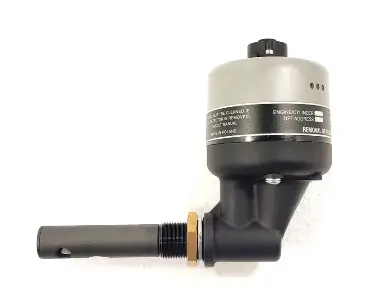
The Kidde Graviner MK7 Oil Mist Detector — Black Label (Latest Revised Version) is a new, individual crankcase sample point detector unit for the Graviner MK7 oil mist detection system. Installed at each crankcase sample point on the engine, the MK7 detector head is the component that directly measures oil mist concentration in the crankcase atmosphere and transmits that measurement to the MK7 control unit for alarm processing. The black label designation identifies this as the latest revised version of the MK7 detector — fully interchangeable with all previous MK7 detector variants and distinguished by its black label markings as shown in the product image.
The defining advantage of the Graviner MK7 over earlier oil mist detection platforms — including the MK-5 — is its distributed detector architecture. Rather than drawing crankcase air samples through pipes back to a central unit for analysis, the MK7 places a detector directly at each crankcase sample point. This eliminates the sample pipe runs that are the most common source of false alarms and flow faults in pipe-based systems, and it means the MK7 responds to an oil mist condition at the point where it is actually developing — without the dilution, delay, or pipe contamination variables that affect centrally sampled systems. For vessels transitioning from MK-5 to MK7, or for new builds specifying a current-generation oil mist detection platform, the MK7 black label detector is the correct new-condition component.
Key Features
Latest Revised MK7 Detector — Black Label Version
This detector carries the black label designation that identifies it as the latest revised version of the Graviner MK7 detector. The black label version is fully interchangeable with all previous MK7 detector variants — meaning it can be installed as a direct replacement for any existing MK7 detector in a current MK7 system installation without requiring system reconfiguration, control unit software changes, or compatibility verification beyond confirming the correct MK7 variant. For vessels maintaining MK7 systems where detector heads require individual replacement, the black label version is the current production standard.
Direct Crankcase Sample Point Detection — No Sample Pipes Required
The MK7 detector mounts directly at the crankcase sample point — measuring oil mist concentration at the location where it is generated, rather than drawing a sample through a pipe to a remote analysis unit. This direct-detection architecture eliminates the sample pipe runs that are a significant source of maintenance burden in pipe-based systems: blocked pipes, condensation in sample lines, pipe joint leaks, and airflow loss faults all become non-issues when there are no sample pipes. Each MK7 detector operates as a self-contained measurement point, communicating its readings directly to the MK7 control unit via the system data bus.
Optical Oil Mist Measurement — Consistent Sensitivity Across Conditions
The MK7 detector uses an optical measurement principle — assessing the attenuation of a light beam by oil mist particles in the crankcase atmosphere — to determine oil mist concentration. Optical measurement provides consistent sensitivity regardless of the oil type or mist particle characteristics, and it does not rely on electrochemical sensors that can drift, saturate, or require recalibration on a fixed schedule. This makes the MK7 detector’s measurement output stable and reliable across the range of diesel engine types, lubricating oil formulations, and operating conditions encountered in marine service.
Individual Detector Replacement — Minimise System Downtime
Because the MK7 uses individual detectors at each sample point rather than a central analysis unit, a detector fault in an MK7 system affects only the sample point covered by that detector — not the entire system. The remaining detectors continue to provide crankcase coverage across the other engine bays while the faulty detector is replaced. This is a significant operational advantage over centrally sampled systems, where a control unit fault takes the entire system offline. Replacing a single MK7 black label detector restores full coverage at that sample point without any interruption to the rest of the MK7 system.
Compact Detector Body with Integrated Sample Port Connection
The MK7 detector is a compact, self-contained unit — as visible in the product image — with an integrated sample port connection fitting that mounts directly into the crankcase sample point opening. The detector body houses the optical measurement cell, signal processing electronics, and data communication interface in a single assembly designed for direct engine-mounting in the vibration, temperature, and oil vapour environment of a marine crankcase installation. The gold-coloured threaded fitting visible in the image is the crankcase mounting connection — the interface between the detector and the engine sample point.
New Condition — Current Production Standard
The MK7 black label detector is supplied new — not refurbished — making it the appropriate procurement choice for new MK7 system installations, new vessel builds, and replacement applications where new condition is specified by the vessel owner, ship manager, or classification society. New condition provides the full original service life expectation of the detector and eliminates the uncertainty about prior operating history that is inherent in refurbished components. For vessels where the cost difference between new and refurbished is acceptable, new condition is the lower-risk procurement choice for a safety-critical detection component.
Technical Specifications
Model: Graviner MK7 Oil Mist Detector
Version: Latest revised — Black label
Manufacturer: Kidde Graviner (UTC Fire & Security)
Detection Principle: Optical (light attenuation by oil mist particles)
Installation: Direct crankcase sample point mounting
Interchangeability: Fully interchangeable with all previous MK7 detector versions
Compatible System: Graviner MK7 Oil Mist Detection System
Category: Oil Mist Detector
Condition: New
Benefits
Eliminates sample pipe-related faults — the most common maintenance issue in oil mist detection systems. Sample pipe blockages, condensation, flow faults, and pipe joint leaks account for a significant proportion of oil mist detector maintenance calls on pipe-based systems like the MK-5. The MK7’s direct detection architecture removes sample pipes from the equation entirely. For vessels transitioning from MK-5 to MK7, the reduction in maintenance demands associated with sample pipe management is one of the most immediately tangible operational benefits of the platform change.
Single-point detector replacement keeps the rest of the system operational during maintenance. When an MK7 detector at one sample point requires replacement, the other detectors continue providing crankcase coverage across the remaining engine bays. This means an MK7 system with one detector under maintenance is still providing partial crankcase protection — a significantly better position than a pipe-based system with a control unit fault, where the entire system is non-operational until the repair is complete.
New condition provides full original service life and eliminates prior-history uncertainty. A new MK7 black label detector starts its service life with all optical and electronic components in original condition, no prior operating hours, and no accumulated contamination or wear on the measurement cell. For new vessel builds, new MK7 system installations, and replacement applications where the procurement specification calls for new condition, this is the correct component.
Black label version ensures compatibility with current MK7 system installations. The black label designation confirms that this detector is the current revised production standard — the version that class surveyors and MK7 system service engineers will recognise as the current correct replacement component. For procurement teams sourcing MK7 detectors without direct access to the vessel’s maintenance documentation, the black label version’s full interchangeability with all previous MK7 detector variants eliminates the risk of ordering a superseded version that may not be accepted as current-standard during a class survey.
Supports class survey compliance with a current-production OEM component. Classification societies expect oil mist detection systems to be maintained with components that meet the original system specification. Replacing an MK7 detector with a new, current-production black label detector from the original manufacturer provides the straightforward compliance position that procurement teams and technical superintendents need when preparing for class survey inspections of the vessel’s crankcase protection systems.
Who It’s For
The Chief Engineer or Marine Superintendent Managing MK7 Detector Replacement
One of the MK7 detectors on your main engine is showing an optical fault — the control unit has isolated that sample point and is reporting it as a detector fault rather than an oil mist alarm. The rest of the system is operational, but you want the faulty detector replaced before the next port call to restore full crankcase coverage. You need the current-version black label detector confirmed compatible with your MK7 system, available on a lead time that works for your port schedule, and supplied new so you’re not introducing an unknown-history component into a running safety system.
The Newbuilding or Conversion Project Procurement Team
You’re specifying the oil mist detection system for a new vessel build or a major engine room conversion, and the MK7 is the specified platform. You need to procure the correct number of MK7 black label detectors for the engine’s sample point configuration — confirmed as the current production version — from a supplier who can provide documentation to satisfy the class society’s new installation approval process. A specialist marine safety equipment supplier with access to new OEM MK7 stock is the right procurement partner for that requirement.
Possible Applications
- Main engine crankcase protection on deep-sea merchant vessels — Individual MK7 detector replacement or new installation on two-stroke and four-stroke main propulsion engines aboard tankers, bulk carriers, container ships, and general cargo vessels
- Auxiliary diesel generator engine installations — MK7 detector supply for generator engine oil mist detection systems on vessels where generator engines above the applicable bore diameter require class-compliant crankcase monitoring
- MK-5 to MK7 system upgrade projects — Detector supply for vessels transitioning from Graviner MK-5 pipe-based systems to the MK7 direct-detection platform during drydock or class renewal programmes
- New vessel builds and engine room conversions — New MK7 detector procurement for vessel newbuilding projects and major engine room conversion programmes specifying the MK7 as the crankcase oil mist detection platform
- Offshore platform and FPSO power generation systems — MK7 detector supply for offshore diesel generator installations where individual detector replacement is preferred over full system downtime during maintenance
- Naval and coast guard vessel propulsion engine protection — New MK7 detector supply for naval vessel main and auxiliary diesel engine crankcase protection systems
- Marine engineering service companies — MK7 detector stock procurement for service contractors delivering MK7 system commissioning, maintenance, and detector replacement services under vessel owner or ship manager service agreements
Trust and Certifications
Kidde Graviner — The Originator of Marine Oil Mist Detection
Graviner (now Kidde Graviner, part of UTC Fire & Security / Carrier Global) developed the first marine oil mist detector over 50 years ago and has continuously evolved the platform through the MK-4, MK-5, and MK7 generations. The MK7 represents Graviner’s current-generation oil mist detection architecture — the platform the company developed to address the limitations of earlier pipe-based systems while maintaining the classification society recognition and operational track record that the Graviner brand carries in the marine industry. Sourcing MK7 detectors directly from the OEM manufacturer’s supply chain provides the product authenticity and component traceability that the marine safety market requires.
IMO Resolution A.1050(27) — Oil Mist Detector Performance Requirements
IMO Resolution A.1050(27) sets the performance standards for crankcase oil mist detectors on seagoing vessels, covering response time, measurement accuracy, alarm threshold requirements, and self-monitoring capabilities. The Graviner MK7 system is designed and approved in accordance with these IMO performance requirements, and the MK7 black label detector — as the current-production detector component for the MK7 system — operates within the system’s IMO-compliant performance envelope.
Classification Society Type Approval
The Graviner MK7 oil mist detection system carries type approval from all major classification societies, including Lloyd’s Register, DNV, Bureau Veritas, ClassNK, ABS, and RINA. The MK7 black label detector, as the current OEM-produced detector for the approved MK7 system, is the component that maintains the system’s type-approved configuration. Using current OEM detectors in an MK7 system installation preserves the system’s type approval status — an important consideration for vessels where class surveyors verify that safety systems are maintained in their approved configuration.
New Condition — Full OEM Warranty
The MK7 black label detector is supplied new, carrying the manufacturer’s standard warranty for new OEM components. New condition combined with OEM warranty provides the highest available assurance standard for a safety-critical crankcase detection component — appropriate for new vessel installations, class renewal programmes, and any replacement application where the vessel owner or ship manager specifies new condition for oil mist detection components.
Supplied by Alright Engineering Solutions
The Kidde Graviner MK7 Oil Mist Detector (Black Label) is supplied through Alright Engineering Solutions Pte. Ltd., a specialist distributor of marine safety equipment and gas detection systems based in Singapore. Alright Engineering Solutions provides OEM and refurbished component sourcing for Graviner oil mist detection systems across the Singapore and regional marine market.
Accessories and Variants
MK7 System Control Unit and Associated Components
The MK7 detector is a sample point component within the broader Graviner MK7 oil mist detection system. The complete MK7 system includes the MK7 control unit, the MK7 detector heads (this component), and the associated system wiring and mounting hardware. Alright Engineering Solutions can assist with sourcing MK7 system components beyond the individual detector — contact our team with your MK7 system configuration and component requirements.
MK7 Detector Variants
The MK7 detector range has been produced in several versions across the system’s production history. The black label version supplied here is the latest revised production standard, fully interchangeable with all previous MK7 detector variants. For vessels where the installed MK7 detectors carry earlier label versions, the black label detector is the correct current-standard replacement without any compatibility limitations.
Graviner MK-5 System Components
For vessels still operating Graviner MK-5 oil mist detection systems, Alright Engineering Solutions stocks refurbished MK-5 spare components — including main PCB assemblies, pressure switch assemblies, and complete MK-5 control bulk units — to support continued MK-5 system maintenance alongside MK7 upgrade planning.
Related Marine Engine Room Safety Products
Graviner MK-5 Control Bulk Unit — Refurbished complete MK-5 oil mist detector system for vessels maintaining legacy MK-5 installations
Graviner MK-5 Main PCB Assembly — Refurbished main control PCB for component-level MK-5 system maintenance
GTYQ-DX 102 Fixed Combustible Gas Detector — Fixed gas detection for engine room hydrocarbon monitoring
GX-8000 Sample Draw Multi Gas Monitor — Portable marine multi-gas monitor for confined space entry and engine room gas surveys
Get in Touch
If you need to source Kidde Graviner MK7 Oil Mist Detectors (Black Label) for a detector replacement, new system installation, or newbuilding project — contact Alright Engineering Solutions to confirm stock availability, discuss your MK7 system detector quantity requirements, and request a formal quotation.
Our team can also assist with full MK7 system component sourcing and related Graviner oil mist detection equipment for your vessel or fleet programme.
📍 3791 Jalan Bukit Merah #06-01, E-Centre @ Redhill, Singapore 159471