
 Cart (
Oil Mist Detector Calibration in Singapore
On-board testing, calibration and repair of crankcase oil mist detectors on ships alongside or at anchorage in Singapore. We check every detector head, the sampling path, the alarm set point and the slowdown or shutdown it triggers, then issue a service report your surveyor can read.
- ISO 9001:2015
- ISO 45001:2018
- bizSAFE Level 4
- bizSAFE Star
- Graviner MK5 · MK6 · MK7
- Spares in Singapore
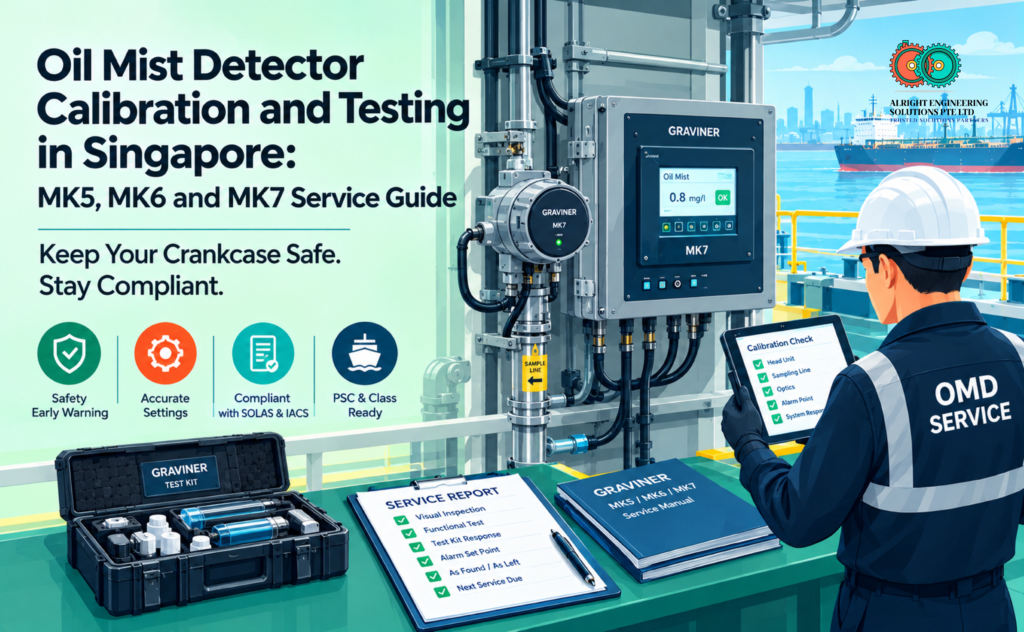
Oil mist detector calibration in Singapore, in short: Alright Engineering Solutions (AES) tests, calibrates and repairs crankcase oil mist detectors, including Kidde Graviner MK5, MK6 and MK7 and Schaller Visatron systems, on ships in Singapore. We clean the optics and sampling path, test each detector head with the maker's test kit, verify the alarm set point and the engine slowdown or shutdown, and report the results head by head.
What We Test and Calibrate on Your OMD System
An oil mist detector is only as good as its weakest head, sample point or relay. We go through the whole chain.
Detector heads
Each head tested for response with the maker's test kit, with optics checked and cleaned. On MK6 and MK7, every head is recorded on its own.
Control unit
Central unit configuration, display, communications, fault indication and event log checked against the installation settings.
Sampling system
On MK5 and other sample-pipe systems: pipes, valves, rotary valve and suction checked so every crankcase point is really being sampled.
Alarm set point
The configured alarm level confirmed within the approved limit, so the warning isn't quietly arriving later than it should.
Slowdown & shutdown
Relay outputs checked through to the engine safety system: slowdown on low-speed engines, shutdown on medium- and high-speed engines.
Repairs & spares
Detector heads, PCBs, displays, light source assemblies and toroids replaced from stock in Singapore.
OMD spares we supply →Why the Alarm Set Point Is the Number That Matters
SOLAS regulation II-1/47.2 requires crankcase oil mist detectors, bearing temperature monitors or equivalent devices on engines of 2,250 kW and above, or with cylinders of more than 300 mm bore. Under IACS UR M10, each engine needs its own oil mist detection arrangement and alarm, with slowdown on low-speed engines and automatic shutoff on medium- and high-speed engines. The equipment is type approved to UR M67, which puts the alarm at no more than 5% of the lower explosive limit, roughly 2.5 mg/l of oil mist in air.
- A dirty lens or blocked sample point moves the effective alarm point up, so the warning comes later
- A self-test button proves the electronics work, not that the heads see oil mist
- The maker's test kit, and the maker's manual, are what a surveyor expects your service to follow
For the full background on testing vs calibration across Graviner models, read our MK5, MK6 and MK7 service guide.
Self-Test, Function Test or Full Calibration?
"OMD service" can mean very different things. Here's what each level actually proves.
| Level | What's done | What it proves |
|---|---|---|
| Self-test | Built-in test from the control unit | Power, electronics and display work. Nothing about the optics or sample path. |
| Function test | Each head exposed to the maker's test medium using an approved test kit | The head responds and raises the alarm |
| Zero / sensitivity check | Baseline and response checked against the manufacturer's procedure | Readings start from a true zero and respond correctly |
| Set-point verification | Configured alarm level checked against approved limits | The alarm still sits at or below 5% of LEL |
| Full calibration | Approved equipment generates controlled reference conditions, per the maker | The detector reads correctly across its range. May need authorised service on some models. |
How an On-Board OMD Service Runs
Planned with the chief engineer around when the engine can be stopped and the crankcase accessed.
Send the details
OMD make and model, number of engines and detector heads, recent alarms or faults, and your ETA and ETD.
As-found check
We record readings, fault history and event log before touching anything.
Clean & inspect
Optics, detector heads, seals and sample paths cleaned and inspected for oil, sludge and damage.
Test each head
Every detector head tested with the maker's test kit and its response recorded.
Set point & outputs
Alarm set point verified and relay outputs tested through to the slowdown or shutdown.
Report
A head-by-head service report with as-found and as-left condition, parts replaced and next due date.
OMD in alarm or showing a fault? Message us now with the fault code.
Why Oil Mist Detectors Give False Alarms or Miss Real Ones
- Oil-coated optics. Film on lenses reduces sensitivity and can cause drift and nuisance alarms.
- Blocked sample points. Sludge in pipes or detector inlets means a crankcase compartment isn't really being watched.
- Leaking seals and valves. Air drawn in dilutes the sample and pushes the reading down.
- Worn light source. On MK5 units, an ageing light source assembly changes the reference reading.
- Wiring and comms faults. Damaged cables to MK6 and MK7 heads show up as head faults or lost communication.
- Changed settings. Alarm levels raised to stop nuisance alarms, and never put back.
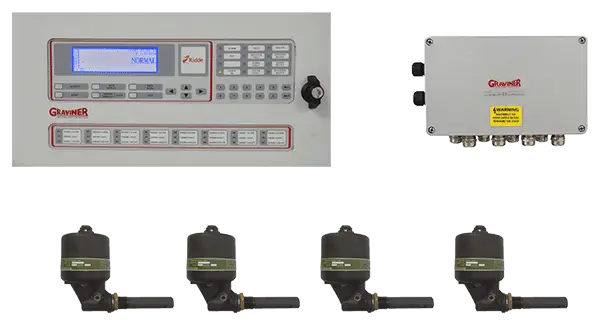
What's in Your OMD Service Report
- System make, model, serial numbers and engine
- As-found condition, readings and event log summary
- Test result for every detector head or sample point
- Alarm set point confirmed and slowdown or shutdown test result
- Parts replaced and any recommendations
- Date, vessel, next due date and engineer's signature
Booking checklist — send us these
- Vessel name and IMO number
- OMD make and model, number of engines and heads
- Recent alarms, fault codes or event log photo
- When the engine can be stopped for access
- Berth or anchorage, ETA and ETD
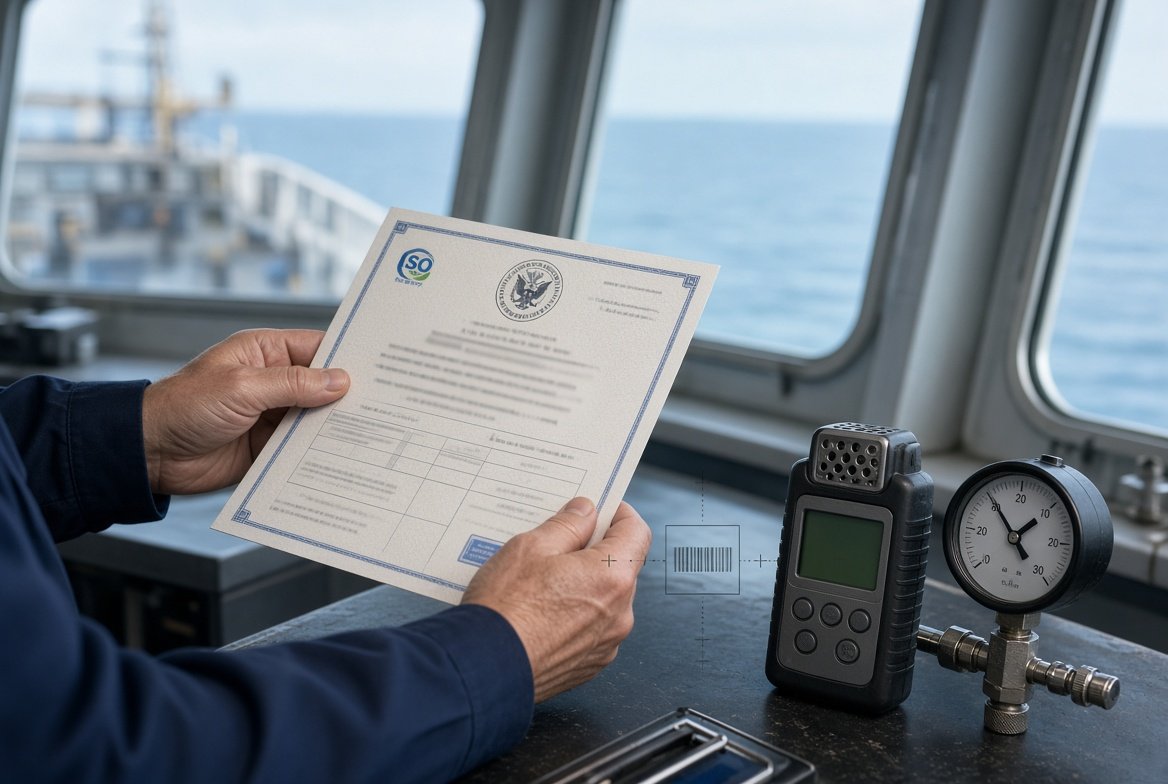
Oil Mist Detector Models We Work With
Same goal across all of them, different hardware and test kits. Send your model and we'll confirm before booking.
| Model | Where service attention usually goes |
|---|---|
| Kidde Graviner MK5 | Optical path cleanliness, sampling pipes, reference or zero condition, light source assembly |
| Kidde Graviner MK6 | Individual detector heads plus the central unit, communications and alarm logic |
| Kidde Graviner MK7 | Maker's test kit and procedure, head condition, central unit configuration, slowdown integration |
| Schaller Visatron VN115/87 Plus | Measuring head, suction and sampling, alarm outputs |
| SPECS and Daihatsu OMDs | Detector condition, alarm and output checks per maker |
We also supply Graviner service kits, MK6 detector heads and OMD spares in Singapore.
Why Ship Managers Use AES for OMD Service
Every head on record
Results per detector head or sample point, so you know exactly which one is the problem.
Spares on the shelf
MK5, MK6 and MK7 heads, PCBs, displays and parts in Singapore, so a failed head doesn't wait for shipping.
Certified management systems
ISO 9001:2015 and ISO 45001:2018, bizSAFE Level 4 completed and bizSAFE Star.
Planned around the engine
We work with the chief engineer on stop windows, alongside or at anchorage.
More done per port call
Combine with pressure & temperature or OWS 15ppm calibration in the same engine room visit.
Ready for inspection
See which equipment PSC most often flags in our article on detainable deficiencies linked to uncalibrated equipment.
See all our marine calibration services in Singapore.
Oil Mist Detector Calibration in Singapore: Common Questions
How often should an oil mist detector be tested?
Follow the maker's manual and your planned maintenance system. Crew usually run routine function checks, with a fuller service and set-point verification at the interval the maker specifies, and before class surveys. Our calibration interval table lists common intervals.
Is the self-test button enough?
No. The self-test proves the electronics work. It doesn't show whether the optics are clean, the sample points are open, or each head responds to oil mist.
Why does our OMD keep giving false alarms?
Most often it's oil-coated optics, a contaminated detector head or a sampling fault. Sometimes it's a real early warning. We find the cause before anyone adjusts the alarm level.
Do you work on Graviner MK5, MK6 and MK7?
Yes, and we stock spares for all three. We also work on Schaller Visatron and other makes. Send your model to confirm.
Does the engine need to be stopped?
For cleaning and testing detector heads, usually yes. We plan the job with the chief engineer so it fits your port stay.
Can you attend at Singapore anchorage?
Yes. We attend ships at anchorage as well as alongside at terminals and shipyards. Your agent usually arranges the launch.
How much does OMD calibration cost?
It depends on the model, number of engines and heads, and any parts needed. Send the details via the contact form or WhatsApp and we'll price it before we board.
Get Your Oil Mist Detector Tested and Calibrated in Singapore
Send the vessel details and OMD model. We'll confirm timing, parts and price, then attend alongside or at anchorage.
Email sales@alrightes.com · 3791 Jalan Bukit Merah #06-01, E-Centre @ Redhill, Singapore 159471