Cart (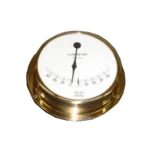

Overview
Weather at sea changes faster than forecasts can track. A vessel master who is watching a steady barometric pressure drop of several millibars over a four-hour watch period has more actionable information about deteriorating conditions ahead than any forecast product alone can provide — because the barometer on the bridge is reading the actual pressure at the vessel’s position, in real time, continuously. Without a permanently installed barometer, the officer on watch is relying entirely on external forecast data and has no independent, locally derived pressure trend to cross-reference. In open ocean passages, coastal navigation, and port approaches where weather development can affect route planning, cargo operations, and crew safety, a reliable bridge barometer is a working navigation tool, not a decorative fitting.
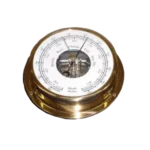
The Hanseatic Barometer (Model 155/0111) is a precision aneroid barometer made in Germany for permanent installation on commercial vessel bridges, wheelhouses, and chart rooms. Housed in a polished brass case of 155 mm outside diameter with a 118 mm dial, the instrument reads atmospheric pressure directly and continuously without any power supply, electronic component, or maintenance dependency. The dial presents both pressure scale graduation and weather tendency markings — the familiar “Stormy / Rain / Change / Fair / Very Dry” indications that allow a watch officer to read developing weather tendency at a glance alongside the numeric pressure value. At 43 mm depth, the instrument sits within the standard bulkhead profile and mounts cleanly alongside other Hanseatic bridge instruments in the same 155 mm case format.
What distinguishes the Hanseatic 155/0111 from lower-cost aneroid barometers in the same category is German manufacture to professional marine instrument tolerances — the precision that determines whether the instrument reads consistently over a decade of service or drifts off calibration after the first year. For a bridge instrument that officers will use to make route and weather decisions, accuracy over time is the specification that matters.
Key Features
Aneroid Barometer Movement — Continuous, Power-Free Pressure Reading
The Hanseatic 155/0111 uses an aneroid measuring element — a sealed, flexible capsule that expands and contracts with changes in atmospheric pressure — to drive the indicator needle against the pressure scale on the dial. The aneroid mechanism requires no mercury, no power supply, no electronic sensor, and no battery. It reads atmospheric pressure continuously from the moment it is installed, and continues to read through any shipboard power interruption or electronic system failure. For a bridge instrument whose primary function is to provide the watch officer with reliable pressure trend information regardless of other system status, the passive aneroid mechanism is the correct technology choice.
Polished Brass Case — Corrosion-Resistant Marine Construction
The 155 mm polished brass case provides the corrosion resistance, dimensional stability, and long-service appearance appropriate for a permanently mounted bridge instrument in a marine environment. Brass resists saltwater atmospheric corrosion far more effectively than ferrous or aluminium alternatives, and the polished finish maintains its appearance over extended service without the surface deterioration that affects painted or lacquered casings. For a wheelhouse instrument that will be visible to masters, pilots, officers, and surveyors for the operational life of the vessel, the polished brass case is both a functional and a professional specification choice.
118 mm Dial with Pressure Scale and Weather Tendency Markings
The 118 mm dial provides a legible pressure scale that can be read at normal bridge working distances, graduated in the standard millibars (hPa) and inches of mercury formats used in maritime meteorology. The dial also carries the traditional weather tendency legend — Stormy, Rain, Change, Fair, Very Dry — positioned around the scale to give the watch officer an immediate qualitative reading of the pressure level’s weather implication alongside the numeric value. While experienced officers read pressure trend rather than absolute value for weather assessment, the tendency markings provide a useful quick-reference indication, particularly for less experienced watch officers who may be developing their meteorological awareness.
155 mm Case / 43 mm Depth — Standard Bridge Instrument Format
The 155 mm outside case diameter and 43 mm depth of the Hanseatic 155/0111 are consistent with the standard format shared across the Hanseatic bridge instrument range — barometer, clinometer, thermometer/hygrometer, and ship’s clock. This standardisation allows the barometer to be installed as part of a matched set of bridge instruments with consistent case size, mounting footprint, and polished brass finish. For vessel outfitters, naval architects, and chief officers planning the bridge instrument layout on a new build or refit vessel, consistent case dimensions across the full set simplify bulkhead mounting arrangement and produce a coordinated, professional result.
German Manufacture — Professional Marine Instrument Precision
The Hanseatic 155/0111 is manufactured in Germany to the tolerances expected of professional marine navigation instruments. Aneroid barometer accuracy is determined primarily by the quality of the aneroid capsule manufacture and the precision of the gear train that translates capsule movement into needle deflection — both of which are functions of manufacturing quality that cannot be verified from the dial face alone. German manufacture in this product category is the most reliable indicator of the production tolerances and quality assurance processes that translate into long-term accuracy and consistency across the instrument’s service life on a commercial vessel bridge.
Technical Specifications
Model: Hanseatic 155/0111
Type: Marine Aneroid Barometer
Case Material: Polished Brass
Case Diameter: 155 mm
Dial Diameter: 118 mm
Depth: 43 mm
Operation: Passive aneroid mechanical — no power required
Country of Origin: Germany
Category: Navigation Equipment / Bridge Instruments
Benefits
The practical value of a permanently installed bridge barometer is the pressure trend it provides over a watch period — a rising or falling pressure reading that gives the officer on watch an independent, locally derived data point for weather assessment that no external forecast service can replicate at the vessel’s exact position in real time. A pressure drop of 3 hPa over three hours is a standard indicator of approaching weather deterioration; a rapid drop of 6 hPa or more in the same period is a severe weather warning. An officer who has been watching the barometer through a watch has this information; an officer relying only on radio forecast bulletins does not have it until the next scheduled forecast transmission.
The passive aneroid mechanism means the barometer contributes to the bridge’s operational information without any maintenance overhead — no batteries, no calibration schedule, no software updates, and no electronic failure modes. The instrument that is mounted and set to correct local pressure today will still be reading reliably in fifteen years if it remains undamaged. For fleet operators managing maintenance budgets across multiple vessels, the lifetime cost of a quality mechanical barometer is effectively the purchase price plus occasional professional calibration verification — substantially lower than electronic pressure monitoring alternatives with sensor replacement and calibration service requirements.
The polished brass case and coordinated presentation with the matching Hanseatic clinometer, clock, and thermometer/hygrometer also contributes to the professional standard of the bridge environment — a factor that is noted during owner inspections, class society surveys, and port state control visits, and that reflects the overall standard of the vessel’s navigation space management.
Who It’s For
Vessel Masters and Chief Officers — Bridge Equipment Specification
A master taking delivery of a new vessel or overseeing a bridge refit wants instruments that meet the standard expected on a professionally operated commercial vessel — accurate, durable, appropriately specified, and consistent in format with the other bridge instruments being fitted. The Hanseatic 155/0111 provides a specification-confirmed, German-made aneroid barometer in the standard 155 mm polished brass format that fits the Hanseatic bridge instrument set alongside the clinometer (155/0911), thermometer/hygrometer, and ship’s clock. For a chief officer who takes pride in the standard of the vessel’s navigation space, specifying Hanseatic instruments across the bridge set is a straightforward decision.
Naval Architects and Vessel Outfitters — New Build and Refit Instrument Packages
Outfitters specifying bridge instrument packages for new build vessels or major refits need a barometer that can be specified consistently across a build programme or fleet, is available with confirmed model number and manufacturer identification, and fits within a coordinated bridge instrument set without custom mounting solutions. The Hanseatic range — with its consistent 155 mm case diameter across barometer, clinometer, thermometer/hygrometer, and clock — is a recognised choice for bridge instrument set specification, and the 155/0111 is the standard barometer model in the range.
HSE Officers and Safety Managers — Bridge Safety Equipment Compliance
Safety managers conducting vessel audits and bridge equipment assessments need to confirm that the vessel is equipped with functional meteorological instruments appropriate for its operation. A permanently installed, passively operating barometer with no electronic failure modes and no battery dependency is a straightforward compliance item — present, undamaged, and correctly set to local pressure means functional. For ISM Code internal audits and class society surveys, the Hanseatic 155/0111 installed on the bridge bulkhead is a clearly identifiable, professionally specified instrument that supports a positive bridge equipment assessment.
Possible Applications
Commercial Cargo, Tanker, and Bulk Carrier Vessel Bridges
Watch officers on cargo ships, tankers, and bulk carriers use the bridge barometer throughout every watch for weather trend monitoring on ocean passages, coastal approaches, and port arrivals. Pressure trend data from the bridge barometer is used to assess whether reported forecast conditions are developing as expected at the vessel’s position — an independent check on received weather information that experienced officers use routinely in voyage planning and heavy-weather decision-making.
Passenger and Ferry Vessel Bridges
Passenger vessel masters and officers monitor bridge barometer readings throughout passages to anticipate weather deterioration that may affect passenger comfort, safety, and schedule. On short-sea ferry routes where weather windows are narrow and schedule pressure is significant, barometric pressure trend from the bridge instrument contributes to the officer’s assessment of whether conditions ahead are consistent with the forecast received at departure.
Offshore Support and Platform Supply Vessels
Offshore support vessels operating in dynamic offshore environments where weather windows govern cargo transfer, crane operations, and vessel approach to offshore structures use the bridge barometer as one component of the weather assessment that informs operational decisions. A falling pressure reading during a critical cargo transfer window is directly actionable information for the master and offshore installation manager.
Sailing and Motor Yacht Wheelhouses
The Hanseatic 155/0111 is widely used in yacht wheelhouses and saloons where a professional standard of bridge instrument is specified. The polished brass case is consistent with the traditional marine instrument aesthetic of yacht interiors, and the 155 mm case format matches the Hanseatic barograph, clock, and clinometer instruments commonly fitted in the same space on large sailing and motor yachts.
Maritime Training Centres and Nautical Colleges
Maritime training facilities use barometers in bridge simulators and navigation training environments to teach trainees the practical application of barometric pressure monitoring to voyage planning and weather assessment — skills required under STCW meteorology competency requirements for officer of the watch certification.
Coast Guard and Government Vessels
Coast guard vessels and government maritime patrol craft carry bridge barometers as standard navigation instruments. Vessels specifying bridge instruments to commercial maritime quality standards will find the Hanseatic 155/0111 consistent with the instrument quality expected on professionally operated government maritime vessels.
Harbour Master and VTS Offices
Vessel Traffic Service offices, harbourmaster stations, and port authority control rooms sometimes install bridge-format instruments — including barometers — as part of the meteorological monitoring equipment used to support port weather assessments and vessel traffic management decisions. A Hanseatic barometer in a VTS or harbourmaster office provides the same local pressure trend information that vessel masters are reading on their own bridge instruments.
Trust & Certifications
Hanseatic — Established German Marine Instrument Manufacturer
Hanseatic is a German manufacturer with a recognised position in the professional marine instrument market, producing the standard 155 mm polished brass instrument range — barometer, clinometer, thermometer/hygrometer, and ship’s clock — that has been specified for commercial vessel bridges for decades. The Hanseatic name on the dial and the model number identification (155/0111) provide an unambiguous procurement reference for repeat orders, fleet standardisation programmes, and warranty claims. German manufacture is the most reliable country-of-origin indicator for aneroid barometer quality in the professional marine instrument category.
WMO Meteorological Instrument Standards
The World Meteorological Organization (WMO) publishes guidance on the performance requirements for meteorological instruments used in maritime observations, including aneroid barometers. Vessels participating in the Voluntary Observing Ship (VOS) programme or carrying out meteorological observations for national meteorological services are expected to use instruments meeting WMO performance standards. Procurement teams specifying barometers for vessels with VOS obligations should confirm the calibration standard and traceable accuracy of the instrument against WMO requirements with their supplier or meteorological service contact.
ISM Code — Bridge Equipment and Safety Management
The ISM Code requires ship operators to maintain vessels in a seaworthy condition, including maintaining navigation and meteorological equipment in a functional state. A permanently installed, passively operating aneroid barometer requires no electronic maintenance and has no power dependency — supporting ISM Code compliance for bridge meteorological equipment without the maintenance overhead of electronic pressure monitoring systems. The Hanseatic model number and manufacturer identification provide the procurement documentation trail required for ISM Code equipment records and class society surveys.
Accessories & Variants
Hanseatic Clinometer (155/0911) — Matching Polished Brass Case
The Hanseatic clinometer in the same 155 mm polished brass case is the natural companion instrument to the barometer for a coordinated bridge set. Barometer and clinometer mounted together on the wheelhouse bulkhead provide atmospheric pressure trend and vessel inclination readings in the same format and finish — the two passive mechanical instruments that deliver continuous situational awareness without any power or maintenance dependency.
Hanseatic Thermometer / Hygrometer Combination — 155 mm Case
The Hanseatic combined thermometer and hygrometer in the 155 mm polished brass case completes the meteorological instrument component of the bridge set alongside the barometer — providing air temperature and relative humidity readings in the same format. Air temperature and humidity alongside barometric pressure gives the watch officer the three primary meteorological parameters for basic bridge weather assessment.
Hanseatic Ship’s Clock — 155 mm Polished Brass
The Hanseatic ship’s clock in the 155 mm polished brass case provides the timekeeping element of a complete coordinated bridge instrument set — barometer, thermometer/hygrometer, clinometer, and clock — in consistent format and finish for a professional wheelhouse presentation. Ship’s time reference alongside pressure, temperature, humidity, and inclination instruments gives the bridge a complete passive instrument station at a single position on the bulkhead.
Barograph — Continuous Pressure Record
A barograph — a recording barometer that produces a continuous ink trace of pressure over time on a paper chart — complements the Hanseatic barometer by providing a visual pressure trend record over the preceding hours and days. While the barometer reads current pressure, the barograph trace shows the rate of change and the pressure history that experienced officers use to assess weather development. For vessels making ocean passages or operating in regions with significant weather variability, a barograph alongside the bridge barometer provides a more complete meteorological picture.
Available Variants
Hanseatic 155/0111 — Aneroid Barometer | 155 mm polished brass case | 118 mm dial | 43 mm depth | Passive mechanical | German manufacture | Standard bridge instrument format
For barometers in alternative case sizes, dial scales (metric only / imperial only), or with additional features such as adjustable reference pointer or alarm output, contact the supplier to confirm available Hanseatic model options and current stock.
Related Navigation and Bridge Equipment
Hanseatic Clinometer (155/0911) — Matching polished brass clinometer for coordinated bridge instrument set
Hanseatic Ship’s Clock (155 mm) — Matching polished brass ship’s clock for bridge instrument set
Electronic Weather Stations — Digital bridge weather monitoring systems with wind, pressure, temperature, and humidity sensors and data logging capability, complementing the passive Hanseatic barometer for vessels requiring electronic meteorological data recording and alarm functions
Get in Touch
If you are specifying bridge instruments for a new vessel delivery, a refit programme, or a fleet instrument standardisation project — or if you need to confirm current availability, matching instrument options, and pricing for a complete Hanseatic bridge set — contact us to discuss your requirement and request a formal procurement quotation.
Our team can assist with instrument selection for your specific vessel type and bridge layout, confirm compatibility within the Hanseatic range, and provide the specification documentation required for class society approval of bridge navigation and meteorological equipment inventories.
📍 3791 Jalan Bukit Merah #06-01, E-Centre @ Redhill, Singapore 159471